HCPCS code E0198: Water pressure pad billing guide
HCPCS code E0198 is a water pad for a standard mattress HCPCS code E0198 is the ...

Last Updated: Oct 13, 2026

CPT code 01392 covers anesthesia for all open procedures on the upper ends of the tibia, fibula, and/or patella – including open fracture repairs and patellectomies.
The standard anesthesia billing formula is (Base Units + Time Units) x Conversion Factor; incorrectly calculating time units is the most common denial trigger for 01392 claims.
Modifiers AA, AD, QK, QX, QY, and QZ determine the anesthesia provider role; physical status modifiers P1-P6 must also be appended for every claim.
Practice management software like Pabau links clinical documentation directly to billing output, reducing manual data entry errors on procedure-based codes like 01392.
CPT code 01392 bills anesthesia for open procedures on the upper ends of the tibia, fibula, and patella, think open reduction and internal fixation of proximal fractures, open patellectomy, and open osteotomy at the tibial plateau.
It carries 4 base units. Here’s how 01392 works, where it gets confused with neighboring codes, and where practices lose reimbursement without realizing it.
CPT code 01392 is published by the American Medical Association (AMA) as part of the anesthesia section of the CPT code set (range 00100-01999). Its official descriptor reads: Anesthesia for all open procedures on upper ends of tibia, fibula, and/or patella.
The phrase “open procedures” is the critical qualifier. This code applies only when the surgeon makes a direct incision to access the bone, not when arthroscopic or percutaneous techniques are used. Procedures in scope include open reduction and internal fixation (ORIF) of proximal tibia or fibula fractures, open patellectomy, and open osteotomy at the upper tibial plateau. The clearinghouse validates structure before the payer validates content, which is why an electronic claim can fail twice. Under current evaluation and management rules, the counted elements changed but the need to show reasoning did not.
Open vs. arthroscopic matters here. If the surgeon converts an arthroscopic knee procedure to open mid-case, confirm the final operative report documents the open approach before billing 01392. Claims submitted on the assumption of open access, without an operative report confirming it, are a frequent source of audits.
CPT code 01392 carries a base unit value of 4 base units, as published in the American Society of Anesthesiologists (ASA) Relative Value Guide.
Base units reflect the inherent complexity of providing anesthesia for a given procedure category. Four units sits above its closed-procedure counterpart, 01390, at 3 units, and below the TKA-specific code 01402 at 7 units.
Understanding how base units translate to a dollar amount comes down to the base-plus-time formula every anesthesia code uses. Use the FastRVU 2026 lookup to verify current RVU values and conversion factors by locality.
Every anesthesia claim – including 01392 – uses this formula:
Time units are calculated from anesthesia start time (induction) to end time (emergence), and both timestamps must appear in the anesthesia record.
The same start-and-stop discipline applies to other time-based anesthesia codes.
Medicare does not pay a flat rate for CPT code 01392. Instead, CMS calculates reimbursement using its locality-adjusted anesthesia conversion factor, applied to the formula above. Rates vary by geographic area through the Medicare Geographic Practice Cost Index (GPCI).
National averages for anesthesia conversion factors typically fall in the $21-$25 range per unit, though coastal and urban markets skew higher. Facility vs. non-facility designation also affects the rate: hospital outpatient settings (facility) generally yield different payment than office-based procedures (non-facility), depending on payer policy.
Commercial payers set their own conversion factors independently of Medicare. Some payers reimburse significantly above Medicare rates; others cap at Medicare. Verify your contracted rates annually, as payer policies for anesthesia conversion factors often change during contract renewals.
The best medical practice management tools capture start and stop times at the point of care, which anesthesia billing depends on.
Modifier selection determines which provider is credited for the anesthesia service and how supervision is characterized. Using the wrong modifier on a CPT code 01392 claim is one of the most common denial reasons in anesthesia billing.
Every anesthesia claim must also carry an ASA physical status modifier. These apply to all anesthesia codes regardless of procedure, including CPT code 01392.
P3 and above may trigger qualifying circumstances add-on codes under certain payer policies, though this varies significantly by payer. Omitting the physical status modifier entirely will result in claim rejection by most commercial payers and Medicare.
No specific ICD-10 diagnosis code is mandated as a crosswalk for CPT code 01392. However, payers require that the submitted diagnosis code supports medical necessity for the anesthesia service. The following ICD-10-CM codes reflect procedures that commonly fall within 01392’s anatomical scope.
Other musculoskeletal diagnoses. The CDC/NCHS ICD-10-CM web tool remains the official reference for the full US code set.
Use the 7th character extension that matches the episode of care: “A” for the initial encounter, “D” for subsequent encounter, and “S” for sequela. Submitting an incorrect episode character is a common cause of claim rejection for trauma-related fracture codes.
Surgical history reaches the claim through status codes as well. ICD-10 code Z90.3 covers total and partial gastrectomy in one entry, and belongs in a secondary diagnosis field.
Medicare and most commercial payers require a complete anesthesia record to support a CPT code 01392 claim. Incomplete documentation is the fastest path to audit findings and recoupment demands.
A HIPAA-compliant billing documentation process should confirm the anesthesia record includes all of the following elements.
Across specialties, the documentation principle is the same: if it isn’t documented, it didn’t happen. Missing timestamps on a 01392 claim eliminate the time unit component from reimbursement entirely, since there’s no defensible basis left to calculate duration.
Run a monthly internal audit on 01392 claims: pull the last 20 submitted and verify that start/end times, physical status modifier, provider role modifier, and post-anesthesia evaluation notes are all present in the corresponding anesthesia records. Catching errors before payers do avoids costly repayment demands.
Run through this before the claim leaves the building. Most 01392 denials trace back to one of these six items.
Anesthesia claims are denied at a higher rate than most other claim types, partly because the formula-based billing method creates more failure points than a simple fee-for-service code.
Selecting the wrong code from the adjacent anesthesia range is a frequent problem for orthopedic billing staff. The codes nearest to CPT code 01392 each cover a distinct anatomical area or procedural approach. The full anesthesia code range is searchable via the AAPC Codify CPT lookup.
The 01390 vs. 01392 distinction comes down to surgical approach, not anatomy. Both codes apply to the same site, the upper ends of the tibia, fibula, and patella: 01390 covers the closed procedure, 01392 covers the open one.
Arthroscopic knee work is coded separately. Coding from the scheduled procedure instead of the documented operative approach creates audit risk.
Anesthesia billing fails at the handoff between clinical documentation and the billing system. The anesthesiologist documents start time, end time, physical status, and provider role in one place; billing staff reproduce that information into the claim in another. Every manual transfer step is an opportunity for error.
Pabau’s claims management software connects clinical records to billing output, so the fields that populate an anesthesia claim pull directly from the documented clinical encounter. Billing staff can confirm modifier selection and time unit calculations against the source record without switching between systems.
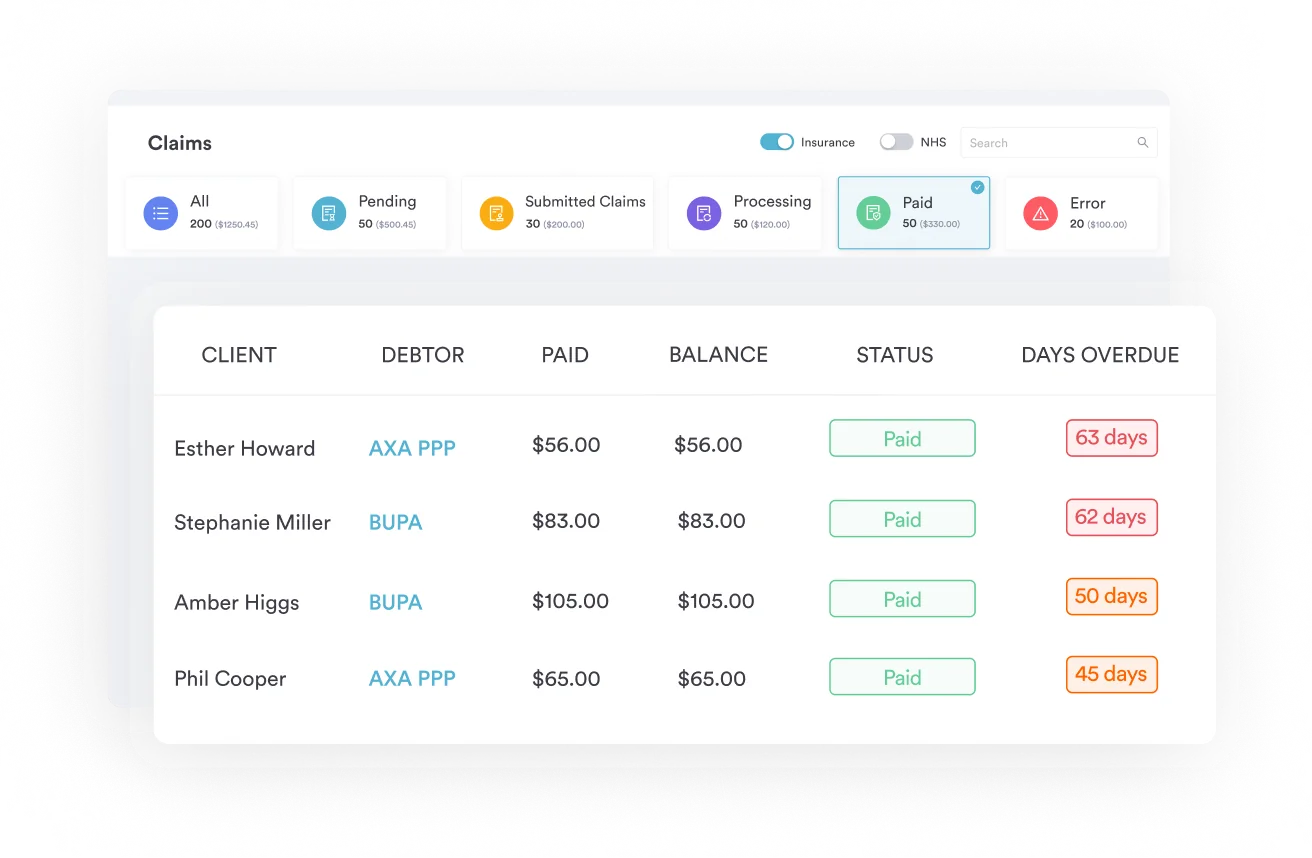

Pabau connects your clinical documentation to billing output, so time units, modifiers, and physical status data reach the claim accurately. See how integrated practice management reduces denials on procedure-based codes.

CPT code 01392 is straightforward in concept but high-risk in execution. The formula-based billing method, the paired provider-role modifier requirement, and the mandatory physical status modifier create three distinct failure points on every claim. Getting any one wrong means a denial or, worse, a repayment demand after audit.
So, there you have it: 01392 pays cleanly when the operative report backs the open approach, the timestamps support the time units billed, and the modifiers match who actually provided and supervised the anesthesia.
Book a demo to see how Pabau keeps that documentation-to-billing handoff accurate on every anesthesia claim.

Billing the closed side of this same procedure? 01390 covers the identical tibia, fibula, and patella site at 3 base units instead of 4.
Handling a general knee-joint case instead? 01400 is the code for ACL repair, meniscectomy, and synovectomy work outside the tibia, fibula, and patella pair.
Billing anesthesia for a different site entirely? 00124 covers anesthesia for ear procedures, with its own base unit and modifier rules.
Billing a home-mixed parenteral nutrition solution? HCPCS Code B4176 covers the parenteral nutrition solution mixed at home rather than by a commercial pharmacy.
Need the wound-closure side of an open procedure? 12007 covers simple wound repair billing for the incision itself.
CPT code 01392 carries 4 base units under the ASA Relative Value Guide, one more than its closed-procedure counterpart, 01390, at 3 units. Reimbursement is (4 + time units) x conversion factor.
Both codes cover the same site, the upper ends of the tibia, fibula, and patella. 01390 applies when the procedure is closed, at 3 base units, and 01392 applies once the approach is open, at 4. Arthroscopic knee work is billed under 01382 or 01400 instead.
Time units run from induction to emergence, at one unit per 15 minutes, and most payers round to the nearest whole or half unit rather than the exact minute. Missing either timestamp removes the time-unit portion of the claim entirely.
A P3-P6 status modifier can add qualifying circumstances units (codes 99100, 99116, 99135, or 99140) under some payer policies. Medical direction (QK/QX) and medical supervision (AD) also pay differently than personal performance (AA), so the modifier must match the actual anesthesia arrangement.
Yes, when documentation supports bilateral upper tibia, fibula, or patella surgery in the same session, though payers typically expect modifier 50 or a separate line with an anatomical modifier rather than doubled base units automatically. Check the payer’s bilateral policy before submitting.