



HCPCS code E0198: Water pressure pad billing guide
HCPCS code E0198 is a water pad for a standard mattress HCPCS code E0198 is the ...

Last Updated: Oct 13, 2026

CPT Code 00300 describes anesthesia for procedures on the integumentary system, muscles, and nerves of the head, neck, and posterior trunk not otherwise specified
The ASA base unit value for CPT Code 00300 is 7, and total anesthesia units equal base units plus time units plus any applicable modifying units
Modifier QS signals monitored anesthesia care (MAC), while G8 and G9 distinguish medically necessary MAC from requested MAC under Medicare billing rules
Pabau’s claims management software helps anesthesia practices document CPT code selections, track time units, and reduce claim errors before submission
CPT Code 00300, as defined by the American Medical Association’s CPT code set, covers anesthesia for procedures on the integumentary system, muscles, and nerves of the head, neck, and posterior trunk not otherwise specified. This reference covers the official descriptor, base unit value, and applicable modifiers. In addition, it covers the 2026 fee schedule context, ICD-10 crosswalk, documentation requirements, and related codes in the 00300-00352 range. Two practices can bill the same encounter at a different visit level, and the note settles which was right.
Modifier selection is where these claims most often go wrong. QS signals monitored anesthesia care; G8 or G9 must specify why MAC was medically necessary rather than simply requested. Documenting that rationale with HIPAA-compliant practice software at the point of care keeps the claim clean. That’s because the record is already complete the first time it’s submitted.
CPT Code 00300 describes anesthesia for procedures on the integumentary system, muscles, and nerves of the head, neck, and posterior trunk, not otherwise specified. The “not otherwise specified” qualifier is important. It applies only when no more specific anesthesia code exists within the 00100-00352 range for the procedure performed.
Covered anatomical areas include the scalp, face, cervical muscles, cervical nerves, and the posterior thoracic trunk. Procedures on internal structures of the head are excluded. So are procedures on the eye, ear, and nose, because those areas have dedicated codes.
You may also see the code written as 00300 CPT code or, informally, procedure code 0300. However, the official CPT descriptor is what governs billing. The table below summarizes the scope of CPT Code 00300 and its key exclusions.
When selecting CPT Code 00300, confirm that the surgical procedure code does not have a more specific anesthesia counterpart. Submitting 00300 when 00352 (anesthesia for procedures on cervical spine) applies, for example, may trigger a medical review request.
The ASA Relative Value Guide assigns CPT Code 00300 a base unit value of 7. Specifically, Medicare fee schedule data confirms this figure. The formula below calculates total anesthesia units, which determine reimbursement.
Worked example: A procedure requiring 45 minutes of anesthesia yields 3 time units. So, with a base of 7 and no modifying units, total units = 10.
The Medicare 2026 anesthesia conversion factor is approximately $21.87 per unit. Verify the current figure via the CMS Physician Fee Schedule lookup. At that rate, the estimated Medicare allowable would be roughly $218.70 before geographic adjustment. Always confirm the local conversion factor for your MAC jurisdiction.
Physical status modifiers (P1 through P6) add qualifying units under the ASA system. However, Medicare and most commercial payers do not reimburse for physical status modifying units. Include them for documentation and clinical accuracy, but do not rely on them to increase the billed amount with Medicare.
Selecting the wrong modifier is the leading cause of anesthesia claim denial under CPT Code 00300. In practice, each modifier signals a different provider role or care delivery model. Most payers require at least one qualifying modifier on every anesthesia claim.
Beyond the anesthesia HCPCS modifiers above, two other modifier types attach to anesthesia claims. However, one commonly listed modifier does not belong on this code at all. Knowing the difference keeps clean claims out of the rework queue.
MAC under CPT Code 00300 requires modifier QS on the claim. Under the Medicare Coverage Database article A57361, G8 and G9 distinguish why MAC was medically necessary rather than simply requested. The distinction matters, because payers may deny QS-only MAC claims for routine, low-risk cases. As a result, documentation must justify the anesthesia level chosen.
Modifier applicability varies by payer. Verify current guidelines with each commercial payer before applying modifiers beyond the Medicare standard set. Using digital anesthesia record forms that capture MAC rationale at the point of care reduces risk. Specifically, it lowers the chance of missing this documentation at billing time.

Audit your last 20 MAC claims billed with CPT Code 00300. Flag any that use QS without G8 or G9 under Medicare. If the patient record supports medical necessity for MAC, append the appropriate modifier and resubmit. This single correction often recovers denied revenue with minimal rework.
Anesthesia reimbursement under CPT Code 00300 is not a fixed dollar amount. Instead, multiply total anesthesia units by the Medicare anesthesia conversion factor. Next, adjust the result using a geographic practice cost index (GPCI) for the service location. The 2026 fee schedule varies by contractor jurisdiction.
For the most current conversion factor, use the 2026 FastRVU RVU lookup tool. Or confirm directly via the CMS Physician Fee Schedule. Never rely on prior-year figures, because CMS adjusts the conversion factor annually. Even a small change affects aggregate revenue for high-volume anesthesia practices. Geographic variation can shift the effective per-unit rate by 10-20% between high-cost and rural localities.

Pabau’s claims management software helps anesthesia practices document CPT codes, capture time units accurately, and submit cleaner claims. See how it fits your billing workflow.

Every anesthesia claim requires at least one supporting ICD-10-CM diagnosis code that establishes medical necessity for the procedure. The crosswalk below lists the diagnosis codes most frequently paired with CPT Code 00300 procedures. Specifically, it reflects common head, neck, and posterior trunk surgical scenarios. This is not an exhaustive list. The correct ICD-10 code always reflects the patient’s documented condition.
Pair the ICD-10 code to the surgical procedure code, not to CPT Code 00300 directly. Anesthesia codes are cross-walked to the diagnosis via the surgical code. For example, using the AAPC Codify CPT lookup can help verify ICD-10 crosswalk pairings for less common procedures in this range. Documenting the diagnosis in the anesthesia pre-assessment note strengthens the claim against medical necessity audits.
Incomplete anesthesia records are, in fact, the second most common reason for post-payment audits on head and neck anesthesia claims. The documentation requirements below reflect Medicare standards. Commercial and Medicaid payers may impose additional requirements. Always verify with each payer’s provider manual. In practice.
When time-unit documentation is incomplete, payers may, as a result, recalculate reimbursement downward or request a full chart review.
The HIPAA-compliant billing documentation standards that apply to other practice types apply equally to anesthesia records. In practice, good recordkeeping at the time of service protects revenue at audit.
CPT Code 00300 sits within the anesthesia section covering procedures on the head and neck. Selecting the correct code within this range requires matching the anatomical site and procedure type precisely. The table below covers codes most often confused with or adjacent to 00300. This includes nasal procedures billed under 00160.
When a procedure involves multiple anatomical sites in the same session, bill the anesthesia code for the primary site. Specifically, choose the code that most accurately reflects the primary surgical procedure. Do not bill multiple anesthesia codes for the same anesthetic event. Procedures extending further down the spine fall outside this range entirely. Bill thoracic spine work under 00625 instead.
Review chart documentation before selecting between CPT Code 00300 and 00352. The operative note’s anatomical description drives the code, not the surgeon’s specialty. A cervical skin lesion excision is 00300. A cervical discectomy requiring posterior approach is 00352. The distinction affects base units by 3 points and reimbursement by roughly $65 per claim at 2026 rates.
Anesthesia billing errors usually come down to documentation captured in one place and billed from another. Manual steps sit in between, so units get miscounted and modifiers get forgotten.
This is especially common for dermatology practices and plastic surgery practices billing CPT Code 00300 for scalp, neck, or posterior trunk excisions. In practice, the anesthesia record and the procedure note often live in separate systems.
Practices using disconnected paper records and spreadsheets consistently face higher denial rates on CPT Code 00300 claims. That’s because the time-unit calculation and modifier selection happen after the fact, without the source data readily accessible.
Pabau’s claims management software connects CPT code documentation directly to the billing workflow. Anesthesia providers can record start and stop times, physical status classifications, and MAC rationale within the clinical record.
That data feeds directly into the claim rather than being re-entered by billing staff. So transcription errors drop, and the path from completed procedure to submitted claim gets shorter.
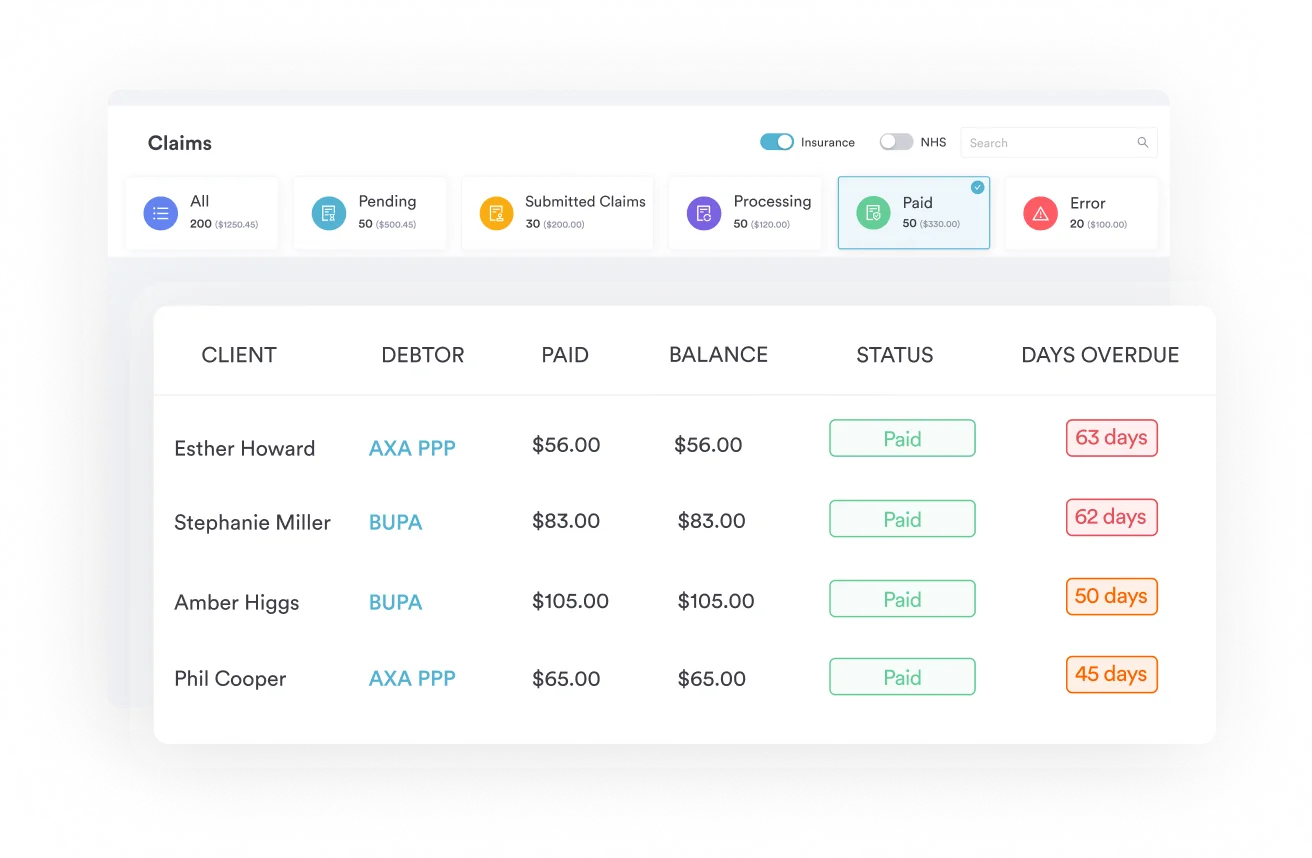
For practices focused on practice compliance management. Specifically, this includes automated workflows that prompt providers to complete anesthesia documentation fields before a record can be closed.
Practices that have integrated their EHR and billing systems through tools like Pabau’s EHR integration for billing also report fewer claim rejections. Specifically, this includes fewer instances tied to missing documentation at the time of submission.
Anesthesia practices looking to systematize their billing process can explore Pabau’s practice management software features. As a result, they can understand how an integrated system handles the full documentation-to-claim lifecycle.
CPT Code 00300 carries a 7-unit base value. It applies to anesthesia for procedures on the integumentary system, muscles, and nerves of the head, neck, and posterior trunk. Specifically, this covers cases not otherwise specified.
This code carries three common billing errors. First, selecting it when a more specific code exists. Second, applying QS without the required G8 or G9 MAC rationale modifier under Medicare. Third, submitting incomplete time-unit documentation. So getting all three right requires documentation built into the clinical workflow, not added retroactively at billing.
Pabau’s claims management software links anesthesia record documentation directly to CPT code selection and claim preparation. As a result, it reduces the manual steps where errors accumulate. To see how the workflow fits your practice, book a demo.

Billing a triamcinolone acetonide injection? HCPCS code J3301 billing guide covers dosage-to-unit conversion, covered ICD-10 diagnoses, and Medicare reimbursement rates for this injection.
Billing a drug with no J-code? HCPCS code J3490 billing guide covers the unclassified drug code used when CMS has not assigned a specific J-code.
Billing a goserelin acetate implant? HCPCS code J9202 billing guide covers the 3.6 mg monthly implant, its code properties, and covered ICD-10 diagnoses.
CPT Code 00300 is used to bill anesthesia services for procedures performed on the integumentary system, muscles, and nerves of the head, neck, and posterior trunk, where no more specific anesthesia CPT code applies. It covers cases such as neck skin lesion excision, cervical nerve procedures, and posterior trunk muscle surgeries that fall under the “not otherwise specified” qualifier within the 00100-00352 anesthesia code range.
The ASA base unit value for CPT Code 00300 is 7. Total billed units equal base units (7) plus time units (1 per 15 minutes of anesthesia time) plus any applicable modifying units for physical status. Physical status modifying units are not reimbursed by Medicare but may apply under some commercial payer contracts.
Applicable modifiers include AA (anesthesiologist personally performing), QK (medical direction of 2-4 concurrent procedures), QX (CRNA under direction), QY (direction of one CRNA), QZ (independent CRNA), AD (supervision of 5+ concurrent), QS (monitored anesthesia care), G8 (MAC for complex or invasive procedure), and G9 (MAC for patient with history of severe cardio-pulmonary condition). At least one qualifying modifier is required by most payers. Under Medicare, MAC claims should include QS plus G8 or G9 as appropriate.
There is no single fixed dollar rate. Medicare reimbursement is calculated by multiplying total anesthesia units by the 2026 anesthesia conversion factor (approximately $21.87 per unit nationally, subject to annual CMS revision), then applying the geographic practice cost index for the service location. A 45-minute procedure yields approximately $218 before geographic adjustment. Confirm current rates via the CMS Physician Fee Schedule lookup tool.
Bill CPT Code 00300 when providing anesthesia for a surgical or diagnostic procedure on the integumentary system, muscles, or peripheral nerves of the head, neck, or posterior trunk, and no more specific code within the 00100-00352 range applies to the specific procedure. Review the operative note’s anatomical description before selecting the code. If a more specific code exists (for example, 00350 for major neck vessel procedures or 00352 for cervical spine), use that code instead.
Common pairings include L72.0 (epidermal cyst) for scalp or neck cyst excision, D23.4 (benign neoplasm of skin of scalp and neck) for lipoma excision, C44.91 (basal cell carcinoma) for skin cancer procedures, M54.2 (cervicalgia) for cervical nerve block procedures, and G54.2 (cervical root disorders) for nerve decompression. The correct ICD-10 code reflects the patient’s documented diagnosis, not the anesthesia code itself.
Required documentation includes a complete anesthesia record with continuous vital sign monitoring, precise anesthesia start and stop times (to the minute), provider identity and role supporting the billing modifier, ASA physical status classification, pre-anesthesia evaluation completed by the anesthesiologist, and a post-anesthesia note. For MAC claims with modifiers G8 or G9, the clinical rationale must be documented in the anesthesia record. Missing start/stop times and absent MAC rationale are the two most commonly audited documentation issues on CPT Code 00300 claims.



