



HCPCS code E0198: Water pressure pad billing guide
HCPCS code E0198 is a water pad for a standard mattress HCPCS code E0198 is the ...

Last Updated: Oct 13, 2026

CPT code 00103 describes anesthesia for reconstructive eyelid procedures, including blepharoplasty and blepharoptosis (ptosis) repair.
The code carries 5 anesthesia base units; total billing uses the formula (Base Units + Time Units) x Conversion Factor.
One of the modifiers AA, QK, QX, QY, or QZ is required on every 00103 claim to identify the anesthesia provider type.
Practice management software like Pabau centralizes clinical documentation, capturing procedure details and anesthesia time in one patient record.
CPT code 00103 is the anesthesia code for reconstructive procedures on the eyelid, including blepharoplasty and blepharoptosis (ptosis) repair. Effective January 1, 2026, the AMA revised the descriptor to focus on eyelid reconstruction only; conjunctiva and lacrimal apparatus procedures, which the code covered before 2026, are no longer part of its scope.
It carries billing rules that differ from the more commonly searched eye anesthesia code, CPT 00140.
Most claim denials on this code trace back to the wrong modifier, missing time documentation, or a mismatch between the anesthesia code and the surgical procedure billed.
This reference guide covers the code’s full descriptor, its 5 base units, the applicable modifier set, the 2026 fee schedule framework, qualifying circumstances add-on codes, ICD-10 crosswalk, and the denial patterns that cause the most rework. Billers, anesthesiologists, and CRNAs can use it as a single-page resource before claim submission.
According to the American Medical Association (AMA), which maintains the Current Procedural Terminology (CPT) code set, CPT code 00103 is defined as: Anesthesia for reconstructive procedures of eyelid (eg, blepharoplasty, ptosis surgery). This is the official full descriptor and should be reproduced verbatim when documentation is required by a payer.
This descriptor took effect January 1, 2026; the prior wording also covered conjunctiva and lacrimal apparatus procedures, which are no longer part of this code’s scope.
The code sits within the Anesthesia for Procedures on the Head section, covering codes 00100 through 00222. It applies specifically to reconstructive work on the eyelid and surrounding structures, which distinguishes it from cosmetic-only procedures that may not meet payer medical necessity thresholds.
The primary surgical procedures associated with 00103 are blepharoplasty and blepharoptosis (ptosis) repair. Anesthesiologists, certified registered nurse anesthetists (CRNAs), and anesthesiologist assistants who provide anesthesia for these cases use this code on the claim.
Conjunctival and lacrimal duct procedures, which the code covered before the 2026 revision, should be reported under a different anesthesia code; verify the correct crosswalk with your payer or MAC before billing.
CPT code 00103 carries 5 anesthesia base units, as reported across multiple coding reference sources including AAPC and MDClarity.
Base units represent the relative complexity of administering anesthesia for a given procedure type, independent of how long the case runs. A blepharoplasty, for example, is less complex than intracranial surgery, which is reflected in the lower base unit value compared to codes like 00210 (11 units).
Base units are assigned by the American Society of Anesthesiologists (ASA) Relative Value Guide and do not change based on the individual patient or the provider’s experience. They are the fixed starting point in every anesthesia billing calculation.
Anesthesia billing uses a time-based formula that all payers, including Medicare, follow. Understanding it is essential before submitting any 00103 claim.
The formula: (Base Units + Time Units) x Conversion Factor = Reimbursement Amount
Each component breaks down as follows:
Worked example: A blepharoplasty case runs 45 minutes. That converts to 3 time units (45 minutes / 15 = 3). Add the 5 base units for a total of 8 units.
If the applicable Medicare conversion factor for the locality is $23.00 per unit, the gross reimbursement calculation is 8 x $23.00 = $184.00 before any geographic adjustment factor (GAF) is applied.
Because the conversion factor changes annually and varies by MAC jurisdiction, always verify the current rate directly using the official Medicare physician fee schedule. Do not rely on third-party rate aggregators as a final source for claims submission.
A claims management tool flags underpaid anesthesia claims quickly, so base-unit and time-unit errors don’t quietly cost you revenue.
Every anesthesia claim requires a modifier that identifies who provided the anesthesia and under what supervision arrangement. Missing or incorrect modifiers are the leading cause of 00103 claim rejections. CMS and most commercial payers require at least one anesthesia provider modifier on every claim line.
CRNA independent billing authority (modifier QZ) varies by state law. Never make a blanket assumption about independent CRNA billing rights without verifying the applicable state’s scope-of-practice regulations.
Qualifying circumstances are add-on codes reported alongside the primary anesthesia code when special conditions increase the complexity or risk of care. Per AAPC coding guidelines, these codes (99100 through 99140) are not standalone billable codes; they must always accompany the primary anesthesia code.
When a blepharoplasty patient has conditions that fall into one of the categories below, the qualifying circumstance add-on code applies alongside 00103. Emergency cases and patients at extremes of age are the most common triggers in ophthalmic and oculoplastic anesthesia practice. When in doubt about the diagnosis code driving medical necessity, such as H02.9, document the clinical rationale clearly in the anesthesia record before billing. Where a code carries an evaluation and management component, documented complexity sets the level billed.
Document the qualifying circumstance in the anesthesia record before adding the add-on code to the claim. Payers may request medical records to support 99100 (extreme age) or 99140 (emergency) billing. Without concurrent documentation, these codes are audit targets.
Medicare reimburses anesthesia using the base unit + time unit formula multiplied by a locality-adjusted conversion factor. The Centers for Medicare and Medicaid Services (CMS) updates the anesthesia conversion factor annually as part of the Medicare Physician Fee Schedule (MPFS).
Because rates vary by MAC jurisdiction and are subject to geographic adjustment factors (GAF), no single national dollar figure applies to every practice.
For current 2026 rates, look up procedure code 00103 with your locality code using the Medicare fee schedule tool. Alternatively, the FastRVU lookup tool provides work, practice expense, and malpractice RVU values with location multipliers applied.
Commercial payer rates are negotiated per contract and may differ significantly from Medicare. Prior authorization requirements also vary by payer and plan; always confirm pre-authorization policy before scheduling the procedure when billing through commercial insurance.

Pabau centralizes clinical documentation in a single platform, capturing procedure details, digital intake forms, and anesthesia time in one patient record.

CPT code 00103 sits within the Head section of the anesthesia code range. Coders frequently need to navigate between sibling codes when the surgical procedure extends beyond eyelid reconstruction into general eye surgery, ear procedures, or oral cavity work. The table below covers the most commonly referenced codes in the 00100 series.
Anesthesia coding follows the same base-unit-plus-time logic outside the Head section too: open hip procedures and upper arm artery repair use the same formula with different base unit values for their anatomical region.
The most common miscoding error in oculoplastic anesthesia billing is using 00140 (anesthesia for procedures on the eye, not otherwise specified) when 00103 is the correct code, or vice versa. The distinction turns on the anatomical site and the nature of the procedure. Using the wrong code triggers payer edits and can result in downcoded reimbursement or outright denial.
When the surgical team performs a combined procedure (for example, blepharoplasty plus cataract surgery in the same session), review NCCI bundling edits before deciding how to code the anesthesia. Some combinations may require modifier 59 to indicate a distinct procedural service.
Payers require at least one ICD-10 diagnosis code on every anesthesia claim to establish medical necessity. For CPT code 00103, the diagnosis code must correspond to the condition justifying the reconstructive procedure. Cosmetic procedures not supported by a medical necessity diagnosis are frequently denied by commercial payers.
Diagnosis coding accuracy matters here just as much as in other specialty contexts, whether the diagnosis is H02.79 for an oculoplastic surgeon or one used by a dermatology practice treating dermatochalasis: the code selected must reflect the clinical documentation, not just the surgical plan.
Practices billing across multiple surgical specialties can also reference how IVF procedure CPT codes handle diagnosis crosswalk requirements as a comparison model.
Denial patterns for 00103 cluster around a small number of recurring mistakes. Practices that experience repeat denials on this code typically have a breakdown in documentation or workflow, not a knowledge problem.
Applying HIPAA compliance standards to your documentation processes also reduces the risk of audit exposure when payers request supporting records. The table below consolidates the most common denial triggers and the corrective action for each.
Run a monthly audit of 00103 denial reasons using your practice management system’s reporting module. Grouping denials by reason code reveals which workflow step (modifier selection, time documentation, or pre-auth) needs a protocol adjustment. Most billing teams find that two or three recurring denial types account for the majority of revenue at risk.
Anesthesia billing accuracy depends on a clean handoff between clinical documentation and the claim that gets submitted. When anesthesia start and end times live in one system and the claim is built in another, time discrepancies and missing modifiers become more likely.
Centralizing procedure documentation in a single EMR keeps the anesthesia time, provider details, and diagnosis codes that support a 00103 claim in one record instead of scattered across separate tools.
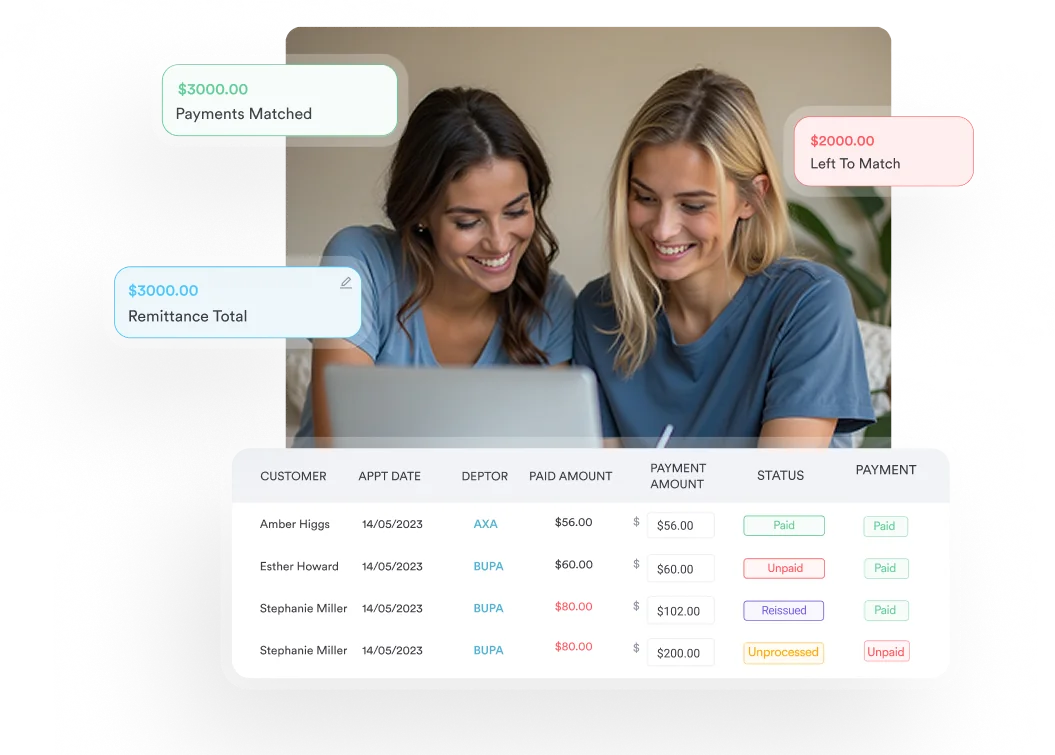
Pabau’s platform connects procedure documentation.
For surgical practices handling blepharoplasty and oculoplastic cases, this matters: the documentation that supports 00103 (anesthesia time, provider role, qualifying circumstance rationale) needs to be accurate before it reaches a claim. Practices interested in how plastic surgery EMR software handles documentation for reconstructive procedures can explore how Pabau structures this workflow end-to-end.
Billing teams can also build automated workflows that route a case for review when required documentation, like anesthesia start and end times, is missing, catching the issue before a claim moves forward.

CPT code 00103 is a precise, anatomy-specific code. Its 5 base units, time-based formula, and strict modifier requirements leave little room for shortcuts. The most avoidable denials come from using 00140 when 00103 applies, omitting the provider modifier, or failing to document anesthesia time in minutes.
Pabau’s integrated documentation tools help anesthesia and surgical practices capture the right data, like anesthesia time and provider details, in one patient record from the start. To see how this works in practice, book a demo with the Pabau team.

Need a reference for ADHD screening procedure codes? ADHD screening CPT reference covers how evaluation and management codes work across different clinical contexts.
Billing a crutch substitute device? HCPCS code E0118 billing guide covers the medical necessity criteria and modifier rules for this crutch substitute platform.
Billing anesthesia for a different surgical region? CPT code 01392 guide covers anesthesia billing rules for a different anatomical site using the same base-unit-plus-time framework.
CPT code 00103 is used to report anesthesia services for reconstructive procedures on the eyelid, including blepharoplasty and blepharoptosis (ptosis) repair. Effective January 1, 2026, the AMA revised the descriptor to focus on eyelid reconstruction only; conjunctiva and lacrimal apparatus procedures are no longer part of its scope. It applies when an anesthesiologist or CRNA administers anesthesia for these eyelid reconstructive procedures and is distinct from the broader eye anesthesia code 00140.
CPT code 00103 carries 5 anesthesia base units, as assigned by the American Society of Anesthesiologists (ASA) Relative Value Guide. These base units are fixed regardless of the individual patient or provider and serve as the starting point in the (Base Units + Time Units) x Conversion Factor billing formula.
The required modifiers are AA (anesthesiologist personally performed), QK (medical direction of 2-4 CRNAs), QX (CRNA with medical direction), QY (medical direction of 1 CRNA), and QZ (CRNA without direction). ASA physical status modifiers P1 through P6 should also be appended. At least one provider-type modifier is required on every 00103 claim.
CPT 00103 applies to reconstructive procedures on the eyelid, including blepharoplasty and blepharoptosis (ptosis) repair; conjunctiva and lacrimal apparatus procedures were removed from its scope effective January 1, 2026. CPT 00140 covers anesthesia for general eye procedures (cataract, retinal, strabismus surgery) and serves as the catch-all code for intraocular work. Both carry 5 base units, but the anatomical scope is distinct, and using the wrong code triggers payer edits.
Add the 5 base units to the time units (1 unit per 15 minutes of anesthesia time), then multiply by the applicable conversion factor for your MAC locality. For a 45-minute blepharoplasty, the calculation is (5 + 3) x conversion factor = total reimbursement. Report actual minutes in field 24G of the CMS-1500 form; do not round to 15-minute blocks.
The most common paired diagnosis codes are H02.40 (ptosis of eyelid, unspecified), H02.831 (dermatochalasis), H02.411 (mechanical ptosis), and H02.421 (myogenic ptosis). For traumatic eyelid repairs, S01.111A applies. The diagnosis code must reflect the medical necessity documented in the clinical record, not a cosmetic indication.
Prior authorization requirements vary by payer and health plan. Medicare generally does not require prior authorization for anesthesia services, but many commercial insurers do, particularly for elective blepharoplasty. Confirm authorization requirements with each payer before scheduling; failure to obtain required authorization is a leading non-clinical cause of denial for this code.
Qualifying circumstances add-on codes 99100 through 99140 may be reported with 00103 when special conditions apply: 99100 for extreme age (under 1 year or over 70), 99116 for total body hypothermia, 99135 for controlled hypotension, and 99140 for emergency conditions. These codes require concurrent clinical documentation to support the additional charge and are common audit targets.



