

CCSD code G5100: Bypass of duodenum billing guide
CCSD code G5100 bills a bypass that leaves the duodenum in place CCSD code G5100...

Last Updated: Oct 16, 2026
E0118 is the HCPCS Level II code for crutch substitute, lower leg platform, with or without wheels, each.
Most guidance on HCPCS Code E0118 assumes it behaves like the rest of the crutch and cane code range: document medical necessity, append the KX modifier, and Medicare pays. That assumption does not hold up against the source policies.
Local Coverage Determination L33733 (Canes and Crutches) sets medical necessity criteria for E0100, E0105, and E0110 through E0116, and it expressly denies E0117 ("medical necessity has not been established"). E0118 is not addressed in that LCD's coverage-criteria section at all.
Noridian, the DME Medicare Administrative Contractor (MAC) that once published dedicated guidance on the code, has retired those articles for lack of published clinical literature to support routine coverage.
Whether you are a physical therapy practice ordering the device or a supplier preparing the claim, the practical takeaway is the same: E0118 should be approached as an exception request, not a routine DME order, and the patient should be told that non-coverage is the likely outcome before the device is dispensed.
Let Pabau's smart automation suggest the right codes, reduce claim denials, and keep your practice compliant—effortlessly.
Automate repetitive tasks and focus on what matters most—your patients.
Reduce coding errors and ensure compliance with the latest regulations.
Clean claims, fewer denials, and faster reimbursements.
Powerful insights and reporting to help your practice thrive.
HIPAA compliant SOC 2 certified GDPR-compliant Trusted by 4,000+ clinics worldwide

HCPCS Code E0118 describes a crutch substitute lower leg platform device (a knee walker or knee scooter), with or without wheels, billed per unit under the Medicare Part B durable medical equipment benefit category.
Unlike E0100 through E0116, E0118 has no dedicated medical necessity criteria in LCD L33733, so traditional Medicare generally treats it as not reasonable and necessary and pays it, if at all, only on a case-by-case basis rather than through a routine KX-modifier workflow.
ICD-10 codes for fractures (S82.x), post-arthroplasty status (Z96.651 for a knee, not Z96.641, which denotes a hip), and chronic lower-extremity conditions can support an individual coverage exception request, though none of them guarantee payment.
Practice management software like Pabau helps practices keep the written order, clinical notes, and diagnosis coding consistent, which matters when building the medical necessity narrative for an E0118 exception or appeal.
HCPCS Code E0118 is the billing code for a crutch substitute, described in Policy Article A52459 as “a device strapped to the lower leg with a platform or a device with wheels,” billed per each unit.
It sits within the E0100 to E0199 HCPCS Level II range, which covers canes, crutches, and related mobility aids classified as durable medical equipment (DME) under the Centers for Medicare and Medicaid Services (CMS) HCPCS system.
The device itself is commonly called a knee walker or knee scooter. It supports the lower leg on a padded platform, allowing the patient to offload the foot and ankle entirely while maintaining ambulation. This makes it clinically distinct from standard axillary crutches (E0114) or an adjustable axillary crutch with pad and handgrip (E0116), which load the upper extremity rather than the lower leg.
Coverage for the crutches and canes code range is set out in LCD L33733. That LCD establishes “reasonable and necessary” criteria for E0100, E0105, and E0110 through E0116, and it explicitly denies E0117 on medical necessity grounds. E0118 does not appear in the coverage-criteria section of L33733 at all, which means the code has no LCD-based medical necessity pathway to satisfy in the first place.
Policy Article A52459, which is often cited as the source of E0118 coverage rules, does not actually contain any. Under its Coding Guidelines section it gives only the one-line code definition quoted above.
The remainder of the article addresses the general Final Rule 1713 written-order-prior-to-delivery (WOPD) and face-to-face encounter requirements that apply across DME categories, plus the general documentation standards in Policy Article A55426. A52459 explicitly disclaims providing “reasonable and necessary” content for E0118, so it should not be cited as a source of qualifying criteria for the code.
In practice, this means traditional Medicare fee-for-service generally denies E0118 as not reasonable and necessary. Noridian’s dedicated E0118 coverage articles are retired, citing insufficient published clinical literature to support the device.
Where E0118 is paid, it is typically the result of an individual claim review or a successful appeal, not a routine KX-modifier submission. Some state Medicaid programs, Medicare Advantage plans, and commercial payers may cover E0118 conditionally under their own medical policies, so it is worth checking plan-specific coverage before assuming denial is automatic outside of traditional Medicare.
As of 2026, there are two DME MAC contractors administering the four DME MAC jurisdictions:
Important: National Government Services (NGS) no longer administers a DME MAC jurisdiction. It exited Jurisdiction B in 2016.
If an individual claim for E0118 is approved, the applicable DME MAC’s own DMEPOS fee schedule for that jurisdiction and locality determines the allowed amount. Confirm current figures through the CMS DMEPOS fee schedule rather than relying on a published rate table, since E0118 is not a routinely priced, routinely paid item.
Before billing E0118 to traditional Medicare, check whether your DME MAC has published any current guidance on the code. If none exists, treat the claim as an exception request: issue an ABN, document the clinical necessity narrative thoroughly, and be prepared to appeal rather than assume KX and standard DMEPOS payment apply.
Because LCD L33733 does not set qualifying criteria for E0118, there is no fixed checklist that guarantees payment the way there is for E0110 through E0116. That does not mean documentation is optional. Practices seeking payment on an individual claim, or preparing to appeal a denial, still need to build the strongest possible medical necessity record. In practice, that record generally covers:
None of these elements creates a coverage guarantee for E0118. They simply position the claim, or a subsequent appeal, as strongly as the clinical picture allows. Supporting HIPAA-compliant documentation practices throughout the patient record still matters here, since a weak necessity narrative is one of the fastest ways to lose an appeal even when the clinical picture was appropriate.
With software for managing patients, DME prescriptions stay linked to the assessments that justified them.
Selecting the correct ICD-10-CM code is still important even though E0118 has no LCD-published covered-diagnosis list. The diagnosis is the primary clinical signal a reviewer uses when deciding an individual exception or an appeal.
Coders should distinguish the fracture and post-arthroplasty codes below from S86.819A, a soft-tissue strain code that carries less weight in an offloading-device necessity narrative. The table below lists commonly cited diagnoses. Commercial and Medicaid payer formularies may differ from these.
Always verify accepted ICD-10-CM codes against your compliance management workflows and the current LCD and policy article published by your DME MAC. No LCD publishes a specific covered-diagnosis list for E0118, so the codes above represent common supporting diagnoses used in exception and appeal narratives, not an official coverage list.
S82.001A and S82.201A above describe right-sided injuries. A left patella or left tibial shaft fracture uses S82.002A or S82.202A instead.
Modifier selection works differently for E0118 than for the rest of the crutch and cane range, because there is no LCD medical necessity threshold for KX to certify against. The table below covers the six modifiers most frequently discussed in connection with E0118 and the scenario each addresses.
Critical note on KX: Appending KX certifies that LCD coverage criteria are documented and met. Since E0118 has no LCD-based criteria to meet, KX should not be used as a default modifier the way it is for E0110 through E0116.
For traditional Medicare, GA with a signed ABN is the more defensible starting point. Practice management software can help enforce documentation completeness checks so the necessity narrative is ready if a DME MAC or another payer requests it during an individual review.
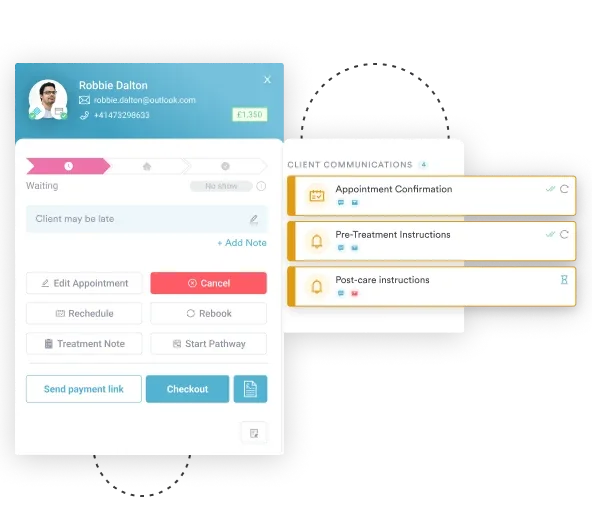
Because payment is decided case by case, a complete documentation package matters even more for E0118 than for routinely covered crutch codes. Missing any single element is grounds for denial on review, and weak documentation is the most common reason an appeal fails even when the underlying clinical picture was appropriate.
Note that CMS discontinued Certificates of Medical Necessity (CMNs) and DME Information Forms (DIFs) for all applicable claims effective January 1, 2023 (MLN Matters SE22002). Claims submitted with CMN or DIF information are now rejected. CMNs were also never part of the coverage framework for E0118 specifically, so there is no CMN requirement to satisfy for this code.
Structured digital intake and consent forms are one practical way to capture the clinical necessity narrative at the point of care. When the prescribing provider’s notes and the patient record are built from the same structured data source, the information stays consistent between the clinical encounter and any subsequent claim or appeal.
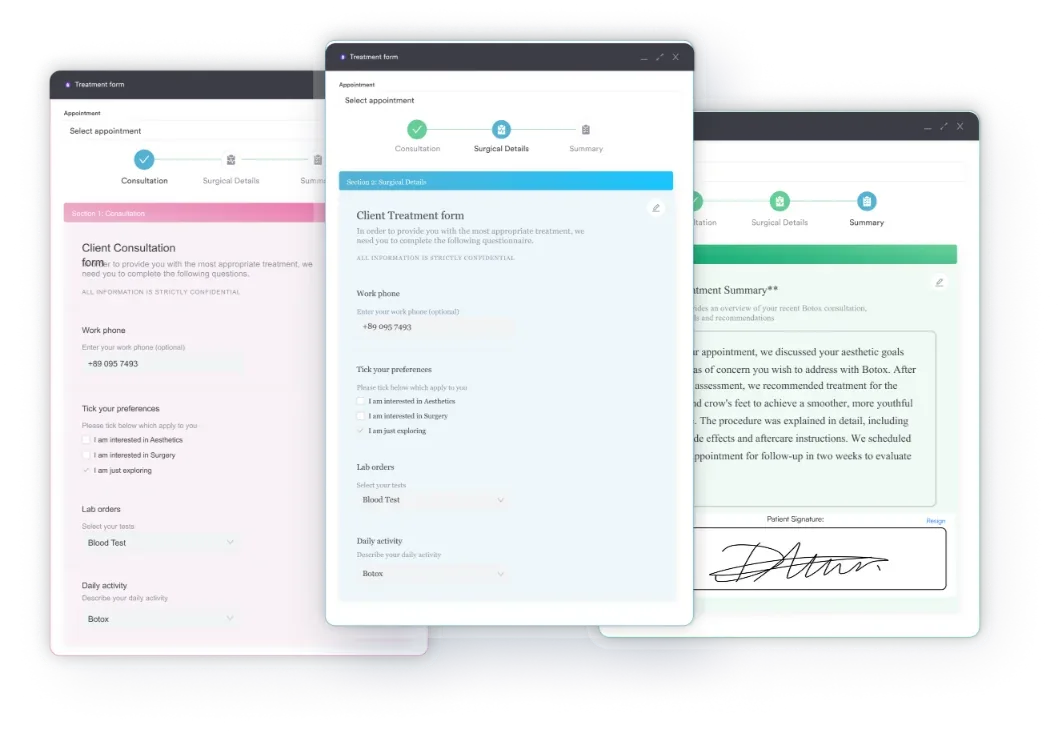
Poor documentation is also the leading reason that E0118 exception requests and appeals fail, even when the clinical picture supports the device. Practices that rely on structured patient record documentation rather than handwritten notes are generally better positioned when a MAC or payer asks for supporting records.
Because E0118 is not routinely covered, the billing sequence for this code differs from the rest of the crutch and cane range. Treating it as a standard, KX-driven DME claim is itself a common source of unpaid balances and beneficiary disputes.
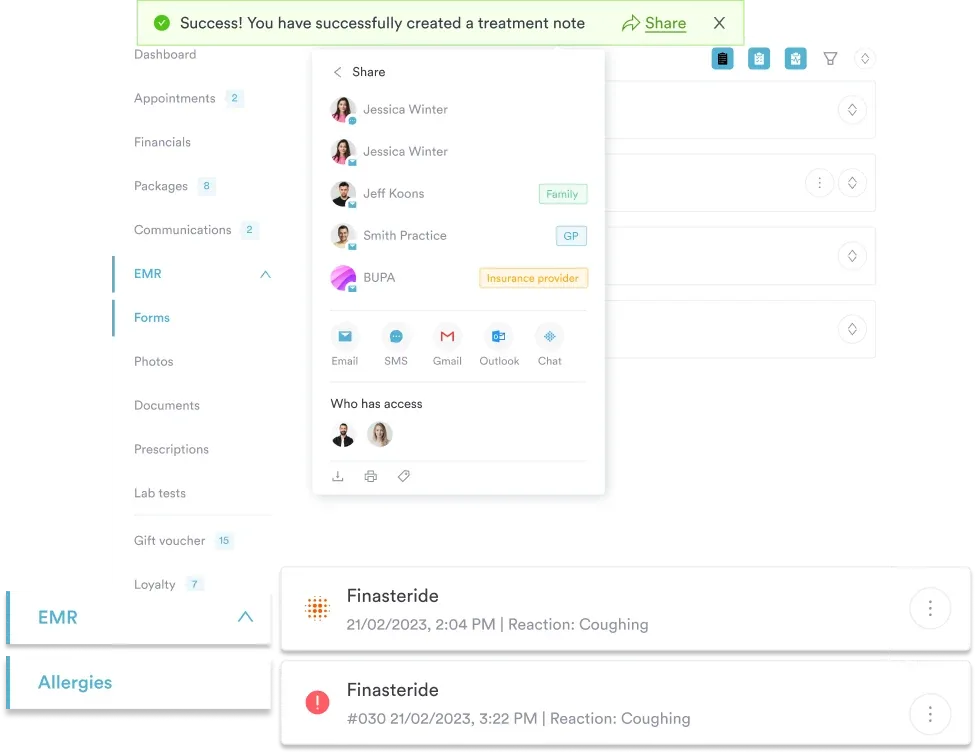
Practices using claims management software can link clinical encounter notes directly to the HCPCS billing code, reducing the manual transfer step that creates transcription errors and missing documentation when a claim needs to be appealed.

Practice management software like Pabau keeps the written order, clinical notes, and diagnosis coding together in one patient record, so the medical necessity narrative behind an E0118 exception request or appeal is easy to assemble and stays consistent over time.

Understanding when E0118 is clinically appropriate strengthens the medical necessity narrative in the written order, even though it does not by itself secure coverage. The clinical scenarios below show when it is genuinely the correct device choice over alternatives like E0114 (axillary crutches) or E0116 (an adjustable axillary crutch).
The lower leg platform design is indicated when the patient needs lower-extremity offloading but cannot safely manage axillary crutches. Ruling out proximal causes of impaired ambulation. This applies to several specific populations.
The clinical reasoning for device selection is what separates a defensible E0118 exception request or appeal from a generic mobility-aid request.
E0118 denials follow predictable patterns. The errors below account for the majority of unpaid claims and beneficiary billing disputes in this code. Addressing them systematically reduces rework and financial surprises for both the practice and the patient. Electronic remittance files post payments automatically, and the adjustment codes explain what was reduced and why.
Tracking denial patterns by HCPCS code across a billing portfolio is far more effective than addressing individual denials in isolation. For practices managing patient data security alongside billing, keeping documentation in a single auditable system reduces both billing risk and data governance exposure. When a claim on this code comes back unpaid, the denial reason codes on the remittance name the cause.
Selecting E0118 over a sibling code in the E0100 to E0199 range is a clinical and billing decision, and it also affects coverage: several sibling codes are routinely covered under LCD L33733, while E0118 and E0117 are not.
Coders working this range often cross-check walker and knee-walker orders as well, since walker and knee-walker orders are sometimes confused during intake. The table below summarizes the most relevant crosswalk codes to help coders confirm they have the right device description before submitting.
For a comprehensive lookup of codes in this range, the AAPC HCPCS lookup tool and the PGM Billing lookup tool both provide current descriptor data against CMS source files. Practices managing structured medical forms for DME ordering benefit from having the crosswalk logic, including E0118’s coverage limitations, built into the ordering template so the correct code and expectations are set at the point of prescription.
When a patient presents with both an upper-extremity limitation and a lower-extremity condition requiring offloading, document both impairments explicitly in the clinical note. The upper-extremity limitation is what makes E0118 clinically superior to E0114, and it belongs in the medical necessity narrative supporting an exception request or appeal.
E0118 differs from the rest of the crutch and cane code range in one important way: it has no dedicated LCD medical necessity pathway, and traditional Medicare generally denies it as not reasonable and necessary.
Treating it as an exception request rather than a routine KX-driven claim, with an ABN in place, a clear clinical necessity narrative, and correct ICD-10 coding, protects both the practice and the patient from surprise billing outcomes, whatever the eventual payer decides.
Practice management software like Pabau keeps the written order, clinical notes, and supporting diagnosis codes together in the patient record, so documentation stays consistent whether the outcome is an individual coverage determination, an appeal, or a beneficiary-billed balance. To see how Pabau supports structured clinical documentation, book a demo.

Treating a foot or ankle injury that needs surgical fixation? CPT Code 28760 covers the billing rules for the same non-weight-bearing recovery window that often calls for a knee walker.
Coding a knee condition alongside a mobility aid request? ICD-10 Code M79.4 explains how to document infrapatellar fat pad hypertrophy when it contributes to the offloading picture.
Documenting a diabetic foot complication? ICD-10 Code I96 covers the gangrene diagnosis code that sometimes accompanies an E0118 exception request.
HCPCS Code E0118 is the billing code for a crutch substitute, lower leg platform device, with or without wheels, billed per each unit. It is a Level II HCPCS code used to bill Medicare Part B and other payers for a knee walker or knee scooter that offloads the foot and ankle while allowing the patient to ambulate.
Not routinely. Unlike E0100 through E0116, E0118 has no medical necessity criteria in LCD L33733, and Policy Article A52459 provides only the code’s definition and general documentation rules, not a coverage pathway. Noridian’s dedicated E0118 guidance articles have been retired for lack of supporting clinical literature, and traditional Medicare generally denies E0118 as not reasonable and necessary. Coverage, when it happens, is decided case by case, and an Advance Beneficiary Notice should be issued before delivery. Some Medicaid programs, Medicare Advantage plans, or commercial payers may cover the device under their own criteria.
Because E0118 has no LCD-based coverage criteria, KX, which certifies that LCD requirements are met, is rarely appropriate. The more common approach for traditional Medicare is to issue an ABN and bill with GA, so the beneficiary can be billed if Medicare denies. GZ applies if no ABN was obtained and denial is certain. NU or RR still identify purchase versus rental if a claim is paid.
Commonly cited ICD-10-CM codes include tibial and fibular fracture codes (S82.x range), post-arthroplasty status (Z96.651 for a knee replacement), diabetic foot ulcer (E11.621), and severe knee osteoarthritis (M17.11). None of these guarantee payment, since no LCD publishes a covered-diagnosis list for E0118, but they support the necessity narrative in an individual exception or appeal request.
E0114 covers standard axillary (underarm) crutches, which transfer load through the axilla and arms and are covered under LCD L33733. E0118 covers a lower leg platform device (knee walker) that offloads the foot and ankle by supporting the lower leg on a padded platform, and it has no dedicated LCD coverage pathway. E0118 is indicated when the patient cannot safely use axillary crutches due to upper-extremity limitations or when lower-leg offloading is clinically required, but that clinical fit does not by itself guarantee Medicare payment.
Required documentation includes a Standard Written Order (SWO) communicated to the supplier before the claim is submitted, clinical notes establishing the necessity narrative, and proof of delivery signed by the beneficiary. E0118 is not on CMS’s Written Order Prior to Delivery list, so obtaining the SWO before delivery is prudent practice for this denial-prone code rather than a regulatory mandate. Because traditional Medicare is expected to deny the claim, an Advance Beneficiary Notice of Noncoverage (CMS Form CMS-R-131) should be signed before the device is dispensed. CMS discontinued Certificates of Medical Necessity for all applicable claims effective January 1, 2023, and a CMN was never part of the coverage framework for E0118 specifically.



