

CCSD Code D1010: Radical mastoidectomy including meatoplasty
CCSD Code D1010: Definition and clinical scope CCSD Code D1010 is the UK private...

Last Updated: Nov 25, 2026
V3720 is the CCSD code for posterior fusion +/– instrumentation – cervical region (1 or 2 levels) Including Spinal Cord Monitoring. The surgeon fuses one or two cervical levels through an incision at the back of the neck. Screws, rods or plates may or may not be placed.
Spinal cord monitoring is part of the code, so the surgeon never bills it separately. A third fused level moves the claim to V3721, and an anterior approach takes V2950. Bupa grades V3720 as CMO 2.
Let Pabau's smart automation suggest the right codes, reduce claim denials, and keep your practice compliant—effortlessly.
Automate repetitive tasks and focus on what matters most—your patients.
Reduce coding errors and ensure compliance with the latest regulations.
Clean claims, fewer denials, and faster reimbursements.
Powerful insights and reporting to help your practice thrive.
HIPAA compliant SOC 2 certified GDPR-compliant Trusted by 4,000+ clinics worldwide

CCSD Code V3720 covers posterior cervical fusion at 1 or 2 levels, including spinal cord monitoring. Three or more levels move the claim to V3721.
Spinal cord monitoring sits inside the V3720 descriptor, so the surgeon must never add a separate monitoring code to the same claim.
Instrumentation is optional: the +/- in the descriptor means V3720 applies whether or not rods, screws or plates are placed.
Pabau’s claims software sends CCSD claims through Healthcode or directly to Bupa, and tracks each pre-authorisation on the patient’s case.
CCSD Code V3720 is the UK private-sector procedure code for posterior fusion +/- instrumentation, cervical region (1 or 2 levels), including spinal cord monitoring. AXA Health’s chapter 3 schedule lists V3720 with exactly that descriptor.
The code comes from the CCSD Schedule, maintained by Clinical Coding and Schedule Development. Bupa, AXA Health, Aviva and Vitality run that group, so all four insurers read the same code.
Each part of the descriptor decides something on the claim:
The hardware question comes back later in this guide, because screws and rods can look like a separate service on the claim.
V3720 sits in Chapter 3 of the CCSD Schedule (Spine, spinal cord and peripheral nerves), in the section Spinal Column (including Intervertebral Disc) Cervical. Bupa grades it CMO 2 in its fee schedule. Its scope is narrow by design. Change the approach to anterior, fuse three or more levels, or move to the thoracic or lumbar spine, and a different code applies.
Posterior cervical fusion is a spinal stabilisation procedure performed under general anaesthesia with the patient in the prone position. The neurosurgeon or orthopaedic spine surgeon reaches the posterior cervical spine through a midline incision. The paraspinal muscles are retracted to expose the target level or levels.
The key surgical steps relevant to billing under V3720 are:
The distinction between one-level and two-level fusion matters for resource allocation and audit purposes, even though V3720 covers both. Operative notes must specify exactly which intervertebral levels were fused (e.g. C4-C5 and C5-C6 for a two-level procedure). A claim that simply states “posterior cervical fusion” without documenting the specific levels is incomplete, and the insurer is likely to query it.
Spinal cord monitoring is written into the V3720 descriptor, so the operating surgeon must not bill it as a separate line item. A monitoring code on the surgeon’s own claim counts the same service twice, and the insurer will strip or query it.
Intraoperative neuromonitoring (IONM) during posterior cervical fusion typically involves one or more of the following modalities:
The operative report must document that IONM was performed, which modalities were used, the technologist or neurophysiologist responsible, and the intraoperative findings. Insurers may ask for this record when they review a high-value spinal claim. If the note is silent on monitoring, the insurer has no evidence that the monitoring element of the code was delivered.
A separate clinical neurophysiologist is a different question. The CCSD Schedule has its own monitoring codes, such as 22026 for intraoperative neurophysiological monitoring of up to 4 hours.
Whether that specialist can claim one of them for a V3720 case is the insurer’s decision, not the surgeon’s. Confirm it with the insurer when you request pre-authorisation, and never add it to the surgeon’s claim.
Every claim for V3720 must carry an ICD-10 diagnosis code that clinically justifies posterior cervical fusion. The diagnosis must also match what was submitted during pre-authorisation. A mismatch between the pre-authorised diagnosis and the claim diagnosis is a straightforward denial trigger. UK insurers use WHO ICD-10, so check each code in the WHO ICD-10 browser before submission.
The ICD-10 code selected must reflect what is documented in the clinical notes, MRI reports, and the pre-authorisation request. The insurer’s claims team cross-references all three.
A code like M47.12 supports both the decompression and the fusion components of V3720. A diagnosis that only supports decompression, without instability, may invite a query about why fusion was performed.
CCSD Code V3720 is one code within a broader family of spinal fusion codes. A wrong pick means either underclaiming (a lower-value code) or overclaiming (a higher-value code), and both create audit exposure. Three facts from the operative note settle it: the approach, the region and the number of levels fused.
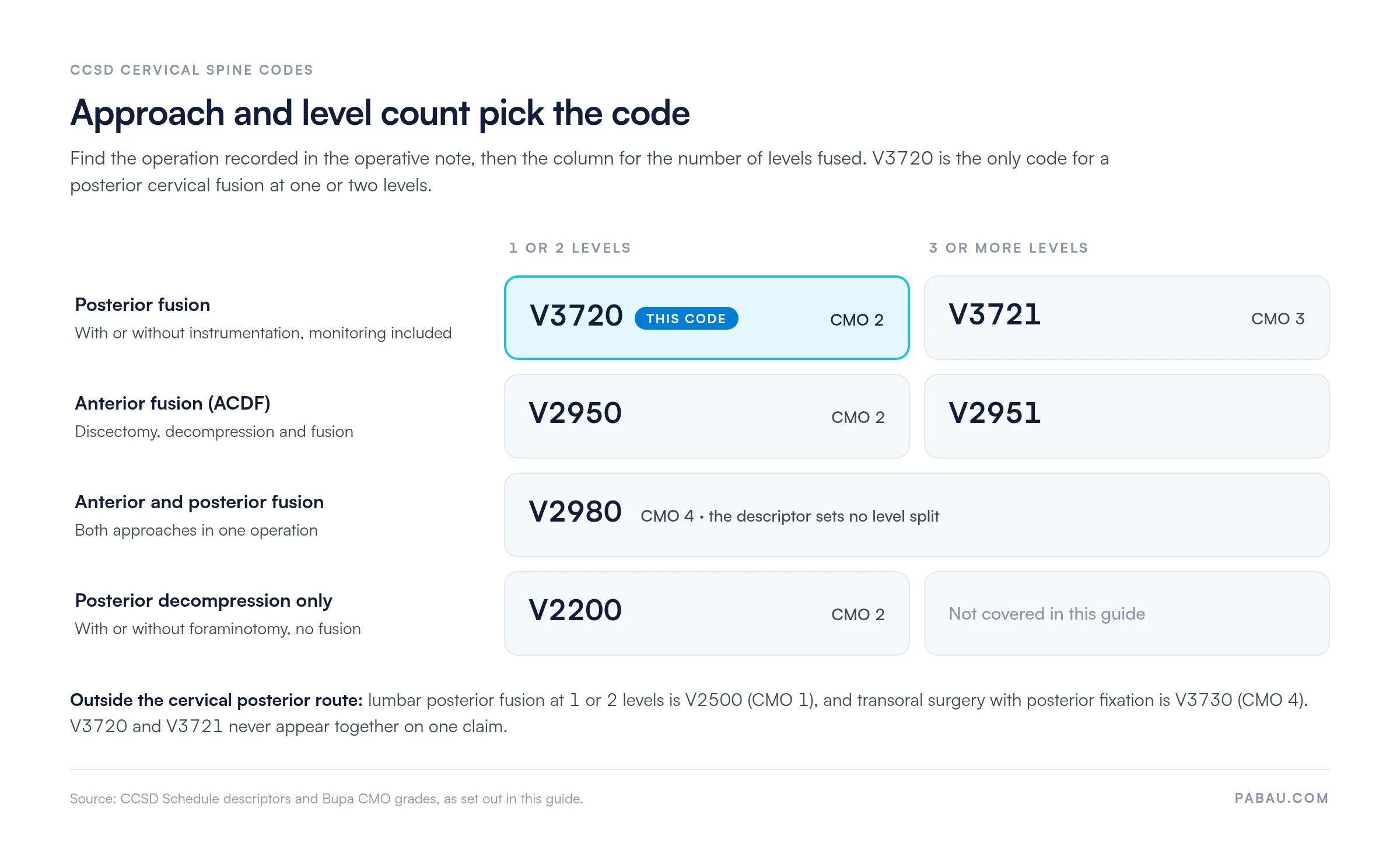
The table below gives each neighbouring code’s full descriptor. Our CCSD code library indexes the rest of the schedule. The Bupa CCSD codes guide explains how it is built.
The descriptors and CMO grades above follow Bupa’s published schedule, which you can browse in our Bupa fee schedule guide. CCSD updates the schedule on a regular publication cycle, and each insurer sets its own fee for a grade.
Check the code against the edition in force on the date of surgery. Lumbar fusion has its own family too, including V3350 for combined anterior and posterior lumbar fusion. Scoliosis correction through both approaches has its own entry as well, code V4000.
UK private medical insurers, including Bupa, AXA Health, Vitality and Aviva, expect pre-authorisation before planned spinal surgery. The patient usually calls the insurer with the CCSD code and diagnosis from their consultant, and the insurer issues an authorisation number. Without that number on the claim, the insurer is likely to reject the invoice or pend it for review.
For a high-value spinal operation, the insurer may ask for clinical detail before it confirms cover. Check each insurer’s current requirements, but expect to supply the following:
The insurer will also check that the consultant is recognised under the patient’s policy, and that the hospital is on the policy’s hospital list. It may ask for the admission date and whether the stay is day case or inpatient.
If the surgeon fuses a third level during the operation, call the insurer to update the authorisation to V3721 before you bill. Billing V3721 against an authorisation for V3720 invites a rejection, even when the operative note supports it.
Send the operative plan with the MRI report when you request pre-authorisation, not afterwards. An incomplete request tends to be pended while the insurer asks for more detail. That can push back the surgery date and leaves the authorisation open to dispute at the billing stage.
Claim denials for CCSD Code V3720 follow a consistent pattern. The table below maps each trigger to the step that prevents it. In Pabau, a practice management platform with UK insurer billing built in, a missing authorisation code is flagged before the claim goes out.
An incomplete operative report is the single most controllable cause of CCSD Code V3720 claim failure. Insurers’ clinical teams review operative notes on queried or high-value claims. The following elements must be present in every operative report supporting a V3720 claim:
Dictated or typed operative notes that omit the IONM section are frequently queried even when IONM was clearly performed. Build the IONM documentation into the standard operative note template so it cannot be overlooked.
Ask your IONM provider, whether in-house or contracted, for a written intraoperative monitoring report for every V3720 case. Attach it to the operative record. When an insurer asks for clinical documentation to support the claim, that report shows the monitoring element was delivered.
The “+/-” in the V3720 descriptor means instrumentation is encompassed within the tariff, whether or not hardware is placed. The surgeon’s fee for placing screws, rods or plates is therefore part of V3720. It cannot be claimed as a separate procedure code.
The implants themselves are a different matter. In UK private practice they are normally charged by the hospital on its own account, within the insurer’s authorisation:
Set your billing workflow to flag any V3720 claim that carries an additional procedure code. Review each extra code for bundling before the claim goes to the insurer.
Getting CCSD Code V3720 right at the point of claim creation prevents the delays that follow a rejection and resubmission. These workflow steps apply to any practice management or billing platform handling posterior cervical fusion cases:
In Pabau, the authorisation code, its dates and its sessions sit on the patient’s case, with a warning when one is missing. That stops the most avoidable V3720 rejection, a claim without a valid authorisation number. Pabau’s claims management software then sends the claim through Healthcode or directly to Bupa. It goes out from the same record that holds the operative note.
Spine practices weighing a system change can compare options in our UK medical billing software guide.

Pabau’s claims management software sends CCSD claims through Healthcode or directly to Bupa. Each pre-authorisation is tracked on the patient’s case, with a warning when the code is missing.

V3720 rewards precision about three facts. The approach was posterior, no more than two cervical levels were fused, and spinal cord monitoring is already in the code. Each of those facts has to appear in the operative note and match the insurer’s authorisation.
The costly errors are a separate monitoring code, a third level billed under the wrong code, and a missing authorisation number. All three are settled before the claim is created.
Keep the authorisation and the claim on one patient case, and the third error is caught before the claim leaves. Book a demo to see how Pabau tracks pre-authorisation and sends CCSD claims to Healthcode and Bupa for spinal practices.

Need a broader CCSD billing reference? CCSD billing codes overview covers the structure and submission rules for the CCSD Schedule.
Want fewer claim rejections across the practice? Claims management software from Pabau sends claims through Healthcode or directly to Bupa and tracks pre-authorisation on the patient’s case.
CCSD Code V3720 is the billing code for posterior fusion of the cervical spine at one or two levels, with or without instrumentation. Spinal cord monitoring is included in the code. It applies when a neurosurgeon or spine surgeon stabilises one or two cervical segments from behind the neck. Fixation hardware may or may not be placed.
Spinal cord monitoring is included in V3720 and must not be billed separately. The official descriptor explicitly states “Including Spinal Cord Monitoring.” A separate IONM code alongside V3720 counts the same service twice, and the insurer will query or strip it.
Yes, V3720 covers both single-level and two-level posterior cervical fusion within a single code. The operative report must name the exact levels fused. Three or more levels move the claim to V3721, and the two codes cannot be billed together for one operation.
Before they authorise surgery, insurers such as Bupa, AXA Health, Vitality and Aviva usually need the CCSD code and the ICD-10 diagnosis. They also ask for the planned date and hospital. For spinal surgery they may also ask for the MRI report, evidence of failed conservative treatment, and the consultant’s clinical summary. Requirements differ by insurer and policy, so check each one before surgery.
The difference is the surgical approach. V3720 covers posterior cervical fusion, where the surgeon reaches the spine from behind the neck. Anterior discectomy, decompression and fusion is coded V2950 for 1 or 2 levels, and V2980 covers combined anterior and posterior fusion. The approach in the operative report decides which code applies.
The professional fee for placing instrumentation is included in V3720. The implants themselves, such as screws, rods, cages and plates, are normally charged by the hospital on its own account. Never claim an additional procedure code for the hardware placement.




