

HCPCS Code Q4175: Billing, coverage, and documentation guide
HCPCS Code Q4175: Code Description and Product Identity HCPCS Code Q4175 is the ...

Last Updated: Nov 20, 2026
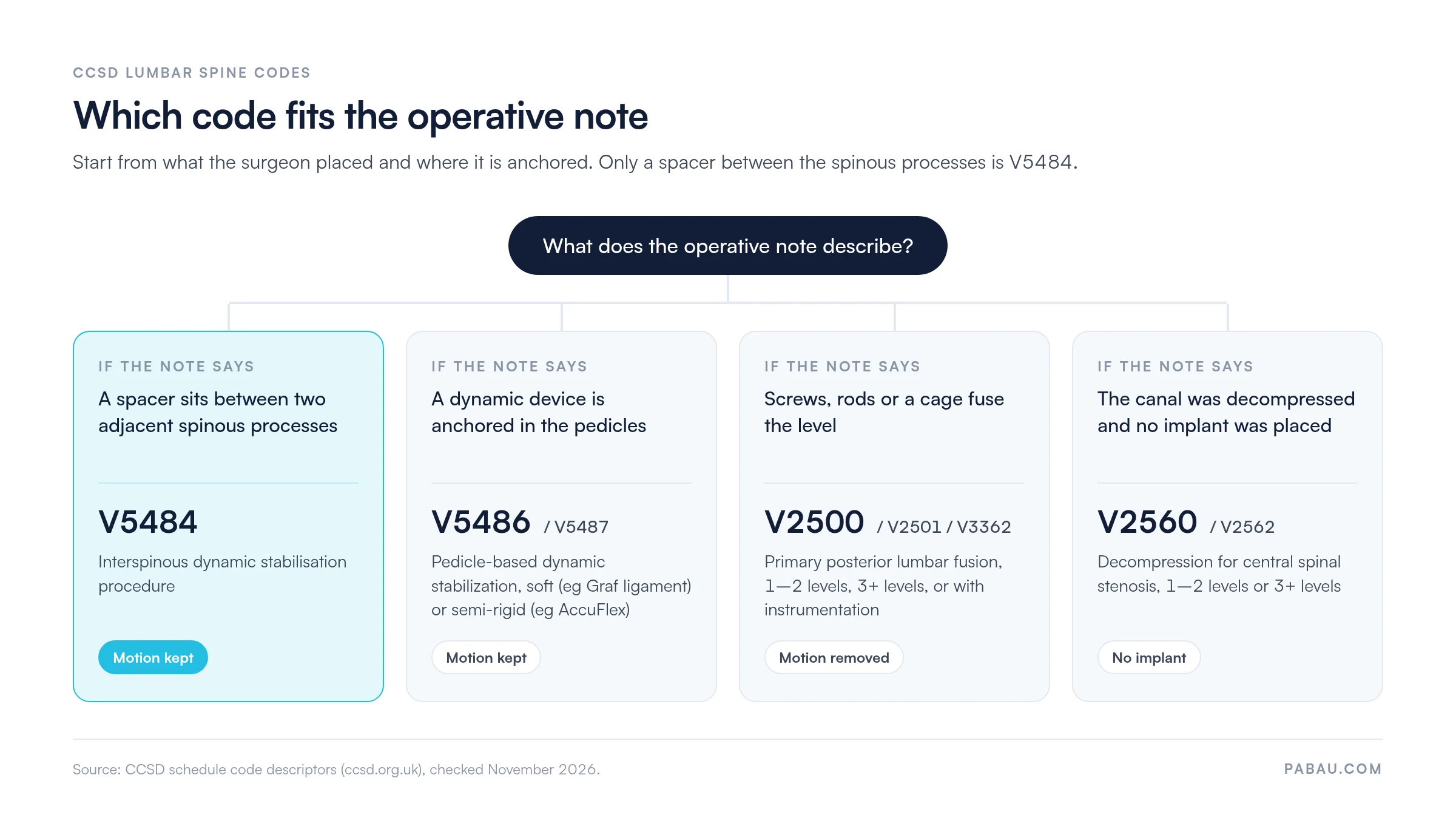
V5484 is the CCSD code for an interspinous dynamic stabilization procedure. It covers a surgeon implanting a spacer between two adjacent lumbar spinous processes, limiting extension while keeping some movement at that level.
UK private insurers see V5484 for lumbar spinal stenosis causing neurogenic claudication after conservative treatment has failed. The implant is billed as a separate prosthesis line, and most insurers require prior authorization before surgery.
Let Pabau's smart automation suggest the right codes, reduce claim denials, and keep your practice compliant—effortlessly.
Automate repetitive tasks and focus on what matters most—your patients.
Reduce coding errors and ensure compliance with the latest regulations.
Clean claims, fewer denials, and faster reimbursements.
Powerful insights and reporting to help your practice thrive.
HIPAA compliant SOC 2 certified GDPR-compliant Trusted by 4,000+ clinics worldwide

CCSD code V5484 covers interspinous dynamic stabilization at lumbar levels. It is a motion-preserving implant, separate from lumbar fusion codes such as V2500, V2501 and V3362.
Mandatory documentation includes pre-operative MRI or CT, evidence of failed conservative treatment, and an operative note naming the device, lot number, and spinal level.
Major UK private insurers, including Bupa, AXA Health, Aviva and Vitality, expect prior authorization before surgery. Confirm the requirement with each payer.
The implant is billed as a separate prosthesis line, not inside the V5484 procedure fee.
NICE guidance IPG365 supports interspinous distraction for carefully selected patients, with specialist spinal surgeons choosing who receives it.
CCSD code V5484 is the UK private healthcare billing code for an interspinous dynamic stabilization procedure. The CCSD Group publishes its schedule as the standard codes for UK private healthcare. Its V5484 record gives the official descriptor as “Interspinous dynamic stabilisation procedure.”
A consultant neurosurgeon or spinal orthopedic surgeon uses V5484 when implanting a device between two adjacent lumbar spinous processes. The device stabilizes the motion segment while preserving some movement, in contrast to rigid instrumented fusion.
In the schedule, V5484 sits under 3.8.0 Other Procedures, within chapter 3.0.0 Spine, Spinal Cord & Peripheral Nerves, as reference Fc.119b. The procedure is performed under general anesthesia, most commonly at L3-L4, L4-L5, or L3-L5, through an open or minimally invasive posterior approach.
The device is inserted between the spinous processes and secured to limit extension at the operative level while allowing flexion. This motion-preserving intent separates V5484 from lumbar fusion codes such as V2500, V2501 and V3362. A fusion construct eliminates movement at the fused level, and the interspinous implant does not.
The procedure implants a spacer between adjacent lumbar spinous processes under direct visualization. The surgeon makes a posterior midline incision, retracts the paraspinal muscles, and prepares the interspinous ligament space before introducing the implant. Depending on its design, the device is then secured with integrated wings or sutures around the spinous processes to prevent displacement.
Coders commonly meet three device families on V5484 claims:
Until November 2014, the CCSD descriptor read “Interspinous dynamic stabilisation procedure (eg X STOP).” Older billing templates may still carry that wording, so bring them in line with the current descriptor.
Confirm which device the surgeon implanted from the operative note before assigning V5484. If the note does not name the device or spinal level, return it for clarification before submitting the claim. Check each device’s current UK market status (UKCA or CE marking) too, as regulatory status can change.
UK private payers accept V5484 claims where the clinical record clearly documents the qualifying indication. The standard accepted indications are:
Payers may reject V5484 claims where the referral letter or clinical summary does not address these criteria. Document each point in the pre-operative assessment, not only in the operative note. Where an insurer asks for a diagnosis code, lumbar spinal stenosis is M48.06 in ICD-10.
NICE interventional procedures guidance IPG365, published in November 2010, covers interspinous distraction procedures for lumbar spinal stenosis causing neurogenic claudication. It finds the procedures efficacious for carefully selected patients in the short and medium term.
IPG365 also advises that specialist spinal surgeons, who can offer a range of surgical options, select the patients. NICE has since reissued the guidance as HealthTech guidance HTG238, with the recommendations unchanged.
For a V5484 claim, the guidance shapes what the record should show:
Check the current version on the NICE website, and confirm each insurer’s own policy. Insurer requirements are more specific than NICE guidance and can change independently of it.
Knowing what the procedure fee covers prevents both underbilling and the unbundling errors that trigger denials.
Included within V5484:
Excluded from V5484 (bill separately):
The costliest coding error on V5484 claims is billing the procedure under a rigid spinal fusion code. The table below lists the codes most often confused with V5484 and what separates each one.
A pedicle screw or cage construct calls for one of the lumbar fusion codes such as V2500, V2501 and V3362, not V5484. Billing a fusion code for an interspinous spacer is upcoding and creates material audit risk. When the surgeon decompressed the canal without placing an implant, bill V2560 or V2562 by the number of levels instead.
In practice, the choice comes down to what the surgeon placed and where it is anchored.
Incomplete documentation is a common cause of post-payment audit clawbacks on V5484 claims. The operative note alone is not enough, because payers expect a complete pre-operative and post-operative record.
Mandatory documentation for V5484 includes:
An operative note template that makes the device, lot number, and spinal level mandatory fields stops these omissions at the source. A missing lot number or spinal level is enough for a payer to query or withhold the claim.
V5484 is a high-cost spinal procedure, and every major UK private insurer expects pre-authorization before surgery. The table below reflects general payer requirements. Terms change and vary by member contract, so check each insurer’s code list, such as the Bupa CCSD codes, before proceeding.
Payer policies on complex spinal procedures are reviewed often. Treat the table as a starting framework, not a confirmed current policy. Contact each insurer’s provider relations team to verify pre-authorization requirements before the patient is listed for surgery. A practice that bills several insurers needs one checklist per payer, so a missing reference is caught early.
V5484 denial patterns are consistent across payers. Knowing them in advance lets billing teams build claims that hold up the first time.
A claim review step in private practice billing software can flag a missing prior authorization number or document link before the claim is submitted.
The interspinous spacer is a high-value implant. Its cost sits outside the V5484 procedure fee and must appear on the invoice as a separate prosthesis line. The steps below describe standard UK private practice billing convention, so verify them against your payer contracts before applying them.
Implant caps and handling rates are commercially sensitive and often confidential. Your signed payer contract sets the definitive terms.
V5484 rarely appears as the only code on a spinal surgery episode. The table below lists the codes and charges that commonly sit beside it on the same invoice or episode of care.
The anesthetist and follow-up are billed separately, on their own lines and dates of service. Always check codes and descriptors against the current CCSD schedule, which is updated periodically. For other procedures in the schedule, start from our CCSD codes for billers.
Before submitting any V5484 claim, run a four-point check. First, the prior authorization reference number is on file. Second, the operative note names the device, lot number, and spinal level. Third, the implant is billed as a separate prosthesis line with full traceability data. Fourth, the signed consent form is in the patient record. Each item maps to one of the denial reasons above.
In many spinal practices, a V5484 claim is assembled from four places. The authorization number sits in an insurer email, and the operative note sits in a dictated letter. The implant invoice arrives from theater on paper, and the consent form lives in a scanned file. The billing desk rebuilds the claim from all four, and one missing piece stalls payment.
Pabau keeps those pieces on the patient record. The authorization code, dates, and sessions are tracked on the case, with a warning when one is missing. The operative note form can require the device, lot number, and spinal level. The invoice carries the V5484 line and the prosthesis line as separate entries.
UK claims then go to the insurer through Healthcode or Bupa, with the supporting documents attached. When a payer queries the claim, the answer is already in the record rather than in someone’s inbox.

Pabau tracks prior authorizations, stores structured operative notes, and sends UK insurer claims through Healthcode. Each V5484 claim leaves the practice with its authorization, device details, and prosthesis line in place.

V5484 pays cleanly when the authorization, the operative note, and the invoice agree with each other. Most denials trace back to one of them contradicting the others, or to an implant cost folded into the procedure fee.
Start with the code choice. If the device sits between the spinous processes, V5484 is right. If it is anchored in the pedicles or fuses the level, a different code applies, and the claim should say so from the first submission.
The effort moves earlier. Checking the record before surgery costs some admin time, while a clawback months later can cost the whole fee. Book a demo to see how Pabau keeps spinal implant claims complete from pre-authorization to payment.

Need a full reference for Bupa procedure codes? Bupa CCSD billing guide covers the CCSD schedule as Bupa uses it for UK private claims.
Looking to reduce claim errors across your private practice? Claims management software from Pabau supports invoicing, payer tracking, and document attachment in one workflow.
Billing the same kind of device in the US? HCPCS code C1821 covers the interspinous process distraction device on US claims.
Comparing lumbar decompression codes? CPT code 62380 explains billing for endoscopic lumbar decompression in the US.
CCSD code V5484 covers the interspinous dynamic stabilization procedure, the surgical insertion of a motion-preserving spacer between adjacent lumbar spinous processes. It applies in UK private healthcare. The implant cost is not included and is billed separately as a prosthesis charge.
V5484 covers a motion-preserving interspinous implant that limits extension without eliminating segmental movement. Lumbar fusion codes such as V2500, V2501 and V3362 cover rigid screw, cage, and rod constructs that eliminate movement at the fused level. The two are mutually exclusive at the same spinal segment and are never co-billed for one operative level.
Major UK private medical insurers, including Bupa, AXA Health, Aviva, and Vitality Health, require prior authorization before V5484 surgery. The request typically needs the referral letter, MRI or CT evidence of stenosis, and documentation of failed conservative treatment. It also names the proposed CCSD code and the intended device. Confirm current requirements with each payer before listing the patient for surgery.
Indirectly. NICE guidance IPG365 supports interspinous distraction procedures for carefully selected patients with lumbar spinal stenosis causing neurogenic claudication. It advises that specialist spinal surgeons select the patients. NICE does not set insurer payment, but a record showing the specialist assessment and the qualifying indication supports a V5484 claim.
The interspinous device is invoiced as a separate prosthesis line, distinct from the V5484 procedure fee. The implant invoice must include the device name, manufacturer, catalog number, lot number, and unit cost. Payers typically reimburse at cost plus a handling percentage or at a capped schedule rate. Confirm the applicable rate in your payer contract before submitting.
It depends on the payer. Some insurers bundle decompression into V5484. Others accept a separate decompression code, such as V2560 or V2562, where the laminotomy is a distinct component documented in the operative note. Confirm the bundling policy with each payer before submitting a combined claim.





