CCSD code XR320: Nasolacrimal duct stenting billing guide
CCSD code XR320 is the UK private insurance code for dilatation or stenting of t...

Last Updated: Nov 24, 2026
V0130 is the CCSD code for surgery for craniostenosis (single suture), billed to UK private medical insurers. It covers the operative correction of one prematurely fused cranial suture: sagittal, unilateral coronal, metopic or lambdoid.
The technique does not change the code. Strip craniectomy, cranial vault remodelling and fronto-orbital advancement on one suture all code to V0130. When two or more sutures are fused, the code is V0180.
Let Pabau's smart automation suggest the right codes, reduce claim denials, and keep your practice compliant—effortlessly.
Automate repetitive tasks and focus on what matters most—your patients.
Reduce coding errors and ensure compliance with the latest regulations.
Clean claims, fewer denials, and faster reimbursements.
Powerful insights and reporting to help your practice thrive.
HIPAA compliant SOC 2 certified GDPR-compliant Trusted by 4,000+ clinics worldwide

CCSD code V0130 covers surgery for a single fused cranial suture. When more than one suture is fused, the code is V0180.
Pair V0130 with WHO ICD-10 Q75.0 (craniosynostosis) as the primary diagnosis on the authorisation request and the invoice.
UK private medical insurers such as Bupa, AXA Health and Aviva expect pre-authorisation before admission, backed by the CT report.
The operative note must name the suture treated and the technique. Without it, the insurer may query the code.
Pabau’s billing and records software keeps the operative note, authorisation number and diagnosis together, then sends CCSD-coded claims to UK insurers through Healthcode.
CCSD code V0130 is the UK private medical insurance code for surgery for craniostenosis (single suture). It is set by the Clinical Coding and Schedule Development group (CCSD), which publishes the procedure codes UK insurers use.
National Friendly’s schedule of fees lists V0130 under that exact descriptor, next to V0180 for more than one suture. The code sits in the chapter for the brain, cranium and other intracranial organs. It applies when only one cranial suture has fused early.
CCSD sets the codes and their descriptors, but it does not set fees. Each insurer publishes its own fee schedule against the CCSD codes. The amount paid for V0130 therefore depends on the patient’s insurer and policy.
Single-suture craniosynostosis surgery corrects the premature fusion of one cranial suture in an infant or young child. Left untreated, the fused suture restricts normal skull expansion, raising intracranial pressure and causing abnormal head shape. The operative goal is to relieve elevated intracranial pressure and restore normal skull growth trajectory.
The patient population is almost exclusively paediatric, typically presenting in the first year of life. Surgery is performed under general anaesthesia in an in-patient neurosurgical setting, with at least one night of monitoring afterwards.
Three surgical approaches are used for single-suture cases:
The approach changes the length of surgery, blood loss and stay. It does not change the code: V0130 applies whenever only one suture is involved. The operative report must specify both the suture treated and the surgical approach used.
CCSD code V0130 covers operative correction of any single cranial suture. The descriptor turns on how many sutures are fused, not which one. The four sutures most often treated are:
Bilateral coronal synostosis involves two sutures, so it falls under V0180, not V0130. The same applies to a syndromic case where the CT shows more than one fused suture. Confirm descriptors against the current CCSD Schedule at the date of treatment. Our CCSD code library lists the other codes in the schedule.
Confirm the suture count from the pre-operative CT report and the operative note before coding. If the two documents disagree, hold the invoice and query the surgeon. Coding a multi-suture case as V0130, or the reverse, invites an insurer query.
UK insurers code diagnoses with WHO ICD-10, not the US ICD-10-CM. The primary diagnosis for V0130 is Q75.0 (Craniosynostosis). A diagnosis that does not support the procedure is a common reason for an insurer to query the claim.
Put Q75.0 first on the authorisation request and the invoice. Add secondary codes only for findings recorded in the notes at the time of surgery.
Two codes sit beside V0130 in the cranium section of the CCSD Schedule. Picking the wrong one under-claims a complex case or over-claims a simple one. The Bupa CCSD codes guide covers the wider schedule.
The V0130 descriptor names no technique. A strip craniectomy and a cranial vault remodelling on one suture both code to V0130. Check the CCSD unacceptable combinations before adding a second code to the same invoice.
Read as a decision, the three codes turn on one question about the operation, set out in the chart below.
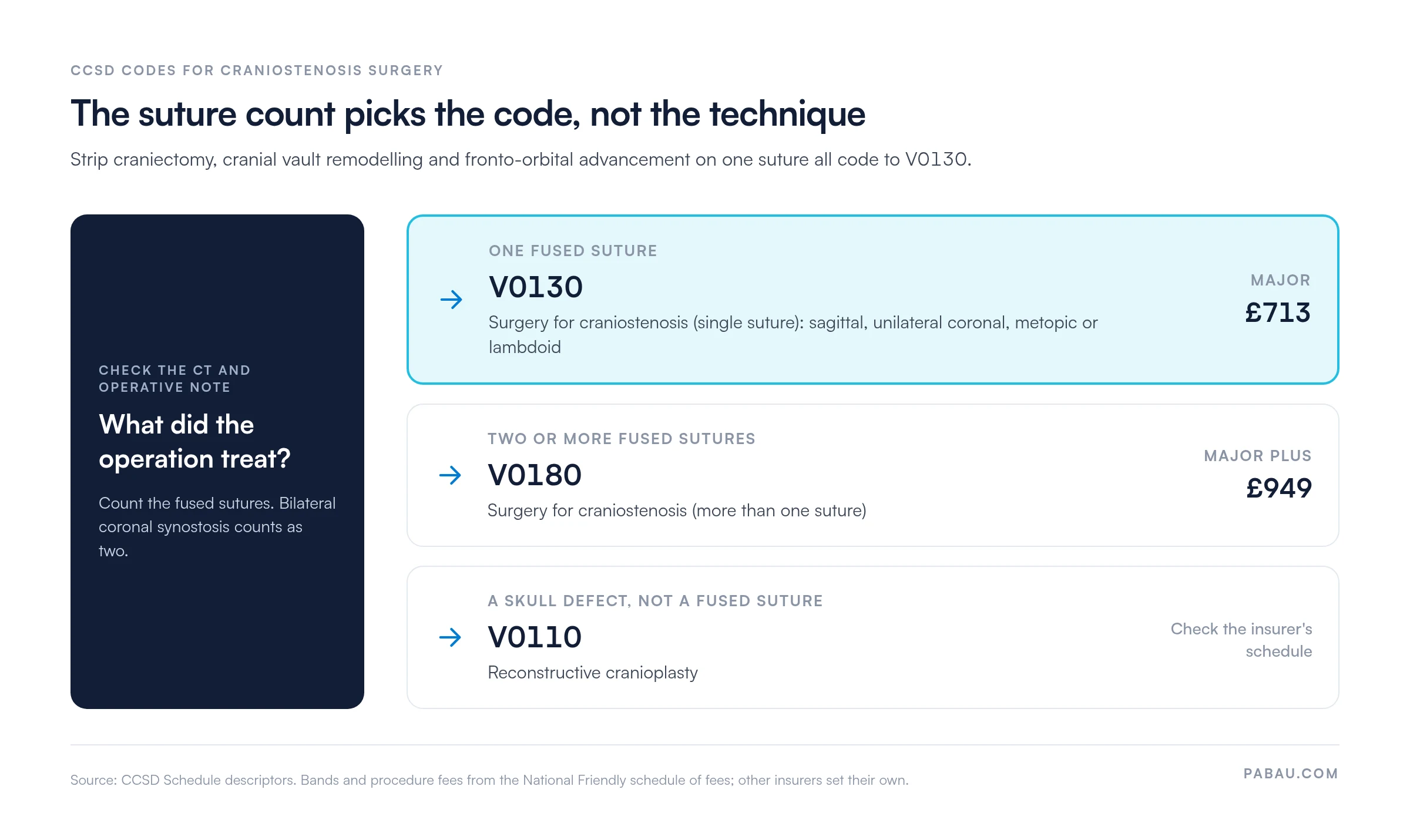
Each insurer sets its own fee against V0130. The National Friendly schedule of fees lists V0130 as Major complexity with a £713 procedure fee. It lists V0180, the multi-suture code, as Major Plus at £949.
Bupa, AXA Health, Aviva, VitalityHealth, WPA, Healix and Allianz Care publish their own schedules. Check the patient’s insurer before quoting a fee, and check again each year. A surgeon who charges more than the insurer pays leaves the family with a shortfall, so explain it in writing before surgery.
UK private medical insurers expect the policyholder to call for authorisation before in-patient treatment. The insurer issues an authorisation number for the planned procedure code. That number is not a promise of payment, because the invoice still has to match the code, the notes and the policy.
The clinical letter for a V0130 request should include:
If the plan changes, ask the insurer to update the authorisation before you invoice. An authorisation for V0130 does not cover V0180 if theatre findings show a second suture. Record every call with the insurer, with the date and the name of the person you spoke to.
A complete record is what separates a paid V0130 claim from a queried one. Digital intake forms and structured patient records make it less likely a document is missing when you invoice.
The operative note is the most important document. It must state:
A note that says only “craniosynostosis surgery performed” gives the insurer grounds to query the code. Name the suture in plain words.
Keep these documents ready to send on request:
The anaesthetist invoices the insurer separately, using the same CCSD procedure code, V0130. The insurer pays the anaesthetist under its own fee schedule. CCSD codes carry no modifiers, so the anaesthetist’s invoice needs only the code, the date and the authorisation number.
Some craniosynostosis operations are done jointly by a neurosurgeon and a craniofacial plastic surgeon. Insurers treat a second operating surgeon in different ways. Ask the insurer before surgery how it pays a joint procedure, and include both surgeons in the authorisation.
A staged operation, with a second session weeks later, is a separate episode. Each session needs its own authorisation, date of treatment and invoice.
Before a joint operation, ask the insurer in writing whether it pays a second surgeon for V0130 under the patient’s policy. A declined fee is far easier to prevent at authorisation than to appeal after surgery.
V0130 is a high-value paediatric code, so insurers check these claims closely. Most of the errors below can be caught before the invoice goes out.
When an insurer rejects a claim, ask for the reason in writing. A clinical letter from the surgeon, with the imaging and operative note, resolves most disputes.
Accurate V0130 billing depends on three things: the right code, a complete operative note and an authorisation that matches both. Each one breaks down when the note, the authorisation and the invoice sit in different systems.
Pabau keeps all three on one patient record. Its claims management software sends CCSD-coded claims to UK insurers through Healthcode and Bupa. The authorisation number, dates and sessions sit on the patient’s case, with a warning when one is missing.

Pabau helps UK private practices keep operative notes, authorisation numbers and WHO ICD-10 codes together, then sends CCSD-coded claims to insurers through Healthcode.

V0130 is a narrow code. It pays for surgery on one fused suture, whatever the technique. Most queried V0130 claims come down to that boundary, not to the surgery itself.
So the claim rests on two lines in the operative note: which suture, and confirmation that it was the only one. Write them plainly, match the authorisation to them and check the insurer’s own fee. Book a demo to see how Pabau sends CCSD claims through Healthcode with the note beside each one.

Choosing billing software for a UK practice? Best medical billing software in the UK compares the systems that submit CCSD-coded claims to UK insurers.
CCSD code V0130 covers surgery for craniostenosis affecting a single suture. It includes strip craniectomy, cranial vault remodelling and fronto-orbital advancement when only one suture is fused. When two or more sutures are fused, the code is V0180.
WHO ICD-10 Q75.0 (Craniosynostosis) is the primary diagnosis for V0130. UK insurers use WHO ICD-10, not ICD-10-CM. Put Q75.0 first on both the authorisation request and the invoice.
Yes. UK private medical insurers such as Bupa, AXA Health and Aviva expect authorisation before in-patient surgery. Send the CT report, the operative plan, the referral letter and the codes. Quote the authorisation number on the invoice.
No. V0130 is for a single suture only. If the CT or theatre findings show two or more fused sutures, use V0180, surgery for craniostenosis (more than one suture). Ask the insurer to update the authorisation before you invoice.
Yes. The anaesthetist sends a separate invoice to the insurer using the same CCSD code, V0130. The insurer pays the anaesthetist under its own fee schedule.
Each insurer sets its own fee. National Friendly lists V0130 as Major complexity with a £713 procedure fee. Bupa, AXA Health, Aviva and other insurers publish their own schedules, so check the patient’s insurer.
The usual reasons are a missing authorisation number or a diagnosis that does not support the procedure. Another is an operative note that does not name the suture. Fix each one before you send the invoice.