

HCPCS Code Q4185: Cellesta flowable amnion billing guide
HCPCS Code Q4185: definition and official descriptor HCPCS Code Q4185 is the Lev...

Last Updated: Nov 20, 2026
T7050 is the CCSD code for lengthening of tendon(s) or open tenotomy. It covers an open operation that lengthens one or more tendons, for example by Z-plasty. It also covers open tenotomy, which divides a tendon completely through an incision to release a fixed contracture.
UK private medical insurers such as Bupa, AXA Health and Aviva use the code to assess consultants' invoices. A needle tenotomy is coded T7010, and Achilles lengthening has its own codes, T6720, T6722 and T6723.
Let Pabau's smart automation suggest the right codes, reduce claim denials, and keep your practice compliant—effortlessly.
Automate repetitive tasks and focus on what matters most—your patients.
Reduce coding errors and ensure compliance with the latest regulations.
Clean claims, fewer denials, and faster reimbursements.
Powerful insights and reporting to help your practice thrive.
HIPAA compliant SOC 2 certified GDPR-compliant Trusted by 4,000+ clinics worldwide

CCSD code T7050 covers open lengthening of one or more tendons, or open tenotomy, which divides a tendon completely through an incision.
A needle tenotomy is T7010, and Achilles lengthening has its own codes (T6720, T6722 and T6723), so neither is billed as T7050.
UK insurers set their own fee for T7050. National Friendly’s published schedule, for example, lists it as Inter complexity at £410.
Pabau’s claims software sends CCSD-coded claims to UK insurers through Healthcode, with the operative note and authorisation reference in the same patient record.
CCSD code T7050 is the UK private-practice procedure code for lengthening of tendon(s) or open tenotomy in the CCSD Schedule. The Clinical Coding & Schedule Development Group maintains the CCSD Schedule for independent healthcare. Insurers such as Bupa, AXA Health, Aviva, Vitality and WPA use its codes to assess and pay consultants’ invoices.
The code covers two open techniques. Tendon lengthening cuts the tendon and repairs it at a greater length, so the tendon stays in continuity. Open tenotomy divides the tendon completely through an incision to release a fixed contracture. A needle tenotomy is not T7050, because CCSD lists it separately as T7010, Percutaneous tenotomy.
T7050 sits in Chapter 16 of the schedule, Bones, joints and connective tissue/tendon muscle, in sub-chapter 16.1.0 Connective Tissue/Tendon Muscle. The descriptor reads “tendon(s)”, so it covers one tendon or several. The CCSD Technical Guide (October 2025) sets the rules on unacceptable combinations and on using more than one code.
Both procedures fall under T7050, but they solve different problems and leave the tendon in a different state. The table below sets out the differences.
The operative note must say which procedure was performed. A note that reads only “tendon procedure” gives the insurer’s claims assessor nothing to check against the code. Name the tendon, for example the hamstrings or a wrist flexor, and the technique, such as Z-plasty lengthening or open division.
T7050 applies when the record supports an open operation on a shortened or spastic tendon. The presentations below are the ones most often behind a T7050 invoice.
Two common tendon operations look like T7050 but take other codes. Achilles tendon lengthening has its own codes: T6720 (percutaneous), T6722 (primary open) and T6723 (revision). Trigger finger release is T7231 when open and T7232 when percutaneous.
Insurers usually want evidence of conservative treatment before they authorise elective tendon surgery. The referral letter should record what was tried, for how long and with what result.
Every T7050 invoice needs a diagnosis code that explains why surgery was necessary. UK insurers take diagnoses in WHO ICD-10, not the US ICD-10-CM, so check each code in the WHO ICD-10 browser. The table lists the pairings most often seen with T7050.
M67.0, Short Achilles tendon (acquired), is a valid code too, but its procedure is an Achilles lengthening code, not T7050. When the diagnosis does not obviously need surgery, add the supporting evidence to the clinical letter. For cerebral palsy, that means functional scores or notes on failed botulinum toxin treatment.
The CCSD Schedule is arranged by anatomy, then by the type of surgery, so neighbouring CCSD codes often describe similar operations. The wrong code is a common reason an insurer rejects a claim. Four questions, asked in order, settle which code a tendon operation takes.
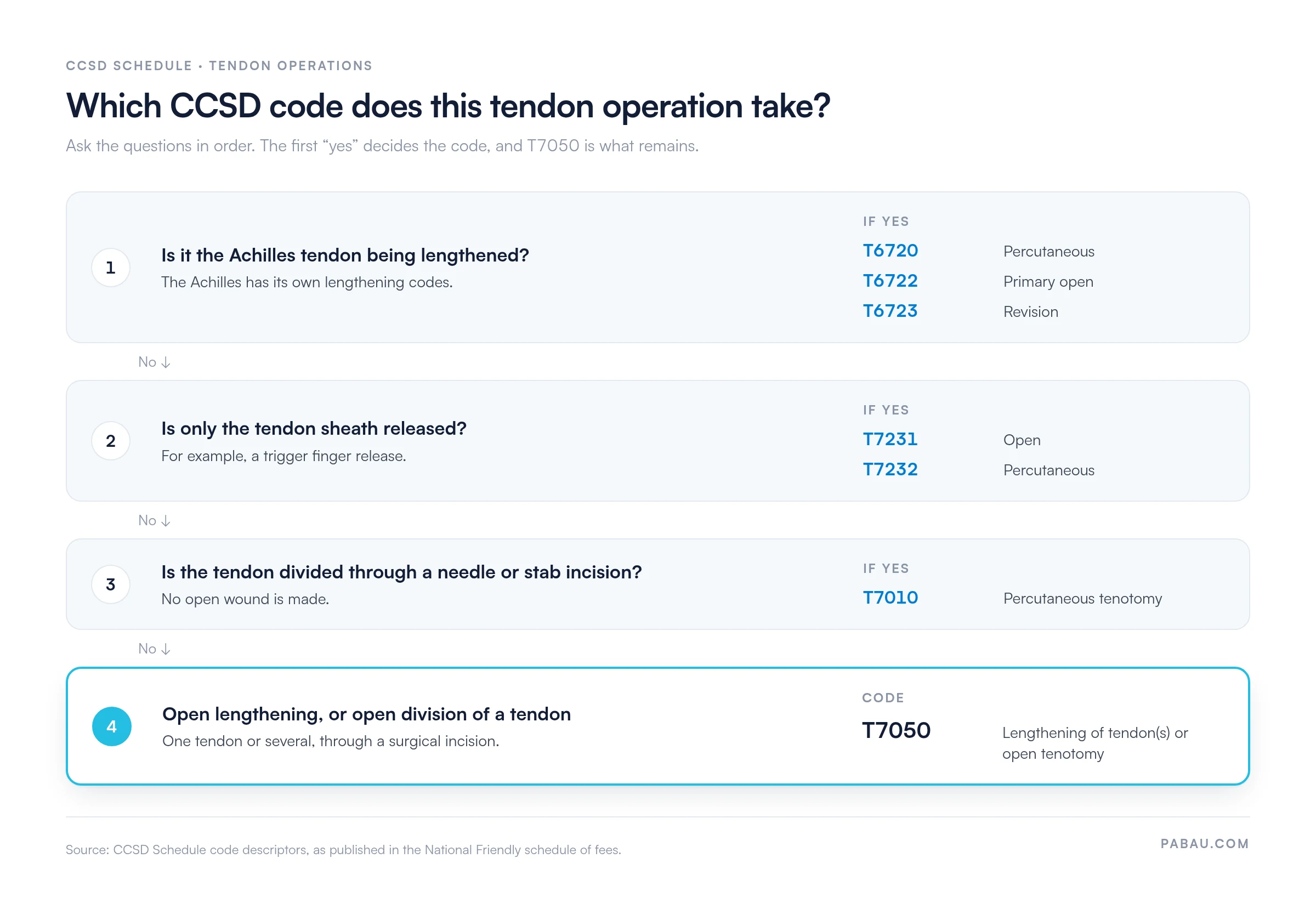
The table sets out each neighbouring code and how it differs from T7050.
CCSD lists unacceptable combinations for T7050, including the Achilles lengthening codes and T7010. Check the full list on the CCSD website before you add a second code. Then confirm the insurer’s own rules on multiple codes, because each insurer sets them in its contract.
A clean T7050 claim passes through five stages before it reaches the insurer. Each stage produces something the insurer checks when it assesses the invoice.
CCSD sets the codes, and each insurer sets its own fees against them. The National Friendly schedule of fees lists T7050 as Inter complexity with a £410 fee. It lists T7010, the percutaneous code, as Minor at £147. Bupa, AXA Health, Aviva, Vitality and WPA publish their own schedules, so check the patient’s insurer.
A consultant who charges more than the insurer pays leaves the patient with a shortfall. Tell the patient about it in writing before surgery. When comparing UK medical billing software, check that it holds each insurer’s fee against the CCSD code.
An authorisation confirms the insurer expects to cover the treatment under the patient’s policy. It is not a promise of payment, because the invoice still has to match the code, the notes and the policy limits. The clinical letter for a T7050 request should include the following.
If the plan changes, for example to an Achilles lengthening, ask the insurer to update the authorisation before you invoice. An authorisation issued for T7050 does not cover T6722. A percutaneous Achilles lengthening needs the same update, because it is billed under T6720.
Run this checklist before you submit any T7050 claim. A missing item usually means the insurer writes back for more information, which delays payment.
Pabau’s client records hold operative notes, authorisation numbers and diagnosis codes in one place. The billing team can build a T7050 claim without chasing paper files. Digital forms capture structured pre-operative information that feeds the same record.
Run the checklist above before every T7050 submission. If the operative note does not name the tendon and describe an open approach, ask the surgeon for an addendum first. Fixing the note before submission is quicker than answering an insurer’s query afterwards.
CCSD codes carry no modifiers. The schedule aims for a single code to describe a whole intervention, and T7050’s wording already covers more than one tendon. Insurers write their own contract rules on multiple codes, so contact the insurer before you invoice more than one.
Invoicing T7050 twice for one operation will usually be rejected as a duplicate. Under-coding a two-limb operation, on the other hand, can leave legitimate work unpaid. Agree the approach with the insurer in writing before surgery and keep that record on file.
T7050 claims are rejected for predictable, preventable reasons. The table maps each one to the action that fixes it.
Most rejections are fixed by correcting the data and resubmitting through Healthcode. When the insurer has applied its rules and you disagree, the route runs through the insurer first.
Keep a log of every rejected T7050 claim with the date and the reason. Reviewing it each week stops a fixable rejection from going stale.
Accurate T7050 billing depends on three things. You need the right code, complete documentation on the day of surgery and a claim that links diagnosis to procedure. Each one breaks down when the note, the authorisation and the invoice live in different systems.
Pabau keeps all three in one patient record. Its claims management software sends CCSD-coded claims to UK insurers through Healthcode and Bupa, then tracks each claim on one dashboard. The authorisation code, dates and sessions sit on the patient’s case, with a warning when one is missing.
For a fuller code reference, the Bupa CCSD codes guide explains how the schedule and insurer fees fit together.
Set up a T7050 billing checklist in your practice management system. Include the code, the common WHO ICD-10 pairings (M67.1, M62.4, G80.1) and the documentation list above. It cuts claim preparation time and makes a missing diagnosis code less likely.

Pabau helps UK private practices keep operative notes, authorisation references and ICD-10 codes together, then sends CCSD-coded claims to insurers through Healthcode.

T7050 is a narrow code. It pays for an open lengthening or open division of a tendon. It does not pay for the Achilles operations or the needle technique beside it. Most rejected T7050 claims come down to that boundary, not to the surgery.
So the claim rests on two lines in the operative note: which tendon, and whether the approach was open. Write them plainly, match the authorisation to them and check the insurer’s own fee. Book a demo to see how Pabau sends CCSD claims through Healthcode with the note beside each one.

Need a broader CCSD reference? Bupa CCSD codes guide explains how the CCSD Schedule and Bupa’s fees fit together.
Choosing billing software for a UK practice? The best medical billing software in the UK compares the options for insurer claims.
Want fewer avoidable rejections? Medical billing compliance covers the checks that keep claims clean.
CCSD code T7050 covers lengthening of one or more tendons, using techniques such as Z-plasty or a sliding lengthening. It also covers open tenotomy, which divides a tendon completely through an incision. A percutaneous (needle) tenotomy is coded T7010 instead.
Tendon lengthening cuts the tendon and repairs it at a greater length, so it stays in continuity. Open tenotomy divides the tendon completely to release a contracture. Both are open procedures under T7050, and the operative note must say which was done and name the tendon.
The descriptor reads “tendon(s)”, so one T7050 code covers one tendon or several. CCSD codes carry no modifiers, and each insurer sets its own rules on multiple codes. Contact the insurer before you add a second line, and name every tendon in the operative note.
UK private medical insurers such as Bupa, AXA Health, Aviva, Vitality and WPA expect pre-authorisation before planned surgery. An authorisation is not a promise of payment. Send the WHO ICD-10 code, the clinical letter and evidence of failed conservative treatment before the admission date.
The most common mix-up is billing T7050 for a percutaneous tenotomy, which is T7010. Achilles tendon lengthening has its own codes, T6720, T6722 and T6723. Trigger finger release is T7231 or T7232, and tendon transfer or graft is T6580.
The usual reasons are a missing authorisation, the wrong code (a percutaneous or Achilles procedure billed as T7050) and a missing or US-only diagnosis code. Others are a vague operative note and a second code that CCSD bundles with T7050. A checklist run before submission prevents most of them.





