

HCPCS Code Q4185: Cellesta flowable amnion billing guide
HCPCS Code Q4185: definition and official descriptor HCPCS Code Q4185 is the Lev...

Last Updated: Nov 20, 2026
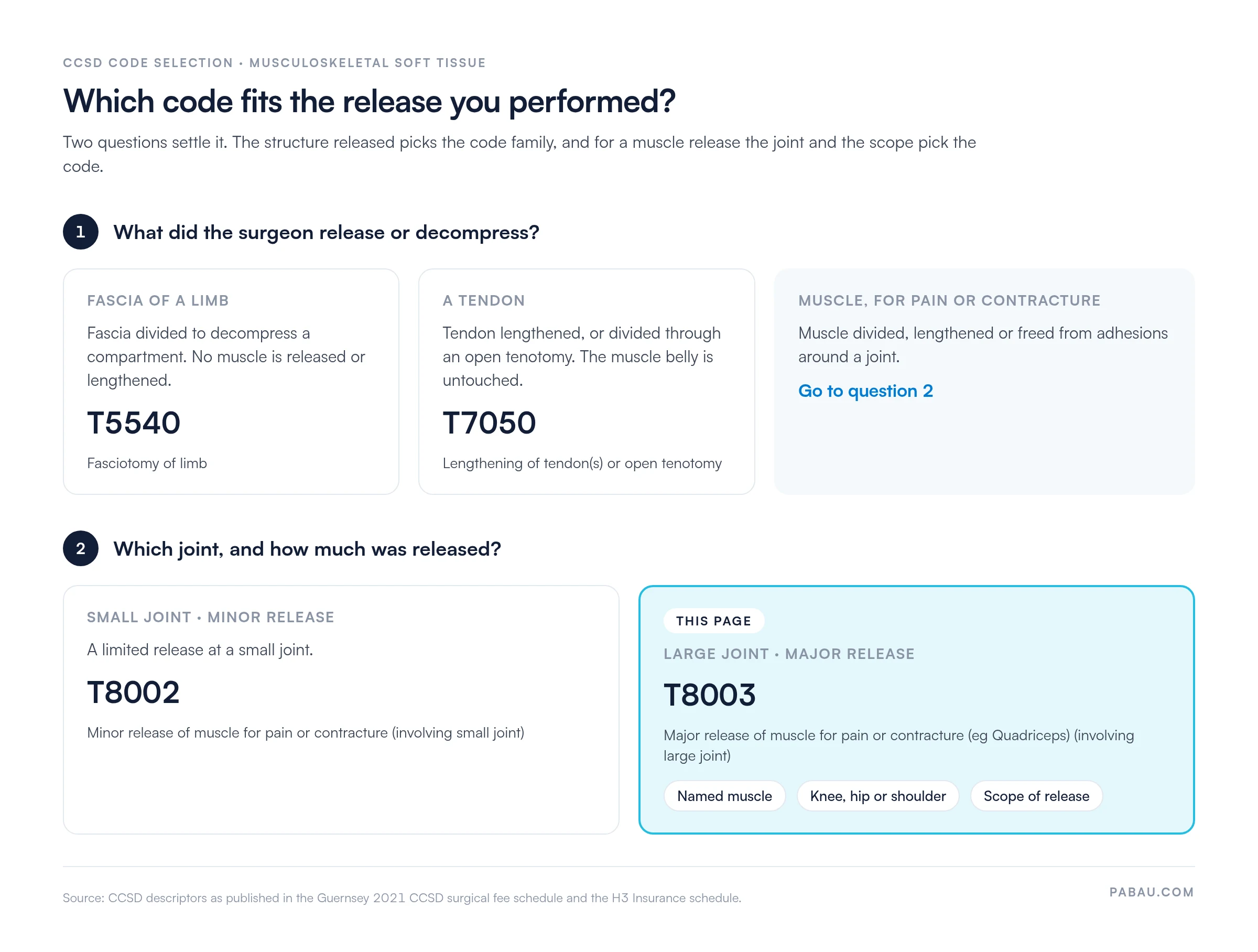
T8003 is the CCSD code for major release of muscle for pain or contracture (eg Quadriceps) (involving large joint). It covers surgery that divides, lengthens or frees a large muscle group around the knee, hip or shoulder after conservative treatment has failed.
A smaller release at a small joint is coded T8002 instead. The CCSD classifies T8003 as an intermediate procedure, and UK private insurers expect pre-authorisation before it. The operative note must name the muscle, the joint and the scope of the release.
Let Pabau's smart automation suggest the right codes, reduce claim denials, and keep your practice compliant—effortlessly.
Automate repetitive tasks and focus on what matters most—your patients.
Reduce coding errors and ensure compliance with the latest regulations.
Clean claims, fewer denials, and faster reimbursements.
Powerful insights and reporting to help your practice thrive.
HIPAA compliant SOC 2 certified GDPR-compliant Trusted by 4,000+ clinics worldwide

CCSD code T8003 covers a major release of muscle for pain or contracture at a large joint, with the quadriceps as the named example.
Its minor counterpart, T8002, covers a release at a small joint. Fasciotomy and tendon lengthening carry codes of their own.
Bupa, AXA Health and Aviva expect pre-authorisation before an elective release, so confirm the reference before the theatre date is booked.
The operative note decides the claim. It must name the muscle, the large joint, the laterality and how much was released.
Pabau, a practice management platform, attaches CCSD codes and pre-authorisation references to the booking, so the insurer invoice carries both.
CCSD Code T8003 is the billing code for a major release of muscle for pain or contracture involving a large joint, such as quadriceps release. The Guernsey 2021 CCSD fee schedule lists it under exactly that descriptor, directly after its minor counterpart, T8002. Two features set T8003 apart from its neighbours: a large muscle group and a large joint, such as the knee, hip or shoulder.
The schedule is maintained by the Clinical Coding and Schedule Development (CCSD) Group. T8003 sits in Chapter 16, Bones, Joints & Connective Tissue / Tendon Muscle, and the CCSD classifies it as an intermediate procedure. Our CCSD code index lists the rest of the chapter.
The descriptor contains three elements, and the operative note has to support all of them:
When any element is missing or unclear in the operative note, insurers will challenge or refuse the claim.
A major muscle release at a large joint divides, lengthens or partly detaches a large muscle group that has become contracted, fibrotic or painful. The goal is to restore a functional range of movement, or to relieve chronic pain that conservative management has not controlled.
For quadriceps release at the knee, the surgeon frees the quadriceps tendon or distal quadriceps muscle from its attachment or scar tissue. This is done through open dissection or arthroscopically, and may include dividing adhesions in the suprapatellar pouch. The release counts as “major” in coding terms because of its scale. A large muscle group is divided or substantially lengthened, not a small fascial band or minor tendinous attachment.
The distinction matters because insurers pay major and minor releases at different rates. On the H3 Insurance fee schedule, the surgeon fee is £369 for T8003 and £229 for T8002. If the operative note does not support the “major” classification, expect a downcode. Document every layer of tissue released, the technique used and the surgical approach.
T8003 is appropriate when a large muscle group has become pathologically shortened around a large joint and conservative treatment has failed to restore function. Major UK private insurers want documented evidence of that failure, typically at least six weeks of physiotherapy, before authorising surgical release. Keep the physiotherapy discharge notes with the pre-operative record, so the evidence travels with the request.
T8003 does not apply to minor tendon releases, fasciotomies for acute compartment syndrome, or small fascial band divisions that leave the large muscle group intact. Those procedures have their own CCSD codes, and billing them as T8003 is upcoding.
Choosing the correct code means knowing how T8003 differs from the codes around it. The table below summarises the codes most often confused with it, using each code’s official descriptor.
The most common coding error is selecting T8003 when the procedure was a fasciotomy or a tendon release. A tendon lengthening or open tenotomy is billed as T7050, and insurers audit for this mismatch against the operative note. The chart below turns the table into two questions a coder can answer from the note.
A T8003 claim succeeds or fails on the operative note, which must contain each element below before submission. A structured operative note template, with a required field for each element, stops a missing detail from triggering a denial.
Audit your operative note template before submitting the first T8003 claim of the year. Check that it has fields for laterality, named muscle, joint, surgical approach, scope, and pre- and post-release range of movement. A template without these fields invites avoidable queries.
Major UK private insurers treat T8003 as an elective surgical procedure that needs pre-authorisation before the operation. Proceeding without it typically means the insurer refuses to pay, even when the procedure is clinically appropriate and correctly coded. Requirements vary by insurer and policy year, so confirm the current position with the payer before booking the patient. The Bupa CCSD billing guide covers the broader pre-authorisation framework for Bupa-covered procedures.
When submitting a pre-authorisation request, include the code T8003 explicitly. Some insurer portals require the code at the time of the request, and leaving it off creates a mismatch when the invoice arrives. Confirm the authorisation reference number and keep it in the patient record.
CCSD Code T8003 can be billed alone, or alongside other musculoskeletal codes when the record shows each procedure was distinct and separately performed. Bundling rules are insurer-specific and change with annual CCSD schedule updates. Always check the payer’s current fee schedule, and treat the guidance below as general CCSD principles.
When you are unsure whether concurrent billing is accepted, get written pre-authorisation confirming both codes before the procedure. Retrospective unbundling disputes are slow, and rarely go the provider’s way without contemporaneous documentation.
The five denial triggers below are all documentation or process failures, and each one has a fix. None of them depends on whether the surgery was clinically justified.
Run a quarterly audit of T8003 claims and note which ones were queried or refused. Any claim missing a pre-authorisation reference or a named muscle should be corrected before first submission, not after a denial.
A denied T8003 claim can be appealed. UK private insurers run formal appeals processes, and a denial over missing documentation is often reversed once the evidence arrives.
Keep a log of every appeal submitted, the response received and the outcome. Repeated denials from one insurer usually trace back to one missing field, and a single template change fixes it for every later T8003 claim.
Orthopaedic and musculoskeletal practices billing T8003 often keep the code, the authorisation and the invoice in separate places. Each hand-off is a chance to drop the authorisation reference or the laterality. Claims management software keeps all three on one record from the moment the procedure is booked.
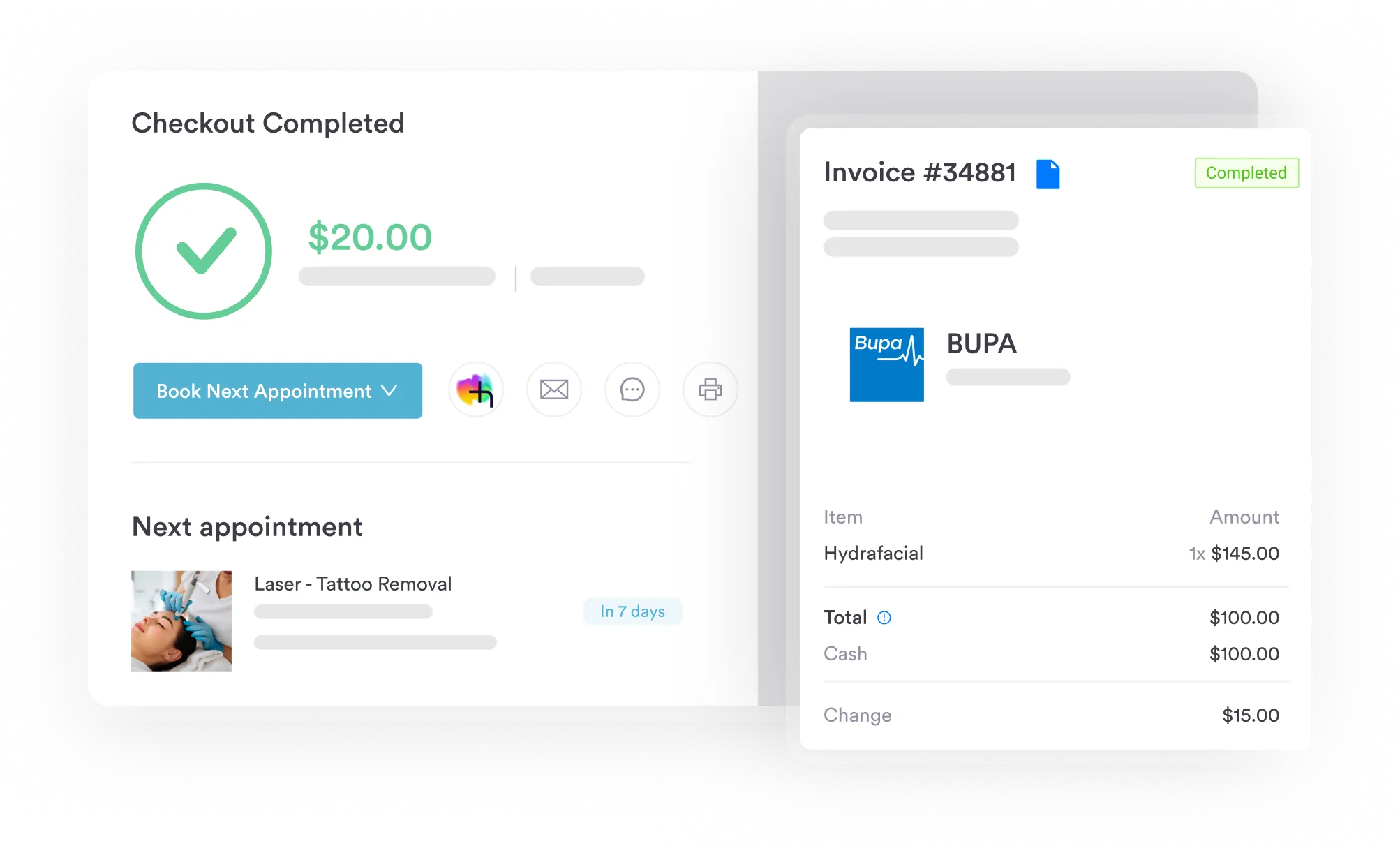
In Pabau, CCSD codes such as T8003 attach to the treatment record, and the pre-authorisation reference is saved against the booking. The insurer invoice is built from that record. It already carries the code and the approval reference the insurer needs to pay without a query.

Pabau attaches CCSD codes to the treatment record, tracks pre-authorisation, and sends UK claims through Healthcode. Your T8003 invoices reach the insurer complete.

T8003 pays when the operative note proves three facts: a named large muscle, a large joint, and a release of major scope. Write those into the note on the day of surgery, and confirm the authorisation reference before the theatre date is set.
The trade-off is a little more effort at the front end. A template with required fields adds a minute per case, and that costs far less than an appeal when an insurer queries the claim. Book a demo to see how Pabau carries the CCSD code and authorisation reference from booking to invoice.

Need help navigating Bupa CCSD codes? Bupa CCSD codes overview covers how Bupa structures its CCSD billing requirements and fee schedule.
Looking for the Bupa fee schedule for T-codes? Bupa procedure codes fee schedule sets out the tariff structure for private musculoskeletal procedures.
Coding a fascial release in the foot? CCSD code T5250 covers endoscopic plantar fascia release and how to document it for insurers.
CCSD Code T8003 covers a major release of muscle for pain or contracture involving a large joint, with quadriceps release as the named example. It applies when a large muscle group is divided or lengthened at the knee, hip or shoulder. The aim is to restore range of movement or relieve pain that conservative treatment has not resolved.
Any large muscle group whose release involves a large joint qualifies, provided the procedure meets the “major” threshold. The quadriceps femoris at the knee is the named example in the official descriptor. Iliopsoas, hip adductor, subscapularis and rotator cuff releases are anatomically consistent with the code. In every case, the operative note must confirm large-joint involvement and major-scope dissection.
Yes. Both Bupa and AXA Health require pre-authorisation before an elective surgical T-code procedure, including T8003. Proceeding without it typically results in non-payment, however clinically appropriate the surgery was. Requirements and portals vary by policy year, so confirm with the insurer before booking the surgical date.
T8002 is the minor counterpart. It covers a minor release of muscle for pain or contracture involving a small joint. T8003 is reserved for a major release at a large joint, such as the knee, hip or shoulder. Insurers check the distinction against the operative note, so a note describing a small band division invites a query or a downcode.
Billing concurrent procedures at the same site needs insurer-specific confirmation. Some payers allow T8003 alongside an arthroplasty code when the release is documented as a distinct additional step. Others treat the release as included in the main procedure. Get written pre-authorisation for both codes before the operation, rather than resolving the dispute afterwards.
Thin operative note detail is the leading cause. Typical failures are not naming the muscle released, not identifying the large joint, or not describing enough dissection to support the “major” classification. Missing pre-authorisation is the second most common reason. A structured operative note template and a pre-authorisation step in the booking workflow prevent both.





