

CCSD Code D1010: Radical mastoidectomy including meatoplasty
CCSD Code D1010: Definition and clinical scope CCSD Code D1010 is the UK private...

Last Updated: Nov 25, 2026
CCSD code T7972 is the UK private billing code for exploration and repair of groin disruption, better known as Gilmore's groin repair. It covers surgery on the torn muscle, fascia and tendons behind sportsman's groin, a cause of chronic groin pain in kicking and twisting sports. The CCSD schedule files it under section 11.9.0, Abdominal wall, and its note says the code includes the Lloyd release for groin strain.
It isn't a hernia repair code, and it isn't a cosmetic treatment. Insurers treat it as clinically indicated surgery, often after physiotherapy has failed. A clean claim depends on three things: the operative findings, the referral history and the authorisation reference.
Let Pabau's smart automation suggest the right codes, reduce claim denials, and keep your practice compliant—effortlessly.
Automate repetitive tasks and focus on what matters most—your patients.
Reduce coding errors and ensure compliance with the latest regulations.
Clean claims, fewer denials, and faster reimbursements.
Powerful insights and reporting to help your practice thrive.
HIPAA compliant SOC 2 certified GDPR-compliant Trusted by 4,000+ clinics worldwide

CCSD code T7972 covers exploration and repair of groin disruption, the operation known as Gilmore’s groin repair.
It’s clinically indicated abdominal wall surgery, filed under section 11.9.0 of the CCSD schedule, not a cosmetic treatment.
The schedule note says T7972 includes the Lloyd release for groin strain, so don’t add that release as a second procedure line.
A hernia repair has its own codes, so the operative note should describe the disruption that was repaired.
Confirm pre-authorisation and the fee on each insurer’s own portal before surgery, then quote the reference on the claim.
CCSD code T7972 pays the operating surgeon for exploring and repairing a groin disruption. The official descriptor reads “Exploration and repair of groin disruption (including repair of muscle, fascia and tendons) (Gilmore’s groin repair)”.
The Clinical Coding and Schedule Development (CCSD) Group publishes the CCSD schedule, the standard procedure codes for UK private healthcare. Four insurers sit on the group: Bupa, AXA Health, Aviva and Vitality.
T7972 sits in Chapter 11 of that schedule, under section 11.9.0 Abdominal wall. Its schedule note adds one more detail: the code includes the Lloyd release procedure for groin strain. NHS hospitals record the same operation with OPCS-4 instead. CCSD codes apply only to private billing, as the Bupa CCSD codes guide shows for one major insurer.
The full schedule sits behind a CCSD login. Check the current descriptor there, or on your insurer’s code search, before you bill. Our CCSD code guides explain other procedures in the schedule without a login.
Gilmore’s groin goes by several names. You’ll also see sportsman’s groin, athletic pubalgia, sports hernia and inguinal disruption. It’s named after Jerry Gilmore, the surgeon who first described it in 1980.
The typical patient is an athlete in a kicking or twisting sport, such as football. They report groin pain that builds with exertion and doesn’t settle with rest. On examination, there’s often no hernia to feel, which is what separates it from a standard hernia.
Physiotherapy and anti-inflammatory medication usually come first. Surgery enters the picture when that conservative route fails. A structured rehabilitation program then follows the repair, so the operation is one stage in a longer plan.
The descriptor names two stages, exploration and repair, and the note adds a third element. Here’s how they map to the theater record.
Surgeons don’t agree on where the weakness sits. Gilmore favored the external oblique aponeurosis and conjoint tendon, while others point to the transversalis fascia. That variation is why the operative note matters so much for this code.
Getting the bundle right prevents a common billing error. You either under-claim by leaving items off, or over-claim by splitting the procedure into parts.
Bundling rules differ between insurers. When you’re unsure, check the insurer’s fee schedule or the CCSD coding principles linked to the code.
The code most often confused with T7972 is an inguinal hernia repair. The patient presents with groin pain, and the incision lands in the same area. Yet the two operations treat different problems, and each one has its own CCSD codes.
Our guides to T2000 and T2002 cover the open and laparoscopic hernia repairs. If the findings sit on a boundary, pick the code whose descriptor matches the main procedure performed. Then confirm it with the insurer at pre-authorisation, before the operating list is set.
Insurers check claims against clinical records, and they can recover payment after an audit. For T7972, the note needs to show a disruption was found and repaired. A structured digital form helps, because it prompts for each required field at the point of care.

UK GDPR sets no fixed retention period for clinical records. The NHS Records Management Code of Practice keeps most adult records for eight years after treatment ends, and private practices often follow it. Confirm your own period with your indemnity provider.
T7972 is clinically indicated surgery, so authorisation turns on the clinical case. Insurers will want to know why conservative treatment hasn’t worked. They’ll also check the patient’s policy covers the operation.
Rules differ between insurers and between policies. Don’t assume one insurer’s answer applies to the next. Confirm pre-authorisation and the fee on each insurer’s own portal, before the operation is booked.
Treating without a required authorisation can result in claim rejection, and appeal routes vary by insurer. Record the reference number in the patient file as soon as you receive it.
Send the physiotherapy history with the pre-authorisation request. A clear record of failed conservative treatment answers the insurer’s first question before they ask it.
Each insurer sets its own fee for T7972 through its schedule or your recognition agreement. Those rates change, and they’re often only visible to recognized providers. Look the fee up on the insurer’s portal for each patient, using the links above.
Self-pay patients are different, because your practice sets the price. Even then, issue an itemized invoice that maps each line to its CCSD code. Our guide to the Bupa fee schedule explains how one insurer structures its fees.
Healthcode is the main electronic clearinghouse for UK private healthcare claims. Most major insurers receive claims through it. Here’s the walkthrough for a T7972 episode.
Healthcode confirms receipt electronically. After that, watch the remittance advice for rejection notices and act on them quickly. Dedicated claims software for practices can track each claim’s status for you.
A rejected claim comes back with a reason code. Fix that specific problem before you resubmit, because the same claim sent twice usually fails twice.
Take an illustrative patient, a 27-year-old amateur footballer. Groin pain has lasted five months, and a course of physiotherapy hasn’t helped. The surgeon finds no palpable hernia and recommends Gilmore’s groin repair.
Your team sends the referral letter and physiotherapy notes to the insurer and receives an authorisation reference. In theater, the surgeon repairs a torn external oblique aponeurosis and performs a Lloyd release. The note names both.
The claim carries one procedure line, T7972, with the reference attached. The anaesthetist and hospital bill separately. Because the findings, the code and the reference agree, the insurer has no reason to query it. The diagram below shows how those three records come together on the claim.
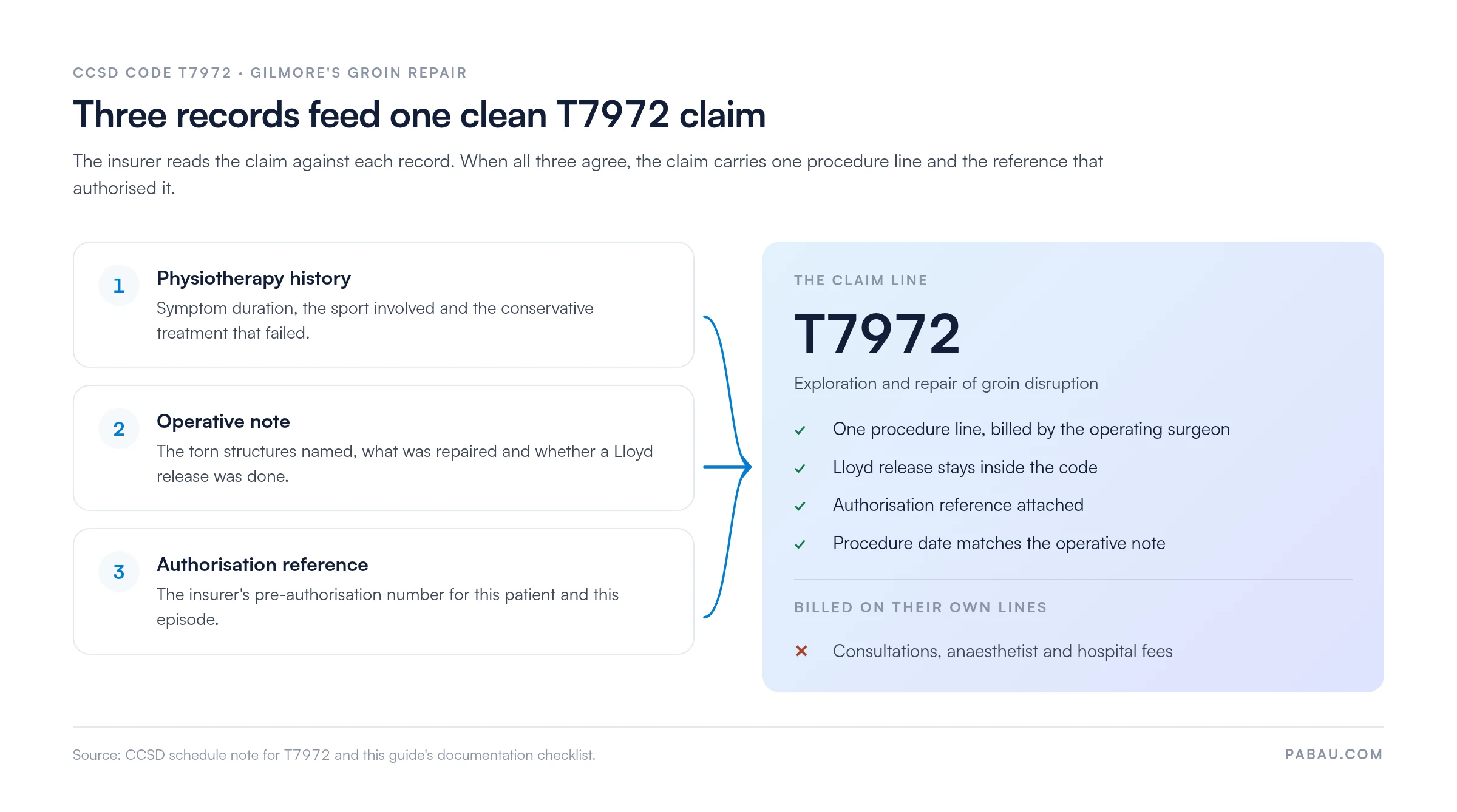
A T7972 claim draws on three records: the physiotherapy history, the operative note and the authorisation reference. When those sit in different systems, a payer query means a hunt across all three.
Pabau keeps all three on one patient record. Its claims tools pre-fill the claim from the invoice and check required fields, such as membership and authorisation numbers, before submission through Healthcode. The authorisation code stays attached to the case.
So when a payer queries a T7972 claim, your team answers from one record. Nobody has to chase the physio letter or the theater note across systems.

Pabau pre-fills each claim from the invoice, keeps the authorisation reference with the case and checks required fields before submission.

T7972 rewards precision. It names a specific injury and a specific repair, and it already contains the Lloyd release. Most rejected claims trace back to a note that blurs those lines, or to a missing authorisation.
So treat the operative note as part of the claim. If it names the torn structures, and the reference belongs to this episode, the code stands on its own record.
Book a demo to see how Pabau keeps the claim, the authorisation reference and the operative note on one record.

Need the wider Bupa view of the CCSD schedule? Bupa CCSD codes covers the full Bupa schedule with billing rules and payer guidance.
Was it a hernia after all? CCSD code T2000 sets out how open inguinal hernia repair is coded and claimed.
Repairing the hernia laparoscopically? CCSD code T2002 covers laparoscopic inguinal hernia repair claims.
Coding another abdominal wall procedure? CCSD code T2200 explains billing for primary repair of a femoral hernia.
Checking what a procedure is worth under Bupa? Bupa procedure codes and fee schedule explains where to verify a current rate.
Yes, the terms usually describe the same condition. Sports hernia, sportsman’s groin and athletic pubalgia are common alternatives. Despite the name, there’s often no true hernia, which is why T7972 is coded separately from hernia repair.
No. CCSD codes are for UK private medical insurance billing. NHS hospitals record the same operation using OPCS-4 procedure codes.
No. The CCSD schedule note states that T7972 includes the Lloyd release procedure for groin strain. Billing it as an extra line risks a rejected or reduced claim.
The operating surgeon bills T7972 for the procedure. The anaesthetist and the hospital bill their own fees separately, under their own codes.




