CPT code 56606: Vulvar biopsy additional lesion billing guide
CPT code 56606: Official descriptor and add-on code classification CPT code 5660...

Last Updated: Nov 26, 2026
S5562 is the CCSD code for release of burn scar contracture on the trunk and limbs. It covers surgery that cuts or removes tight post-burn scar on the chest, abdomen, back, arms or legs to restore movement.
The code sits in sub-chapter 15.3.0, burns, scars and contractures, of the CCSD schedule used by UK private medical insurers. Contractures of the head, neck, hands, feet and genitalia are billed as S5560 instead.
Let Pabau's smart automation suggest the right codes, reduce claim denials, and keep your practice compliant—effortlessly.
Automate repetitive tasks and focus on what matters most—your patients.
Reduce coding errors and ensure compliance with the latest regulations.
Clean claims, fewer denials, and faster reimbursements.
Powerful insights and reporting to help your practice thrive.
HIPAA compliant SOC 2 certified GDPR-compliant Trusted by 4,000+ clinics worldwide

CCSD code S5562 covers release of burn scar contracture on the trunk and limbs, in sub-chapter 15.3.0 of the schedule UK private insurers use.
Hands and feet sit on the limbs, but their contractures go to S5560, along with the head, neck and genitalia.
Pair L90.5 with the T95.1, T95.2 or T95.3 sequela code that matches the burn site, and add M62.4 only for documented muscle contracture.
Bupa, AXA Health and Aviva usually want planned surgery authorized first. The note must also record the movement the scar restricts.
Pabau, a practice management platform, sends the claim through Healthcode with the authorization reference and diagnoses attached.
CCSD code S5562 is the code UK private medical insurers use for release of burn scar contracture on the trunk and limbs. The CCSD Group lists it as “Release of burn scar contracture, trunk & limbs” in sub-chapter 15.3.0, burns, scars and contractures.
The operation frees scar that has tightened after a burn and now limits movement. The surgeon cuts or removes the contracted band, releases the joint or skin segment, then closes the defect. Common trunk and limb sites include the armpit, the inside of the elbow, the chest wall and the back of the knee.
The CCSD Group updates its schedule over time, so check the edition your insurer works from. The CCSD Group website holds the current schedule for registered users. Pabau’s CCSD code index lists the other procedure codes we cover.
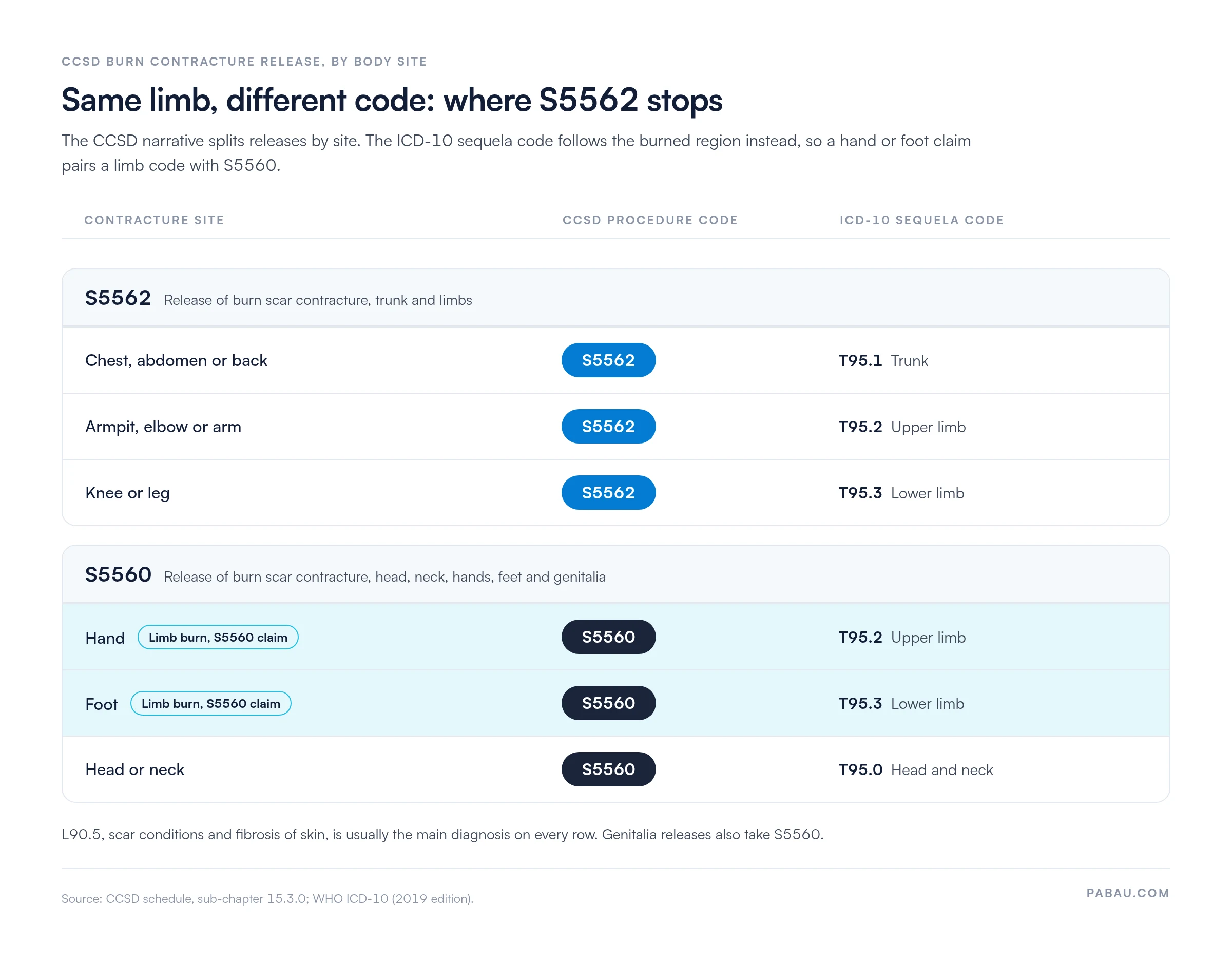
The CCSD schedule codes a burn contracture release by where the scar sits, not by its size. S5562 takes the trunk and limbs. S5560 takes the head, neck, hands, feet and genitalia.
That split catches coders out on the limbs. A contracture across the palm or the top of the foot sits on a limb, but the narrative sends it to S5560. The note has to name the site precisely, so the coder can tell a wrist release from a hand release.
The ICD-10 sequela code follows a different map, which is why hand and foot claims pair a limb diagnosis with S5560.
Narratives come from the CCSD schedule’s 15.3.0 sub-chapter. If one session combines a release with an excision or a graft, check the insurer’s combination rules before both codes go on the claim.
Burn excisions follow the same site split. On the head, neck, hands, feet and genitalia they run from S5520 for up to 9cm² to S5523 for over 25cm².
The technique depends on the depth, extent and site of the scar. The closure method matters most for coding, because it decides whether a second code may apply. The usual sequence runs as follows:
If the wound closes directly, S5562 may be the only procedure code. If a graft or flap closes the defect, a separate code may apply. The note then has to show why direct closure wasn’t possible.
A claim for S5562 is only as strong as the operation note behind it. Most UK private medical insurance policies exclude cosmetic treatment. The note therefore has to make the functional case in measurable terms.
Measure the range of motion before surgery and again at the end of the release, and put both figures in the note. That pair of numbers answers the insurer’s functional question in one line, before anyone asks whether the operation was cosmetic.
UK private claims carry diagnoses from the World Health Organization’s ICD-10 classification. For a burn contracture, the diagnoses usually name the scar condition and its burn origin. Each code below matches the WHO ICD-10 tabular list.
ICD-10 codes the residual condition as the main diagnosis, with the T95 sequela code added to show its burn origin. Add M62.4 only when the operation note documents muscle involvement.
Two pairings need care. T95.0 covers the sequelae of a head and neck burn, so it matches S5560, not S5562. T95.2 and T95.3 also include the hand and the foot. A matching T95 code doesn’t turn a hand or foot release into an S5562 claim.
The work starts before the operation. Most insurers want planned surgery approved in advance, and the patient’s policy decides what is covered. Treat the table below as a starting point, and confirm each detail with the payer before the procedure date.
Once the operation is done, the claim follows the same steps whichever insurer pays it.
It can be, depending on the insurer. When the release leaves a defect too large to close directly, the graft or flap that closes it carries its own CCSD code. A split skin graft of up to 25cm² on the trunk or a limb, for example, is coded as S3500. Flaps have their own section, 15.4.1, which also holds free functioning muscle transfer under flap code T7620.
If the wound closed directly, S5562 stands alone, and a graft code reads as unbundling.
Before the graft code goes on the claim, check that the operation note records five details:
Each insurer applies its own combination rules when a release and a graft fall in one session. Bupa’s procedure code search shows how Bupa lists each code and its fee.
Burn contractures often affect both sides, such as both armpits after a chest burn. Record each site and side as a separate entry in the note, with its own findings and range of motion.
How a second side or a second site is paid depends on each insurer’s rules, not on the S5562 narrative. Ask the payer how it wants bilateral work coded before the operation, and keep the answer on file.
Most refused contracture claims trace back to six avoidable slips, and each one can be caught before the claim leaves the practice.
If a claim is still refused, check the insurer’s current provider manual for its appeal process. Our guide to Bupa CCSD codes explains how Bupa’s procedure list and claim process work.
In many plastic surgery practices, the authorization sits in an email and the operation note lives in another system. The claim is then keyed in by hand. Every handoff is a chance to lose the reference number or code the wrong site.
Pabau keeps those steps on one patient record. Its claims software for insurers sends claims electronically through Healthcode and to Bupa. The authorization code, dates and sessions sit on the patient’s case, with a warning when one is missing.
Your surgeons record site, side, range of motion and closure in one structured note. The coder reads S5562 or S5560 straight from it, so fewer claims come back with a site query.

Pabau links the operation note, the insurer authorization and the Healthcode claim on one patient record. Book a demo to see how your S5562 claims leave the practice complete.

S5562 is easy to define and easy to misapply, because hand and foot releases sit on a limb yet belong to S5560. The coder can only make that call from a note that names the site.
Agree on a standard operation note with your surgeons, with site, range of motion and closure in fixed fields. Then check each insurer’s current fee and combination rules before the claim leaves. Book a demo to see how Pabau tracks authorizations and sends your Healthcode claims from one patient record.

Billing Bupa for reconstructive surgery? Bupa CCSD codes explains how Bupa’s procedure list, fees and claim process work.
Looking for another procedure code? Pabau’s CCSD codes index lists every CCSD code we cover, chapter by chapter.
Excising a burn scar on the hand or foot? CCSD code S5520 covers burn wound and scar excision up to 9cm² on the head, neck, hands, feet and genitalia.
CCSD code S5562 covers release of burn scar contracture on the trunk and limbs. UK private medical insurers use it when tight post-burn scar on the chest, abdomen, back, arms or legs limits movement. Contractures of the head, neck, hands, feet and genitalia are billed as S5560.
Usually, yes. Bupa, AXA Health and Aviva generally expect planned surgery to be authorized before the operation, and the reference goes on the claim. Cover depends on the patient’s policy, so confirm it with the insurer before the procedure date.
L90.5, scar conditions and fibrosis of skin, is usually the main diagnosis. Add T95.1, T95.2 or T95.3 to show that a burn of the trunk, upper limb or lower limb caused the scar. Add M62.4, contracture of muscle, only when the note documents muscle involvement.
Both codes cover release of burn scar contracture, split by body site. S5562 covers the trunk and limbs. S5560 covers the head, neck, hands, feet and genitalia, so a hand or foot release goes to S5560.
It can be, when the release leaves a defect too large to close directly. The operation note must show why direct closure wasn’t possible, plus the graft type, size and donor site. Each insurer applies its own rules to combined procedures, so check the payer’s schedule first.
The operation note should record the functional limit, ideally as a measured range of motion, plus the exact site and side. It should also cover the release technique, the closure method and the aftercare plan. A note that reads as cosmetic invites a query, because insurers fund functional treatment.