HCPCS Code Q4175: Billing, coverage, and documentation guide
HCPCS Code Q4175: Code Description and Product Identity HCPCS Code Q4175 is the ...

Last Updated: Nov 20, 2026
S5523 is the CCSD code for burn excision (wound or scar) of the head, neck, hands, feet and genitalia, greater than 25cm². It covers surgical excision of an acute burn wound or a mature burn scar at those sites.
The code sits in section 15.3.0, burns, scars and contractures, of the CCSD schedule used by UK private medical insurers. Smaller areas at the same sites are billed as S5520 (up to 9cm²) or S5522 (9cm² to 25cm²).
Let Pabau's smart automation suggest the right codes, reduce claim denials, and keep your practice compliant—effortlessly.
Automate repetitive tasks and focus on what matters most—your patients.
Reduce coding errors and ensure compliance with the latest regulations.
Clean claims, fewer denials, and faster reimbursements.
Powerful insights and reporting to help your practice thrive.
HIPAA compliant SOC 2 certified GDPR-compliant Trusted by 4,000+ clinics worldwide

CCSD code S5523 covers burn excision (wound or scar) of the head, neck, hands, feet or genitalia when the excised area is greater than 25cm².
The series has three bands: S5520 up to 9cm², S5522 for 9cm² to 25cm², and S5523 above 25cm². There is no S5521.
Burns on the trunk and limbs use S5524 to S5526, which are banded by percentage of body area rather than square centimeters.
UK claims pair S5523 with a WHO ICD-10 diagnosis, such as T20.3 for a full-thickness head burn or L90.5 for a mature scar.
Insurers such as Bupa and AXA Health usually need pre-authorization for planned surgery, and claims go through Healthcode or direct to the insurer.
CCSD code S5523 is the UK private insurance code for burn excision of the head, neck, hands, feet and genitalia, greater than 25cm². Insurer schedules such as National Friendly’s CCSD-based fee schedule list it under that narrative as a Major procedure.
The code covers two kinds of operation. Burn wound excision removes acutely burned, necrotic tissue down to a viable bed. Burn scar excision removes mature scar that formed after the burn healed. Both qualify when the site is on the list and the excised area is greater than 25cm².
Those five sites are grouped because a burn there costs the patient the most function. Hands lose grip, a neck scar limits movement, and a facial burn sits close to the airway and the eyes.
The CCSD Group updates its schedule over time, so check the edition your insurer works from. Our index of CCSD codes links to every other CCSD code guide we publish.
Burn excision on the head, neck, hands, feet and genitalia runs in three size bands. The measured area is all that separates them. The series skips a number. There is no CCSD code S5521, so a claim carrying it will be rejected as an invalid code.
Code from the documented measurement, never from the surgeon’s impression of the wound. An area of exactly 25cm² falls in S5522, because S5523 starts above it. The smallest band has its own guide, CCSD code S5520.
The jump to S5523 matters more than the extra centimeters suggest. In National Friendly’s schedule it moves the operation from the Intermediate to the Major band, with a higher listed fee. An undermeasured wound billed as S5522 leaves that difference unclaimed.
Outside the five listed sites, CCSD measures burns differently. The trunk and limb codes are banded by percentage of body area, not by square centimeters.
For an excision on the trunk or limbs, start with CCSD code S5524 and move up the bands by body area. A graft that closes the excised bed is a separate procedure with its own codes. A full-thickness graft to the head, neck, hands or genitalia, for example, starts with S3624 (up to 9cm²), with S3625 added for each further 16cm². On the trunk and limbs, the full-thickness series starts at S3622 (up to 9cm²), with S3623 added for each further 25cm².
The decision path below runs these checks in the order a coder makes them, from procedure to site to area.
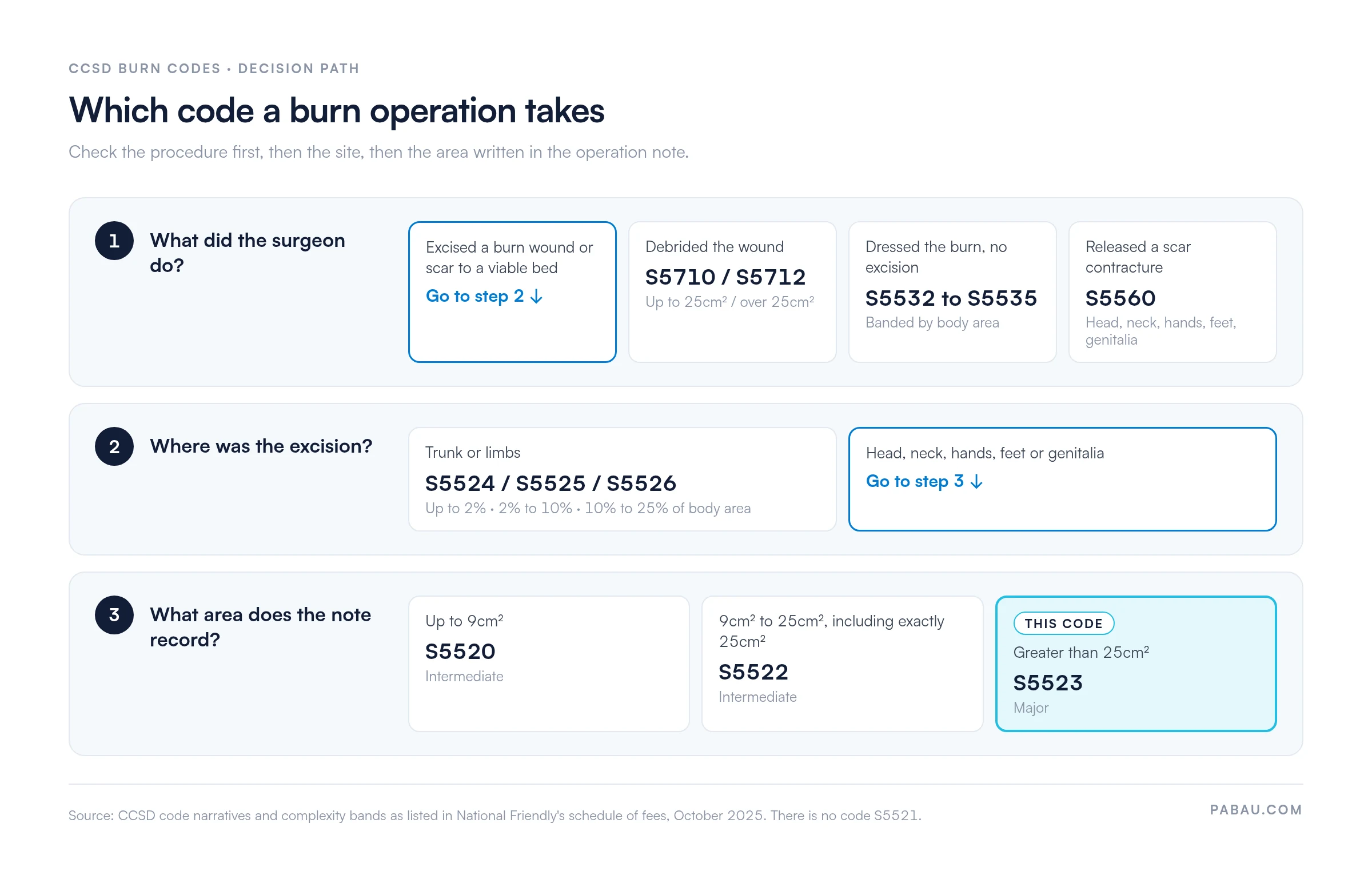
Debridement and excision are separate procedures with separate codes. Coding one when the note describes the other is a common reason an insurer queries a burns claim.
If the note says “debridement” but describes excision to fascia and a bed prepared for grafting, ask the surgeon to clarify before you code. The claim has to match the note, so any correction starts with the surgeon. Debridement of a wound over 25cm² has its own guide, CCSD code S5712. A burn that was dressed without excision is coded from the dressing series, which tops out at S5535 for more than 25% of body area.
A claim for S5523 is only as strong as the operation note behind it. The insurer needs to see both conditions of the code, the site and an area above 25cm², in writing.
Length × breadth in centimeters is the most common method. For an irregular wound, planimetry traces the outline and calculates the area from it, which is more accurate. Whichever method the surgeon uses, the note should name it beside the figure.
When the area sits close to 25cm², the intraoperative measurement takes precedence over the pre-operative estimate. Record both and explain any difference. If several wounds were excised, ask the insurer how it wants them coded before you add areas together.
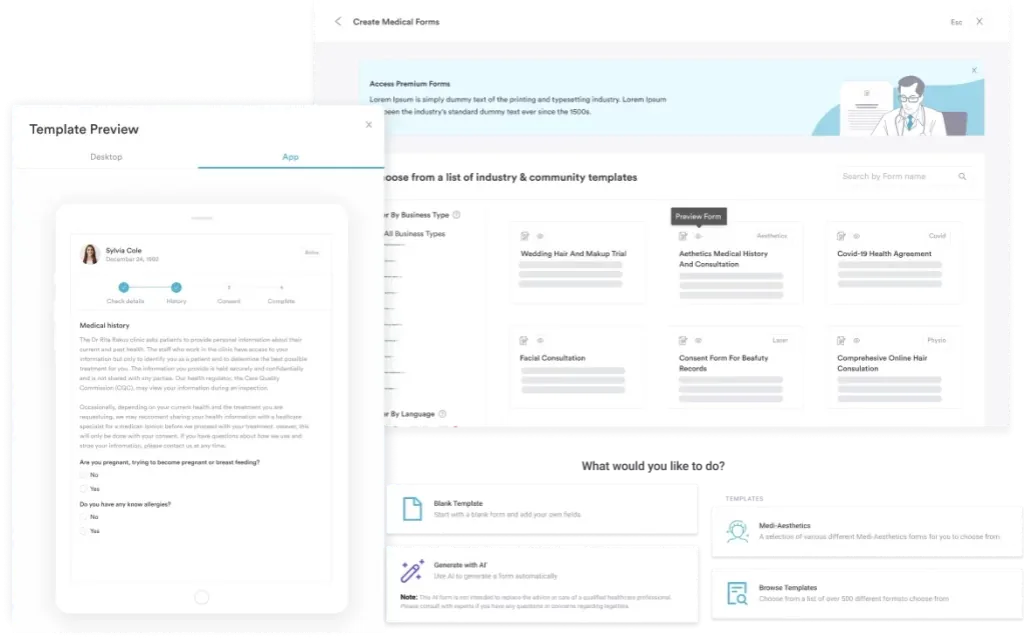
Agree a standard procedure title with your burns and plastic surgeons, such as “Burn excision, left hand, 32cm2, to fascia”. When the title carries the site and the area, the person coding the claim can pick the band in seconds.
UK insurers that ask for a diagnosis expect a WHO ICD-10 code beside the CCSD procedure code. Burn codes are structured by site and depth, so the diagnosis has to match both the site in the note and the burn degree.
For scar excision, L90.5 is usually the main diagnosis. Some insurers also accept the original burn code as a secondary diagnosis to show the history. Check the insurer’s preference before you submit, and keep the burn degree consistent with the clinical record.
The work starts before the operation. Most UK insurers want planned surgery approved in advance, and the patient’s policy decides what is covered.
The table below is a starting point, so confirm each detail with the payer before the procedure date.
Once the operation is done, the claim follows the same five steps whichever insurer pays it.
The anesthetist bills separately for the same operation, against the same authorization. The CCSD technical guide (PDF) sets out the rules on multiple codes and unacceptable combinations. Our guide to Bupa CCSD codes explains how Bupa’s procedure list and claim process work.
Most queried burn excision claims trace back to one of seven slips, and each has a simple fix.
If a claim is still refused, check the insurer’s current provider manual for its appeal process. Only commit to a deadline you have confirmed there.
In many plastic and burns practices, the authorization sits in an email and the operation note in another system. Then someone keys the claim in by hand. Each handoff is a chance to lose the reference number or bill the wrong size band.
Pabau keeps those steps on the patient record. Its claims management software sends claims electronically through Healthcode and to Bupa. The authorization code, dates and sessions sit on the patient’s case, with a warning when one is missing.
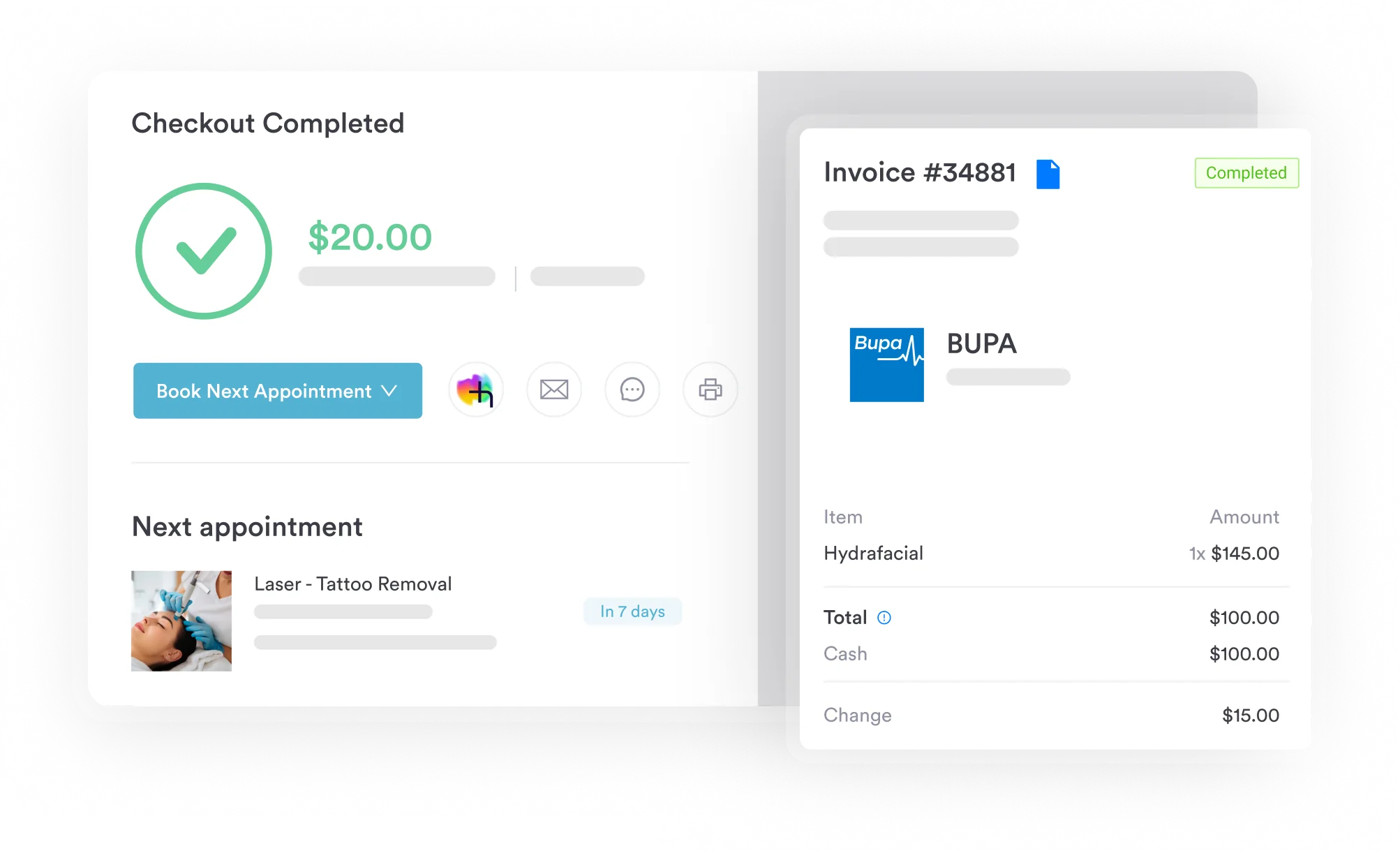
The result is fewer claims bounced for a missing reference or an unsupported band. You also get a clear view of what each insurer still owes, so your team spends less time on rework.

Pabau keeps authorization codes and operation notes on the patient’s case and sends claims electronically through Healthcode and to Bupa. You see each claim’s status without phoning the insurer.

S5523 is a two-condition code. The site has to be on the list and the excised area has to be above 25cm², and the note has to prove both. When either is vague, the claim drops a band or stalls in a query.
Build the measurement into your operation-note template and check each insurer’s current fee before you invoice. Those two habits remove most of the queries that slow burn excision payments. Book a demo to see how Pabau tracks authorizations and sends your Healthcode claims from one patient record.

Billing a smaller excision? CCSD code S5520 covers burn excision on the same sites up to 9cm².
Excising a burn on the trunk or a limb? CCSD code S5524 explains the body-area bands that replace square centimeters there.
Need a full Bupa CCSD billing reference? Bupa CCSD codes covers Bupa’s procedure list and how its claims work.
Checking Bupa fees before you invoice? Bupa procedure codes and fee schedule walks through Bupa’s recognized codes and fee tiers.
CCSD code S5523 covers burn excision (wound or scar) of the head, neck, hands, feet or genitalia, where the excised area is greater than 25cm². The site and the area both have to be documented in the operation note. Burns on the trunk or limbs use S5524 to S5526 instead.
No. The burn excision series for the head, neck, hands, feet and genitalia skips S5521. The bands are S5520 up to 9cm², S5522 for 9cm² to 25cm², and S5523 above 25cm².
The excised area must be greater than 25cm², so a wound of exactly 25cm² is billed as S5522. Record the area as a number in the operation note, measured by length × breadth or planimetry.
Excision removes burned or scarred tissue down to a viable bed, usually ready for a graft, and is coded S5520 to S5523 on these sites. Debridement cleans necrotic or infected tissue and is coded S5710 or S5712. The wording of the operation note decides which applies.
Use the WHO ICD-10 burn code that matches the site and depth. That is T20 for head and neck, T23 for hands, T25 for feet and T21 for genitalia. For a mature scar, L90.5 (scar conditions and fibrosis of skin) is usually the main diagnosis.
Most UK private insurers, including Bupa and AXA Health, usually want planned surgery pre-authorized. Get the reference number before the operation date and put it on the claim. Cover still depends on the patient’s policy, so confirm it with the insurer first.
The usual causes are a missing area figure in the note, a missing authorization reference and a diagnosis that does not match the site. Billing debridement as excision, or using S5523 on the trunk or a limb, causes queries too. A pre-submission checklist catches most of them.