CCSD code F3070: Suture of palate billing guide
CCSD code F3070 covers stitching a wound in the palate CCSD code F3070 is the co...

Last Updated: Oct 12, 2026
E2140 is the CCSD code for reconstruction using stomach pull up following pharyngolaryngectomy. The surgeon bills it when the stomach is used to rebuild the swallowing passage after the larynx and pharynx are removed. It sits in Chapter 5, Ear, nose and throat, under Section 5.7.0 Larynx and Trachea.
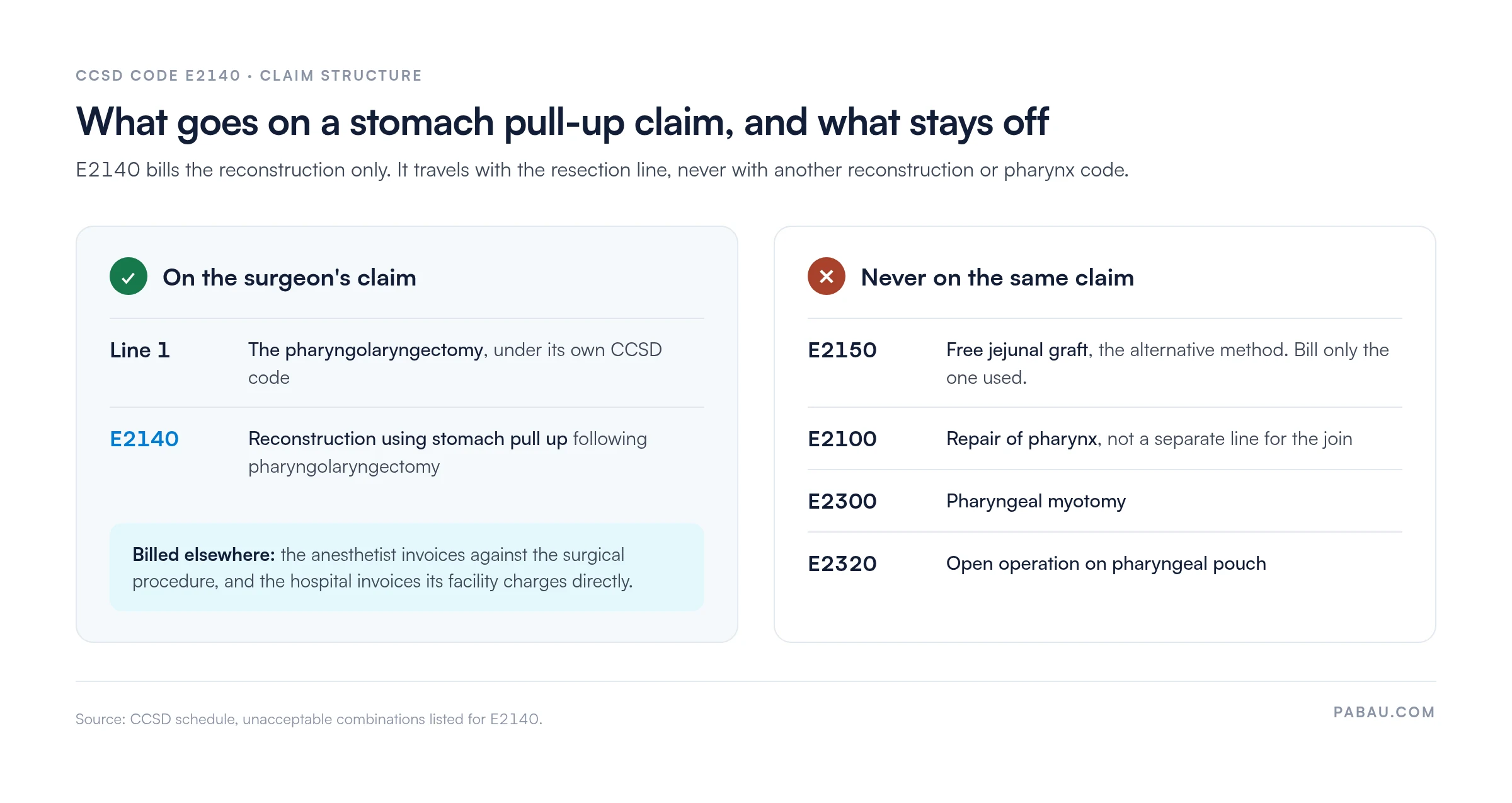
E2140 covers the reconstruction only. The pharyngolaryngectomy goes on the claim as its own line, and a free jejunal graft takes E2150 instead. Anesthesia is invoiced separately, with the anesthetist billing against the surgical procedure.
Let Pabau's smart automation suggest the right codes, reduce claim denials, and keep your practice compliant—effortlessly.
Automate repetitive tasks and focus on what matters most—your patients.
Reduce coding errors and ensure compliance with the latest regulations.
Clean claims, fewer denials, and faster reimbursements.
Powerful insights and reporting to help your practice thrive.
HIPAA compliant SOC 2 certified GDPR-compliant Trusted by 4,000+ clinics worldwide

CCSD code E2140 covers reconstruction using a stomach pull-up after pharyngolaryngectomy. It is a surgical ENT code, not an anesthesia code.
The pharyngolaryngectomy is billed as its own line, and E2140 sits beside it for the reconstruction.
The CCSD lists E2150, E2100, E2300 and E2320 as unacceptable combinations with E2140.
The surgeon’s operative note must name the stomach pull-up and tie it to the resection done in the same operation.
Pre-authorization should list both the resection and the reconstruction before the operation date.
CCSD code E2140 is the procedure code for reconstruction using stomach pull up following pharyngolaryngectomy. The CCSD schedule places it in Chapter 5, Ear, nose and throat.
Within that chapter, it sits under Section 5.7.0 Larynx and Trachea. UK private medical insurers (PMIs) pay specialist fees against this schedule. Our index of CCSD codes lists the other procedures it covers.
The code describes one step of a larger operation. First, the surgeon removes the larynx and pharynx. Then the swallowing passage is rebuilt using the stomach, and E2140 bills that rebuild. The resection itself goes on the claim under its own code.
A stomach pull-up, also called a gastric pull-up or gastric transposition, replaces the removed throat segment with the patient’s own stomach.
The surgeon frees the stomach from its abdominal attachments while keeping its blood supply intact. The stomach is then drawn up through the chest and joined to the remaining pharynx in the neck. Surgeons usually choose this method when the esophagus is removed along with the larynx and pharynx.
Because the operation spans the neck, chest and abdomen, two surgical teams often share it. In that case, each surgeon should record which part they performed.
Scope decides which lines go on the claim, so check it before you code. The diagram below sorts each line onto the surgeon’s claim, another invoice, or off the claim entirely.
An E2140 claim always travels with the resection line. Here is the path it takes from booking to payment.
Healthcode is the main electronic billing route to UK insurers. A claim that reaches it with both lines and a matching authorization has the fewest reasons to stall.
Picture a patient with cancer of the postcricoid region, coded C13.0. The surgeon removes the larynx, pharynx and esophagus, then rebuilds the passage with a stomach pull-up.
The finished claim looks like this:
Now suppose a second team mobilized the stomach through the abdomen. Each surgeon’s note then names their own part. Before you submit, ask the insurer how it wants the shared work invoiced.
The CCSD lists four codes as unacceptable combinations with E2140. Each looks plausible on a long throat operation, so check them before you submit.
Always confirm descriptors in the schedule edition in force on the date of surgery. Insurers check the claim against that edition.
The surgeon’s operative note carries the claim. Insurer reviewers compare it with the descriptor, so it should use the same words.
Write the note so a reviewer who never met the patient can match each claim line to a paragraph.
Before you send the invoice, read the operative note next to the E2140 descriptor. If it doesn’t name both the pharyngolaryngectomy and the stomach pull-up, fix the note first.
UK insurers generally expect pre-authorization before planned inpatient surgery. For E2140, the authorization needs to cover the reconstruction as well as the resection.
Rules differ by insurer and policy, so check each one directly.
Ask for the authorization reference in writing. If it names only the resection, ask the insurer to add E2140 before the operation date.
E2140 claims usually stall on the lines around the code. The table pairs each common problem with its fix.
Run through these checks before the invoice leaves the practice.
Keying a two-line surgical claim by hand means retyping codes, references and policy numbers for every insurer. Each retyped line is another chance for E2140 to go out without its resection code.
In Pabau, the practice software we build, billers send claims through the Healthcode integration. Its claims management software puts E2140 and the resection code on one invoice and sends it electronically. The operative note sits in the same patient record, ready if the insurer raises a query.
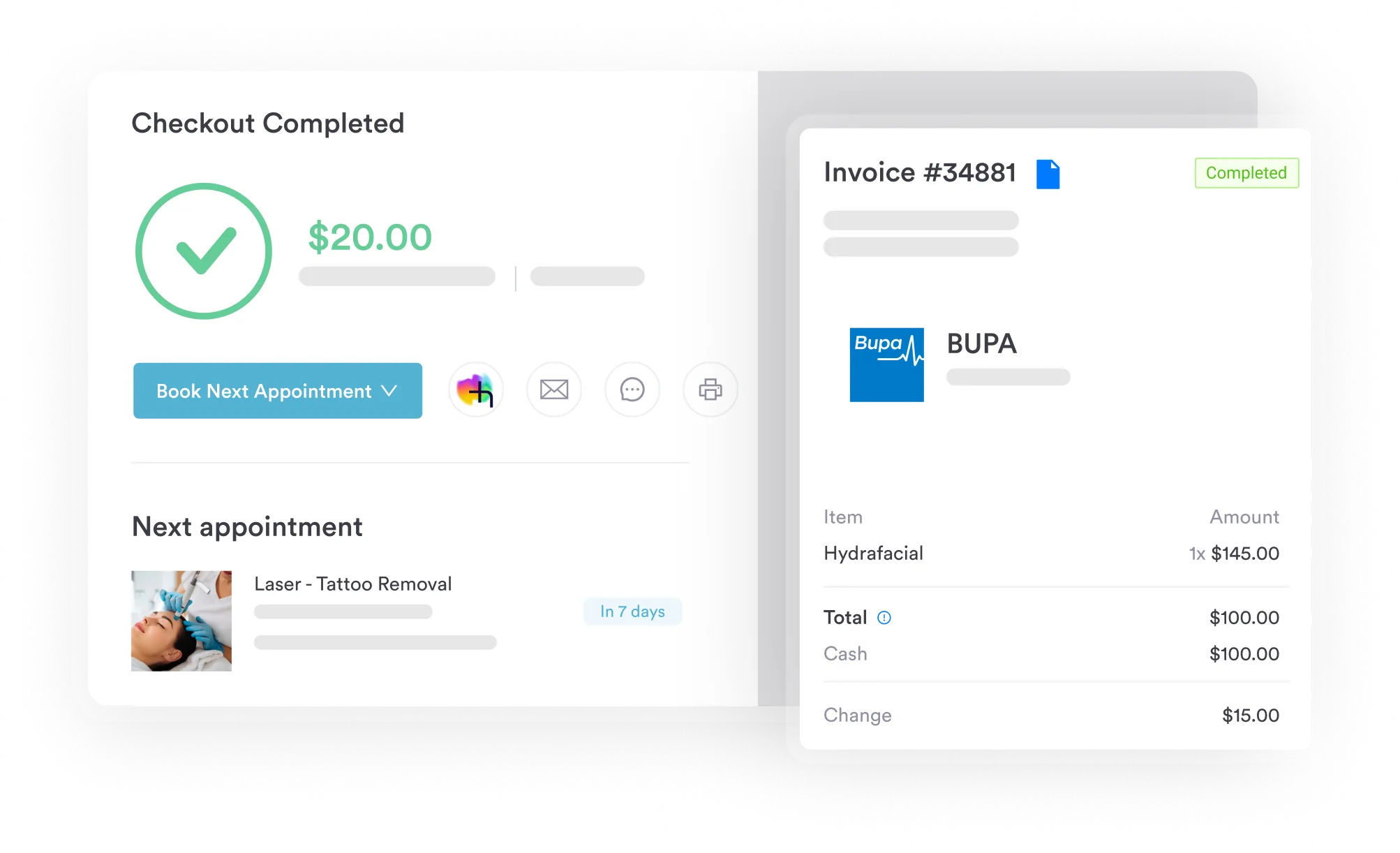

Pabau lets UK private practices put CCSD codes on invoices and submit claims through the Healthcode integration. Operative notes and invoices stay in one patient record.

E2140 is a reconstruction code that only makes sense next to the resection it follows. Treat the two as a pair at every step, from authorization to submission. Then the claim has little left to trip on.
The effort is front-loaded. Checking the authorization and the operative note takes minutes before surgery. Fixing a rejected claim means reopening the note, the authorization and the invoice after the fact.
Book a demo to see how Pabau sends CCSD claims through Healthcode for your private practice.

Need the full picture of Bupa’s code set? Bupa CCSD codes explains how Bupa applies the schedule, its billing rules, and how to use its provider portal.
Billing another procedure on the pharynx? CCSD code E2300 covers pharyngeal myotomy, one of the codes that can never share a claim with E2140.
Coding the diagnosis behind the resection? ICD-10 code C13.0 covers malignant neoplasm of the postcricoid region, a common reason for pharyngolaryngectomy.
Looking up other ENT procedure codes? CCSD codes indexes the schedule’s procedures, with a billing guide for each code.
No. E2140 is a surgical code in Chapter 5, Ear, nose and throat. It covers reconstruction using a stomach pull-up after pharyngolaryngectomy. The anesthetist bills against the surgical procedure, not a separate anesthesia code.
Both bill reconstruction after pharyngolaryngectomy, but with different tissue. E2140 uses a stomach pull-up, while E2150 uses a free jejunal graft from the small bowel. They can’t be billed together, so code the method the operative note records.
Yes. Both names describe moving the stomach up to the neck to replace the removed throat segment. The CCSD descriptor calls it a stomach pull up, and E2140 covers it under any of these names.
The operating surgeon who performs the reconstruction bills E2140. If a second team carries out part of the stomach pull-up, ask the insurer how it wants the work invoiced before you submit.
Use the diagnosis that justified the pharyngolaryngectomy. That is often hypopharyngeal cancer, C13 in WHO ICD-10. Laryngeal cancer (C32) or cancer of the cervical esophagus (C15.0) applies where the record supports it.