HCPCS code J3471: Hyaluronidase ovine injection billing guide
HCPCS code J3471: Descriptor, code type, and quick-reference data HCPCS code J34...

Last Updated: Oct 14, 2026
G2430 is the CCSD code for transabdominal antireflux operations. It covers open surgery, through an abdominal incision, that wraps the top of the stomach around the lower esophagus to control reflux. UK private insurers use it for Nissen, Toupet, or Dor fundoplication done by the open approach.
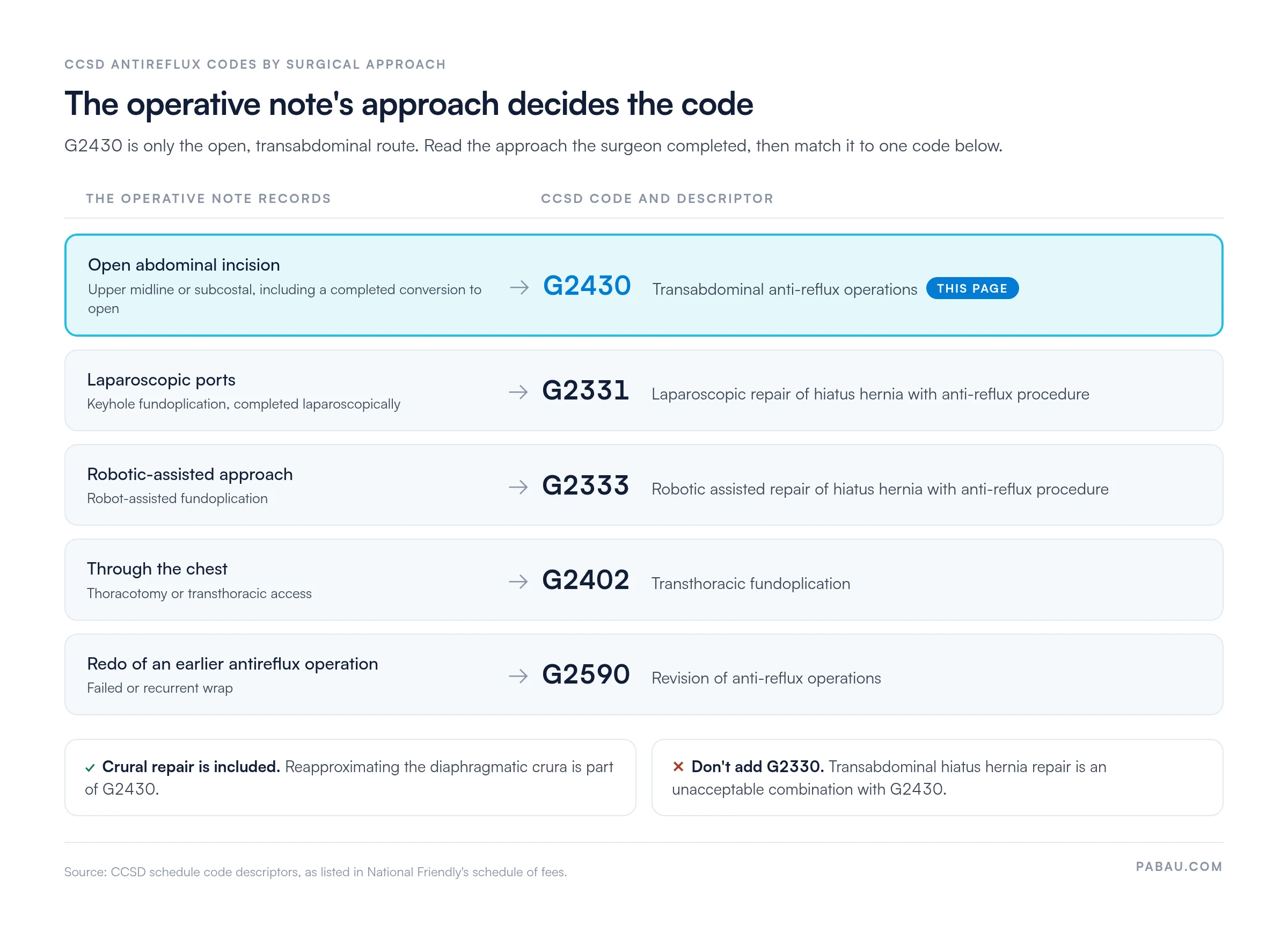
The surgical approach decides the code. Laparoscopic antireflux surgery with hiatus hernia repair is billed as G2331, and revision of an earlier antireflux operation as G2590.
Let Pabau's smart automation suggest the right codes, reduce claim denials, and keep your practice compliant—effortlessly.
Automate repetitive tasks and focus on what matters most—your patients.
Reduce coding errors and ensure compliance with the latest regulations.
Clean claims, fewer denials, and faster reimbursements.
Powerful insights and reporting to help your practice thrive.
HIPAA compliant SOC 2 certified GDPR-compliant Trusted by 4,000+ clinics worldwide

CCSD Code G2430 covers open, transabdominal antireflux surgery only, and laparoscopic cases are billed under G2331.
The operative note must name the approach the surgeon completed, because that detail decides between G2430, G2331, G2333 and G2402.
Pre-operative esophageal manometry and 24-hour pH monitoring results support medical necessity and belong in the claim file.
Major UK private insurers typically require prior authorization before elective antireflux surgery goes ahead.
Crural repair is part of G2430, and CCSD lists G2330 hiatus hernia repair as an unacceptable combination with it.
CCSD Code G2430 is the CCSD schedule code whose official descriptor is “Transabdominal antireflux operations.” It sits within Chapter 8 (Thorax and intra-thoracic organs), Oesophagus category, of the CCSD schedule.
Billing staff at private surgical units use the code when a consultant upper GI surgeon performs an open antireflux operation through an abdominal incision.
It does not apply to transthoracic approaches, which carry codes of their own. Laparoscopic surgery is billed as G2331 instead. Getting the approach right is the most important coding decision for this procedure.
CCSD codes differ from NHS OPCS-4 procedure codes. CCSD is maintained by the Clinical Coding and Schedule Development group and governs private healthcare billing only. Practices submitting claims through Healthcode or directly to insurers put CCSD procedure codes on their invoices, not OPCS-4 codes.
A transabdominal antireflux operation is performed through an open abdominal incision, typically upper midline or subcostal.
The surgeon mobilizes the lower esophagus and gastric fundus and repairs the crura of the diaphragm around the esophagus. A fundal wrap then reinforces the lower esophageal sphincter (LES).
Three fundoplication techniques determine the degree of wrap:
Coders must identify the technique from the operative note. The choice of wrap does not change the CCSD code, but it confirms the procedure falls within the G2430 descriptor. The note must also state the abdominal approach explicitly. If it records only “antireflux repair” with no approach, the coder can’t confirm that G2430 applies.
Transabdominal antireflux surgery is indicated when lifestyle and medical management of gastroesophageal reflux disease (GERD) has failed or is inappropriate. Insurers treat it as clinically necessary only when specific documented criteria are met.
Common documented indications include:
According to NICE guideline CG184 on the management of gastro-oesophageal reflux disease, pre-operative esophageal manometry and 24-hour pH monitoring are standard investigations before antireflux surgery.
Insurers typically require results from both studies as part of the prior authorization submission. Missing results are one of the most common reasons a G2430 claim stalls at the authorization stage.
The approach the surgeon completed, not the intended outcome, determines which CCSD code applies. Coders must read the operative note rather than assume laparoscopic just because most modern antireflux procedures are done that way.
Laparoscopic procedures are sometimes converted to open during surgery. The coder must then confirm from the note that the open approach was completed, not merely attempted.
G2430 applies to the completed open procedure. Billing G2331 for a converted case leads to a denial once the insurer reviews the operative note.
Robotic, transthoracic and revision cases each carry a code of their own too, as the map below shows.
Coders working on upper GI episodes should also understand how G2430 relates to neighboring codes and to the OPCS-4 system used by NHS trusts. The NHS Classifications Browser cross-references OPCS-4 procedure codes and ICD-10 diagnosis codes for practitioners in hybrid NHS/private settings.
The CCSD descriptors below match the ones listed in National Friendly’s schedule of fees.
In hybrid private/NHS settings, practitioners sometimes need both systems but should never put an OPCS-4 code on a private insurance claim. Most insurer claim forms require ICD-10 diagnosis codes (K21.0, K21.9, K44) alongside G2430 to confirm medical necessity.
Payers cross-check the diagnosis code against the procedure code, and a mismatch is a common denial trigger. For an uncomplicated hiatal hernia, K44.9 is the usual secondary code.
A G2430 claim without a complete clinical record will typically be queried or denied. These documents should be in place before the claim is submitted, and available for any post-payment audit. A complete file also protects the practice against retrospective clawbacks.
Collect these documents before the episode closes. A claim that waits on a missing manometry report is a claim that waits on the whole file.
Private medical insurers typically require prior authorization before an elective antireflux operation goes ahead. The authorization number must appear on the claim form. Surgery performed without it is almost always declined for payment, whatever the clinical need.
Before submitting G2430 claims to Bupa specifically, review the Bupa CCSD codes guide and the Bupa procedure fee schedule.
Policies change and fees are updated periodically, so verify directly with the insurer before the admission date. Treat the table above as a guide and confirm current policy with each payer’s provider relations team.
Upper GI surgical claims attract more queries than simpler procedures, because the documentation is heavier and approach-code errors are easy to make. The most frequent denial triggers for CCSD Code G2430 are:
Request the operative note from the surgical team within 48 hours of the procedure. Record the approach term (open, laparoscopic, converted) in your billing checklist before you select the CCSD code. Approach-code errors are the most preventable G2430 denial.
Antireflux surgery is often performed alongside other upper GI procedures. Whether they earn a separate CCSD code turns on the schedule’s combination rules and the insurer’s unbundling policy. It also depends on whether the extra work is integral to the main procedure.
Most G2430 denials start upstream, in a referral letter with no PPI history or an operative note that never names the approach. Billing staff then chase consultants, endoscopy units and secretaries for documents after the patient has gone home.
Pabau, the practice management platform we build, keeps that file in one place. Consent and intake forms collect referral history before surgery, and investigation reports sit in the patient record. Its claims management software lets billing staff attach those documents to the claim, so an insurer query gets answered from one screen.
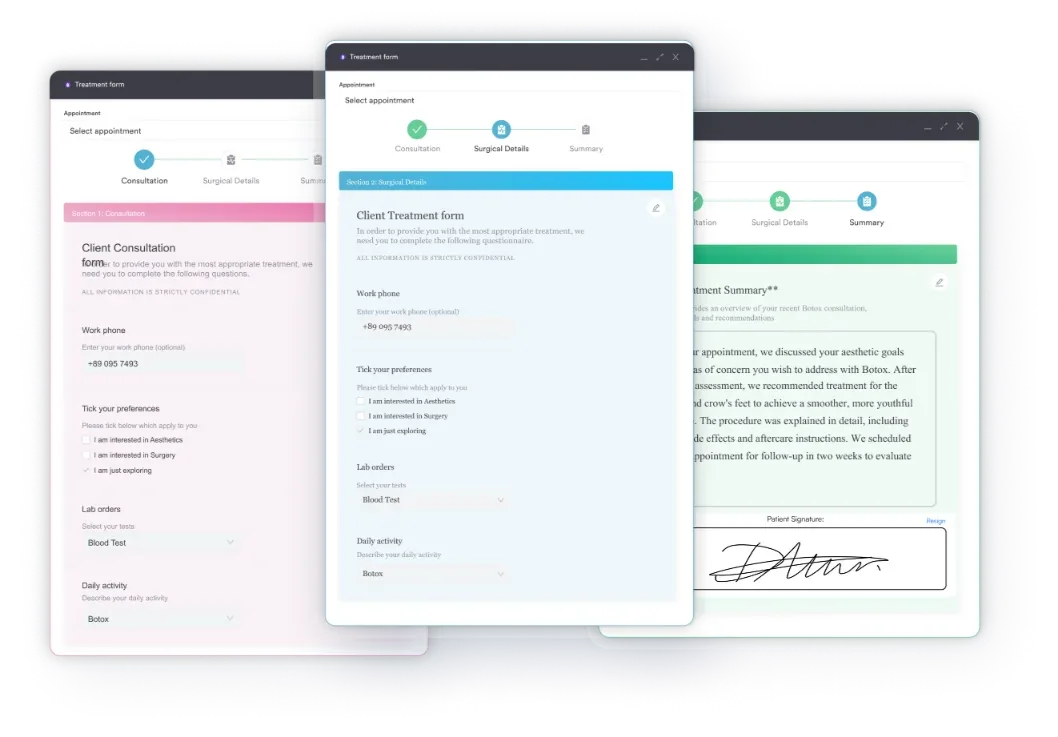
The result is a G2430 claim that leaves with its evidence attached, instead of one that comes back with a query.

Pabau keeps consent, clinical documentation and billing for UK private surgical practices in one place. Your team spends less time chasing records before claim submission.

G2430 rewards a billing team that reads before it codes. Confirm the completed approach in the operative note and check that the pH and manometry reports are on file. Then hold the claim until the authorization number is in hand.
Do that, and the claim goes out once, with evidence the insurer can match against the code. Skip it, and the practice spends weeks rebuilding a file after discharge while the fee sits unpaid.
Book a demo to see how Pabau keeps G2430 documentation and claims together for private surgical practices.

Coding a keyhole case instead? CCSD code G2331 covers laparoscopic hiatus hernia repair with an anti-reflux procedure.
Want to reduce billing admin for your whole practice? Pabau’s claims management tools help private practices track, submit, and audit CCSD claims.
CCSD Code G2430 covers transabdominal antireflux operations. These are open procedures, performed through an abdominal incision, that reinforce the lower esophageal sphincter to control gastroesophageal reflux disease. The code applies to Nissen, Toupet, and Dor fundoplication by the open approach. Laparoscopic antireflux procedures are billed as G2331.
G2430 applies to the open (transabdominal) approach, where the surgeon makes an abdominal incision. The laparoscopic approach, using keyhole ports, is billed as G2331. The approach documented in the operative note decides the code, not the surgeon’s preference or the intended technique. If a laparoscopic procedure is converted to open, G2430 applies to the completed operation.
Yes, crural repair performed as part of the antireflux procedure is integral to G2430 and isn’t billed separately. CCSD lists G2330, transabdominal repair of hiatus hernia, as an unacceptable combination with G2430. Record the hernia as a secondary ICD-10 diagnosis, such as K44.9, rather than adding a second procedure code.
Bupa, AXA Health, and Aviva typically require prior authorization before elective antireflux surgery, as do most major UK private medical insurers. Authorization must be in place before the admission date, and the reference number must appear on the claim. Procedures performed without it are almost always declined for payment. Verify current requirements with each insurer’s provider relations team.
The most frequent denial reasons are the wrong approach code, missing prior authorization, and thin evidence of PPI failure or objective GERD. Others are an ICD-10 diagnosis that doesn’t match G2430, unbundling errors on concurrent procedures, and late submission beyond the insurer’s claim window.
The nearest OPCS-4 code is G24.3 (Antireflux fundoplication using abdominal approach), used in NHS settings. CCSD and OPCS-4 do not map one-to-one, and an OPCS-4 code should never be substituted on a private insurance claim. Practitioners in hybrid NHS/private settings should keep separate coding records for NHS activity (OPCS-4) and private billing (CCSD).