

HCPCS code E0198: Water pressure pad billing guide
HCPCS code E0198 is a water pad for a standard mattress HCPCS code E0198 is the ...

Last Updated: Oct 13, 2026
E6100 is the CCSD code for open resection of an invasive mediastinal tumor. It covers surgery through a sternotomy or thoracotomy to remove a tumor that has grown into nearby structures. Those include the pericardium, the great vessels or the chest wall.
Bupa places E6100 in band Major+ 5, the top band among its mediastinal codes. An open excision without invasion is E6110, and a robotic-assisted excision is E6111. The operative note has to show both the open approach and the invasion, or insurers will query the code.
Let Pabau's smart automation suggest the right codes, reduce claim denials, and keep your practice compliant—effortlessly.
Automate repetitive tasks and focus on what matters most—your patients.
Reduce coding errors and ensure compliance with the latest regulations.
Clean claims, fewer denials, and faster reimbursements.
Powerful insights and reporting to help your practice thrive.
HIPAA compliant SOC 2 certified GDPR-compliant Trusted by 4,000+ clinics worldwide

CCSD code E6100 covers open resection of an invasive mediastinal tumor, never a thoracoscopic or robotic-assisted removal.
The tumor must have grown into nearby structures, and both the imaging report and the operative note need to show it.
Bupa bands E6100 at Major+ 5, paying £147 more than E6110, the open excision code for tumors without invasion.
UK private insurers, including Bupa, AXA Health and Aviva, expect pre-authorization before surgery, and a missing reference is the leading cause of denial.
Pabau, the practice management platform we build, tracks claim status, submits claims through Healthcode and keeps operative documents on the patient record.
CCSD code E6100 is the code in the CCSD coding schedule for “open resection of invasive mediastinal tumour.” Each word in that descriptor narrows when the code applies.
The mediastinum has three compartments: anterior, middle and posterior. E6100 can apply in any of them, as long as the tumor meets the invasion test. Most cases are anterior, because thymoma is the most common primary anterior mediastinal tumor in adults. Germ cell tumors and locally invasive lymphoma also come up.
A mediastinal tumor counts as invasive once it has grown into a neighboring structure. That means the pericardium, the great vessels, lung tissue, the chest wall or the superior vena cava.
Insurers expect two pieces of evidence. The first is pre-operative CT or MRI showing the extension, and the second is the intraoperative findings recorded in the operative note.
A large tumor that stays inside its capsule doesn’t meet the threshold, however big it is. An open excision of that kind is coded E6110 instead.
Two coding errors come up again and again with E6100. Under-coding uses a lesser mediastinal code when E6100 applies. Over-coding applies E6100 to a non-invasive tumor or a minimally invasive procedure. The table sets out where the boundaries sit.
A tumor that starts in the lung takes a lung resection code instead. One example is E4600, for a sleeve resection of the bronchus or pulmonary artery.
The approach depends on which compartment the tumor sits in and how far it has spread. Anterior tumors, the most common E6100 scenario, are usually reached through a median sternotomy. It gives wide exposure of the anterior mediastinum, the thymus and the great vessels.
Posterolateral thoracotomy suits posterior masses and tumors that extend sideways into the pleural space. For very extensive disease, surgeons may combine the two approaches.
Invasion drives the operative complexity, and complexity drives the documentation. A tumor that invades the pericardium may need pericardial resection and reconstruction.
Superior vena cava involvement can call for partial resection with patch repair or bypass grafting. The oncological goal is en bloc resection, which removes the tumor with the involved tissue without entering the tumor plane.
That’s why the operative note has to name the structures involved and the steps taken to manage them. A note that says only “tumor removed via sternotomy” won’t survive insurer review.
Several CCSD codes sit close to E6100 in chapter 8, and the boundaries between them decide both the code and the fee. Bupa’s schedule of procedures puts E6100 in band Major+ 5 at £845. E6110, the open excision code for tumors and cysts without invasion, sits in band Major+ 1 at £698.
Coding an invasive resection as E6110 leaves £147 unclaimed on every Bupa case. Billing E6100 for an encapsulated mass is the over-coding that fails insurer review. The chart shows where the neighboring mediastinal codes fall.
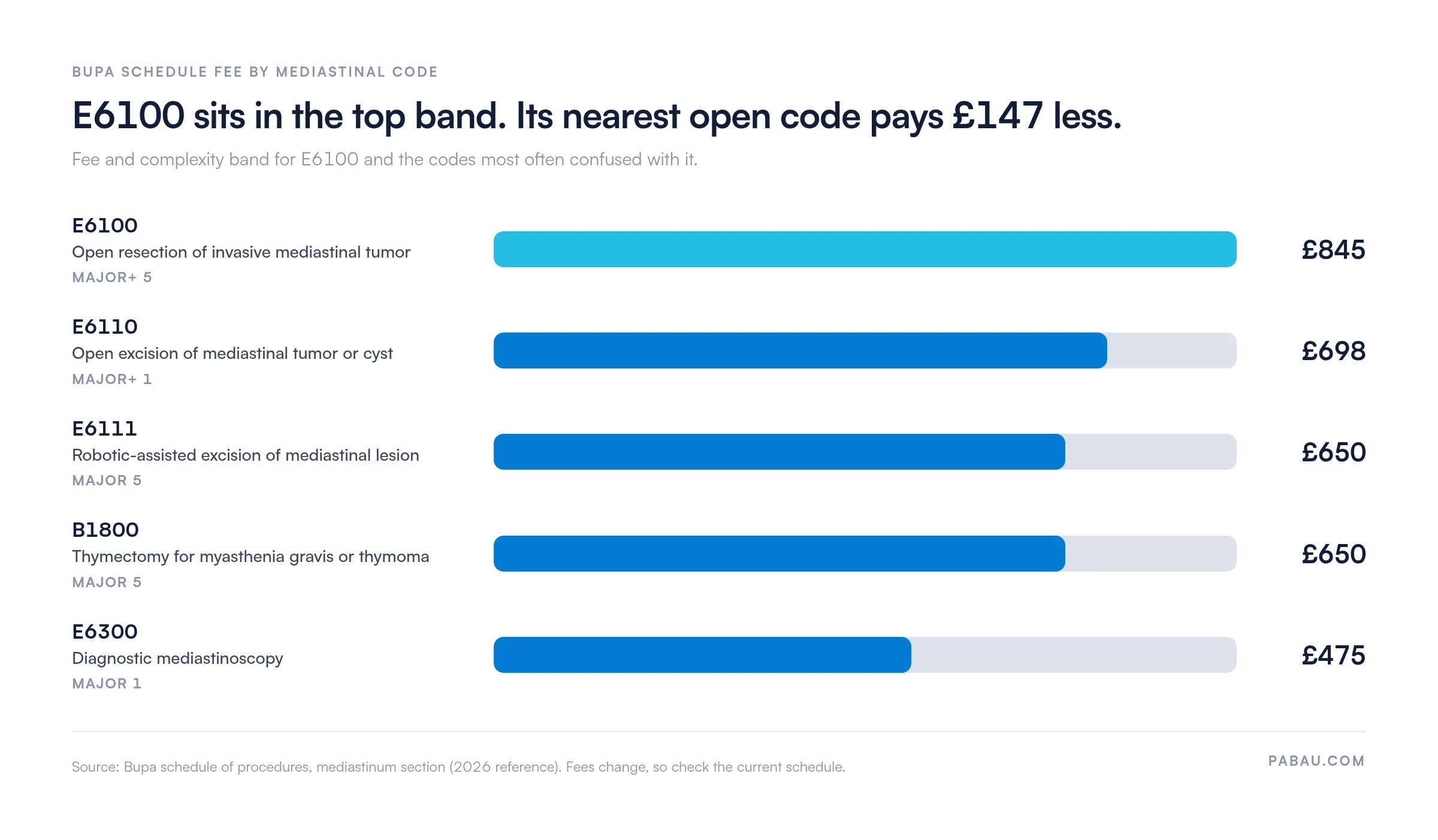
Thymoma cases need a careful read of the operative note. Thymectomy for myasthenia gravis or thymoma has its own code, B1800, which Bupa bands at Major 5.
Sometimes unplanned invasion turns a VATS procedure into an open one. When that happens, the billable code changes from the thoracoscopic code to E6100. The operative note must record the conversion and its reason, such as vascular proximity or no clear plane with the scope. Insurers won’t accept the higher-value code without that explanation.
E6100 is a high-value thoracic code, so UK private insurers check its supporting records more closely than for lower-complexity work. The CCSD technical guide and insurer portals expect the following package.
Auditors ask for the operative note and the histopathology report more often than any other records in an E6100 review. Building the operative note as a template with required fields stops either one going out incomplete.
Open resection of an invasive mediastinal tumor is among the highest-value procedures in the CCSD schedule. Bupa, AXA Health, Aviva and Vitality all run mandatory prior-approval processes for major elective thoracic surgery.
The submission route and supporting documents vary by insurer. Check current requirements on the relevant insurer provider portal before each request, because policies change regularly.
A typical pre-authorization request for E6100 includes:
Bupa and AXA Health generally respond within five to 10 working days for complex surgical cases, and urgent cases can be expedited. Aviva and Vitality run similar timelines. Build that lead time into the schedule when you book elective cases.
Our guide to Bupa CCSD codes explains how Bupa processes CCSD claims more broadly. The Aviva fee schedule and the AXA Health procedure codes portal publish their reimbursement rates and any conditions on surgical codes in this category.
Sometimes surgery goes ahead without pre-authorization, through oversight or genuine clinical urgency. Notify the insurer straight after the operation and submit a retrospective request with full clinical justification. Without that step, the claim is unlikely to be paid at the standard rate, and some insurers decline it entirely.
Set up a pre-authorization tracker for every scheduled E6100 case. Log the submission date, the insurer reference number and the authorization expiry date. Most approvals are valid for a limited window, typically 90 days. A claim submitted after expiry follows the same denial pathway as one with no pre-authorization at all.
E6100 denials follow a predictable set of errors, and each one has a fix you can build into the workflow.
E6100 has more billing touchpoints than most elective private procedures. These six steps help keep denials down on high-value thoracic codes.
On a typical E6100 case, the pre-authorization reference sits in an email and the operative note sits in the hospital system. The submission deadline often lives in a spreadsheet. Pulling those together at billing time is where references go missing and deadlines slip.
Pabau, the practice management platform we build, keeps that work in one place. Its claims management software submits claims through Healthcode and tracks each claim’s status after it goes out. Operative notes and pathology reports stay attached to the patient record, so the billing team isn’t chasing paperwork across systems.
The outcome is an E6100 claim that leaves with its supporting documents already in order. Your team can also see at a glance which claims are still waiting on an insurer.

Pabau tracks the status of every CCSD claim, submits through Healthcode and keeps operative documentation on the patient record. Your team spends less time chasing paperwork across systems.

With E6100, the coding decision gets made in the operating room, when the surgeon writes up the approach and the invasion. If the note proves both, the code holds at Bupa’s top mediastinal band. If it doesn’t, the claim slides to E6110 or stalls at review, whatever the billing team does afterward.
So put the effort upstream. Agree a structured operative note with your surgeons, and confirm the pre-authorization names E6100 before the surgical date. A few extra minutes of documentation per case is a small price next to a denied claim on the highest-banded code in the section.
Book a demo to see how Pabau keeps operative documents and claim status together for complex thoracic cases.

Need the wider picture on Bupa billing? Bupa CCSD codes explains how Bupa structures its CCSD schedule and what surgeons need for consistent claim submission.
Billing other open thoracic work? CCSD code E5705: Pleurectomy for pneumothorax covers blocked code pairs and the records insurers ask for.
Coding an airway resection? CCSD code E4400: Carinal resection explains how the code applies with or without pneumonectomy.
CCSD code E6100 covers open resection of an invasive mediastinal tumor. The surgeon removes the tumor through a median sternotomy or thoracotomy after it has grown into nearby structures. Those include the pericardium, the great vessels or the chest wall.
Yes, when the thymoma is invasive. Pre-operative imaging should show structural extension, and histopathology should support the diagnosis. An encapsulated thymoma removed through an open approach takes a different code, and thymectomy for myasthenia gravis or thymoma has its own code, B1800.
E6100 is for open resection only. VATS and robotic-assisted approaches have their own CCSD codes, such as E6111 for robotic-assisted excision. If a planned VATS procedure converts to open because of unexpected invasion, the code changes to E6100. The operative note must record that conversion.
Yes. Major UK private insurers require pre-authorization for high-value thoracic surgery of this kind. Confirm current requirements on each insurer’s provider portal before scheduling, because policies and submission routes change. A missing pre-authorization reference is the leading cause of E6100 denials.
The core package has six parts. Start with pre-operative imaging confirming invasion, histopathology or cytology, and an operative note showing the open approach and invasion findings. Then add the anesthesia record, the pre-authorization reference and the discharge summary. A missing item often triggers an information request or a denial.
Anesthesia and an assistant surgeon’s fee are billed with separate CCSD codes alongside E6100. Check that the anesthetic code reflects an open major thoracic procedure. Confirm the insurer recognizes the assistant before you bill their fee. Folding these fees into E6100 is a common billing error.



