HCPCS code J1439: Ferric carboxymaltose billing guide
HCPCS code J1439: definition and quick-reference facts HCPCS code J1439 is a Lev...

Last Updated: Oct 16, 2026
E4840 is the CCSD code for dilatation of tracheal stricture, including insertion of stent, in UK private healthcare. It covers the consultant's fee for widening a narrowed trachea, with any stent placed in the same session included in the code.
The CCSD schedule lists E4840 in chapters 5.8.0 and 8.4.0, both titled Fibreoptic Endoscopic Procedures (GA or LA). Wider therapeutic bronchoscopy work is coded E4800 instead, and CCSD has no separate dilatation-only code for the trachea.
Let Pabau's smart automation suggest the right codes, reduce claim denials, and keep your practice compliant—effortlessly.
Automate repetitive tasks and focus on what matters most—your patients.
Reduce coding errors and ensure compliance with the latest regulations.
Clean claims, fewer denials, and faster reimbursements.
Powerful insights and reporting to help your practice thrive.
HIPAA compliant SOC 2 certified GDPR-compliant Trusted by 4,000+ clinics worldwide

CCSD code E4840 covers dilatation of a tracheal stricture, with any stent inserted in the same session included in the code.
CCSD lists E4840 in chapters 5.8.0 and 8.4.0, both titled Fibreoptic Endoscopic Procedures (GA or LA).
E4840’s descriptor names the trachea, while E4800 covers wider therapeutic bronchoscopy, so the stricture site recorded in the note drives the code.
The procedure note must document the bronchoscopic approach, dilatation method, and stent type or brand placed to satisfy insurer audit requirements.
Stent consumable costs are not universally bundled into E4840: Check your specific insurer contract before submitting a separate device charge.
CCSD code E4840 is “Dilatation of tracheal stricture (including insertion of stent)” in the CCSD official schedule. It covers widening a narrowed segment of the trachea, and a stent placed in the same session is included in the code.
The bracketed wording folds the stent into E4840, so it never appears as a second procedure on the claim. E4800 is written the same way, listing laser, cryotherapy, lavage, snare, dilatation and stenting as included techniques. CCSD lists no separate dilatation-only code for the trachea. If a case involves dilatation without a stent, confirm with the insurer how it wants the work reported.
CCSD lists E4840 in two chapters, both titled Fibreoptic Endoscopic Procedures (GA or LA). One is 5.8.0, under Ear, Nose & Throat, and the other is 8.4.0, under Thorax & Intra-Thoracic Organs. Because CCSD lists E4840 under both an ENT and a Thorax chapter, surgeons from either specialty can use it.
The descriptor names no access route, so record whether the bronchoscopy was rigid or flexible in the procedure note. Some insurers flag claims without an explicit approach statement during audit.
A tracheal stent insertion procedure begins with the patient under general anesthesia or deep sedation. Rigid bronchoscopy is the preferred access route for stent deployment because it provides a stable working channel and allows larger instruments. Flexible bronchoscopy may be used for initial assessment. In some cases it is also used for balloon dilatation, when rigid access is not feasible or the patient’s condition rules it out.
Once access is established, the surgeon assesses the stricture’s length, diameter, and location. Dilatation follows, using a balloon catheter inflated to a predetermined diameter, a rigid bronchoscope advanced through the stenosis, or graduated bougies. After dilatation, the stent is deployed under direct vision or fluoroscopic guidance to bridge the narrowed segment and prevent recoil.
Many insurers require the stent brand and size in the operative report. A report that records only “stent inserted” without naming the device type creates an audit flag. It may also trigger a request for more information before the claim is processed.
Tracheal stricture treatment in UK private practice most commonly addresses scarring from prolonged intubation or tracheostomy. Post-intubation and post-tracheostomy stenosis together account for the majority of benign cases. Other indications include malignant compression from thyroid, esophageal, or lung tumors, post-surgical anastomotic stricture following tracheal resection, and idiopathic subglottic stenosis.
Stent insertion is chosen over dilatation alone when the narrowing is likely to recur rapidly or the cause cannot be treated surgically. It is also used when the patient is not a candidate for open resection and reconstruction. Under CCSD, the stent is included within E4840 rather than carried by a separate code. The decision therefore changes the operative note more than the code, because a placed stent brings device details the insurer will ask about.
E4840 shares its two endoscopy chapters with the other bronchoscopy codes, and CCSD’s coding principles link it to open and interventional radiology codes too. Picking the wrong one is easiest when the operative note is vague about where the stricture sat or what was done to it. The chart below sorts the common cases by what the note records.
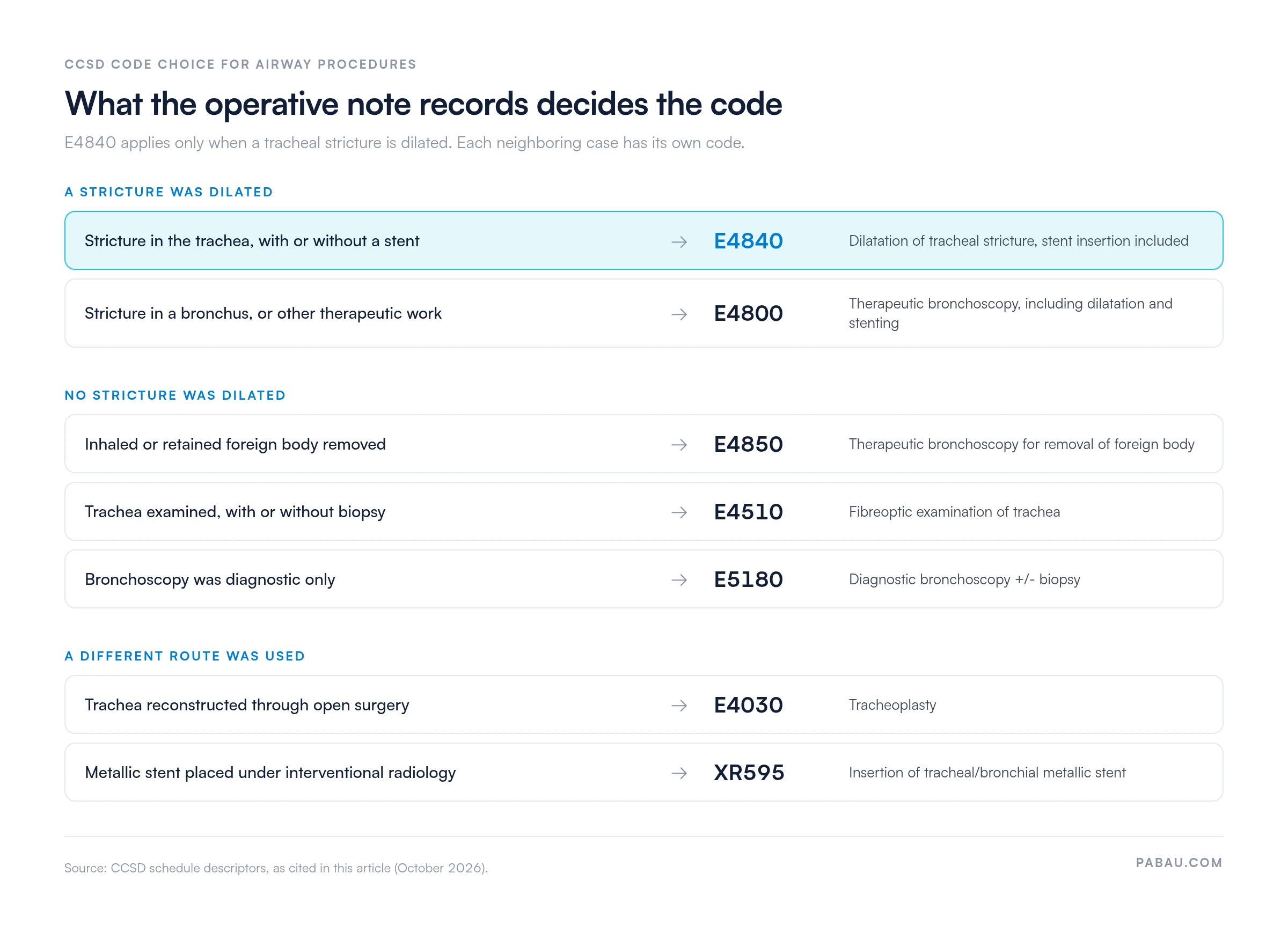
The table that follows gives each code’s full CCSD descriptor and the case it fits.
Each description above comes from the CCSD schedule, which is reviewed periodically, so check it again before billing. CCSD’s coding principles connect E4840 with E4510, E3900, E4030, XR450 and XR595. Read those rules before putting any of them on the same claim as E4840.
Our guide to Bupa CCSD codes explains how Bupa recognizes CCSD codes, and Bupa’s code search portal shows the current fee level for each one. For the rest of the schedule, our CCSD guides for consultants cover each code’s scope and claim rules.
Before submitting a claim under E4840, read back the operative note and check three points. Does it place the stricture in the trachea, describe how it was dilated, and name any stent inserted? If the stricture sat in a bronchus, E4800 is likely the closer match. If the dilatation method or stent details are missing, request an addendum from the operating surgeon before submission.
Private medical billing for tracheal airway procedures follows a consistent workflow across UK insurers. The steps below apply to all major PMI payers including Bupa, AXA Health, VitalityHealth, and Cigna, though individual insurer requirements for pre-authorization and documentation vary.
Pabau, the practice management platform we build, includes private practice claims software that cuts the manual steps in this workflow. It pulls the patient’s insurer details into a pre-filled claim and sends it straight to Healthcode. Before you send, it checks that details such as membership numbers and authorization codes are in place.
Every E4840 claim requires a paired ICD-10 diagnosis code. The cause of the tracheal stricture drives which code applies. Using a non-specific code when a more specific one fits reduces clinical credibility on audit and, with some insurers, triggers additional review.
Verify these ICD-10 codes against the NHS Classifications Browser, which lists the UK ICD-10 fifth edition codes used by NHS England. UK private insurers reference the same codes for diagnosis pairing. Coding to the most specific available code is standard practice under NHS and private clinical coding guidance.
Insurer audit of tracheal airway claims focuses on whether the operative note supports the code billed. An E4840 claim with a thin procedure note is the most common reason these submissions move from auto-processing to manual review.
The operative report must contain each of these elements to pass audit cleanly.
Keeping procedure documentation digital lets practices store operative records in the same system used for billing. That shortens the lag between procedure and claim, and makes records easy to retrieve during insurer audit.
Most E4840 denials trace back to the authorization, the code choice, or the operative note. The table below sets out the common causes and how to fix each one.
Not by its wording. The E4840 descriptor names no access route, although CCSD files the code under its two Fibreoptic Endoscopic Procedures chapters. For a case done through a rigid bronchoscope, confirm with the insurer that E4840 is the code it expects.
In clinical practice, rigid bronchoscopy is the standard approach for tracheal stent placement. Silicone stents (Dumon, Montgomery T-tube) in particular need a rigid working channel for deployment. Flexible bronchoscopy is more commonly used for assessment, for balloon dilatation in patients who cannot tolerate rigid instrumentation, and occasionally for self-expanding metallic stent deployment.
The documentation risk sits in the sequence of steps. If a flexible bronchoscopy note never states that the stricture was dilated, an auditor may read the case as an examination under E4510 or E5180. Record the approach, the dilatation, and any stent placement as distinct sequential steps in every operative report.
Review your insurer fee schedules annually. Bupa, AXA Health, and Vitality each publish updated fee levels for CCSD codes. The reimbursement rate for E4840 may differ between insurers by a material amount. Check the VitalityHealth fee finder and the AXA Health specialist procedure portal before your billing year starts. That lets you set accurate patient estimates and flag contract anomalies before they affect cash flow.
The procedure code E4840 covers the intervention itself. Your insurer contract decides whether the stent device cost is bundled into E4840 or billed separately as a consumable. The CCSD code structure alone does not settle it.
Silicone stents (Dumon, Montgomery T-tube): Reusable instrumentation is involved in delivery, but the stent itself is a single-use implant. Some insurer contracts allow a separate implant line. Others bundle it. Verify before billing the device cost separately on a claim that includes E4840.
Self-expanding metallic stents (SEMS): Covered SEMS and uncovered SEMS are higher-cost devices. Major PMI payers typically require a separate pre-authorization for the stent consumable and may request the manufacturer invoice. Check the Healix fee schedule and your own insurer’s unbundling guidelines before submitting the device as a separate line item.
You can explore insurer-specific fee levels through individual portals. The VitalityHealth fee finder and the Aviva fee schedule both publish procedure-level rates for CCSD codes. Refer to these for current reimbursement values rather than relying on historical figures.
Many consultant practices still run an airway list across a dictated operative note, an authorization email, and a billing spreadsheet. The stent details sit in one place, the authorization number in another, and the code choice in a third. The claim is then only as clean as the person reconciling them.
Pabau keeps the referral, the insurer’s authorization number, and the procedure note together in the patient record. A structured procedure template can prompt for the stricture site, dilatation method, and stent type before the note is signed. Your coder then works from one source when choosing between E4840 and E4800.
The result is an E4840 claim built from the record the consultant signed, without a week of chasing device details. Audit responses get faster too, because the operative report sits in the same patient record as the claim.

Pabau keeps the operative note, the authorization number, and the insurer claim in one patient record. Your team can check the airway code and stent details before the claim goes to Healthcode.

E4840 is the CCSD code for dilating a tracheal stricture, with any stent placed in the same session included. Most errors around it come from the stricture’s location and the order of steps, so the operative note decides whether the claim holds up.
Before your next airway list, check that your procedure template asks for the stricture site, the dilatation method and the stent details. Then check that each patient’s authorization covers therapeutic work as well as a diagnostic scope.
The trade-off is a few extra fields per note against weeks of resubmissions and audit letters. Book a demo to see how Pabau builds that template into your claims workflow.

Removing an inhaled object instead of dilating a stricture? CCSD code E4850 covers therapeutic bronchoscopy for removal of a foreign body.
Was the bronchoscopy diagnostic only? CCSD code E5180 explains how to bill a diagnostic bronchoscopy, with or without biopsy.
Did the case move to open airway surgery? CCSD code E4030 sets out the billing rules for tracheoplasty in UK private practice.
Was part of the trachea excised? CCSD code E3900 covers partial excision of the trachea with reconstruction.
Examining the trachea without dilating it? CCSD code E4510 covers examination of the trachea, with or without biopsy.
CCSD code E4840 covers dilatation of a tracheal stricture, including insertion of a stent in the same session. CCSD lists it in chapters 5.8.0 and 8.4.0, both titled Fibreoptic Endoscopic Procedures (GA or LA). The descriptor names no access route, so the operative note must record whether the scope was rigid or flexible.
Bill using CCSD code E4840, paired with the appropriate ICD-10 diagnosis code, after confirming pre-authorization with the patient’s insurer. Attach the full operative report at the time of submission. Submit via Healthcode or the insurer’s provider portal. Anesthesia is billed separately under most contracts, but check your specific insurer agreement.
Dilatation widens the stricture, while a stent is a device left in place to hold it open. For coding, the E4840 descriptor includes stent insertion, and CCSD lists no separate dilatation-only code. Stenting is chosen when dilatation alone is unlikely to provide durable relief.
The closest neighbors are E4800 (therapeutic bronchoscopy), E4510 (fibreoptic examination of trachea), E5180 (diagnostic bronchoscopy) and E4850 (foreign body removal). CCSD’s coding principles also link E4840 to E3900, E4030, XR450 and XR595. Check those rules before billing any of them on the same claim.
The most common reasons are missing pre-authorization, an operative note without the stent type or dilatation method, and an absent or non-specific ICD-10 code. Another is a code mismatch, such as E4800 billed for tracheal stricture work. Each has a straightforward fix.
Not universally. E4840 covers the procedure; whether the stent implant is bundled or separately billable depends on your specific insurer contract. Some PMI payers allow a separate implant line for high-cost devices like covered SEMS. Check your contract and the insurer’s unbundling guidelines before submitting a device charge.
Not by its wording. The E4840 descriptor names no access route, so the approach goes in the operative note rather than driving the code. For a rigid case, confirm the insurer expects E4840. The stricture’s site matters more, because a bronchial stricture points toward E4800.