

CCSD code G5100: Bypass of duodenum billing guide
CCSD code G5100 bills a bypass that leaves the duodenum in place CCSD code G5100...

Last Updated: Oct 16, 2026
C8654 is the CCSD code for insertion of radioactive plaque into eye (including later removal). It covers ocular plaque brachytherapy for intraocular tumours such as choroidal melanoma, from suturing the plaque to the episclera through its removal days later.
One treatment episode is one C8654 claim, whichever isotope is used. The code sits in Chapter 4 (Eye and orbital contents), section 4.12 General, and UK private medical insurers band it as Major complexity.
Let Pabau's smart automation suggest the right codes, reduce claim denials, and keep your practice compliant—effortlessly.
Automate repetitive tasks and focus on what matters most—your patients.
Reduce coding errors and ensure compliance with the latest regulations.
Clean claims, fewer denials, and faster reimbursements.
Powerful insights and reporting to help your practice thrive.
HIPAA compliant SOC 2 certified GDPR-compliant Trusted by 4,000+ clinics worldwide

CCSD Code C8654 covers insertion and later removal of a radioactive ocular plaque as one billable episode, not two separate codes.
Primary indications include choroidal and ciliary body melanoma (ICD-10 C69.3 and C69.4), retinoblastoma (C69.2), and other intraocular tumours.
Iodine-125 and ruthenium-106 plaques both bill under C8654, so the isotope changes the documentation but never the code.
UK private medical insurers list C8654 in Chapter 4, section 4.12 General, as a Major complexity procedure.
Pabau, the practice software we build, keeps insurer-specific price lists, checks authorisation codes are in place, and submits C8654 claims through Healthcode.
The Clinical Coding and Schedule Development (CCSD) Group defines CCSD Code C8654 as “Insertion of radioactive plaque into eye (including later removal).” That parenthetical decides how often the code is billed per treatment episode. In short, the answer is once, whether removal follows insertion by days or by weeks.
The code sits in Chapter 4 (Eye and orbital contents) of the schedule of CCSD codes, under section 4.12 General. In addition, insurers band it as Major complexity. However, it applies only to UK private medical insurance (PMI) billing. Trusts code NHS activity in OPCS-4 and group it into HRGs for payment, so CCSD codes never go on NHS-funded episodes.
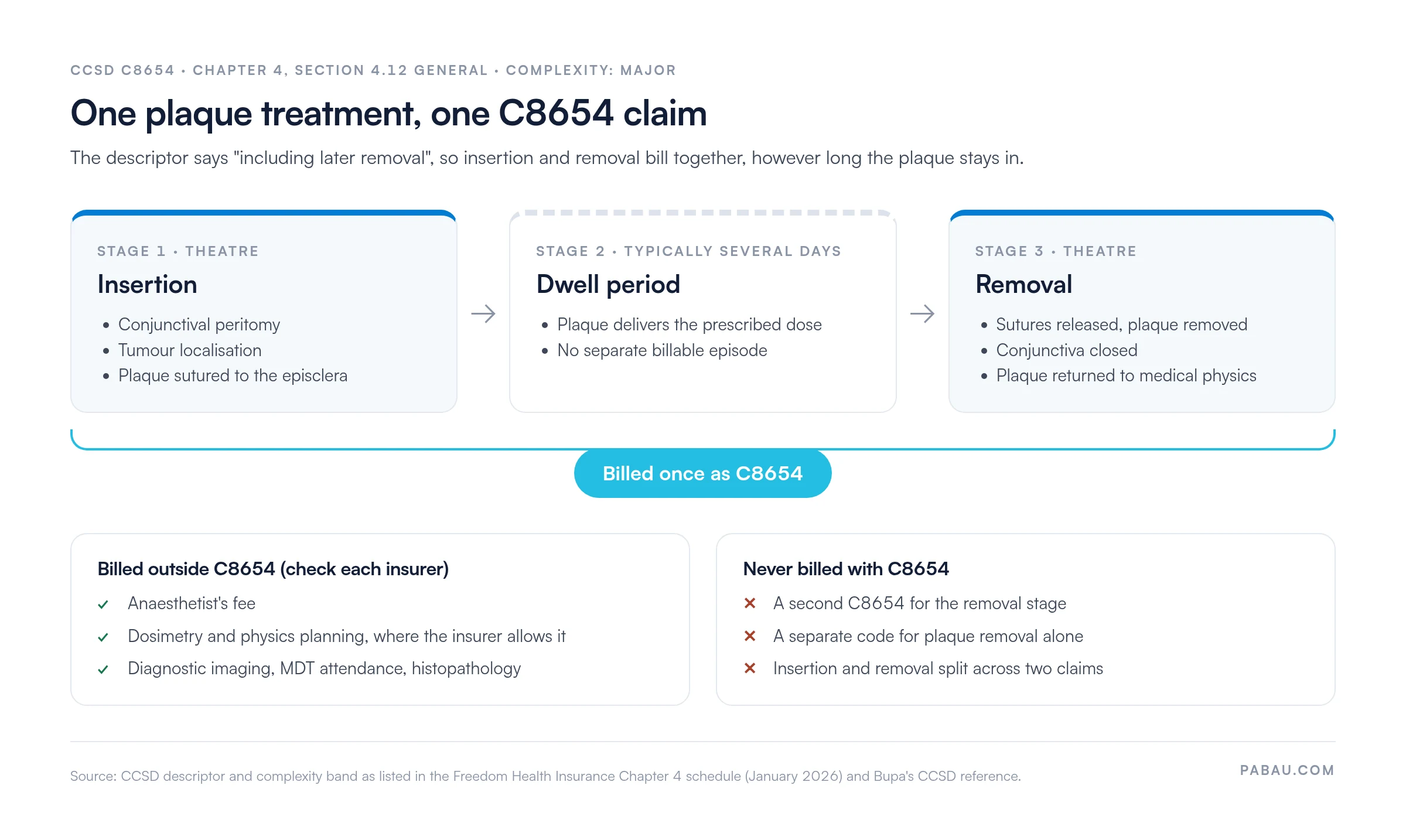
The procedure sutures a small, dome-shaped radioactive plaque to the episclera, the outer surface of the eye, directly over the tumour. The plaque delivers a prescribed radiation dose over a dwell period, and the surgeon then removes it. Both stages need theatre time and anaesthesia, which is why the CCSD bundles them into one code. Moreover, the anaesthetist claims a separate fee, which insurer schedules list as its own line against C8654.
The surgical sequence shows coders exactly what one episode of C8654 covers and what falls outside it.
Steps 1 through 3 are the insertion stage, and step 5 is the removal stage. The diagram below shows how both sit inside a single C8654 claim, while the dwell period between them creates no separate billable episode.
Uveal melanoma, the most common primary intraocular malignancy in adults, is the leading diagnosis behind C8654. The Collaborative Ocular Melanoma Study (COMS) found plaque brachytherapy equivalent to enucleation for survival in medium-sized choroidal melanoma. As a result, that evidence made the technique standard of care at UK specialist centres.
The table below maps the principal indications to their WHO ICD-10 codes, the edition UK insurers use rather than the US ICD-10-CM. First, selecting the correct diagnosis is a must for claim acceptance. Submitting C8654 against an inaccurate or non-specific ICD-10 code is a common cause of insurer rejection.
C8654 works with any isotope. The same code covers iodine-125 (I-125) and ruthenium-106 (Ru-106) plaques. The ocular oncologist and medical physicist choose the isotope based on tumour thickness, tumour location, and what the treating centre has available.
From a billing perspective, the isotope changes neither the code nor the claim. Therefore, coders never select a different code for I-125 versus Ru-106 procedures. However, the operative note and dosimetry record should still name the isotope, plaque model and source activity. Insurers may ask for that detail during claim review.
Clear bundling boundaries stop avoidable errors on C8654 claims. The table below separates what the code covers from services billed separately and from services never billed alongside C8654.
In practice, separate billing of dosimetry planning depends on each insurer’s provider agreement. Some UK private medical insurers bundle physics planning into the surgical fee, while others allow a separate medical physics charge. Therefore, check the relevant provider manual before billing.
Several Chapter 4 codes cover the treatment of intraocular tumours. Choosing the wrong one typically leads to rejection or, where the error inflates the claim, a compliance audit. The table below lists the codes that sit closest to C8654.
For example, one possible mix-up is billing laser photocoagulation when the treatment was plaque brachytherapy. However, the two are clinically distinct. Laser is typically used for smaller choroidal haemangiomas or as follow-up therapy, while C8654 applies to the full plaque insertion and removal sequence. Verify the operative note before assigning the code.
When the eye is removed instead, the claim moves to C0122 if an implant goes in, or to C0120 if it does not. Likewise, when the surgeon excises a ciliary body tumour rather than irradiating it, the claim bills as C5910.
Also, radiotherapy to a surface lesion of the conjunctiva is a different procedure from plaque treatment of an intraocular tumour. It has its own code, C3950.
Missing or incomplete documentation is a frequent reason C8654 claims are rejected. UK private medical insurers increasingly request supporting records at the point of claim for high-value oncology procedures. Preparing these documents in advance shortens the wait between procedure and payment.
Therefore, store each document in the patient record at the time of the procedure, not afterwards. Pabau’s digital forms capture operative notes and supporting documents straight into the patient record, so the claim file is complete before the invoice is raised. Accurate, same-day records are also a CQC expectation for independent providers in England.

Run a documentation checklist straight after each C8654 procedure: operative note (insertion), dosimetry record, tumour measurement and MDT summary. Chase a missing document on the day of discharge, not weeks later at claim submission. A single missing document can hold up payment for weeks.
Most UK private medical insurers require pre-authorisation before ocular brachytherapy is performed. This reflects the procedure’s specialist oncology classification and its high relative cost within PMI schedules. Without confirmed pre-authorisation, the patient risks bearing the full cost and the practice risks non-payment.
The pre-authorisation process varies by insurer, so check each insurer’s provider portal. Our Bupa CCSD codes guide covers Bupa’s submission requirements in detail. Confirm a code’s descriptor and band in the Bupa code search portal or a published schedule such as Freedom Health Insurance’s Chapter 4 fees.
A complete CCSD Code C8654 claim needs the procedure code, diagnosis code and supporting references filled in accurately. Skipping any step risks automatic rejection at the insurer’s processing stage.
High-value ophthalmic oncology claims attract closer scrutiny than routine outpatient procedures. The usual reasons for rejection are predictable and largely avoidable, and each one below comes with a remediation step.
Finally, check the WPA medical fees portal and each insurer’s own schedule for the fee bands and procedural requirements that apply to C8654.
Many ophthalmology practices still track C8654 fees in a spreadsheet, chase authorisation numbers by email, and assemble claim packs by hand. In fact, each handoff is a chance for a missing reference or a duplicated code. Whatever system you use, these setup steps prevent the rejections above:
Pabau’s claims management software keeps insurer-specific price lists, so C8654 carries the right fee for each insurer. It checks that membership numbers and authorisation codes are in place before a claim goes out. It then raises the invoice to the correct insurer and sends the claim through Healthcode with the invoice attached.
The result is one C8654 claim per episode, submitted with its reference and supporting records, and fewer resubmissions to chase.

Pabau keeps insurer-specific price lists, checks authorisation codes, and submits C8654 claims through Healthcode with the invoice attached.

Billing C8654 well comes down to one discipline: treat plaque insertion, dwell and removal as a single episode and a single claim. In contrast, splitting it in two is an avoidable error that triggers a rejection and can prompt an audit query.
The practical move is to front-load the work. Confirm pre-authorisation before admission, file both operative notes and the dosimetry record before the invoice goes out, and code the most specific WHO ICD-10 diagnosis. Done in that order, C8654 stops being a claim that gets queried and becomes one that gets paid.
Book a demo to see how Pabau keeps C8654 price lists, authorisation codes and Healthcode submissions in one place for your ophthalmology practice.

Managing Bupa claims in a UK private practice? Bupa CCSD codes guide covers the Bupa procedure code schedule and its submission requirements.
Treating the tumour by removing the eye instead? CCSD code C0122 explains billing enucleation or evisceration with an implant.
Excising a ciliary body tumour rather than irradiating it? CCSD code C5910 covers iridocyclectomy coding, complexity and claims.
Looking to streamline invoicing across UK private insurers? Claims management software shows how Pabau handles insurer price lists and Healthcode submission.
CCSD Code C8654 is the UK private healthcare billing code for inserting a radioactive plaque into the eye and later removing it. The two stages bill as a single episode. It covers the surgical stage in which the plaque is sutured to the episclera and the later removal, however much time passes between them.
Both iodine-125 (I-125) and ruthenium-106 (Ru-106) plaques are covered by C8654. The code is isotope-agnostic. The choice of isotope does not change the CCSD code used or the number of times it is billed. The operative note and dosimetry record should specify which isotope was used, as insurers may request this during claim review.
Before the procedure, send the patient’s insurer the proposed CCSD code (C8654) and the ICD-10 diagnosis code. Include the treating consultant’s GMC number and a clinical summary. Most UK PMIs process elective oncology pre-authorisation requests within 3 to 10 working days. Record the authorisation reference number and include it on every claim submission for that episode.
This varies by insurer. Dosimetry planning is a distinct clinical service performed by a medical physicist, and it is often billable separately. However, some PMI provider agreements bundle it into the surgical fee. Verify the applicable provision in each insurer’s current provider manual before billing a separate physics charge alongside C8654.



