HCPCS code J1180: Dyphylline injection billing guide
What HCPCS code J1180 covers: the official descriptor explained HCPCS code J1180...

Last Updated: Oct 16, 2026
CCSD code E4850 is the procedure code for therapeutic bronchoscopy for removal of foreign body. It sits in Chapter 5 of the CCSD schedule, Ear, nose and throat, among the fiberoptic endoscopic procedures. UK private medical insurers use it to bill a bronchoscopy whose purpose is to find and extract an inhaled object from the airway.
The code covers rigid and flexible approaches alike. A bronchoscopy that only inspects or biopsies the airway is billed as E5180, diagnostic bronchoscopy, while other therapeutic airway work falls under E4800.
Let Pabau's smart automation suggest the right codes, reduce claim denials, and keep your practice compliant—effortlessly.
Automate repetitive tasks and focus on what matters most—your patients.
Reduce coding errors and ensure compliance with the latest regulations.
Clean claims, fewer denials, and faster reimbursements.
Powerful insights and reporting to help your practice thrive.
HIPAA compliant SOC 2 certified GDPR-compliant Trusted by 4,000+ clinics worldwide

CCSD Code E4850 describes therapeutic bronchoscopy for removal of foreign body and covers both rigid and flexible bronchoscopic approaches.
The correct ICD-10 pairing comes from the T17 block (foreign body in respiratory tract), with site-specific subcodes required when the anatomical location is documented.
Major UK insurers typically require prior authorization for elective E4850 procedures. Emergency foreign body removal may use an expedited pathway, but verify per policy.
Billing E4850 alongside E5180, the diagnostic bronchoscopy code, on the same date creates a bundling risk. Anesthesia is coded separately using the relevant CCSD anesthesia code.
CCSD Code E4850 is defined as “therapeutic bronchoscopy for removal of foreign body” in the CCSD (Clinical Coding and Schedule Development) schedule. That schedule governs procedure code billing across UK private healthcare. E4850 sits in Chapter 5, Ear, nose and throat, among the fiberoptic endoscopic procedures.
The code captures the whole bronchoscopic episode in which a foreign body is identified and extracted from the airway. That episode runs from scope insertion and visualization through retrieval and post-procedure observation.
E4850 is a therapeutic code, so it applies only when extracting a foreign body is the procedure’s primary intent. A bronchoscopy done only to inspect the airway, with or without a biopsy, is billed as E5180, diagnostic bronchoscopy +/- biopsy. Other therapeutic airway work, such as laser treatment, stenting, or stricture dilation, falls under E4800.
The code covers a single episode. If a second bronchoscopy is required on a different date to retrieve a retained or missed fragment, a fresh E4850 claim is appropriate. Bilateral or staged procedures on separate dates are each billable independently.
Therapeutic bronchoscopy for foreign body removal follows a structured sequence, and the operative note must reflect each stage to support the E4850 claim.
Each of these stages corresponds to an element that insurers check during audit. An operative note that omits the anatomical location or the retrieval instrument is a common denial trigger, regardless of whether the extraction itself was successful.
E4850 applies to both rigid and flexible bronchoscopic approaches. The CCSD schedule does not restrict the code to a single instrument type.
Scope selection is therefore a clinical decision rather than a coding one. Some payers may still ask for clarification if the operative note leaves out the scope type, because it affects anesthesia complexity and resource use.
Verify scope-type documentation requirements with each insurer directly, as payer policies can change between fee schedule updates.
The correct ICD-10 diagnosis codes for E4850 come from Chapter XIX of the WHO ICD-10 classification. The relevant block is T17, which covers foreign body in the respiratory tract. Select the most specific code the clinical documentation supports.
Using an unspecified code (T17.9) when the anatomical site is documented is a common audit finding and a denial trigger.
T17.5 (bronchus) is the code most often paired with E4850 in pediatric practice. It reflects how often children under five inhale food and small objects into the right main bronchus.
Selecting E4850 correctly requires knowing where it sits among the adjacent bronchoscopy entries in the schedule of CCSD codes. The most common coding errors involve substituting a diagnostic code for the therapeutic one, or billing both in the same session without reviewing bundling rules.
A bronchoscopy that begins as diagnostic but converts to therapeutic retrieval in the same session warrants E4850 rather than E5180. Billing both E5180 and E4850 for a single session creates a bundling risk and is likely to trigger a review.
Check the current CCSD schedule notes and your payer agreement before billing diagnostic and therapeutic codes in one episode.
In practice, the choice comes down to what the scope achieved, which the diagram below maps against the three codes.
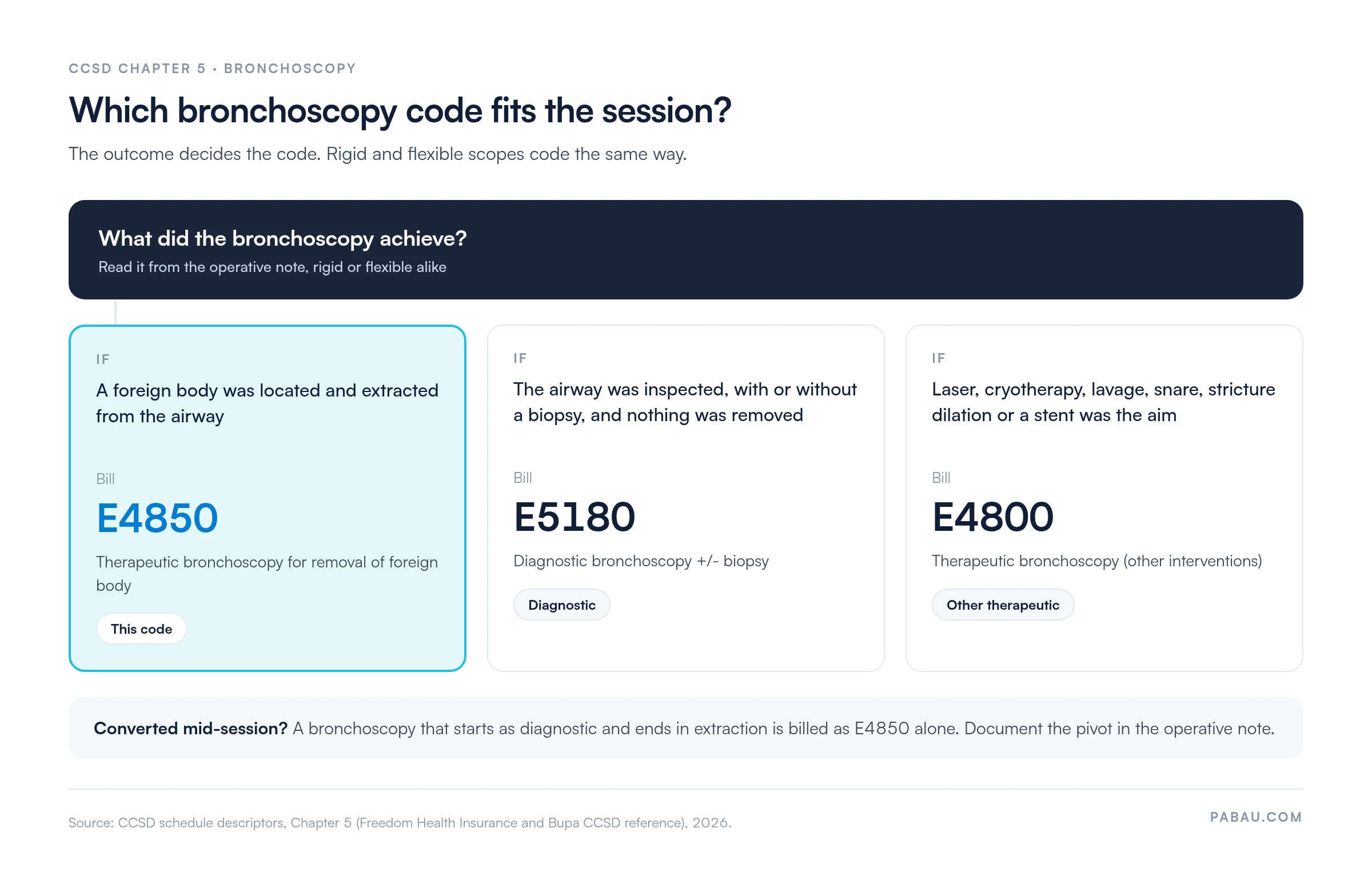
When a bronchoscopy starts as diagnostic but results in foreign body extraction, document the pivot in the operative note. A line such as ‘Procedure converted from diagnostic to therapeutic following identification of foreign body at [location]’ does the job. This single sentence justifies E4850 and reduces the bundling challenge risk.
The operative note is the single most important document supporting an E4850 claim. Payers audit CCSD E4850 documentation requirements closely, and missing elements are the leading cause of denial.
Freedom Health Insurance’s schedule lists E4850 at £200, below the £320 it pays for E5180 diagnostic bronchoscopy. Every operative note must contain all of the following.
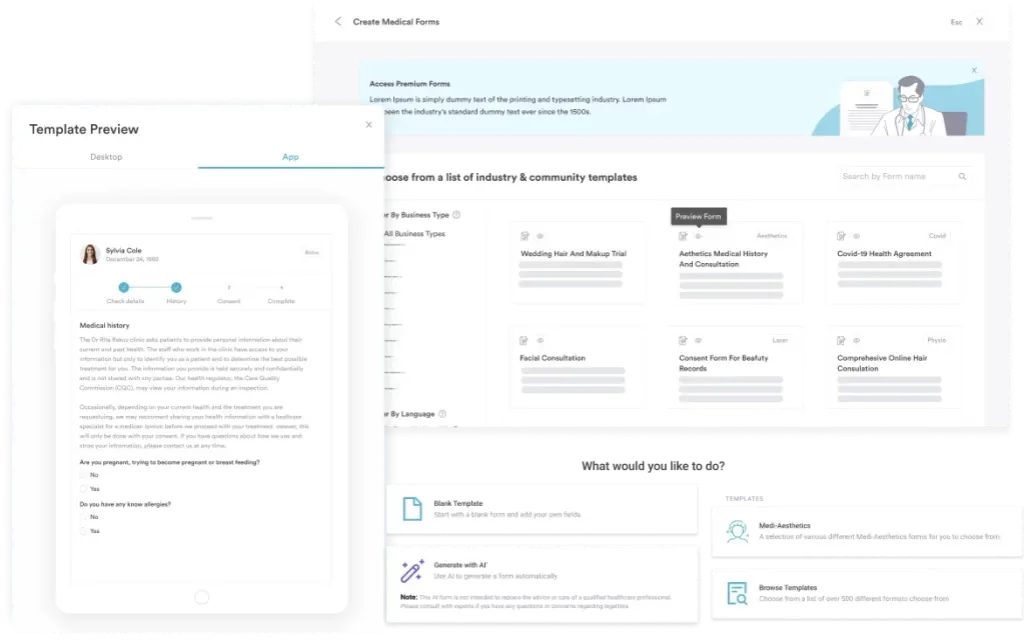
Practices using digital procedure forms can build these elements into a structured bronchoscopy form, which reduces the risk of omission under time pressure.
CCSD E4850 prior authorization requirements vary by insurer and by policy. For elective procedures, most major UK private insurers require pre-authorization before the bronchoscopy is performed.
Emergency foreign body removal, where delay would risk airway compromise, may use an expedited or retrospective authorization pathway. Practices must still notify the insurer and verify the policy terms. Always confirm per policy rather than per insurer name, as individual plan terms differ.
The Bupa CCSD billing guide covers Bupa-specific code submission requirements. Verify the prior authorization details above with each insurer before billing, as payer policies change with each annual schedule update.
Anesthesia is coded separately from E4850. The procedure code covers the bronchoscopic extraction. The anesthesia episode is a distinct CCSD billing item regardless of whether the anesthesiologist is a separate provider or part of the same clinical team.
Never include anesthesia in the E4850 claim without confirming against the current CCSD schedule notes and your insurer agreement.
The following concurrent coding scenarios arise most frequently with E4850.
E4850 claim denial patterns are consistent across UK private insurers. Most denials fall into five categories, each with a specific corrective action.
Track E4850 denial rates by insurer across a rolling three-month period. If one payer accounts for a disproportionate share of denials, request their specific operative note requirements in writing. Payer-specific templates cut resubmission rates faster than general documentation improvements.
This eight-step sequence maps an E4850 billing episode from referral to payment receipt.
Without a shared system, an E4850 claim gets assembled by hand. The operative note sits in one place, the pre-authorization reference in an inbox, and the imaging report somewhere else. A missing attachment then surfaces only when the insurer queries the claim.
Pabau, the practice management platform we build, keeps those pieces on the patient record. A digital bronchoscopy form captures the six operative note elements, and the patient’s insurer and policy sit on the same record. Its claims management software pre-fills the claim from that record and sends it to Healthcode without re-keying.
Before a claim goes out, Pabau checks for the details insurers need, such as membership numbers and authorization codes. If one is missing, the claim can’t be sent until it’s added. Each claim then moves through pending, submitted, processing, paid, or error, so billing staff can see which E4850 claims still need attention.
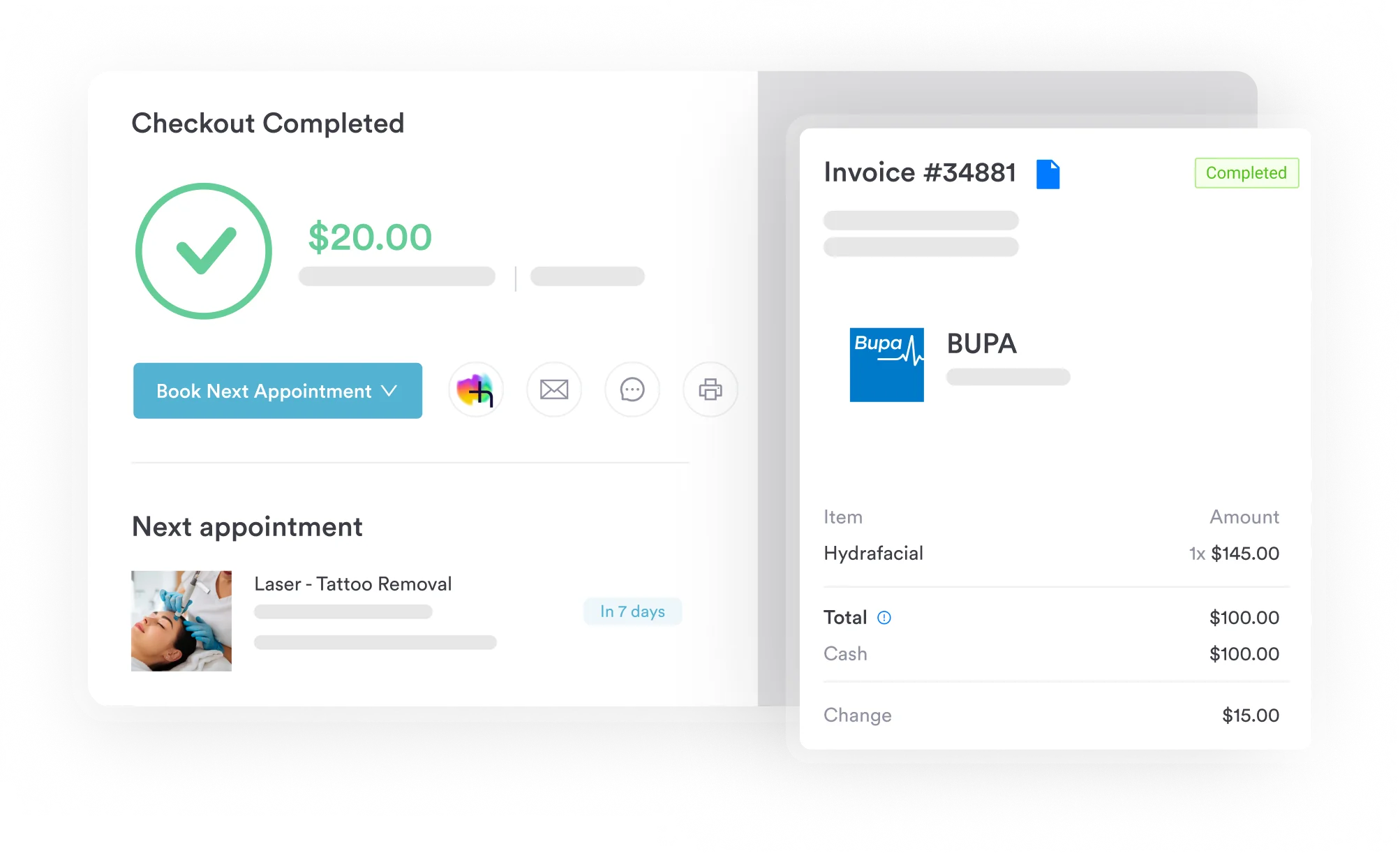

Pabau helps UK private practices track procedure codes, prior authorizations, and claim submissions in one place. See how it fits your bronchoscopy billing workflow.

E4850 rewards precision. Bill it when extraction was the point of the session, and pair it with the most specific T17 code the note supports. Keep E5180 off the same claim unless a separate indication justifies it.
The bigger risk sits in the operative note. A note that names the airway site, the scope, the instrument, and the removed object turns a likely query into a clean payment. Because E4850 pays less than diagnostic bronchoscopy, each resubmission eats a larger share of its fee.
Book a demo to see how Pabau links bronchoscopy notes, authorizations, and Healthcode claims in one patient record.

Coding another airway procedure from Chapter 5? CCSD Code E3900 covers billing for partial excision of the trachea with reconstruction.
Looking up a different procedure code? CCSD and procedure codes gathers Pabau’s CPT, HCPCS and CCSD billing guides in one place.
CCSD Code E4850 covers therapeutic bronchoscopy for removal of foreign body. That means the complete bronchoscopic episode in which a foreign object is visualized and extracted from the airway. It applies to both rigid and flexible bronchoscopy and covers the procedure regardless of the patient’s age, including pediatric foreign body aspiration cases.
Yes. CCSD Code E4850 applies to both rigid and flexible bronchoscopic approaches. The scope type is a clinical decision based on the patient’s age, the object’s location, and the available equipment. Coders should document the scope type in the operative note, as some payers may request this detail during review.
The correct ICD-10 pairings come from the T17 block, which covers foreign body in the respiratory tract. Use T17.3 for larynx, T17.4 for trachea, T17.5 for bronchus, and T17.8 for other or multiple parts. Use the most anatomically specific code the operative documentation supports. T17.9 (unspecified) should only be used when the site is undocumented.
For elective procedures, yes. Both Bupa and AXA Health require pre-authorization before interventional procedures including E4850. For emergency foreign body removal where delay would compromise the airway, most insurers allow retrospective notification. Verify the policy with the specific insurer before assuming the emergency exemption applies.
Not routinely. Billing E4850 alongside E5180 for a single session creates a bundling risk that most payers will challenge. If a bronchoscopy converts from diagnostic to therapeutic in the same session, bill only E4850. Concurrent billing is only justified when a separate diagnostic procedure is performed for an independent indication on the same date. Separate clinical documentation must support both codes.
Anesthesia is coded separately. E4850 covers the bronchoscopic extraction; the anesthesia episode is billed using the relevant CCSD anesthesia code. This applies whether a separate anesthesiologist is involved or the anesthesia is managed by the proceduralist. Confirm the specific anesthesia code against the current CCSD schedule and the insurer agreement.