HCPCS Code A4709: Acid concentrate solution for hemodialysis
What is HCPCS code A4709? HCPCS code A4709 is the Healthcare Common Procedure Co...

Last Updated: Oct 15, 2026
E3680 is the CCSD code for endoscopic laryngopharyngoscopy as sole out-patient procedure. It covers a flexible or rigid scope examination of the nasopharynx, oropharynx, hypopharynx and larynx, performed in an outpatient clinic under topical anaesthesia.
The descriptor sets two conditions. The patient must not be admitted as a day case or inpatient. The scope must also be the only procedural code billed for that episode of care.
Let Pabau's smart automation suggest the right codes, reduce claim denials, and keep your practice compliant—effortlessly.
Automate repetitive tasks and focus on what matters most—your patients.
Reduce coding errors and ensure compliance with the latest regulations.
Clean claims, fewer denials, and faster reimbursements.
Powerful insights and reporting to help your practice thrive.
HIPAA compliant SOC 2 certified GDPR-compliant Trusted by 4,000+ clinics worldwide

CCSD Code E3680 covers endoscopic laryngopharyngoscopy carried out as the sole outpatient procedure, not as part of a wider surgical episode.
The procedure note must confirm outpatient setting, scope type, all anatomical regions visualised, and clinical indication to pass insurer scrutiny.
Most claim denials trace to wrong code selection, missing prior authorisation, or a procedure note that records too little.
The next code in the sequence, E3681, covers stroboscopy of larynx, so numbering is no guide to clinical similarity.
Pabau’s clinical records and claims management tools help ENT teams capture the procedure note fields insurers require and submit invoices accurately.
CCSD Code E3680 defines endoscopic laryngopharyngoscopy as sole out-patient procedure. CCSD stands for Clinical Coding and Schedule Development. The CCSD Group maintains the schedule, and its members include Bupa, AXA Health, Aviva and Vitality. It gives UK private healthcare one set of procedure codes, so consultants and insurers describe the same clinical activity the same way.
E3680 sits in chapter 5 of the procedural schedule, Ear, Nose and Throat, within the larynx and trachea sub-chapter. It applies only where the laryngopharyngoscopy is the single procedural code billed for that outpatient episode.
The code captures a full upper-airway endoscopic examination. A flexible or rigid scope passes through the nasal cavity to visualise the nasopharynx, oropharynx, hypopharynx, and larynx including the vocal cords. NHS pathways use OPCS-4 rather than CCSD codes. As a result, consultants moving into private ENT work usually meet this schedule for the first time when they take on private cases.
The CCSD Group revises schedule wording from time to time. Because of this, note the schedule version whenever you quote a code descriptor in letters to an insurer.
Every CCSD code runs to five characters, and most are a letter followed by four numbers. The opening letter points at the chapter the code sits in, so an E code belongs to chapter 5, Ear, Nose and Throat.
The four digits that follow carry no clinical logic. Codes sitting next to each other in the sequence can describe unrelated work. For example, E3681 covers stroboscopy of larynx rather than another form of laryngopharyngoscopy. Select on the descriptor, and treat proximity in the sequence as meaningless.
That discipline holds across the whole schedule, not only in ENT. CCSD code A6740 covers cubital tunnel release only where the procedure is endoscopic and the ulnar nerve stays in its groove.
A consultant ENT surgeon or a suitably trained specialist performs endoscopic laryngopharyngoscopy as a diagnostic outpatient procedure. The most common instrument is a flexible fibreoptic or video nasolaryngoscope, which passes through the nose under topical anaesthesia. A rigid laryngoscope suits some cases, though flexible scope examination dominates outpatient ENT practice.
The typical procedure sequence runs as follows.
Total procedure time is usually 5 to 15 minutes. The procedure needs no general anaesthesia or sedation, so staff manage the patient throughout on an outpatient basis. That is exactly the setting E3680 captures.
E3680 is appropriate when a consultant performs a diagnostic laryngopharyngoscopy as the standalone outpatient procedure. The common clinical triggers include the following.
Faster access to diagnostic scoping than NHS waiting lists allow drives much of the private ENT referral flow. Record the clinical necessity plainly, because insurers read the indication alongside the procedure note when they assess an E3680 claim.
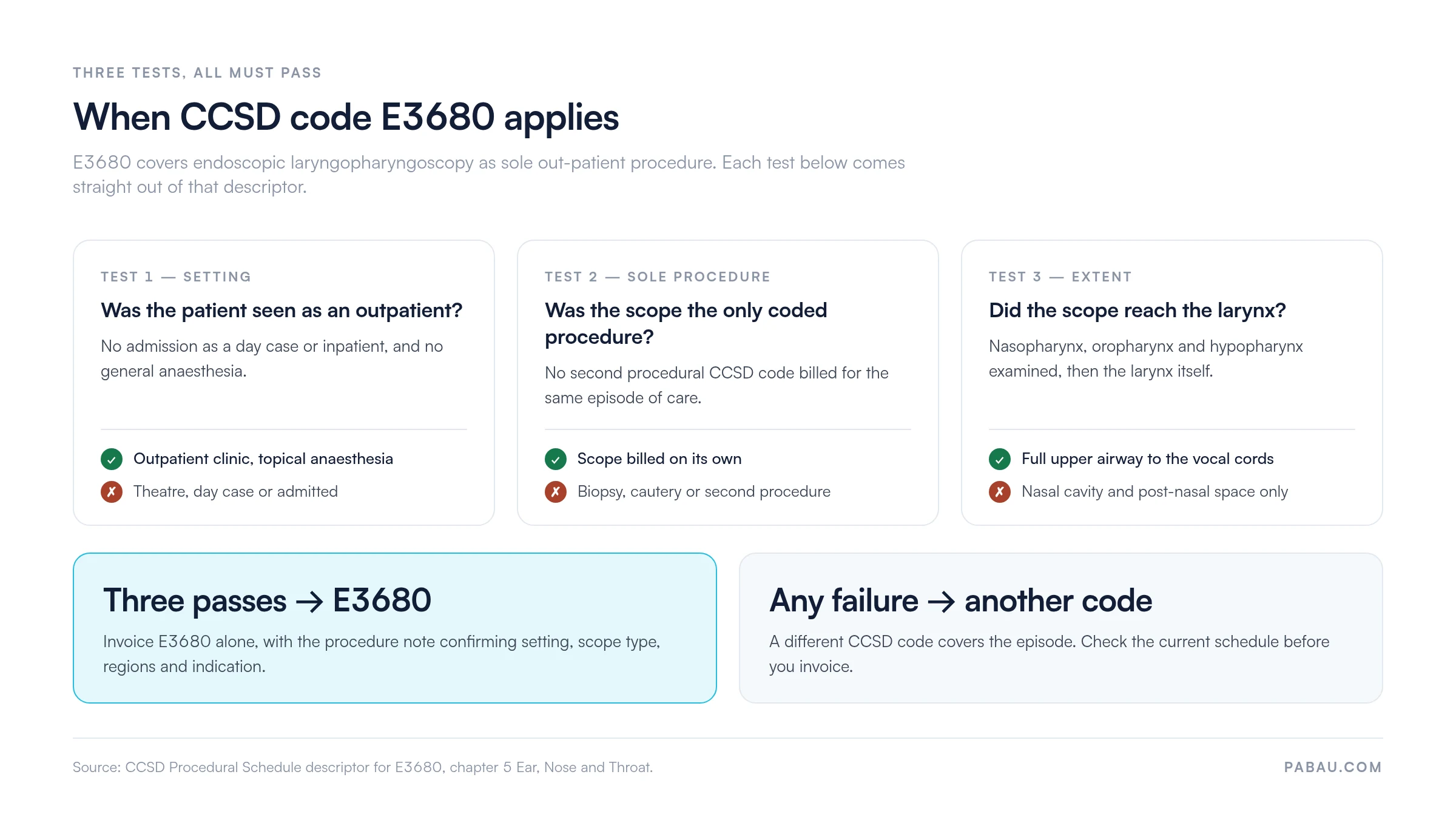
The phrase “sole out-patient procedure” in the E3680 descriptor carries the whole billing boundary for this code. Both halves of it have to hold before you invoice E3680.
“Sole procedure” means the laryngopharyngoscopy is the only procedural CCSD code you submit for that episode of care. Suppose the consultant also performs a nasal examination with instrumentation, a microlaryngoscopy biopsy, or another coded procedure at the same visit. E3680 no longer applies, and the episode takes whichever code describes the combined work.
“Outpatient” means the patient is not admitted as a day case or inpatient. E3680 does not apply if the consultant performs the scope under general anaesthesia on a combined operative list, or if the patient is admitted for any other reason.
Three tests decide whether the code fits an episode, and all three have to pass.
The most common coding error with E3680 is reaching for a code that sits nearby in the schedule but describes different clinical work. The table below sets E3680 against two codes ENT billing teams confuse it with. Verify every descriptor against the current schedule before you invoice, since the CCSD Group revises wording and code assignments.
E2500 appears in chapter 5 of the procedural schedule and chapter 35 of the diagnostic schedule, so the same code carries two classifications. Confirm both descriptors against the published schedule before billing either one. Quoting a neighbouring descriptor from memory is a frequent source of coding errors.
Run a quarterly audit of your ENT endoscopy claims. Filter for E3680 claims and check whether you submitted any on the same date as another procedural code. If they were, the episode likely warranted a different CCSD code, and resubmission may be necessary.
Insurers assessing an E3680 claim look for a fixed set of elements in the procedure note. Capture all of them before the claim leaves the system.
Retention periods come from the NHS Records Management Code of Practice and GMC guidance, not UK GDPR: eight years from the conclusion of treatment for adult records, and until the patient’s 25th birthday for a child. UK GDPR adds only the storage limitation principle, which asks you to justify retention rather than naming a period.
Insurers can request clinical records when they audit claims later, so note quality matters well past submission.
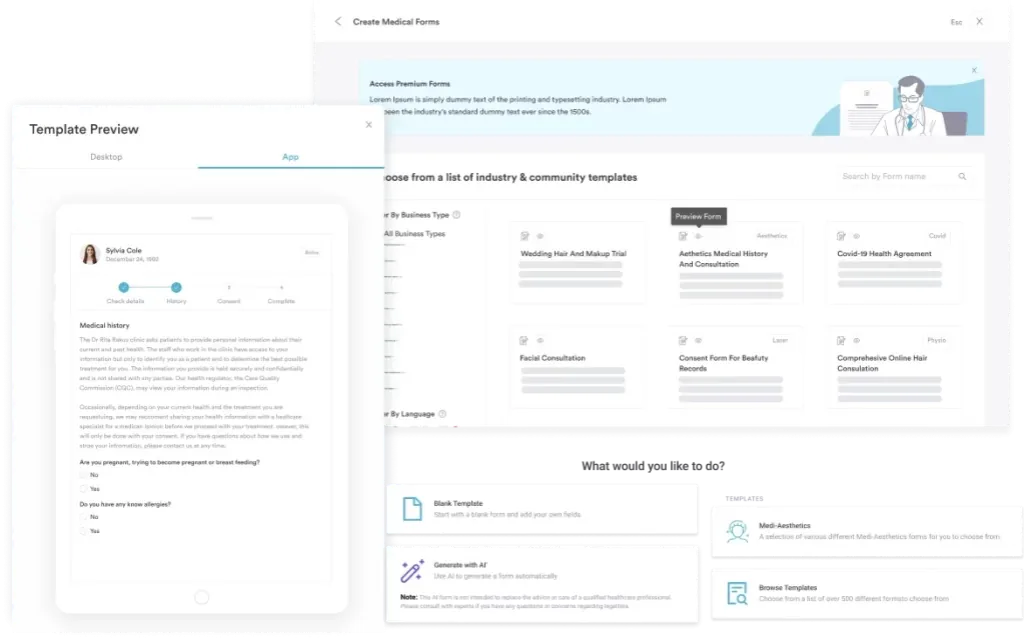
Practice management software like Pabau lets ENT teams build procedure-note templates with required fields for scope type, regions, findings, and indication, so the note is complete at the point of care rather than rebuilt weeks later.
Prior authorisation requirements for CCSD Code E3680 vary by insurer, policy type, and year of treatment. Always verify directly with each payer before proceeding, as requirements change without notice. The summary below reflects general patterns UK private healthcare billing teams report. It does not replace the current provider guidance of each insurer.
For Bupa, the Bupa CCSD codes reference covers how Bupa maps CCSD codes to its fee schedule, and the recognition requirements consultants must meet. Healix and Allianz Care run CCSD-based fee schedules with their own unbundling rules. Those rules decide how E3680 interacts with a consultation code billed at the same episode.
Denial patterns for CCSD Code E3680 are well established in UK private ENT billing. Most rejections fall into one of five categories.
Denial prevention belongs in the pre-submission checklist rather than in the appeals process. Confirm prior authorisation before the patient arrives, and match the invoiced code to the authorised code. Then check the procedure note is complete before you raise the invoice.
Yes, you may bill a consultation code alongside E3680 in certain cases, but the consultation and the procedure have to be distinct, and you have to note each one on its own.
The general CCSD principle allows you to invoice a consultation fee at the same episode as a procedural code. The consultation has to involve a separate clinical assessment, history-taking and management decision. A decision to perform the scope does not qualify on its own.
In practice, the consultant conducts a clinical consultation first, then performs the laryngopharyngoscopy as a separate act within the same appointment. Several payers, including Bupa, set their own policy on reimbursing both at one outpatient visit. Some allow it only where the procedure was incidental to the consultation rather than the purpose of the appointment.
Verify payer policy on co-billing before raising the invoice, and keep the procedure note and the clinical note as separate records.
Document the consultation and the laryngopharyngoscopy as two distinct entries in the patient record, each with its own date-timestamp, clinician note, and clinical rationale. Insurers rejecting co-billed claims often do so because the consultation and the procedure sit in one merged note. A merged note leaves no way to verify that a separate consultation took place.
The following workflow reflects standard practice for submitting an E3680 claim through UK private healthcare insurers. Adapt it to each payer’s portal and submission requirements.
Fee schedules for CCSD Code E3680 are payer-specific and subject to annual revision. A pound figure quoted without its source schedule goes stale within a year, so this section points at the official schedules instead.
Each major insurer publishes its own CCSD-based fee schedule or operates a recognised-consultant rate system.
The Private Healthcare Information Network (PHIN) publishes consultant-level pricing transparency data under the Competition and Markets Authority’s Private Healthcare Market Investigation Order 2014. Consultants must register fees for common outpatient procedures. PHIN data gives a market-range reference point for a procedure of this kind, but it is not a payer fee schedule.
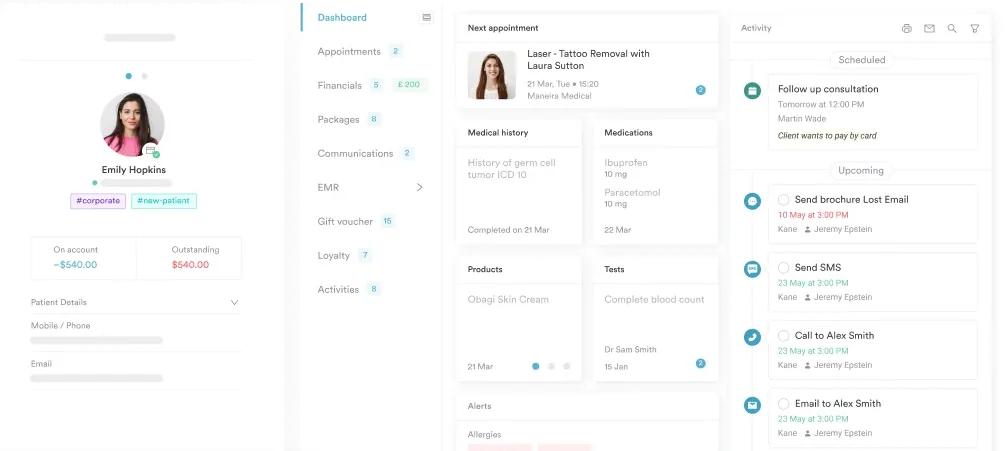
ENT practices using Pabau can build the documentation requirements for E3680 into the patient journey, rather than bolting them on at the billing stage. A procedure-note template prompts the clinician to record scope type, anatomical regions, findings, indication and setting at the point of care.
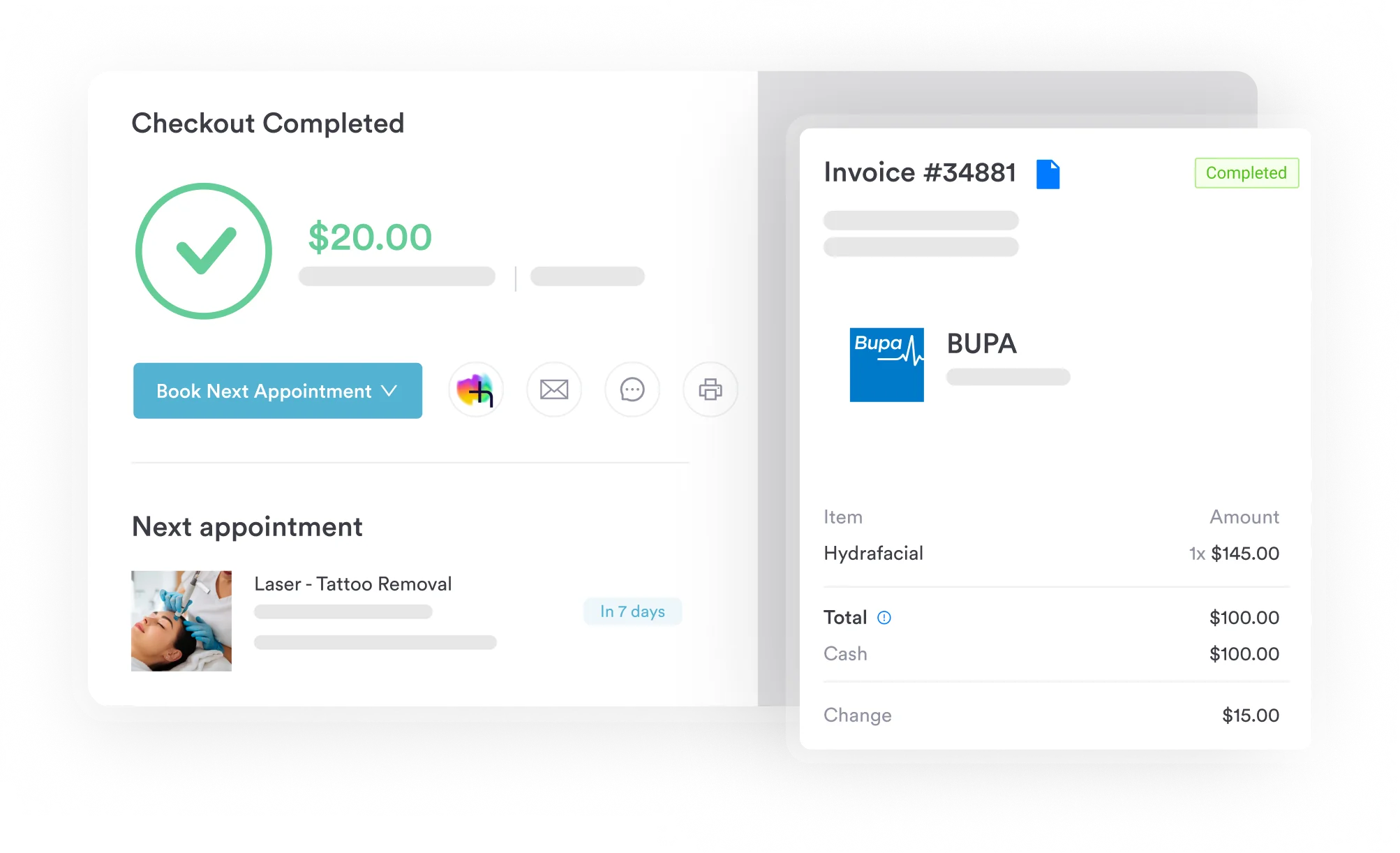
The completed note sits on the patient record, ready to attach to an insurer query. Invoices carry the CCSD code, the prior authorisation reference and the submission date, so the values an insurer cross-checks stay together.
A practice billing across Bupa, AXA Health, Aviva and others has several portals to track. Holding every claim in one system cuts the missed deadlines and mismatched references that drive E3680 denials.

Build CCSD-compliant procedure note templates, track prior authorisation references, and manage insurer claims for E3680 and every other code your ENT practice bills. See how Pabau supports UK private healthcare billing teams.

E3680 is straightforward when the episode matches its descriptor exactly. The scope has to be an endoscopic laryngopharyngoscopy performed as the sole outpatient procedure. Trouble starts at the edges, where the setting is ambiguous, a second procedure is added, or the note fails to record what the insurer needs.
Documentation written at the point of care, rather than rebuilt at billing, is what keeps E3680 denials down. Pabau’s structured clinical records and claims workflow build that discipline into every episode. Book a demo to see how Pabau keeps ENT procedure notes and insurer claims in step.

Need a broader guide to CCSD billing with Bupa? Bupa CCSD codes reference covers how Bupa maps CCSD procedure codes to its fee schedule and what consultants need to meet recognition requirements.
Looking for the rate behind an ENT procedure code? Bupa procedure codes fee schedule explains how Bupa sets rates by procedure code and by consultant recognition level.
Working through a batch of rejected invoices? Denial codes in medical billing sets out the reasons payers give for a rejection and what each one asks you to fix.
CCSD Code E3680 covers endoscopic laryngopharyngoscopy performed as the sole outpatient procedure. That means a flexible or rigid scope examination of the nasopharynx, oropharynx, hypopharynx and larynx, carried out in an outpatient setting. No other procedural code may be billed at the same episode.
E3680 does not specify the scope type in its descriptor. Either a flexible fibreoptic or video nasolaryngoscope, or a rigid laryngoscope, may be used. In practice, flexible scope examination is the standard approach for outpatient laryngopharyngoscopy. State which instrument was used, so the note does not draw an insurer query.
Prior authorisation requirements vary by insurer, policy type, and year. Bupa and AXA Health usually require pre-authorisation for outpatient procedural codes including E3680, but policies differ. Always verify with the insurer before the procedure date, and record the authorisation reference number for the invoice.
Yes, in principle, though payer rules differ. Co-billing E3680 with a consultation code requires that the consultation and the procedure were distinct events within the same appointment, each documented separately. Some insurers accept co-billing. Others require the procedure to be the primary purpose of the visit, with no separate consultation fee. Verify the payer’s co-billing policy before submitting.