CPT Code 52352: Ureteroscopic stone removal billing guide
CPT Code 52352: Official descriptor and procedure overview CPT Code 52352 descri...

Last Updated: Oct 30, 2026
E1780 is the CCSD code for diagnostic endoscopy of sinus and bilateral (as sole procedure). An ear, nose and throat (ENT) specialist bills it after examining the sinuses with an endoscope, with no treatment in the same session.
The code sits in Chapter 5 (Ear, nose and throat), section 5.5.0 Nasal sinuses. One E1780 covers one side or both. Insurers such as Bupa and AXA Health set their own fees for it.
Let Pabau's smart automation suggest the right codes, reduce claim denials, and keep your practice compliant—effortlessly.
Automate repetitive tasks and focus on what matters most—your patients.
Reduce coding errors and ensure compliance with the latest regulations.
Clean claims, fewer denials, and faster reimbursements.
Powerful insights and reporting to help your practice thrive.
HIPAA compliant SOC 2 certified GDPR-compliant Trusted by 4,000+ clinics worldwide

CCSD code E1780 covers diagnostic endoscopy of the sinuses on one side or both, billed only when no other procedure is coded.
It sits in Chapter 5 Ear, nose and throat, section 5.5.0 Nasal sinuses.
The CCSD schedule lists sinus surgery codes such as FESS (E1432) and intranasal antrostomy (E1330) as unacceptable combinations with E1780.
The operative note should name the indication, the sinuses examined and the findings, and state that no treatment was given.
UK private medical insurers usually expect pre-authorization, and the authorization number should match the code on the claim.
CCSD code E1780 covers a diagnostic endoscopy of the sinuses performed as the sole procedure. The specialist passes an endoscope through the nose to inspect the sinus openings and lining. No tissue is treated or removed.
The full descriptor reads “Diagnostic endoscopy of sinus and bilateral (as sole procedure).” The “and bilateral” wording means one E1780 covers one side or both. A bilateral examination still goes on the claim once.
CCSD is the procedure and diagnostic coding schedule used across UK private healthcare. It is maintained by the CCSD Group, which is made up of representatives from four private medical insurers. Those insurers are Aviva, AXA Health, Bupa and Vitality.
The CCSD Group sets the CCSD codes and descriptors, while each insurer sets its own fee. Check the current figure in the payer’s schedule, such as the Bupa code search, before you quote the patient.
Diagnostic sinus endoscopy is a structured examination of the nasal cavity and paranasal sinuses. Specialists commonly use a rigid endoscope with a 0-degree or 30-degree lens. Most examinations take place in an outpatient room under topical anesthetic.
A standard diagnostic session runs in this order:
The split between looking and treating is the clinical basis of the sole-procedure wording.
The CCSD Technical Guide defines the phrase directly. A code with “as sole procedure” in its narrative should not be coded in addition to another procedure.
The guide also explains why. A procedure with this wording is ordinarily part and parcel of another procedure, unless it is performed on its own. So the diagnostic look is already paid within the surgical code.
The rule governs coding, not clinical practice. The specialist can still look before operating. That look just isn’t billed as a separate E1780.
Two scenarios show where coders go wrong:
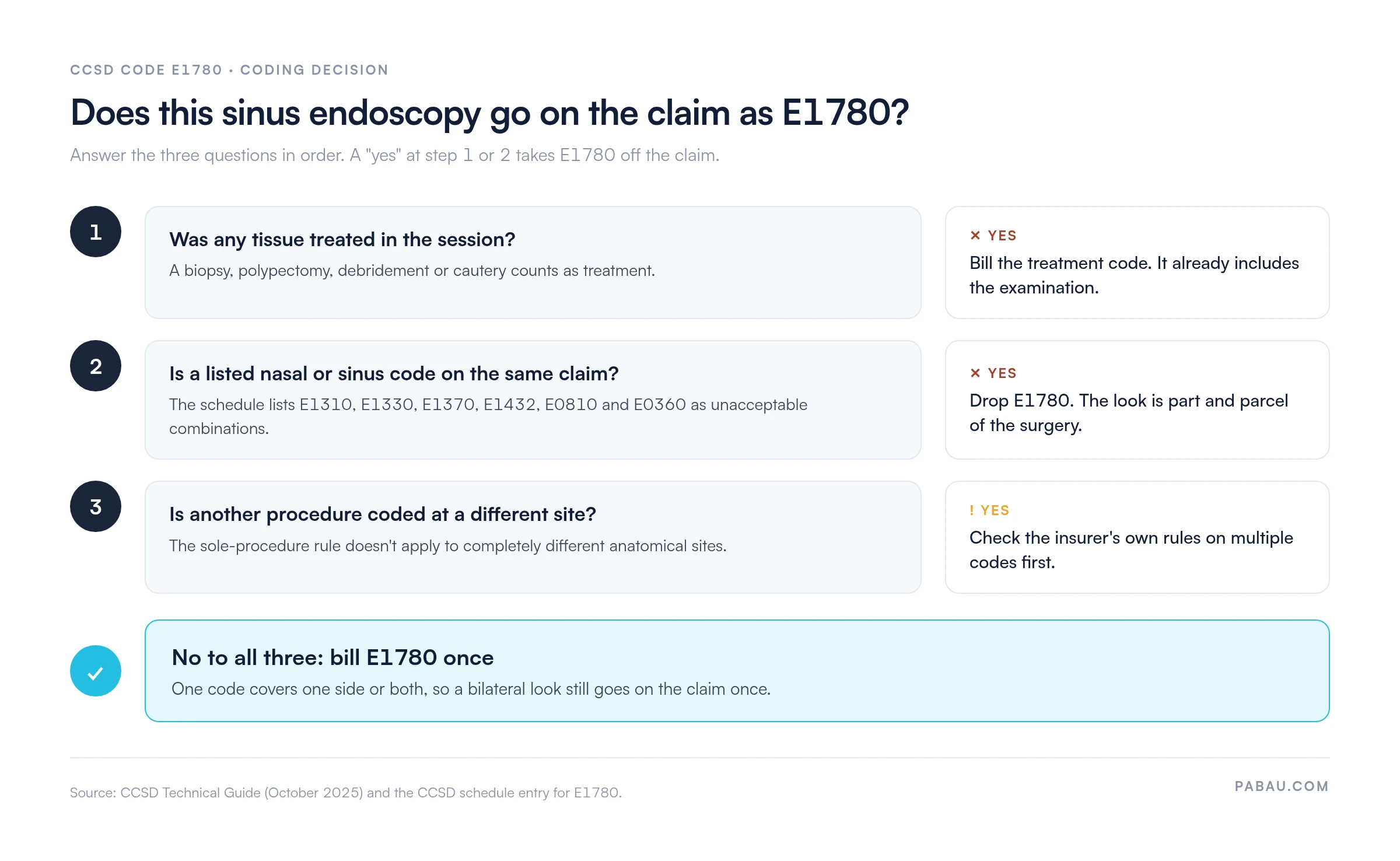
The practical test is simple. If any instrument beyond the endoscope is used to treat tissue, E1780 comes off the claim and the treatment code goes on. The three checks below put that test and the schedule’s combination rules in order.
E1780 fits when the purpose of the endoscopy is assessment rather than treatment. Common indications include:
Each of these scenarios ends at documentation. No tissue is removed and no structure is altered.
UK private medical insurers expect the claim to state the diagnosis behind the procedure. Many practices record it as an ICD-10 code taken from the operative note. Common pairings are shown below.
Code selection is the treating clinician’s call. The code should match the finding recorded in the note, not the working diagnosis at referral. Each insurer sets its own claim requirements, so check them before you submit.
E1780 sits among the sinus surgery codes in section 5.5.0, and one question separates them. Was the endoscope used only to look, or also to treat? The descriptors below are as published in the CCSD schedule.
The CCSD schedule lists E1310, E1330, E1370 and E1432 among the codes that can’t share a claim with E1780. The same list also includes nasal polypectomy (E0810) and septoplasty (E0360).
A scope of the nose, pharynx and larynx has its own code. E2500 covers diagnostic nasolaryngopharyngoscopy, with or without biopsy or cautery, as a sole procedure.
Codes and combinations change between schedule updates. Check them against the CCSD Technical Guide (updated October 2025) and the insurer’s own schedule. For insurer-specific detail, see Pabau’s CCSD code guide for Bupa procedures.
Insurers can query or reject an E1780 claim on documentation grounds, even when the procedure itself was right. The operative note should contain each of the following.
Add a yes/no field to your E1780 note template that asks whether any treatment was given in the session. A “yes” tells the billing team to swap E1780 for the treatment code before the claim goes out.
Templates help here. In Pabau, the practice management platform we build, digital forms can mark each of these fields as required. Patient records keep the note, the diagnosis and the invoice together, so an insurer query is answered from one file.
UK private medical insurers generally ask members to get pre-authorization before treatment. Rules vary by insurer and policy, so check before a diagnostic endoscopy too.
Usually, the patient calls their insurer and quotes the procedure code you give them. The insurer confirms cover and issues an authorization number. That number, the code and the date should all match the claim.
Authorization confirms cover, not payment. If the session turns into treatment, the code changes. Contact the insurer to update the authorization before you bill the new code.
Some policies also limit outpatient cover. Confirm the patient’s benefit before the appointment, and give a cost estimate if cover is uncertain.
The table sets out five common reasons an insurer rejects an E1780 claim, each with a direct fix.
The sole-procedure wording settles most cases, but three situations come up often.
Same session as sinus surgery: E1780 isn’t billed with a sinus surgery code in the same session. The CCSD schedule treats the diagnostic look as part of the operation, and insurers query claims that split it out.
Different anatomical site on the same date: The Technical Guide says the sole-procedure rule doesn’t apply to completely different anatomical sites. Each insurer still has its own contractual rules on multiple codes. Contact the insurer before you put two procedure codes on one claim.
Consultation on the same date: Some insurers pay an outpatient consultation alongside E1780 when the note records it as a separate event. Others treat it as part of the procedure fee. Check the insurer’s rules before you bill both.
Diagnostic endoscopy claims are small but frequent. The details often get typed twice, first into the practice system and then into the claim, with the authorization number copied from an email.
Pabau connects to Healthcode, so the claim builds from the patient record instead. With claims management, the CCSD code, membership number and authorization reference carry across without retyping.
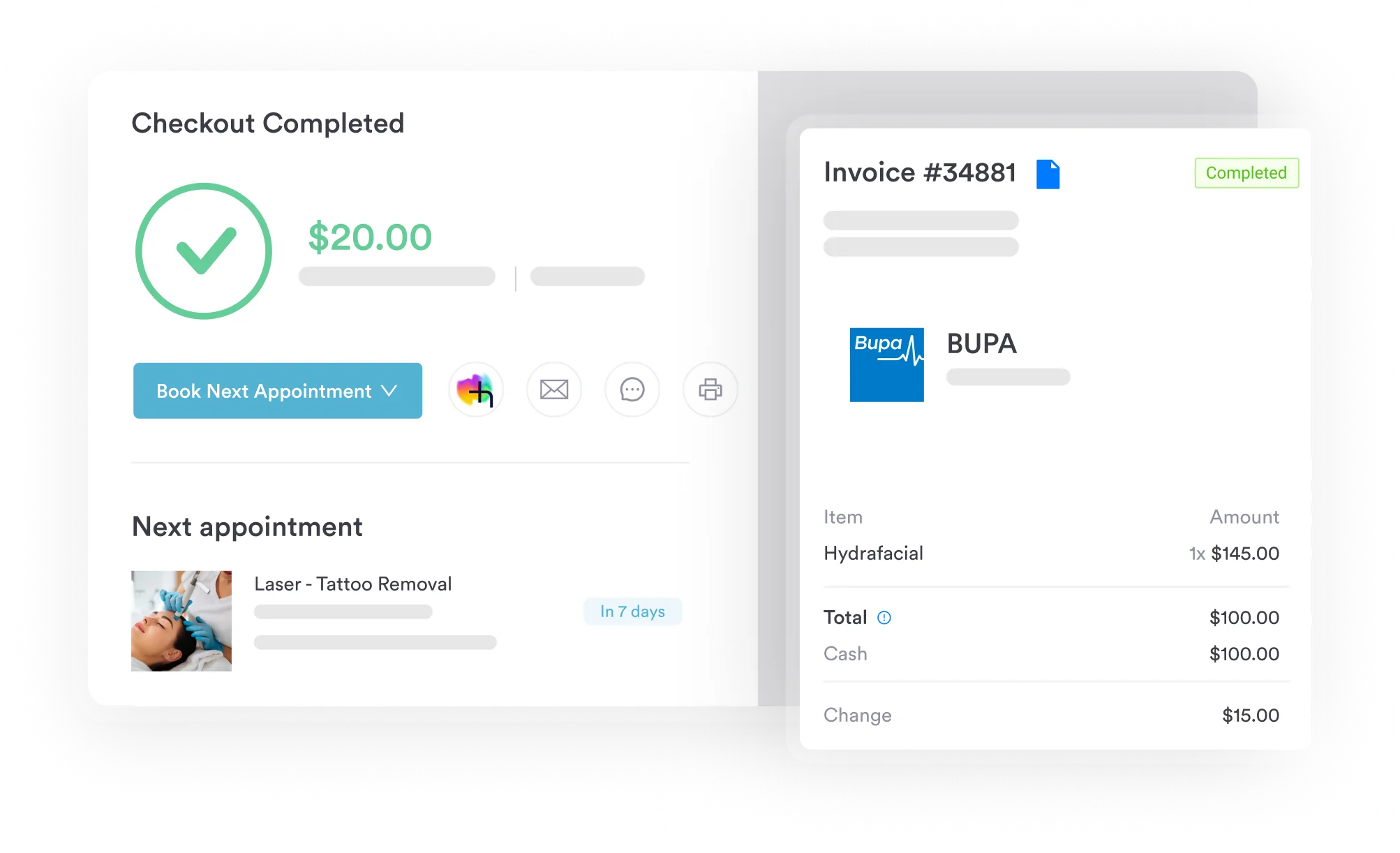
Consent and medical history forms are completed before the appointment and saved to the same record. When an insurer asks for evidence, your team finds it in one place. To see this workflow for an ENT practice, book a demo.

Pabau builds CCSD claims like E1780 from the patient record, with the authorization reference attached. Your team then tracks every claim in one place.

E1780 is a narrow code. It pays for a look at the sinuses, on one side or both, and only when no other procedure is coded.
So settle the operative note first, then the code, then the claim. Once the note names the indication, the sinuses examined and the findings, the code choice is quick. The CCSD combination list and the insurer’s own rules then show what must stay off the claim.
Book a demo to see how Pabau carries an E1780 claim from the patient record to Healthcode without retyping.

Billing full sinus surgery? CCSD code E1432 covers bilateral FESS and the procedures it already includes.
Working on the sphenoid sinus? CCSD code E1500 explains how sphenoid sinus operations are coded.
New to the CCSD schedule? CCSD codes sets out how the chapters and code structure work.
Want every Bupa code in one place? Bupa CCSD procedure codes lists the schedule and its fee categories.
Sending claims to Healthcode? Pabau’s claims management builds each claim from the patient record.
E1780 covers a diagnostic endoscopy of the sinuses, on one side or both, performed as the sole procedure. The specialist examines the sinuses with an endoscope and gives no treatment in the same session.
Bill E1780 when the endoscopy is the only procedure coded for that attendance. Typical cases are post-FESS checks, chronic sinusitis assessment before a surgery decision, and epistaxis investigation without cautery.
Common pairings are J32 codes for chronic sinusitis and J33.0 or J33.9 for nasal polyps. J30 codes cover allergic rhinitis, J34.2 a deviated septum and R04.0 epistaxis. The code should match the finding recorded in the operative note.
Most UK private medical insurers ask members to get pre-authorization before treatment, and rules vary by insurer and policy. The patient usually calls the insurer with the code and receives an authorization number for the claim.
E1780 is a diagnostic look with no treatment. FESS codes such as E1432 cover surgery that treats or removes tissue. The surgical code already includes the examination, so E1780 isn’t billed with it in the same session.
Common reasons are E1780 billed with a sinus surgery code, a missing or mismatched diagnosis, or no authorization number. An operative note without a clear statement that no treatment was given is another.
The operative note should include the indication, the endoscope type and angle, the sinuses examined and their findings. It should also state that no treatment was given. Stored endoscopic images add useful evidence.
Not with a sinus surgery code in the same session. The CCSD Technical Guide says the sole-procedure rule doesn’t apply to completely different anatomical sites. Insurers set their own rules on multiple codes, so check before you submit.