HCPCS Code J1560: Gamma globulin IM injection billing guide
HCPCS Code J1560: Official descriptor and covered services HCPCS Code J1560 carr...

Last Updated: Nov 11, 2026
30905 is the CPT code for control of nasal hemorrhage, posterior, with posterior nasal packs and/or cautery, any method; initial. It covers the first physician control of a bleed that starts deep in the nasal cavity, near the sphenopalatine artery. Anterior-only techniques cannot reach that source.
That posterior origin separates 30905 from the anterior codes 30901 and 30903, and first-control status separates it from 30906. Choosing the wrong code in the 30901-30906 family is a common source of denials.
Let Pabau's smart automation suggest the right codes, reduce claim denials, and keep your practice compliant—effortlessly.
Automate repetitive tasks and focus on what matters most—your patients.
Reduce coding errors and ensure compliance with the latest regulations.
Clean claims, fewer denials, and faster reimbursements.
Powerful insights and reporting to help your practice thrive.
HIPAA compliant SOC 2 certified GDPR-compliant Trusted by 4,000+ clinics worldwide

CPT code 30905 covers initial control of a posterior nasal hemorrhage with posterior nasal packs and/or cautery, any method.
ICD-10 R04.0 (epistaxis) is the primary diagnosis paired with 30905, and the procedure note must state the posterior location explicitly.
Bill 30906 for a subsequent posterior control on the same bleed, never a second 30905.
When anterior and posterior control happen in one session, report 30905 alone, because NCCI bundles 30901 and 30903 into it.
Pabau, the practice management platform we build, lets ENT practices submit claims, check eligibility and track remittances through Claim.MD.
CPT code 30905 is the code for the initial control of a posterior nasal hemorrhage. The American Medical Association descriptor reads Control nasal hemorrhage, posterior, with posterior nasal packs and/or cautery, any method; initial. The code covers physician control of active bleeding from a posterior nasal source. Posterior hemorrhage control may be achieved by:
The technique is bundled into the code value. You do not change codes based on whether a balloon catheter versus gauze pack was used. What determines 30905 versus any other epistaxis code is anatomy (posterior origin) and service sequence (initial, not subsequent).
What 30905 does NOT cover:
The 309xx family covers four distinct epistaxis scenarios. Choosing the wrong one is a common source of denials. This table uses the AAPC CPT code reference framework to map each clinical scenario to the correct code.
30905 vs. 30906 decision logic: Bill 30905 for the first time posterior control is performed for a given bleed. If the physician must return to control bleeding from the same episode (the pack re-saturates, or the bleed recurs), bill 30906. Do not re-bill 30905 on a second encounter for the same posterior hemorrhage. That re-bill is a frequent sequencing error in this code family, and the decision path below puts both questions in order.
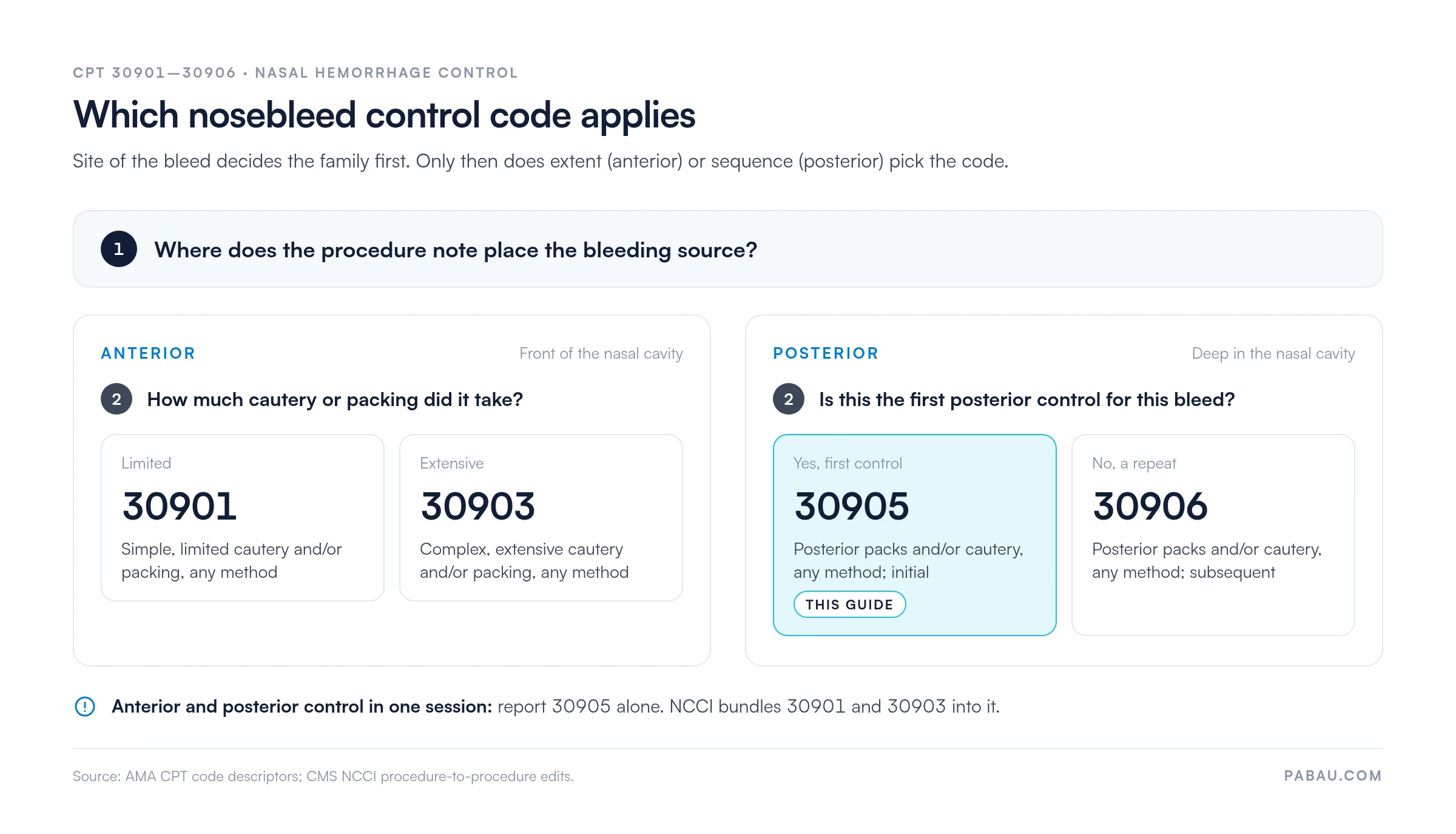
The anterior codes turn on extent. The posterior codes turn on sequence.
Document the anatomical origin of the bleed explicitly in the procedure note. Write ‘posterior nasal hemorrhage’, not just ‘epistaxis’ or ‘nasal bleed’. Payers read that wording to match the claim to the right code. Vague documentation is a common cause of 30905 downcodes to 30901.
ICD-10 R04.0, Epistaxis, is the primary diagnosis code paired with CPT code 30905 on the claim. R04.0 is a billable code and requires no additional character beyond the fourth digit. The diagnosis alone does not establish medical necessity for the posterior approach. The documentation must support it.
Secondary diagnoses are not mandatory. They do strengthen the medical necessity argument when a payer asks why simpler anterior management was not enough. A claim for a hypertensive patient on warfarin who bled from a posterior source tells a clinically coherent story. R04.0 alone on a 30905 claim is technically correct but provides less context.
Medicare pays CPT code 30905 under the CMS Medicare Physician Fee Schedule (MPFS). Rates differ by place of service and are adjusted by the Geographic Practice Cost Index (GPCI) for each Medicare Administrative Contractor (MAC) locality. The national figures below use the CY2026 relative values and the non-qualifying conversion factor of $33.4009. Qualifying APM participants are paid at $33.5675 instead.
The non-facility rate applies when the procedure is performed in the physician’s office. The facility rate applies in a hospital outpatient department or emergency department, where the facility is paid separately for its overhead. Nearly the whole difference sits in practice expense, at 9.53 RVUs in the office against 0.66 in a facility.
The RVUs come from the CMS PFS relative value file, and the MPFS look-up tool gives locality-adjusted rates. Commercial contracts vary. Many use the MPFS as a base multiplier, so the facility and non-facility split often carries over to commercial claims.
A clean 30905 claim rests on a procedure note that documents six specific elements. An E/M note that only says the epistaxis was managed is not sufficient.
When 30905 is billed from an emergency department, the same documentation requirements apply. The place of service shifts the reimbursement rate; it does not change what the operative or procedure note must contain.
Two modifiers come up regularly on 30905 claims, and modifier 50 is not one of them. The code already describes posterior control on either or both sides, so modifier 50 is never appended. A wrong or missing modifier is a denial trigger worth catching in your claims management workflow before submission.
Billing CPT code 30905 on the same day as septoplasty code 30520 is a contested scenario in ENT coding. The core issue is NCCI (National Correct Coding Initiative) bundling. CMS maintains NCCI edit tables that identify procedure pairs where one code is typically included in another.
Check the current NCCI PTP table for the 30905 and 30520 pair before billing. Where an edit is active, payers bundle the epistaxis control into the surgical package unless a modifier applies. Inside the epistaxis family, NCCI bundles 30901 and 30903 into 30905, and 30906 is a Column 2 code to 30905.
When 30905 is included in the surgical package: A patient may bleed during or right after a septoplasty. The surgeon then controls it in the same operative session. That management is typically part of the global surgical package for 30520, and it is not separately billable.
When 30905 may be separately billable: A posterior hemorrhage can be a postoperative complication that needs a separate return to the procedure room. The bleed can also come from a site unrelated to the surgical field. In either case, modifier 59, or the more specific XS for a separate structure, may allow separate billing.
Document clearly that the bleeding source is distinct from the operative field and that a separate procedure was required. CMS updates the NCCI edit pairs quarterly, so verify the pair in the current table before billing. A practice’s denial management workflow should include a pre-claim NCCI check for any same-day surgical pair.
30905 denials tend to trace back to six root causes. Each is preventable with the right documentation protocol and a pre-submission eligibility and edit check. Reading common denial codes alongside payer EOBs speeds up the appeals process.
Run a pre-submission eligibility check for every 30905 claim, not just the complex ones. Prior authorization rules for this code vary by payer and plan type, and an unexpected PA requirement is a common source of avoidable denials. Pabau’s Claim.MD integration runs real-time eligibility verification before the claim goes out.
Prior authorization requirements for CPT code 30905 vary by payer, plan type, and care setting. Traditional Medicare does not generally require prior authorization for this code. Confirm the rule payer by payer, and document an emergent or urgent encounter as such, since many commercial payers handle those differently.
Medicare Advantage plans are not bound by traditional Medicare PA rules and many do require authorization. Commercial PPO and HMO plans vary widely. ENT practices billing 30905 to commercial payers should maintain a payer-specific PA matrix updated at least annually. For practices using the clean claim submission process, confirming authorization status before the claim goes out is a standard pre-transmission gate.
What most PA requests for 30905 require:
Billing 30905 well starts with a procedure note that names the posterior site and a coder who checks NCCI edits before submission. Today many ENT practices then re-key that claim into a separate clearinghouse portal. Pabau connects to the Claim.MD clearinghouse instead.
Your team submits CMS-1500/837P claims, checks eligibility and receives 835 ERAs through Claim.MD without leaving Pabau. The remittance lands on the same patient record as the procedure note. A denial can then be read beside the documentation behind it.
Every plan includes the core features, and add-ons enhance the experience. In a practice with a high volume of ENT procedure claims, billing staff spend less time moving data between systems. That time goes to the claims that need judgment.

Submit ENT procedure claims, check eligibility and track remittances through Pabau’s Claim.MD integration. Book a demo to see the workflow for your practice.

CPT code 30905 rewards precision in the procedure note. The phrase “posterior nasal hemorrhage” is what separates a payable 30905 from a downcode to 30901. Write the site and the technique into every note, and pick the code by site first and sequence second. Check NCCI edits before any same-day surgical claim.
The trade-off is a few extra lines of documentation per encounter, which cost far less than an appeal. Pabau lets ENT practices submit those claims, check eligibility and track remittances through Claim.MD in one place. Book a demo to see how that workflow handles 30905 and the wider ENT code set.

Need to understand how clearinghouse claim validation works? Claim.MD clearinghouse guide explains how EDI claim validation reduces denials before claims reach payers.
Looking for a primer on the full billing cycle? What is medical billing covers the end-to-end revenue cycle from charge capture through payment posting.
Want to reduce overall claim rejection rates? Revenue cycle management guide outlines the workflow improvements that lower denial rates across all procedure codes.
CPT code 30905 covers initial control of a posterior nasal hemorrhage with posterior nasal packs and/or cautery, any method. It applies when a physician controls active bleeding from a posterior nasal source using posterior packing, balloon catheterization, or cautery. It does not cover anterior-only bleeds or repeat intervention on the same bleed.
30901 covers simple anterior nasal hemorrhage control with limited cautery and/or packing. 30905 covers initial posterior control, which targets a deeper bleeding source. The anatomical origin of the bleed determines the code, not the technique complexity alone.
CPT 30906 is the subsequent posterior nasal hemorrhage control code. Use it when the same bleed needs a second physician intervention, on the same or a later date. Bill 30905 for the first session and 30906 for any additional session for the same episode. Never re-bill 30905 for a second intervention on the same bleed.
Only if the hemorrhage control was a separate, distinct service from the surgical procedure. NCCI bundling edits typically include posterior epistaxis control within the global surgical package for same-session nasal surgery. Modifier 59 or XS may override the edit when the bleeding source is unrelated to the operative field and a separate procedure was required. Clinical documentation must clearly support the distinction.