HCPCS code C1731: Catheter billing, OPPS reimbursement, and denial guide
HCPCS code C1731: Official descriptor and code series context HCPCS code C1731 i...

Last Updated: Oct 8, 2026
D2630 is the CCSD code for osseous labyrinthectomy, surgery that removes the membranous labyrinth from inside the bony labyrinth of the inner ear. The surgeon reaches it through the mastoid bone. The operation ends all remaining hearing and balance function in that ear, so it's kept for disabling vertigo where hearing is already non-serviceable.
Bupa bands D2630 as MAJOR+ 3 in its fee schedule. Most private insurers want pre-authorization first, and the operation note has to confirm bony labyrinth access. It should also record the hearing loss as a planned result of the surgery.
Let Pabau's smart automation suggest the right codes, reduce claim denials, and keep your practice compliant—effortlessly.
Automate repetitive tasks and focus on what matters most—your patients.
Reduce coding errors and ensure compliance with the latest regulations.
Clean claims, fewer denials, and faster reimbursements.
Powerful insights and reporting to help your practice thrive.
HIPAA compliant SOC 2 certified GDPR-compliant Trusted by 4,000+ clinics worldwide

CCSD Code D2630 covers osseous labyrinthectomy, which removes the membranous labyrinth inside the bony labyrinth and ends all hearing and balance function in that ear.
Hearing loss in the operated ear is the planned result of the surgery. Operative notes must record it that way to meet medical necessity criteria.
Most private insurers require pre-authorization before the procedure, and a missing pre-auth reference is a common reason D2630 claims are denied.
Bupa bands D2630 as MAJOR+ 3, so check each insurer’s fee schedule and bundling rules before you bill.
Pabau’s claims management software blocks a D2630 claim from being sent until the membership number and authorization code are filled in.
CCSD Code D2630 is assigned to osseous labyrinthectomy, defined by the CCSD schedule as surgical destruction of the membranous labyrinth within the bony labyrinth. It sits in the inner ear section of the schedule’s ear, nose and throat chapter. Bupa bands it MAJOR+ 3 in its fee schedule.
Our CCSD codes for billers index lists the neighboring inner ear and vestibular procedures. It helps when you need to rule out a close alternative.
The “osseous” qualifier matters clinically. Osseous labyrinthectomy requires access through the bony labyrinth itself, while a membranous-only approach stops short of it. That difference drives both the code selection and the documentation standard, because the operative report must confirm bony access.
Osseous labyrinthectomy is the surgical destruction of the membranous labyrinth, performed via a transmastoid approach. The surgeon drills through the mastoid bone to access the bony labyrinth, then removes the membranous structures within the semicircular canals and vestibule.
The cochlea is also disrupted during the procedure, so residual hearing is lost permanently. The surgeon plans for that loss from the start. Insurers read the operative note closely on this point. A note that calls the hearing loss a risk or an adverse event invites a medical necessity challenge.
Osseous labyrinthectomy is reserved for patients with end-stage vestibular dysfunction and non-serviceable hearing, where conservative and less destructive surgical options have already been exhausted. It is not a first-line treatment.
The primary indication is intractable Meniere’s disease (endolymphatic hydrops). That usually means disabling episodic vertigo that hasn’t responded to diet changes, diuretics, intratympanic steroid or gentamicin injections, or endolymphatic sac surgery.
Non-serviceable hearing is generally taken as a speech discrimination score below 50% or a pure-tone average above 50 dB. Insurers apply their own thresholds, so check current policy before citing specific values.
Each of these indications needs documented evidence in the clinical record. A bare reference to “intractable Meniere’s disease” in the operative report is rarely enough. The claim record has to show the treatment pathway the patient went through before surgery was proposed.
Billing D2630 through UK private insurers follows a set sequence. Skipping a step raises the denial risk on a code that already carries a heavy documentation load.
If Bupa is the patient’s insurer, start with the Bupa CCSD codes list, because Bupa publishes its own approved codes and fee schedule. For any insurer, confirm D2630 is on the covered code list before the procedure date.
Practices billing several ENT surgeries a month can use claims software for specialists to catch a missing authorization code before submission. On a high-value claim like D2630, that saves a full resubmission cycle.
Private insurers review D2630 closely because the outcome is irreversible and the candidacy criteria are narrow. Medical billing compliance here means assembling the full record before the claim leaves the practice. The table lists what each document has to show.
The ICD-10 diagnosis code paired with CCSD Code D2630 must match the operative indication exactly. In UK private billing, ICD-10 codes follow the NHS Classifications Browser hierarchy, so check the current edition before submitting.
The codes above follow the international WHO classification. The NHS hierarchy may add local extensions, so confirm the code on the claim matches the primary indication in the clinical notes.
Several otology procedures treat the same vertigo, so a neighboring code is an easy mistake. D2630 is set apart by bony labyrinth access combined with the planned, permanent hearing loss from cochlear involvement. Endolymphatic sac surgery, often tried before labyrinthectomy, bills separately under D2610.
Two questions settle the code, in a fixed order, as the diagram below shows.
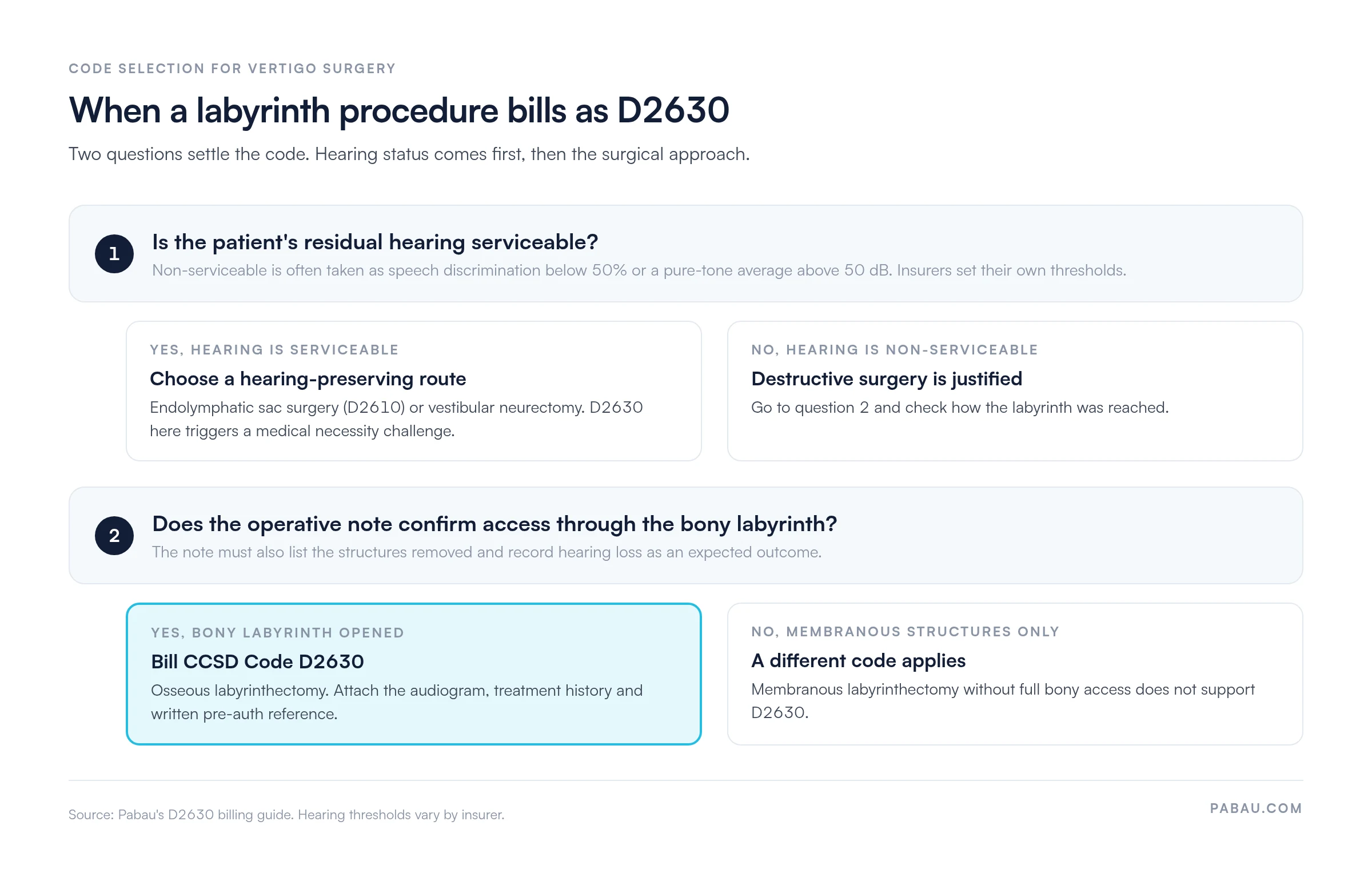
The table below sets the four procedures side by side.
The costliest mix-up for D2630 is with vestibular neurectomy. Both treat intractable vertigo, and hearing is what separates them. A patient with serviceable hearing suits vestibular neurectomy, which preserves cochlear function. Billing D2630 for that patient triggers a medical necessity challenge, because destroying usable hearing isn’t clinically justified.
Treat pre-authorization as mandatory for D2630 with every UK private insurer. Osseous labyrinthectomy is inpatient surgery with a permanent outcome, and that combination draws the closest review most insurers apply.
Coverage policies and benefit levels change. The details above reflect general patterns in UK private healthcare, so check each insurer’s current provider guidance before relying on them for a patient’s claim.
D2630 has a narrower candidacy window than most ENT codes, so a single missing document can sink the claim. Effective denial management in healthcare starts with knowing the common denial reasons before the claim is lodged.
A denial can be challenged. Most UK private insurers run a formal appeals process, and documentation-based D2630 denials are often reversed with the right additional evidence.
ENT practices that bill D2630 regularly should build a pre-submission checklist into their workflow. The candidacy requirements are specific enough that a standard check catches the usual omissions before the claim goes out.
A clean claim submission for D2630 has the audiogram, treatment pathway, pre-auth reference and operative report filed and cross-referenced before it goes out. Assembling them after a denial arrives costs far more time.
Review each insurer’s bundling rules for D2630 every year, not only at setup. Healix and other insurers occasionally revise their CCSD unbundling guidelines. A mastoidectomy access code that was billable separately last year may sit inside the D2630 fee this year.
Many ENT practices still assemble a D2630 claim from separate places. The pre-auth reference sits in an email, the audiogram in a scanned file, and the invoice in a billing tool that sees neither.
Pabau, the practice management system we build for private practices, keeps the patient’s insurer and policy on their record. When the invoice is ready, Pabau pulls the patient, procedure and insurer details into a pre-filled Healthcode submission.
Before the claim goes, Pabau checks that the membership number and authorization code are in place. If one is missing, the Send button stays disabled until someone adds it. Each claim then shows its status on one dashboard, so your billing team knows which D2630 claims still need chasing.
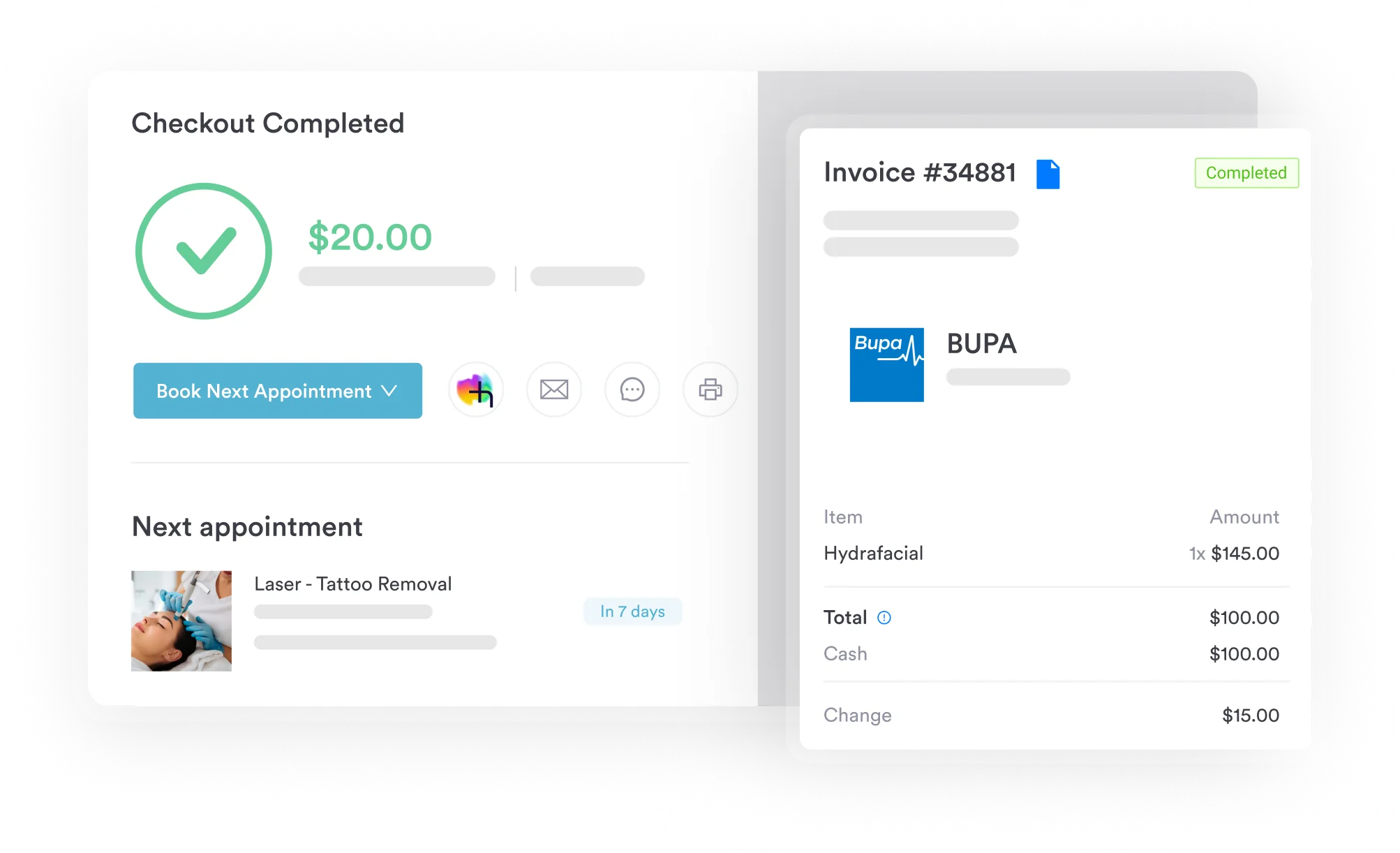

Pabau checks each claim for the membership number and authorization code before it goes to the insurer, then tracks it through to payment.

A D2630 claim is won or lost on paperwork that exists before the patient is admitted. When the audiogram, the dated treatment history and the written pre-auth reference are on file first, the insurer has little left to dispute.
The trade-off is effort up front. A D2630 operative note template and a one-page pre-auth pack take time to build once. After that, they stop the same wording and dating errors from coming back on every claim.
Book a demo to see how Pabau checks authorization codes and tracks every ENT claim from submission to payment.

Coding other ear procedures? CCSD Code D2030 explains how to bill grommet removal and what the operative note must name.
CCSD Code D2630 is the UK private healthcare procedure code for osseous labyrinthectomy. The surgery destroys the membranous labyrinth within the bony labyrinth of the inner ear. It is used primarily to treat intractable Meniere’s disease in patients with non-serviceable residual hearing.
Osseous labyrinthectomy is indicated for intractable Meniere’s disease that hasn’t responded to medical or less destructive surgical treatment. It also covers end-stage unilateral vestibular dysfunction and chronic suppurative labyrinthitis with cochlear destruction. Most insurers require non-serviceable residual hearing first.
The key billing difference is hearing preservation. Vestibular neurectomy cuts the vestibular nerve, preserves cochlear function, and suits patients with serviceable hearing. Osseous labyrinthectomy (D2630) destroys cochlear function and applies only where hearing is already non-serviceable. Using D2630 for a patient with serviceable hearing triggers a medical necessity challenge.
Yes. Most major UK private insurers require pre-authorization for D2630, because it is inpatient surgery with a permanent outcome. The request usually needs audiological evidence of non-serviceable hearing, a treatment history, and the consultant’s clinical justification letter.
The most common reasons are missing or lapsed pre-authorization and serviceable hearing documented before surgery. Others include an operative report that doesn’t confirm osseous access, a diagnosis code that doesn’t match the indication, and thin evidence of prior treatment failure.
H81.0 (Meniere’s disease) is the primary supporting diagnosis in most cases. H81.3 (other peripheral vertigo) applies where the full Meniere’s triad isn’t present. H83.8 (other specified diseases of inner ear) covers end-stage vestibular dysfunction from other causes. Check current code versions in the NHS Classifications Browser before submission.