CPT code 28825: Amputation, toe; interphalangeal joint
CPT code 28825: official descriptor and anatomical scope CPT code 28825 is descr...

Last Updated: Oct 6, 2026
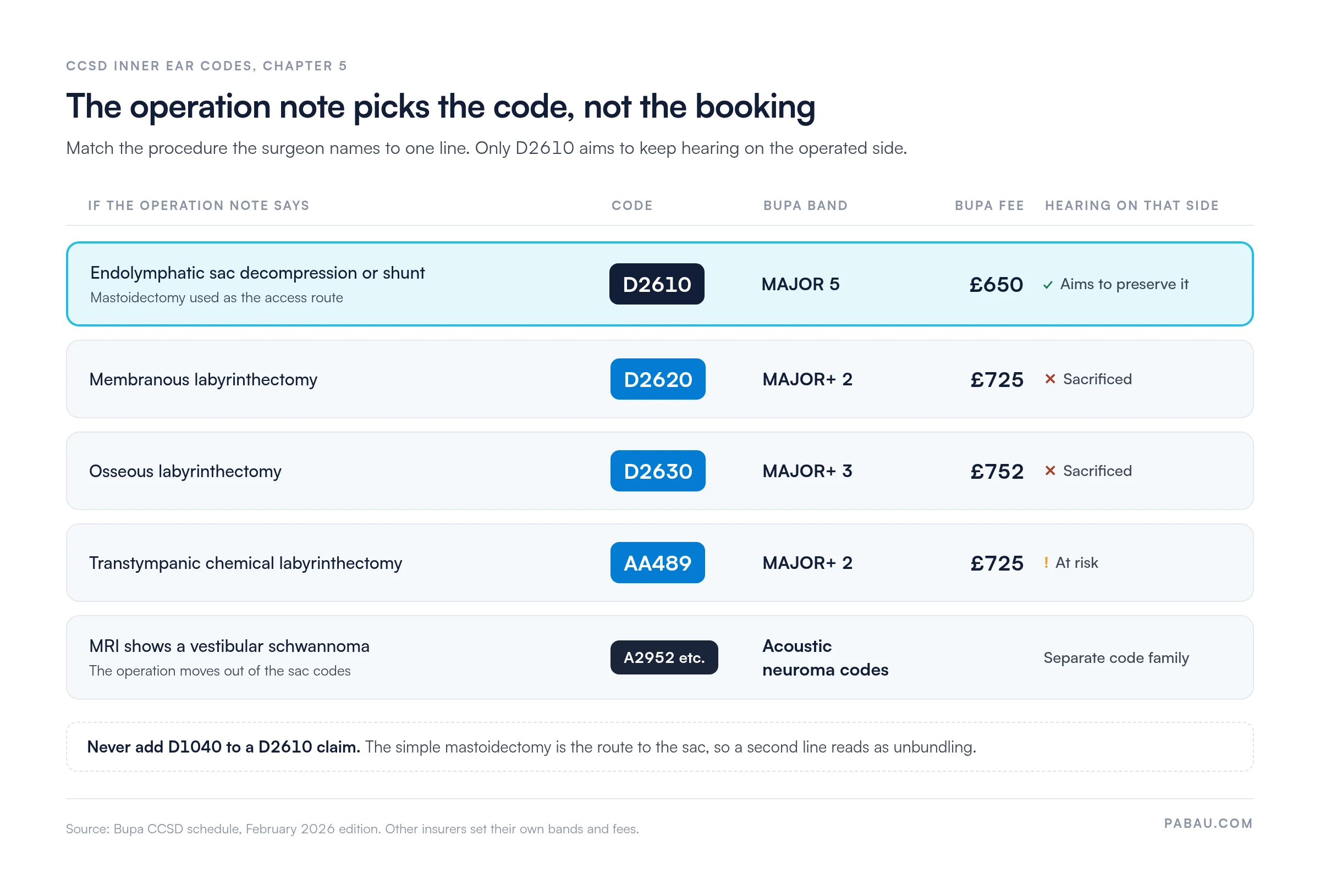
D2610 is the CCSD code for operation(s) on the endolymphatic sac, the inner ear surgery most often used to control vertigo in Ménière's disease. The surgeon opens the mastoid bone and decompresses the sac, sometimes adding a shunt. Bupa's February 2026 schedule bands it MAJOR 5, with a listed fee of £650.
On a claim, D2610 sits one line above two labyrinthectomy codes that destroy the balance organ and pay more. The operation note decides which code applies. Insurers also want proof that medical treatment failed before surgery was booked.
Let Pabau's smart automation suggest the right codes, reduce claim denials, and keep your practice compliant—effortlessly.
Automate repetitive tasks and focus on what matters most—your patients.
Reduce coding errors and ensure compliance with the latest regulations.
Clean claims, fewer denials, and faster reimbursements.
Powerful insights and reporting to help your practice thrive.
HIPAA compliant SOC 2 certified GDPR-compliant Trusted by 4,000+ clinics worldwide

CCSD code D2610 covers operation(s) on the endolymphatic sac, a hearing-preserving inner ear procedure used mainly for Ménière’s disease.
Bupa’s February 2026 schedule places D2610 in the MAJOR 5 band, with a listed fee of £650.
Labyrinthectomy is coded separately as D2620 or D2630, and both sit in Bupa’s higher MAJOR+ band.
Insurers look for a confirmed Ménière’s diagnosis, hearing tests and failed medical treatment before they authorize surgery.
The mastoidectomy is the access route to the sac, so it does not go on the claim as a second code.
CCSD code D2610 covers operation(s) on the endolymphatic sac. In practice, that means endolymphatic sac decompression, or decompression with a shunt. Surgeons use it mainly to control vertigo from Ménière’s disease.
The code comes from the CCSD schedule, published by the Clinical Coding & Schedule Development group. UK private medical insurers use that schedule to process specialist claims. The CCSD codes reference explains how its chapters fit together.
D2610 sits in Chapter 5, Ear, nose and throat, under the inner ear section. Its neighbors there include cochlear implants, acoustic neuroma excision and two labyrinthectomy codes.
Bands and fees belong to each insurer, not to CCSD. Bupa’s figures appear here because Bupa publishes them. AXA Health, Aviva and Vitality each set their own, so check the relevant schedule before you quote a patient.
Ménière’s disease causes attacks of spinning vertigo, fluctuating hearing loss, tinnitus and a feeling of pressure in the ear. It is linked to endolymphatic hydrops, a build-up of fluid inside the inner ear.
The endolymphatic sac is thought to help absorb that fluid. It lies against the dura on the back of the temporal bone, behind the inner ear. Sac surgery aims to relieve the pressure while keeping hearing and balance function intact.
A typical operation runs through five steps:
The whole sequence bills as one D2610 claim. Insurers treat the mastoidectomy as the route to the sac. Adding the simple mastoidectomy code D1040 to the same claim will usually be queried as unbundling.
Sac surgery is a second-line treatment. ENT surgeons usually offer it once vertigo attacks continue despite medical management. The NHS guidance on Ménière’s disease describes inner ear surgery as a rare step for symptoms that are hard to manage.
First-line care typically includes:
The evidence behind sac surgery is still debated. A Cochrane review of surgery for Ménière’s disease found two small trials, with 59 patients between them. It judged the evidence insufficient to show a benefit.
Many surgeons still offer the operation, because it preserves hearing where destructive options do not. For billing, that debate has one practical effect. A clinical reviewer may ask for more proof of medical necessity than usual.
Before you request authorization, make sure the record shows:
D2610 is the hearing-preserving option in the inner ear section. The labyrinthectomy codes beside it remove the balance organ, and with it any remaining hearing on that side.
Surgeons usually reserve labyrinthectomy for an ear with little useful hearing left. That is why the operation note must name the procedure performed. “Ménière’s surgery” on its own leaves the coder guessing.
Bands and fees come from Bupa’s CCSD schedule, February 2026 edition. The Bupa CCSD codes guide covers how Bupa applies them.
One more neighbor matters during the workup. If the MRI shows a vestibular schwannoma, the operation moves to the acoustic neuroma codes, such as A2952.
Before you pick a line, read the operation note against the panel below. Each wording points to one code, one band and one fee.
Sac surgery is planned, so the claim can be built in the right order. Here is the sequence a clean claim follows.
Planned surgery leaves little excuse for operating before the reference arrives. If the date moves, ask the insurer to update the authorization before the operation.
Queried D2610 claims tend to trace back to one of five errors. Each one has a simple fix.
Ask the surgeon to name the sac procedure in the first line of the operation note. A clear line like endolymphatic sac decompression, right ear, answers most reviewer queries before they are raised.
Planned ENT surgery leaves a long paper trail. The referral, audiograms, authorization and operation note often live in different places.
Pabau, the practice management platform we build, keeps them on one patient record. Its claims management software pre-fills the claim from that record. It also checks required fields, such as membership and authorization numbers, before the claim can be sent.
Pabau then submits the CCSD claim to the insurer through Healthcode. When the insurer pays, the remittance is matched against the claim. A short payment on D2610 shows up straight away, rather than at month end.

Pabau pre-fills CCSD claims from the patient record, checks the required fields and submits them to UK insurers through Healthcode. ENT billing teams spend less time chasing queried claims.

D2610 is a mid-band code on paper, yet it draws more scrutiny than its £650 fee suggests. The evidence for sac surgery is debated, and higher-paying labyrinthectomy codes sit one line below it.
The claims that pay first time share one trait. The record proves medical treatment failed before anyone booked the operation, and the operation note names the sac procedure.
Put that proof in the consultation letter, not in an appeal. Book a demo to see how Pabau keeps the referral, authorization and D2610 claim on one record.

Need the wider Bupa view of the CCSD schedule? Bupa CCSD codes covers the full Bupa schedule with billing rules and payer-specific guidance.
Has the MRI found a vestibular schwannoma instead? CCSD code A2952 explains how acoustic neuroma excision is coded and claimed.
Checking what a procedure is worth under Bupa? Bupa procedure codes and fee schedule explains how the fee schedule is structured and where to verify a current rate.
Coding another Chapter 5 ENT procedure? CCSD code E4100 sets out the billing rules for inserting a voice prosthesis.
No. The two codes only share a label. In the US dental code set, D2610 describes a one-surface porcelain inlay. In the UK CCSD schedule, D2610 is an operation on the endolymphatic sac. Always confirm which code set an insurer expects.
No. D2610 belongs to the CCSD schedule, which UK private medical insurers use to process claims. OPCS-4 is the classification the NHS uses to record procedures. A privately funded sac operation is claimed under CCSD.
No. £650 is the fee in Bupa’s February 2026 schedule. Each insurer sets its own band and fee for the same CCSD code. Check the patient’s insurer before quoting a price.
No. An injection through the eardrum is not an operation on the endolymphatic sac. Bill it under the code the insurer’s schedule lists for that injection, as a separate episode.
No. The anesthesiologist submits a separate claim for the same episode. That claim quotes the same date and authorization reference as the surgeon’s D2610 claim.