CCSD Code D0812: Billing guide for ear canal osteoma removal
CCSD code D0812 covers one osteoma in the ear canal CCSD code D0812 is the billi...

Last Updated: Oct 7, 2026
D1910 is the CCSD code for middle ear polypectomy, the surgical removal of a polyp from the middle ear cavity behind the eardrum. UK private medical insurers such as Bupa, AXA Health, Aviva and VitalityHealth use CCSD codes to reimburse procedures in private practice.
It is a minor ear, nose and throat procedure in Chapter 5 of the CCSD schedule, filed under Middle ear and mastoid. Polyps in the external ear canal are billed under D0810, not D1910.
Let Pabau's smart automation suggest the right codes, reduce claim denials, and keep your practice compliant—effortlessly.
Automate repetitive tasks and focus on what matters most—your patients.
Reduce coding errors and ensure compliance with the latest regulations.
Clean claims, fewer denials, and faster reimbursements.
Powerful insights and reporting to help your practice thrive.
HIPAA compliant SOC 2 certified GDPR-compliant Trusted by 4,000+ clinics worldwide

CCSD code D1910 covers polypectomy of the middle ear cavity, not the external auditory canal.
ICD-10 code H74.4 (Polyp of middle ear) is the primary diagnosis pairing, with H66.1 or H66.3 added when chronic otitis media drives the polyp.
UK private medical insurers, including Bupa, AXA Health, Aviva, VitalityHealth and WPA, set their own pre-authorization rules, so confirm approval before every D1910 case.
Pabau’s claims management software keeps the insurer, the operation note and the Healthcode claim on one patient record, which cuts re-keying errors.
CCSD code D1910 is the procedure code used to reimburse a middle ear polypectomy. Its official descriptor in the Clinical Coding & Schedule Development (CCSD) schedule is “Middle ear polypectomy.”
The CCSD Group maintains the schedule, and its founding members are Aviva, AXA Health, Bupa and VitalityHealth. WPA and other insurers recognize CCSD codes too. For one insurer’s rules, see the guide to Bupa CCSD codes. To check a neighboring procedure fast, browse our CCSD code guides.
The anatomical qualifier is critical. D1910 applies only to polyp removal from the middle ear cavity, which sits medial to the tympanic membrane. Polyps in the external auditory canal are billed under D0810 instead.
The schedule files D1910 in Chapter 5, Ear, nose and throat, under Middle ear and mastoid, as a minor procedure. ENT surgeons and their billing teams use it whenever a polyp in the middle ear needs surgical excision. That holds whether the polyp is primary or secondary to a chronic infection.
A middle ear polypectomy removes a soft tissue growth from the middle ear under direct visualization. It is performed under local or general anesthesia, depending on the patient’s age and the extent of disease.
In most cases, the surgeon reaches the middle ear through the ear canal. A microscope or rigid endoscope shows the tympanic membrane and the middle ear space beyond it. Where the anatomy is complex or the polyp is large, the surgeon may make an incision behind the ear instead.
Once the polyp is identified, the surgeon excises it with microsurgical instruments and controls any bleeding. Packing or a dressing goes in before closing. The operation note has to place the polyp in the middle ear, and the documentation section below lists what it must record.
UK insurers check the diagnosis on every surgical claim against the documented clinical findings. For D1910, the ICD-10 code must describe a middle ear condition, not an external ear condition. An external ear polyp code on a middle ear polypectomy claim is one of the most common triggers for a mismatch denial.
The WHO ICD-10 browser provides the authoritative classification for these codes. The table below lists the accepted pairings and the clinical scenario each covers.
Check the full descriptor and any coding notes in the WHO browser before you submit. Confirm that the code maps to the middle ear, because unspecified ear polyp codes often point to the external canal. Insurer auditors will challenge that mismatch.
Several ear codes sit close to D1910 in the CCSD schedule. Billing one when the operation note supports another is a common source of both undercoding and inappropriate claims. The table below separates the most frequently confused procedures, from a D1530 myringotomy to an external canal excision.
The chart below puts both coding decisions in order: where the polyp sat, then what else the surgeon did in the same session.
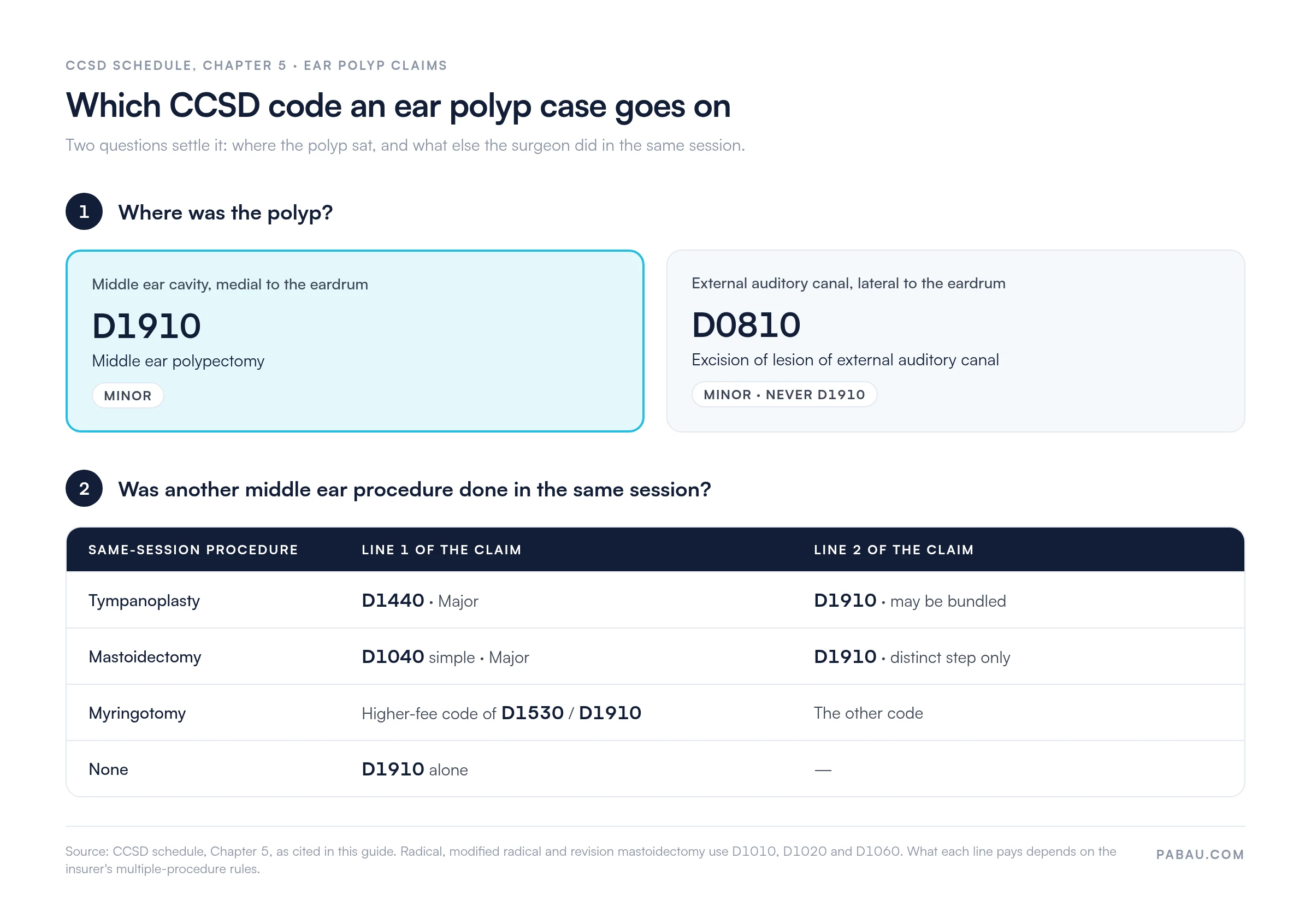
Document the anatomical site of the polyp in the operation note as ‘middle ear cavity’ or ‘medial to the tympanic membrane’ rather than just ‘ear’. A generic site description is the most common reason D1910 claims are queried at audit. A specific operation note protects the claim.
The major UK private medical insurers all use the CCSD schedule as the basis for procedure reimbursement. Each one sets its own fee for D1910 and its own pre-authorization (pre-auth) rules. There is no blanket rule, so the same claim can pay differently across insurers.
The table below lists where each insurer publishes its fees. Use the insurer’s own portal for current figures, because fee schedules change and third-party summaries lag behind.
Some insurers require pre-auth for all elective surgery, while others apply it only above a cost threshold. Operating without pre-auth when the policy requires it is the simplest denial trigger in UK private billing. It is also rarely recoverable afterward.
Before operating on any insured patient under D1910, confirm the following:
Insurers typically ask for the following when they review a D1910 request:
Build a pre-auth check into the booking workflow for every middle ear surgery referral. An emergency case may be reviewed afterward, but the insurer will want written clinical justification for the urgency.
A complete clinical record is the foundation of a clean claim. UK insurers audit ENT surgical claims, and thin operation notes are the fastest route to a query or denial. The note for a middle ear polypectomy needs anatomical and procedural detail that cannot be rebuilt after the fact.
Using digital forms for clinical documentation captures every required field before the surgeon leaves the operating room. That lowers the risk of incomplete notes surfacing weeks later during a claims audit.
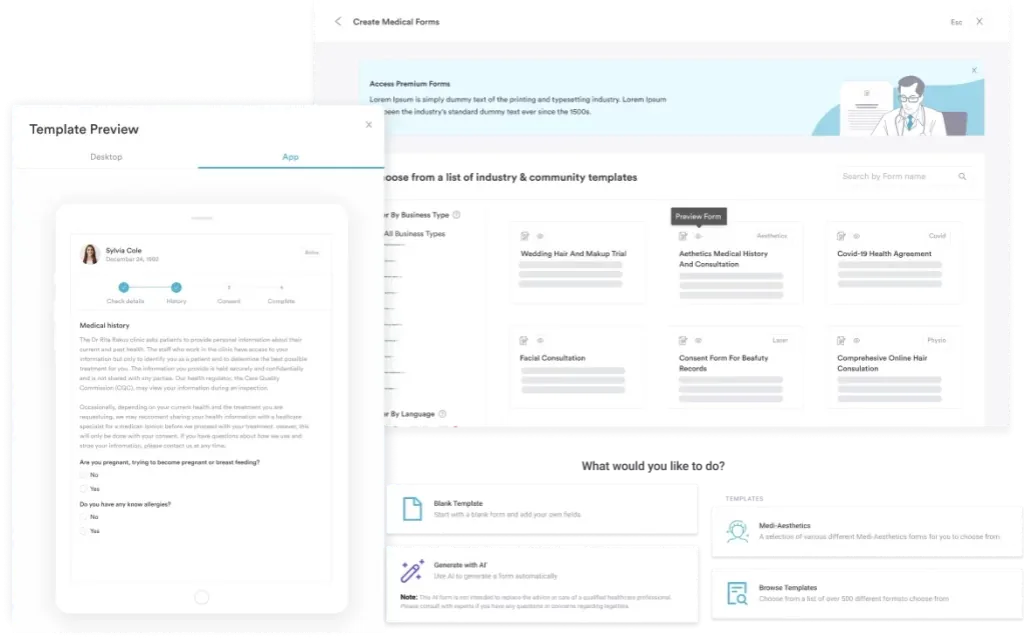
Required documentation elements for a defensible D1910 claim:
Healthcode is the main electronic billing platform for UK private practice, and most major insurers receive claims through it. Practice software that connects to Healthcode removes manual re-entry and the transcription errors that come with it. Pabau’s claims management software sends the claim to Healthcode straight from the invoice.
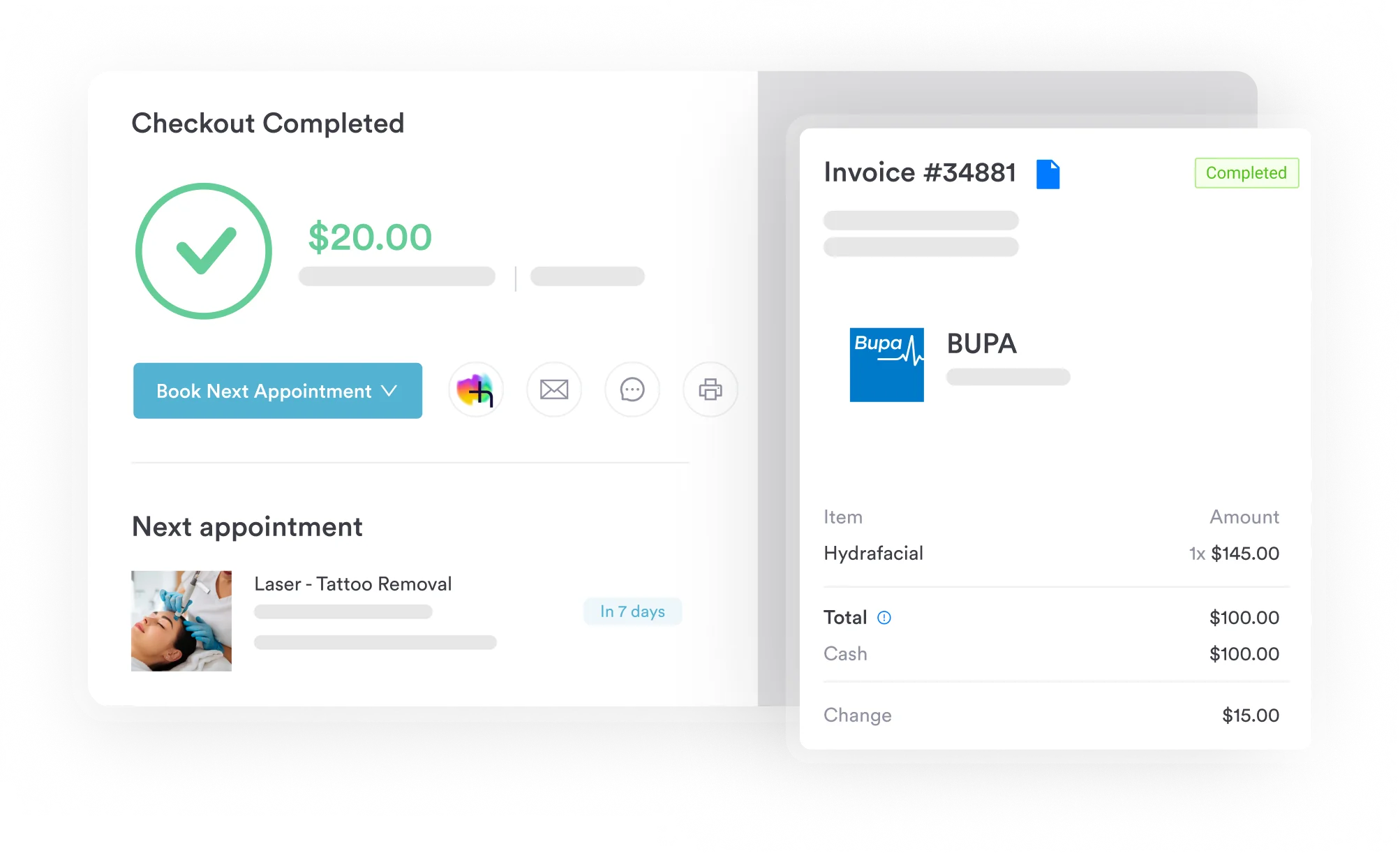
Claim submission steps for CCSD code D1910:
Middle ear polypectomy is often performed alongside tympanoplasty, myringotomy or mastoidectomy in the same session. The CCSD schedule sets codes and descriptors, not fees. Each insurer applies its own multiple-procedure rules to decide how much of each fee it pays.
On the claim, a combined approach tympanoplasty is D1440 and a simple mastoidectomy is D1040. Both are Major procedures.
Check those rules on the insurer’s provider portal before you bill two codes together. Some insurers treat polyp removal as part of a larger middle ear operation, so it may not be payable separately.
Sequence the codes with care. The principal procedure, usually the tympanoplasty or mastoidectomy, goes on the first line of the claim, with D1910 as the secondary procedure. A reversed order rarely changes the fee, but it can send the claim to manual review.
D1910 denials from UK insurers cluster around a few predictable causes. Knowing which type of denial you face tells you the right way to resolve it.
Review your denial patterns every quarter. Recurring ICD-10 mismatches for this code usually mean someone codes the claim without reading the operation note. A billing compliance review between the note and the claim submission breaks that pattern.
In many private ENT practices, the operation note lives in one system, the invoice in another and claim status in a spreadsheet. Each hand-off is a chance to key the wrong diagnosis or lose a pre-auth reference.
Pabau keeps that work on one patient record. Add the patient’s insurer and policy to the client card, and invoices go to the right insurer at its own price list. When the invoice is ready, Pabau pre-fills the claim and sends it to Healthcode, or by email for insurers that aren’t on Healthcode.
Every claim then moves through clear stages: Pending, Submitted, Processing, Paid or Error. Your billing team can filter by insurer and chase a queried D1910 claim before it ages past the resubmission deadline.

Pabau links each D1910 invoice to the patient’s insurer, pre-auth reference and operation note, then sends the claim to Healthcode. Your team tracks every claim to payment from one dashboard.

Most D1910 denials trace back to the paperwork around the code. The usual culprits are a missing pre-authorization and a diagnosis that points to the wrong part of the ear.
Those checks cost minutes before surgery and weeks once a claim is queried. Confirm the insurer’s pre-auth, code the diagnosis from the operation note rather than the referral letter, and send the note with every claim.
Book a demo to see how Pabau sends D1910 claims to Healthcode with the operation note and insurer details already attached.

Coding other middle ear and mastoid surgery? CCSD code D1060 covers billing for revision mastoidectomy.
Clearing the middle ear before or after surgery? CCSD code D1520 explains how to bill suction clearance of the middle ear.
CCSD code D1910 is the UK private medical insurance procedure code for middle ear polypectomy. It covers surgical removal of a polyp from the middle ear cavity. Polyps in the external auditory canal are billed under D0810 instead.
H74.4 (Polyp of middle ear) is the primary ICD-10 pairing for D1910 when the polyp is the principal reason for surgery. H66.1 or H66.3 (chronic suppurative otitis media) apply when chronic infection is the underlying cause and the polyp is a secondary finding.
Usually, yes, though rules vary by insurer and by the member’s policy. Bupa, AXA Health, Aviva, VitalityHealth and WPA each set their own pre-authorization rules for ENT surgery. Confirm approval and record the reference number before surgery, because a missing pre-auth is rarely recoverable.
Yes, but D1910 is listed as the secondary procedure when tympanoplasty is performed in the same session. Each insurer’s multiple-procedure rules then decide what it pays. Some insurers bundle the polypectomy into the tympanoplasty fee. If that happens, send a clinical justification explaining that the polypectomy was a distinct surgical step.
The most common reason is a missing pre-authorization. Others are an ICD-10 code for the external ear instead of the middle ear, or a claim sent without the operation note. A polypectomy bundled into a same-session tympanoplasty is another. Complete documentation and a pre-surgery authorization check prevent most of them.
No. D1910 covers only the middle ear cavity. The external auditory canal is a different anatomical site, billed under D0810 (Excision of lesion of external auditory canal). Billing D1910 for an external canal polyp is an anatomical mismatch that insurers will reject.