CPT code 93503: Swan-Ganz catheter billing and modifiers
CPT code 93503: Official descriptor and procedure overview In the AMA CPT code s...

Last Updated: Oct 23, 2026
D1060 is the CCSD code for revision of mastoidectomy (including meatoplasty). It covers a repeat operation on a mastoid that has already been operated on. The code sits in Chapter 5, Ear, nose and throat, under Middle Ear and Mastoid. Despite the D prefix, it is an ear surgery code, not a dental one.
Surgeons usually revise a mastoid for recurrent cholesteatoma or a cavity that keeps discharging. Widening the ear canal opening is part of the code, so meatoplasty is never billed separately. D1060 cannot be combined with D0340, D1010, D1020, D1040 or D1240 on the same claim.
Let Pabau's smart automation suggest the right codes, reduce claim denials, and keep your practice compliant—effortlessly.
Automate repetitive tasks and focus on what matters most—your patients.
Reduce coding errors and ensure compliance with the latest regulations.
Clean claims, fewer denials, and faster reimbursements.
Powerful insights and reporting to help your practice thrive.
HIPAA compliant SOC 2 certified GDPR-compliant Trusted by 4,000+ clinics worldwide

CCSD code D1060 covers revision of mastoidectomy, including meatoplasty, in Chapter 5 Ear, nose and throat.
Previous surgery on the same mastoid is what points the claim to D1060, whichever mastoidectomy came first.
CCSD lists D0340, D1010, D1020, D1040 and D1240 as unacceptable combinations with D1060.
WHO ICD-10 codes such as H95.0 and H95.1 describe the usual reasons for a revision.
Fees and pre-authorization rules for D1060 differ by insurer, so check each schedule before surgery.
CCSD code D1060 is the UK private insurance code for revision of mastoidectomy (including meatoplasty). Surgeons use it when they operate again on a mastoid that has already been drilled. The meatoplasty, which widens the outer ear canal opening, is part of the code.
D1060 sits in Chapter 5, Ear, nose and throat, under section 5.2, Middle Ear and Mastoid. Private medical insurers such as Bupa, AXA Health, Aviva and Vitality use the CCSD schedule to identify surgical procedures. The CCSD code library lists the neighboring ear procedures.
A revision follows an earlier mastoidectomy that did not fully solve the problem. The commonest reason is cholesteatoma that has come back or was left behind. Another is a mastoid cavity that keeps discharging despite regular cleaning.
A narrow ear canal opening can also trap debris in an open cavity. That is why the revision code carries the meatoplasty with it. The surgeon widens the opening during the same operation.
The diagnosis on the claim should explain why the surgeon went back in. These WHO ICD-10 codes fit most D1060 claims:
Quick check: Did the surgeon only clean the cavity? Then no revision took place, and D1060 does not apply. Did they reopen and re-drill the mastoid? Then D1060 is the code.
The decision tree below runs both checks and sends a first operation to its own primary code.
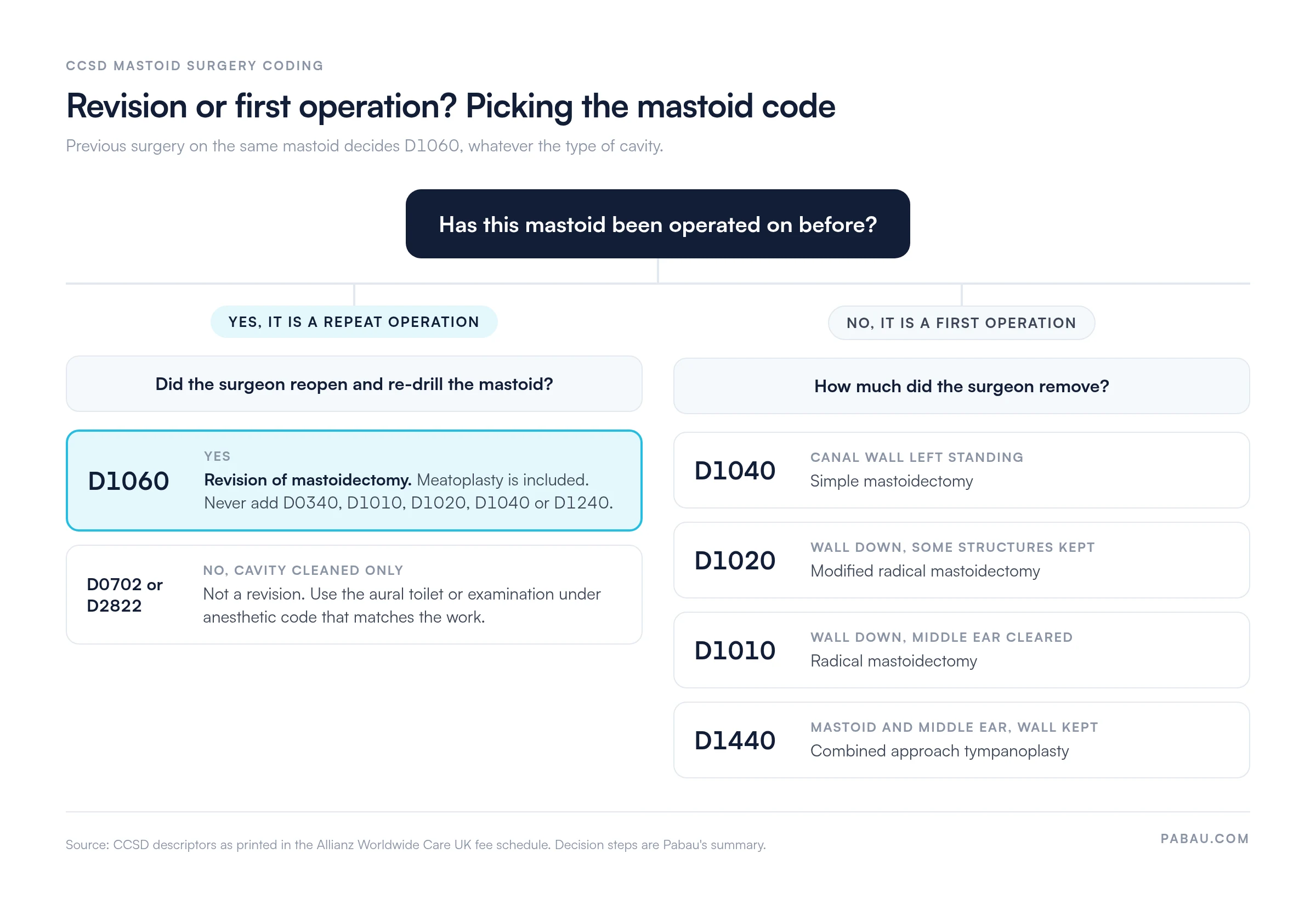
The primary mastoid codes depend on how much bone and middle ear the surgeon removes. D1060 works differently. Its descriptor names no mastoidectomy type, so any repeat operation on an operated mastoid falls under it.
Descriptors match the CCSD narratives as printed in the Allianz Worldwide Care UK fee schedule. A first operation with the canal wall standing goes to D1040. Combined approach surgery that keeps the wall is D1440.
CCSD flags certain pairs as unacceptable combinations. Insurers can reject a claim that bills both codes in the same episode. For D1060, the list covers the other mastoid operations and two procedures the revision already includes.
Planning another procedure in the same sitting? Check it against the CCSD combination list before you add it to the claim.
Take a patient who had a canal wall down mastoidectomy on the left ear three years ago. The cavity now holds recurrent cholesteatoma, and the canal opening has narrowed. The surgeon clears the disease and widens the opening.
The anesthetist bills separately, under the same CCSD code with their own fee.
Insurers query revision claims when the note reads like a first operation. The record should make the earlier surgery obvious to a reviewer who has never seen the patient.
Each insurer publishes its own fee for D1060 and updates it on its own timetable. Check your contracted rate in the insurer’s current schedule rather than relying on another insurer’s figure.
Rules for extra procedures vary too. Allianz Worldwide Care’s UK schedule pays 100% of the main procedure fee and 50% of a second procedure under the same anesthetic. Other insurers set their own percentages.
Most UK private medical insurers expect pre-authorization before elective surgery. Request it with the planned code and diagnosis, and keep the reference for the claim. The prior authorization process guide covers each step.
Returned claims still cost time to rework. A short denial management routine helps you spot repeat reasons.
Many ENT practices still copy codes, membership numbers and pre-authorization references into an insurer portal by hand. One missed field sends the claim back.
Pabau sends CCSD claims through its Healthcode integration. Its private practice claims software fills the claim from the patient record. It checks required fields, such as membership and authorization numbers, before the claim goes out.
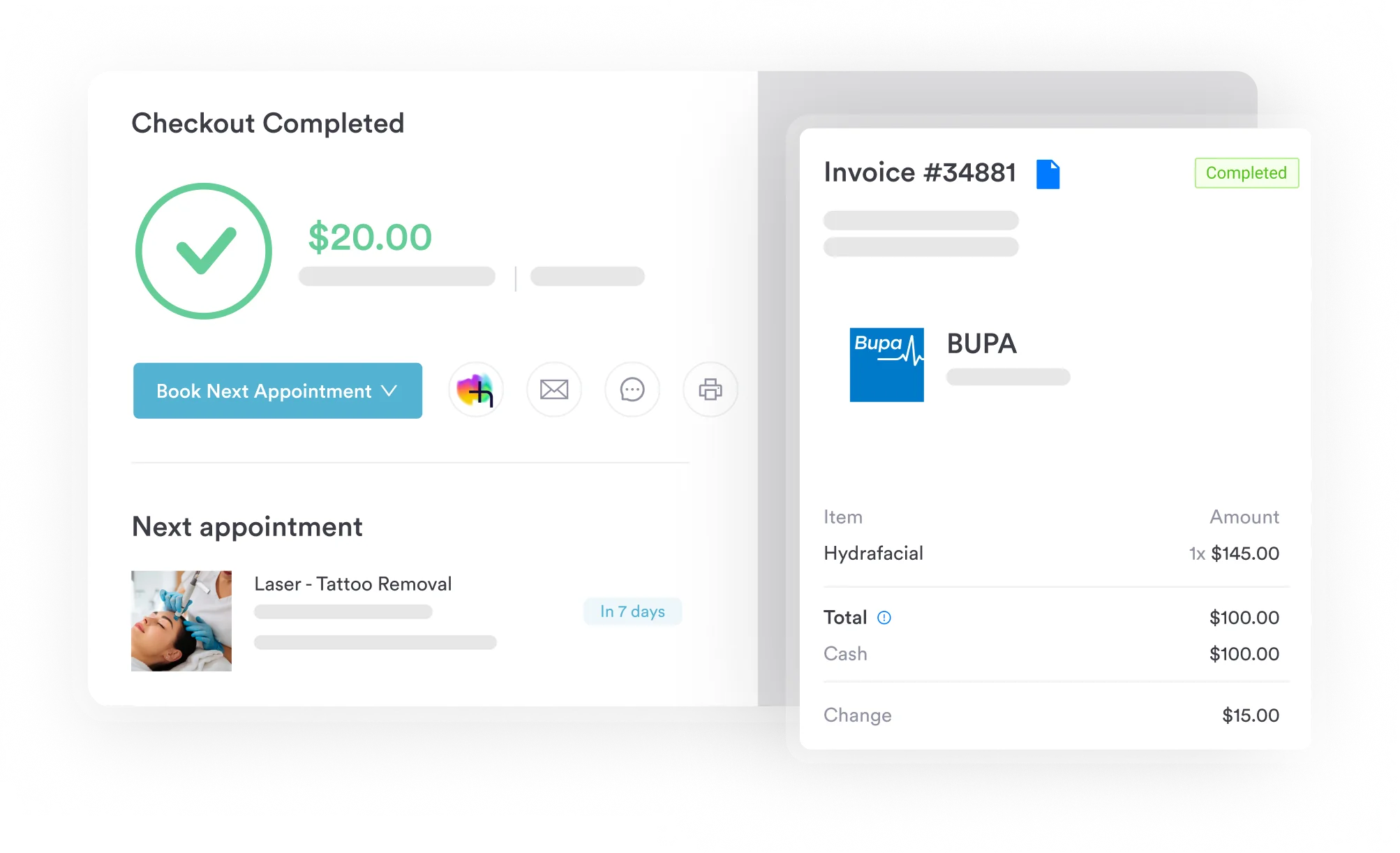
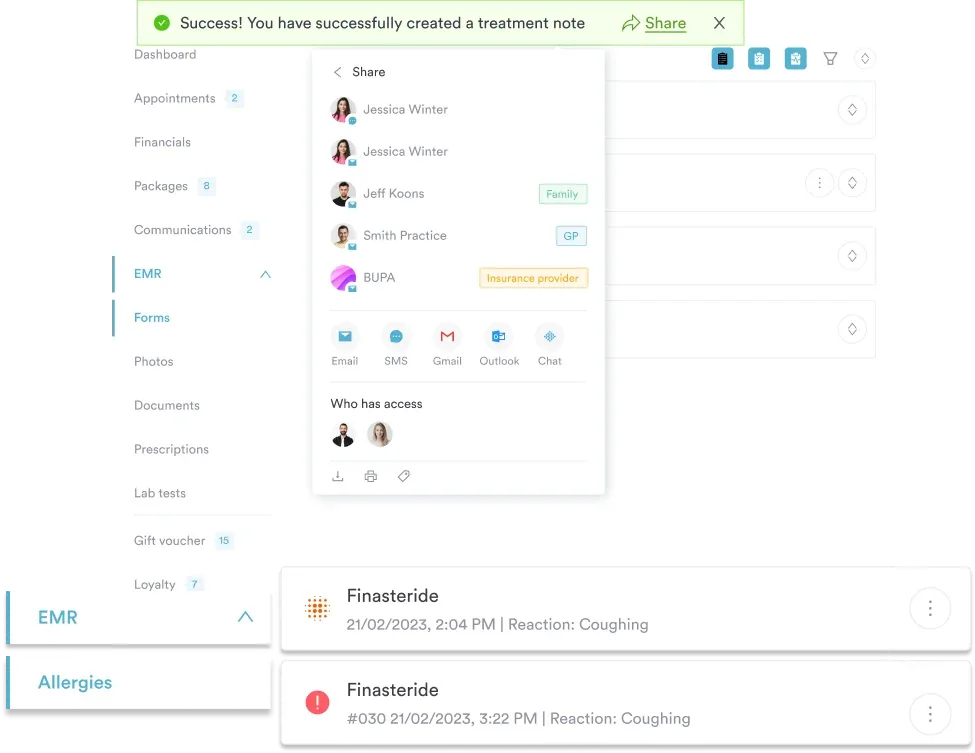
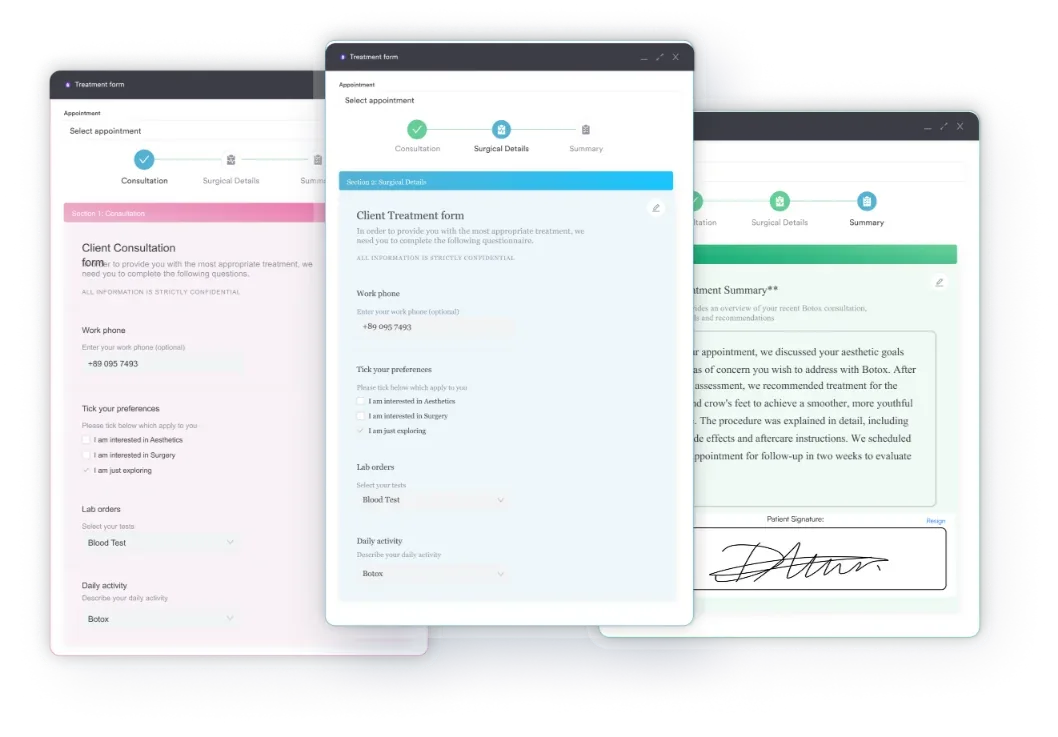
After submission, you can follow each claim to payment in the same system. Insurer details collected on intake forms are already in the record when the claim opens.

Pabau fills CCSD claims from the patient record, checks required fields such as pre-authorization numbers, and tracks each claim to payment.

D1060 turns on one question: has this mastoid been operated on before? If it has, the claim carries D1060 and nothing for the meatoplasty or the primary mastoid codes.
Before the claim goes out, make sure the record names the earlier operation. The claim itself needs a matching diagnosis and the pre-authorization number. A reviewer then has no reason to read the revision as a first operation.
Book a demo to see how Pabau sends ENT claims through Healthcode with every required field filled.

Coding a first mastoid operation? CCSD code D1040: Simple mastoidectomy billing guide explains when the canal wall stays up and the claim stays at D1040.
Clearing disease with the canal wall intact? CCSD code D1440: Intact canal wall tympanoplasty billing guide covers combined approach surgery and how it differs from canal wall down work.
Billing ENT procedures to Bupa? Pabau’s Bupa CCSD codes guide walks through how Bupa uses the CCSD schedule.
Seeing the same rejection twice? Denial management in healthcare sets out a routine for tracking and fixing returned claims.
No. CPT codes 69601 to 69604 describe revision mastoidectomy for US payers. UK private insurers use CCSD code D1060 instead, so a UK claim never carries the CPT code.
No. Cleaning a cavity without re-operating is not a revision. Codes such as D0702, aural toilet including microsuction, or D2822, examination of ear under general anaesthetic as sole procedure, describe that work.
The Allianz Worldwide Care UK schedule lists no bilateral version of D1060. Where no bilateral code exists, insurers usually apply their multiple procedure rules. Confirm the approach with the insurer during pre-authorization.
Yes. The Allianz Worldwide Care UK schedule, for example, lists a separate anesthetist fee against D1060. The anesthetist invoices under the same code, with their own fee.