CPT code 93503: Swan-Ganz catheter billing and modifiers
CPT code 93503: Official descriptor and procedure overview In the AMA CPT code s...

Last Updated: Oct 23, 2026
Billable Code
D1040 is the CCSD code for simple mastoidectomy. The surgeon drills away the mastoid air cells through the mastoid cortex and keeps the posterior bony canal wall standing. That preserved wall defines the code.
Surgeons bill the operation under D1040 to UK private medical insurers such as Bupa, AXA Health, Aviva, Vitality and Allianz. Canal wall-down surgery is coded D1010 or D1020 instead, and revision surgery is D1060. Claims go through Healthcode with a WHO ICD-10 diagnosis code.
Let Pabau's smart automation suggest the right codes, reduce claim denials, and keep your practice compliant—effortlessly.
Automate repetitive tasks and focus on what matters most—your patients.
Reduce coding errors and ensure compliance with the latest regulations.
Clean claims, fewer denials, and faster reimbursements.
Powerful insights and reporting to help your practice thrive.
HIPAA compliant SOC 2 certified GDPR-compliant Trusted by 4,000+ clinics worldwide

CCSD code D1040 is the UK private insurance code for a simple mastoidectomy, where the posterior canal wall is left intact.
Canal wall-down surgery is coded D1010 or D1020, and a repeat operation on the same mastoid is coded D1060.
WHO ICD-10 codes such as H66.1, H70.0 and H70.1 are the usual diagnosis pairings for D1040.
The operative note must state that the posterior canal wall was preserved, along with laterality and ossicular chain status.
Bupa, AXA Health, Aviva, Vitality and Allianz each set their own pre-authorization rules and fees for D1040.
Pabau, the practice management platform we build, keeps the operative note and the Healthcode claim on one patient record.
CCSD code D1040 is the procedure code for a simple mastoidectomy on the schedule kept by the Clinical Coding and Schedule Development (CCSD) Group. UK private medical insurers, including Bupa, AXA Health, Aviva, Vitality and Allianz, use the schedule to identify and pay for private procedures. The official descriptor is “Simple mastoidectomy.”
Clinically, D1040 describes a cortical mastoidectomy, also called the Schwartze procedure. The surgeon drills away the mastoid air cells through the mastoid cortex and keeps the posterior bony canal wall standing. That preserved wall is the feature that defines D1040. Once the canal wall comes down, a different CCSD code applies.
D1040 sits in Chapter 5 (Ear, nose and throat) of the schedule, in the middle ear and mastoid section. It covers the surgeon’s fee for one ear. The anesthetist invoices their own fee, and the hospital bills its facility charges separately.
A simple mastoidectomy removes diseased mastoid air cells to clear infection, improve drainage, or reach the middle ear. The anatomy of the ear canal stays intact. Knowing the surgical steps helps coders check that the operative note matches what D1040 covers.
D1040 is the wrong code if the operative note describes removing the posterior canal wall or clearing out the middle ear. The same applies to a canal wall-down cavity.
Coders should confirm that the diagnosis matches an accepted reason for a simple mastoidectomy before pairing any ICD-10 code with D1040. These are the most common surgical justifications:
UK private insurers expect diagnosis codes from the WHO ICD-10 classification, not the US ICD-10-CM. Every D1040 claim needs at least one ICD-10 code that justifies the surgery. The table below lists the codes most often paired with D1040.
Check each code against the WHO ICD-10 browser before you submit. Insurer reviewers check that the diagnosis justifies the extent of surgery described in the operative note.
D1040 sits beside the other mastoid codes in the middle ear and mastoid section of the schedule. Choosing the wrong neighbor is a common reason for an insurer query. The descriptors below follow the Allianz UK published fee schedule and the Kent and Sussex ENT procedure code list.
Two facts in the operative note settle most of these choices. One is whether the mastoid has been operated on before, and the other is whether the posterior canal wall came down. If the answer to the first is yes, D1060 replaces D1040 on the claim.
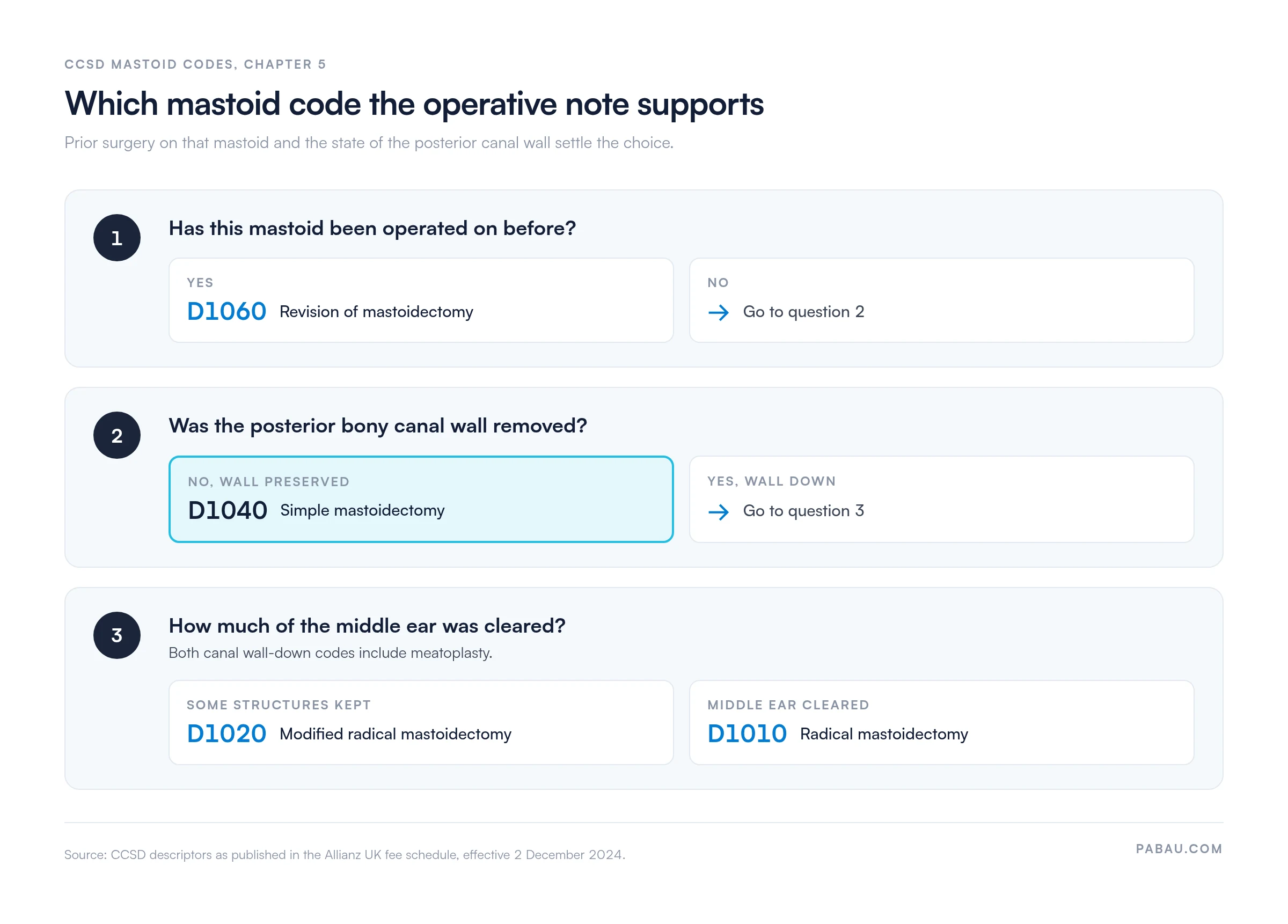
The CCSD schedule and its technical guide set out the code selection principles. They also list unacceptable combinations, which are pairs of codes that should not be billed together. For how one insurer applies the wider schedule, see our guide to Bupa CCSD codes, or browse the CCSD codes hub for other codes.
Knowing where CCSD code D1040 stops matters as much as knowing what it covers. The procedures below fall outside D1040 and need a different or additional code:
The operative note is the main document behind a D1040 claim. Insurer reviewers and clinical auditors check whether the note supports the code submitted. A complete note for a simple mastoidectomy should include these elements:
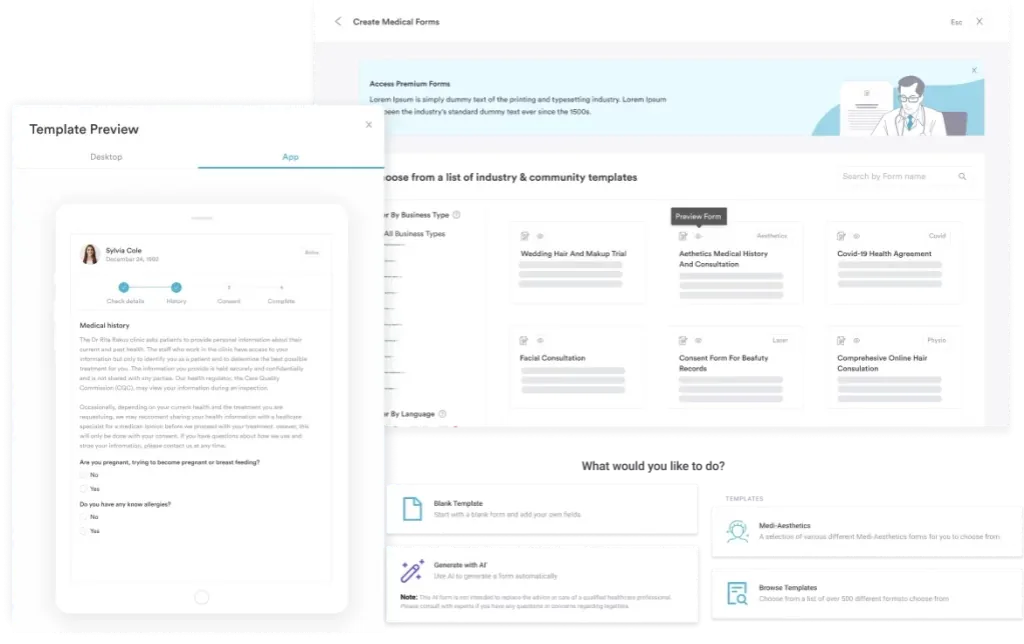
A structured operative note template prompts the surgeon for each of these points. The note is then complete before the invoice is raised, and the billing team has less to chase.
UK private medical insurers generally ask for pre-authorization before planned surgery such as a mastoidectomy. Each insurer sets its own rules on top of the CCSD code, and those rules vary by policy. Confirm the pathway with the patient’s insurer before the operation date is fixed.
A pre-authorization request usually carries the planned CCSD code, the ICD-10 diagnosis, the consultant’s details and the planned date. Attach the ENT surgeon’s clinic letter and any imaging or hearing test reports that support the indication.
Build a standard D1040 pre-authorization pack: The clinic letter, the imaging report, the hearing test, and the planned CCSD and ICD-10 codes. Send it as one submission before the operation is booked, so the authorization reference is on file when the invoice goes out.
Most D1040 problems trace back to paperwork rather than cover disputes. Each reason below can be caught before the invoice goes out.
Automated claims checks catch most of these problems early. They look for the authorization reference and the signed operative note before an invoice leaves the practice.
Ear surgery often combines D1040 with a second procedure, so each code needs its own documentation. Insurers also set their own rules on how much they pay for each code.
A tympanoplasty or myringoplasty is often done in the same operation once the mastoid disease is cleared. When the note documents both procedures, invoice both codes. Allianz, for example, pays 100% of the fee for the most complex procedure and 50% for the second. Other insurers set their own rules, so check the patient’s policy.
Where the surgeon performs a combined approach tympanoplasty, check whether D1440 describes the whole operation better than D1040 plus a separate tympanoplasty code.
Simple mastoidectomy is performed under general anesthesia. The anesthetist invoices the insurer separately, under their own Healthcode details. The Allianz schedule, for example, lists a separate anesthetist fee for D1040. That fee does not change the surgeon’s invoice.
Allianz states that assistant fees are included in its published fee and should not be claimed separately. Other insurers write their own rules on assistants. Check the patient’s policy before an assistant surgeon invoices for a D1040 operation.
There is no single UK price for D1040. Each insurer publishes its own fee schedule for the code, and the figures differ. The table below shows two published schedules.
If the consultant charges more than the insurer pays, the patient owes the shortfall. Allianz asks consultants to discuss any shortfall with the patient before treatment. Raise it at the consultation so the patient can decide with the figures in front of them.
Fee schedules change, so check the insurer’s current schedule before you quote a patient.
ENT billing teams often keep the operative note in one system, the authorization reference in an email and the invoice in a third. That split is where references go missing and follow-ups slip.
Pabau keeps clinic letters, consent forms and operative notes on the patient record. Staff can note the authorization reference on that same record, so the billing team sees it before the operation is booked.
When the invoice is ready, Pabau’s claims management pulls the details already on the record into the claim. It then sends the claim to the insurer through Healthcode. Your team still chooses the CCSD and ICD-10 codes. Pabau then tracks each claim from submitted to paid, so a queried D1040 invoice shows up early.
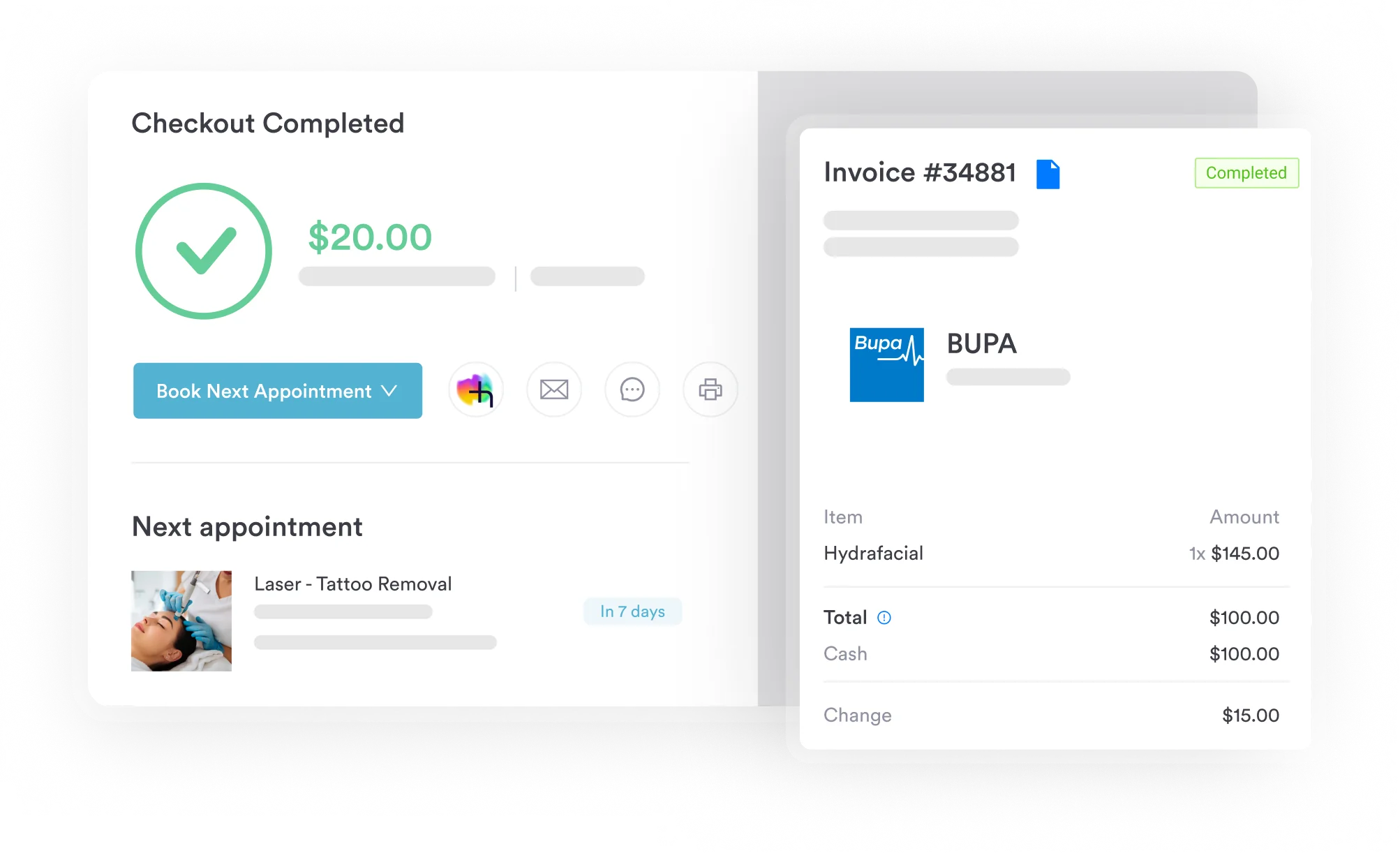

Pabau keeps operative notes, authorization references and Healthcode claim status on one patient record, so ENT practices can send D1040 invoices with fewer insurer queries.

D1040 turns on one sentence in the operative note. If the note says the posterior canal wall was preserved, the code holds. If it does not, the insurer has grounds to query the claim or ask whether D1010 or D1020 fits better.
Treat each simple mastoidectomy as a planned billing event. Secure the authorization before the date is fixed, and pair the code with a WHO ICD-10 diagnosis. Check the insurer’s fee before you quote the patient.
The trade-off is a few minutes of checks per case against weeks of chasing a queried claim. Book a demo to see how Pabau keeps operative notes, authorizations and Healthcode claims together for ENT practices.

Need the wider insurer picture? Bupa CCSD codes explains how the Bupa schedule is structured and what to check before billing private procedures.
Looking up another code on the schedule? CCSD codes brings together our guides to individual codes used by UK private insurers.
Billing a combined approach tympanoplasty? CCSD code D1440 covers coding and documentation for tympanoplasty with an intact canal wall.
Want fewer queried invoices? Claims management software shows how Pabau sends and tracks private insurance claims through Healthcode.
CCSD code D1040 covers a simple mastoidectomy, which removes the mastoid air cells through the mastoid cortex with the posterior bony canal wall left intact. UK private medical insurers use it when the operative note confirms a cortical (Schwartze) mastoidectomy with the canal wall preserved.
CCSD stands for Clinical Coding and Schedule Development, the group that maintains the CCSD schedule of procedure codes. UK private medical insurers such as Bupa, AXA Health, Aviva, Vitality and Allianz use the schedule to identify and pay for private procedures.
Yes. Cortical mastoidectomy, simple mastoidectomy and the Schwartze procedure are names for the same operation. All are billed under D1040, provided the operative note confirms the posterior canal wall was preserved.
The most common WHO ICD-10 codes paired with D1040 are H66.1, H66.2, H70.0, H70.1 and H71. They cover chronic suppurative otitis media, acute and chronic mastoiditis, and cholesteatoma of the middle ear. The code must match the diagnosis in the operative note and the referral letter.
Usually, yes. UK private medical insurers generally ask for pre-authorization before planned surgery, and each sets its own rules by policy. Confirm with the patient’s insurer, such as Bupa, AXA Health, Aviva, Vitality or Allianz, before the operation date is fixed. Self-pay patients need no authorization.
The note must state the reason for surgery, the approach, which ear was operated on, and that mastoid air cells were removed. It must also say the posterior canal wall was preserved and record the ossicular chain status. The canal wall statement is what separates D1040 from D1010 or D1020.
Yes, when both are done in the same operation and the note documents both. Tympanoplasty is coded separately, for example D1420 for a myringoplasty. Insurers set their own payment rules for a second procedure, and Allianz pays 50% of the second procedure’s fee.
The usual reasons are a missing authorization reference and a diagnosis that does not justify surgery. A note that never says the canal wall was preserved is another. Billing D1040 with D1020 on the same ear causes rejections too, as does a consultant the insurer has not recognized.
Each insurer sets its own fee. The Allianz UK schedule, effective 2 December 2024, lists £700 for the surgeon and £220 for the anesthetist. Freedom Health Insurance lists £650 and £357. Check the patient’s insurer for its current figure.