CPT Code 93662: Intracardiac echocardiography billing guide
CPT Code 93662: official descriptor and quick-reference data CPT Code 93662 desc...

Last Updated: Oct 7, 2026
D0812 is the CCSD code for removal of a solitary osteoma of the external auditory canal, a single benign bony tumor in the ear canal. It sits in chapter 5 (Ear, nose and throat) of the CCSD schedule, in the external ear section.
UK private insurers such as Bupa, AXA Health, Aviva and VitalityHealth use it for surgeon claims, and most expect pre-authorization first. The word "solitary" carries the code. Multiple bony exostoses are billed as D0280 instead, so the operative note and pathology report must describe one osteoma.
Let Pabau's smart automation suggest the right codes, reduce claim denials, and keep your practice compliant—effortlessly.
Automate repetitive tasks and focus on what matters most—your patients.
Reduce coding errors and ensure compliance with the latest regulations.
Clean claims, fewer denials, and faster reimbursements.
Powerful insights and reporting to help your practice thrive.
HIPAA compliant SOC 2 certified GDPR-compliant Trusted by 4,000+ clinics worldwide

CCSD code D0812 covers surgical removal of one osteoma, a benign bony tumor, from the external auditory canal.
Multiple bony exostoses, often called surfer’s ear, are billed as D0280, so the pathology report can change the code.
Pair D0812 with ICD-10 D16.4, benign neoplasm of bones of skull and face, once the osteoma is confirmed.
UK private insurers such as Bupa, AXA Health, Aviva and VitalityHealth expect pre-authorization before the procedure date.
The operative note should name one osteoma, the side, the site in the canal and the technique used.
CCSD code D0812 is the billing code for removing a solitary osteoma of the external auditory canal. An osteoma is a benign bony tumor that grows from the wall of the ear canal. The code sits in chapter 5, Ear, nose and throat, in the external ear section of the CCSD schedule.
The Clinical Coding and Schedule Development group (CCSD) maintains the codes UK private insurers use for specialist claims. Bupa, AXA Health, Aviva and VitalityHealth all take D0812 on the operating surgeon’s invoice. The word “solitary” sets the limit. One lesion fits D0812, while several bony growths belong under a different code.
The external ear codes around D0812 describe similar-sounding work on the same canal. The difference comes down to what was removed and what it was made of.
Read the operative note against the descriptor, never against the code number. Insurers check that the note supports the exact wording of the code billed. Bupa also places these codes in different fee categories, so a wrong pick changes the payment as well.
The pathology report decides between D0812 and D0280. An osteoma and an exostosis can look alike under the operating microscope, but they are different lesions with different CCSD codes.
Send the specimen to pathology and hold the claim until the report comes back. If the report describes exostoses rather than an osteoma, bill D0280 instead. A claim that already went out under D0812 then has to be corrected with the insurer. The decision path below shows where each pathology finding lands.
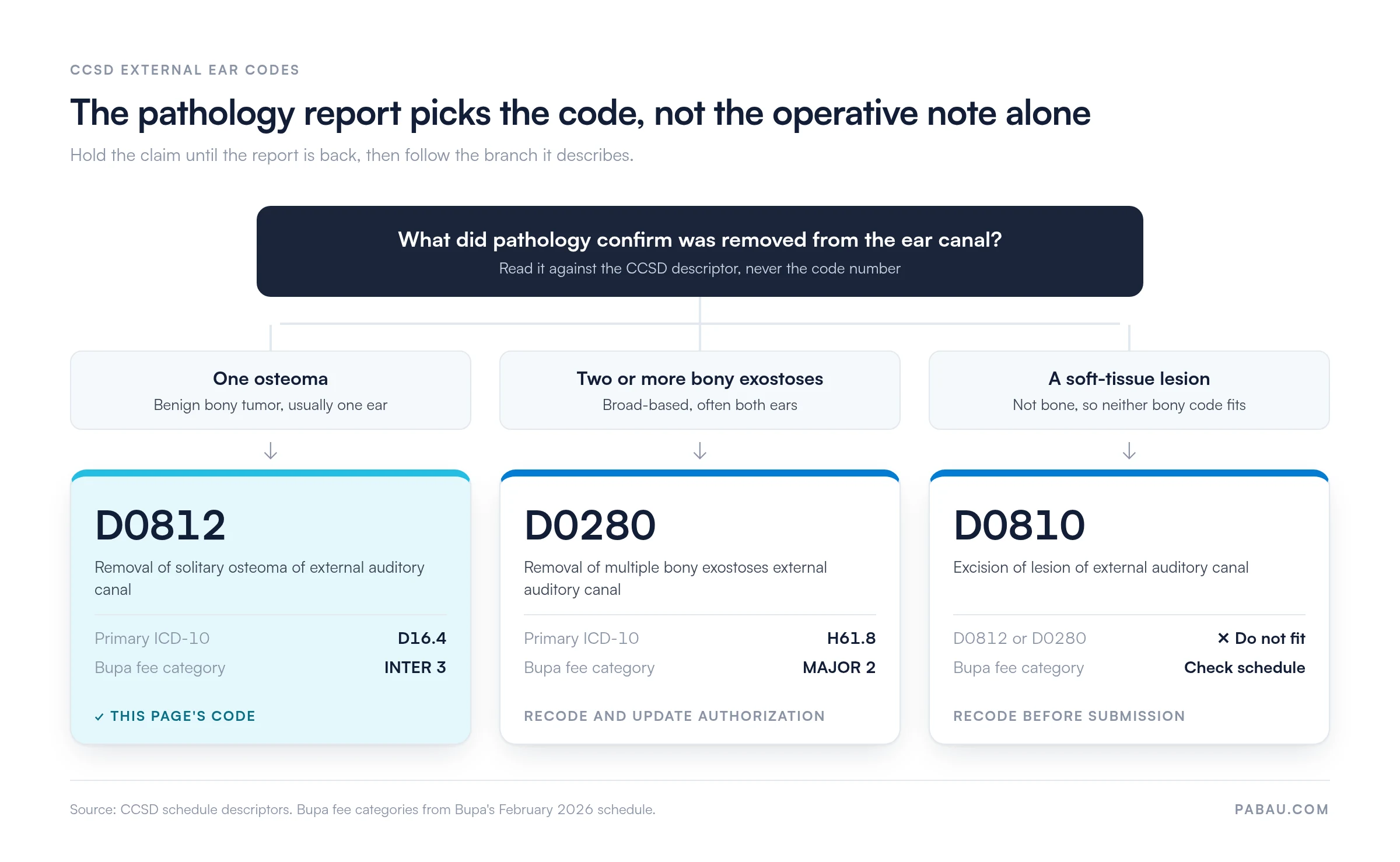
D16.4, benign neoplasm of bones of skull and face, is the primary diagnosis code for D0812. Lead with that confirmed pathology, then add the problems the osteoma caused.
Check each code in the WHO ICD-10 browser before submission. D16.6 is an easy slip one digit away, but it covers the vertebral column, not the skull.
Insurers query D0812 claims when the note leaves the lesion count or type unclear. Before the claim goes anywhere, make sure the record covers these points.
The lesion count does more work than it looks. A note that mentions “bony growths” in the plural invites a D0280 query, even when the surgeon removed one osteoma.
UK private insurers expect pre-authorization before a planned procedure like D0812. The insurer issues an authorization number, and that number belongs on the surgeon’s invoice. Have these details ready when the patient or the practice requests authorization.
Bupa, AXA Health, Aviva and VitalityHealth each run their own authorization process. Never assume one insurer’s rules apply to another. Cover also depends on the member’s plan, so authorization is never automatic.
If pathology could move the code from D0812 to D0280, ask the insurer how it handles a code change. Ask when you request authorization, and you avoid chasing a fresh reference after surgery.
Once the note is right, the claim follows a predictable path. Each step below has its own way of tripping up an osteoma claim.
The surgeon’s invoice covers the surgeon’s fee only. The anesthetist invoices separately, and the hospital bills the insurer for the facility and nursing costs.
The CCSD group maintains the CCSD codes specialists bill, but it does not set fees. Each insurer decides its own D0812 fee, fee category and authorization rules.
Bupa’s February 2026 schedule places D0812 in the INTER 3 category, with a £329 surgeon fee. Treat that figure as a starting point, and check the current schedule for the patient’s plan. Our Bupa fee schedule guide shows how Bupa groups its fees.
Most rejected osteoma claims trace back to a handful of errors. Each one has a straightforward fix.
In many ENT practices, the operative note lives in one system and the invoice in another. A biller copies the code, the side and the authorization number across by hand. The pathology report often waits in a third place.
Pabau, the practice software our team builds, keeps the note and the claim on the same patient record. With claims management, the CCSD code, membership number and authorization reference carry into the invoice. Pabau checks the required fields, then sends the claim to Healthcode.
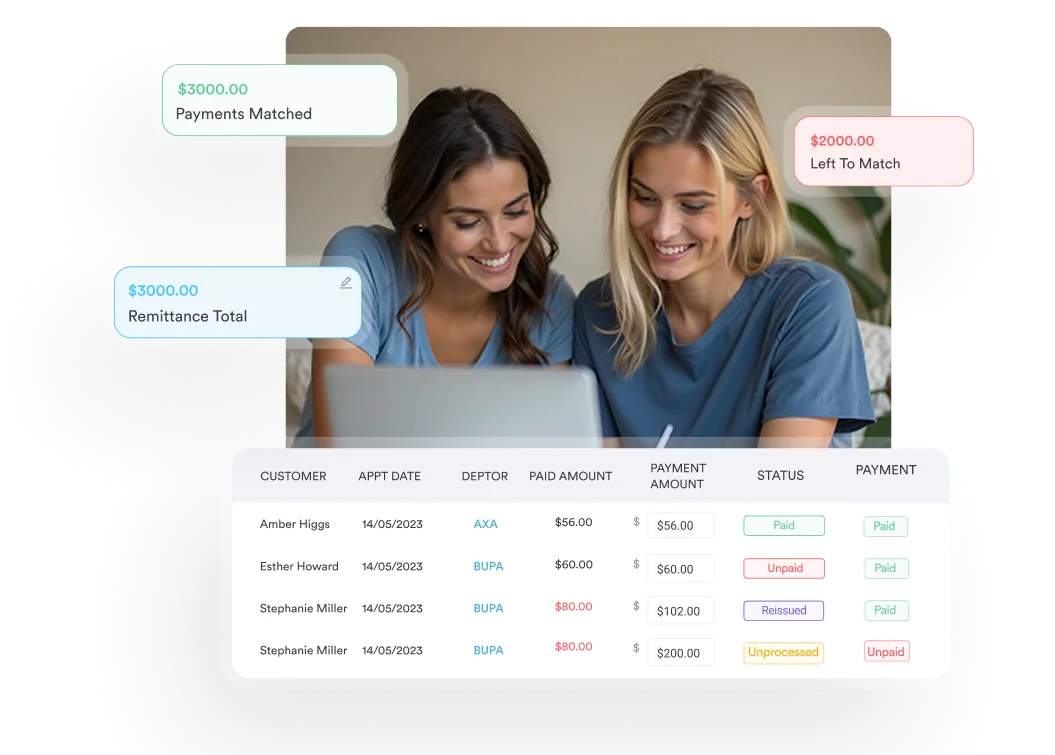
Your billing team then follows each claim’s status and payment in one place. Re-keying stops, and a missing authorization number gets caught before the insurer sees it.

Pabau builds UK private claims like D0812 from the operative note and checks required fields before Healthcode submission. Then you can track each insurer’s payment in one place.

D0812 comes down to one test. Did the surgeon remove a single osteoma from the ear canal, and does the pathology report agree? If so, the code fits.
Get the note to say that plainly on the day of surgery, and hold the claim until pathology confirms it. With authorization in place and D16.4 on the claim, the insurer has little left to query.
Book a demo to see how Pabau carries a D0812 claim from the operative note to Healthcode without retyping.

Coding other ear surgery? CCSD code D1530 explains myringotomy from the same ear, nose and throat chapter.
Want every Bupa code in one place? Bupa CCSD codes sets out the schedule and how its codes are organized.
Worried about audit risk? Medical billing compliance shows how to keep coding defensible across every claim.
CCSD code D0812 covers surgical removal of one osteoma from the external auditory canal. UK private insurers use it for the surgeon’s claim. Multiple bony exostoses are billed as D0280, and a soft-tissue canal lesion as D0810.
An osteoma is usually a single benign bony tumor, often on a narrow stalk, in one ear. Exostoses are usually several broad-based growths in both ears, linked to cold-water exposure. The pathology report tells them apart and decides between D0812 and D0280.
D16.4, benign neoplasm of bones of skull and face, is the primary code once the osteoma is confirmed. Add a hearing loss or otitis externa code where the note documents it. Avoid D16.6, which covers the vertebral column.
Most UK private insurers, including Bupa, AXA Health, Aviva and VitalityHealth, expect pre-authorization before a planned procedure like D0812. The authorization number then goes on the surgeon’s invoice. Rules vary by insurer and plan, so check each one.
Each insurer sets its own fee, because the CCSD group maintains the code but not the price. Bupa’s February 2026 schedule places D0812 in the INTER 3 category at £329. Check the current schedule before invoicing.