CPT code 93503: Swan-Ganz catheter billing and modifiers
CPT code 93503: Official descriptor and procedure overview In the AMA CPT code s...

Last Updated: Oct 23, 2026
D0410 is the CCSD code for drainage of haematoma/abscess of pinna. Surgeons use it when blood or pus collects in the outer ear, usually after a blow, and has to be released. Prompt drainage protects the cartilage underneath, so these cases are often treated the same day.
The claim looks simple, but it breaks easily. CCSD lists six codes that can't be billed with D0410, including repair of pinna and biopsy of a pinna lesion. Add one of them and the insurer can reject the claim. A clean claim starts with an operative note that matches the code and a pre-authorization raised under D0410 itself.
Let Pabau's smart automation suggest the right codes, reduce claim denials, and keep your practice compliant—effortlessly.
Automate repetitive tasks and focus on what matters most—your patients.
Reduce coding errors and ensure compliance with the latest regulations.
Clean claims, fewer denials, and faster reimbursements.
Powerful insights and reporting to help your practice thrive.
HIPAA compliant SOC 2 certified GDPR-compliant Trusted by 4,000+ clinics worldwide

CCSD code D0410 covers drainage of a hematoma or abscess of the pinna, listed in Chapter 5 under External Ear.
CCSD lists six unacceptable combinations for D0410: D0210, D0610, D0630, S4720, S4740 and S4780.
The operative note should name the side, the contents and the drainage, so the note matches the code.
A wrong code pairing and a pre-authorization raised under another code are the first two errors to check.
Each insurer sets its own fee for D0410, so confirm the rate in that insurer’s schedule before you quote.
CCSD code D0410 is the code for “drainage of haematoma/abscess of pinna.” The pinna is the visible outer ear. The code covers releasing blood or pus that has collected there. It sits in Chapter 5 of the CCSD schedule, under the External Ear heading.
A pinna hematoma usually follows blunt trauma, such as a blow in a contact sport. Blood pools between the cartilage and the tissue that covers it. Left in place, it can damage the cartilage and leave a thickened, misshapen ear, often called cauliflower ear. An abscess is a pocket of pus in the same area, and it needs the same release.
CCSD stands for Clinical Coding and Schedule Development. It is a group of UK private medical insurers, including Aviva, AXA Health, Bupa and Vitality. The group sets the codes and the rules for combining them, while each insurer sets its own fees. You can browse neighboring ear codes in our CCSD codes library.
CCSD flags six unacceptable combinations for D0410. An unacceptable combination is a pair of codes that shouldn’t be billed together for the same procedure. When a claim carries both, the insurer can reject it or pay only one line.
The three S-codes cover drainage and aspiration of skin and subcutaneous collections. They matter because a pinna hematoma looks like a skin swelling from the outside. A coder working from a brief note might reach for one of them. On the ear, D0410 is the specific code, and CCSD bars pairing D0410 with those three.
The ear codes catch a different habit. Surgeons often take a sample or close the wound in the same sitting. Each of those steps has its own pinna code, such as D0610 for a biopsy. Next to D0410, though, none of them belongs on the claim. The grid below pairs each extra step with what to bill instead.
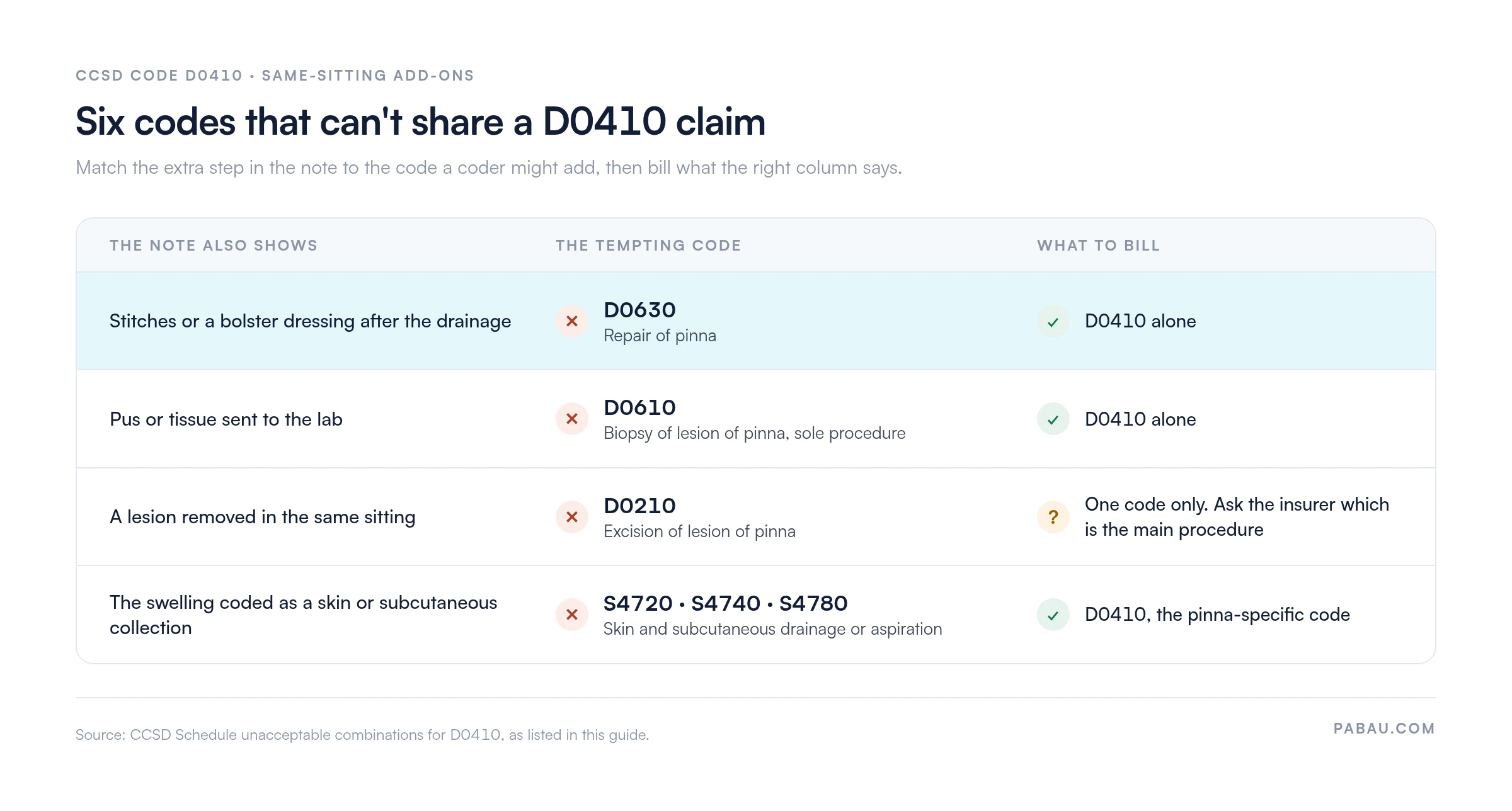
The surgeon drained a hematoma and stitched a pressure dressing in place. Which code? D0410 on its own. CCSD bars billing it with D0630, so the stitches don’t justify a repair code.
The surgeon drained an abscess and sent pus to the lab. One code or two? One. D0610 covers a biopsy as the sole procedure, and it is on the unacceptable list for D0410.
The surgeon removed a lesion and found a collection underneath. Which code wins? Ask the insurer before you submit. D0210 and D0410 can’t be billed together, so the claim needs the code for the main procedure.
The collection was drained with a needle rather than cut open. Is it still D0410? The descriptor names drainage without naming a method. If you’re unsure, confirm with the insurer when you request pre-authorization.
A D0410 claim follows the usual path for UK private medical insurance. Each step adds one detail the insurer will check later.
Urgent cases tend to break the first step. A hematoma is often drained the day the patient walks in, before anyone calls the insurer. In that case, contact the insurer as soon as you can and log the reference against the episode.
An insured patient arrives with a tense, swollen left ear after a weekend match. The surgeon drains the hematoma the same afternoon and stitches a bolster dressing in place to stop it refilling.
The note reads: “Incision and drainage of hematoma, left pinna. Clot evacuated. Bolster sutured.” Days later, a coder sees the word “sutured” and adds D0630 for repair of pinna. The insurer rejects the claim, because D0630 is an unacceptable combination with D0410.
The fix takes a minute. The coder removes D0630 and resubmits with D0410 alone. The lesson takes longer to stick, so put the six codes where coders see them every time they open a pinna claim.
A two-minute check catches most of the errors above. Work through it on every pinna claim, urgent ones included.
Each slip below leads to a rejection or a round of rework. Each also has a fix your team can make before the claim goes back.
The last one is easy to miss. The US dental code set also uses codes that start with D, and a quick web search can mix the two. For claims that still come back, a steady denial management routine shows which errors keep repeating.
Many D0410 errors start when the note and the claim live in different places. A coder reads the note days later and has to guess what the surgeon meant by “sutured.”
Pabau, the practice management platform we build, keeps the note and the invoice in one patient record. The service carries its CCSD code, so the claim starts with D0410 already on it. Our claims management software then checks the required fields, such as membership and authorization numbers, before the claim goes.
For UK insurers, claims go through Pabau’s Healthcode integration, with the required fields checked before you send. That way, your team can see which claims have gone out.
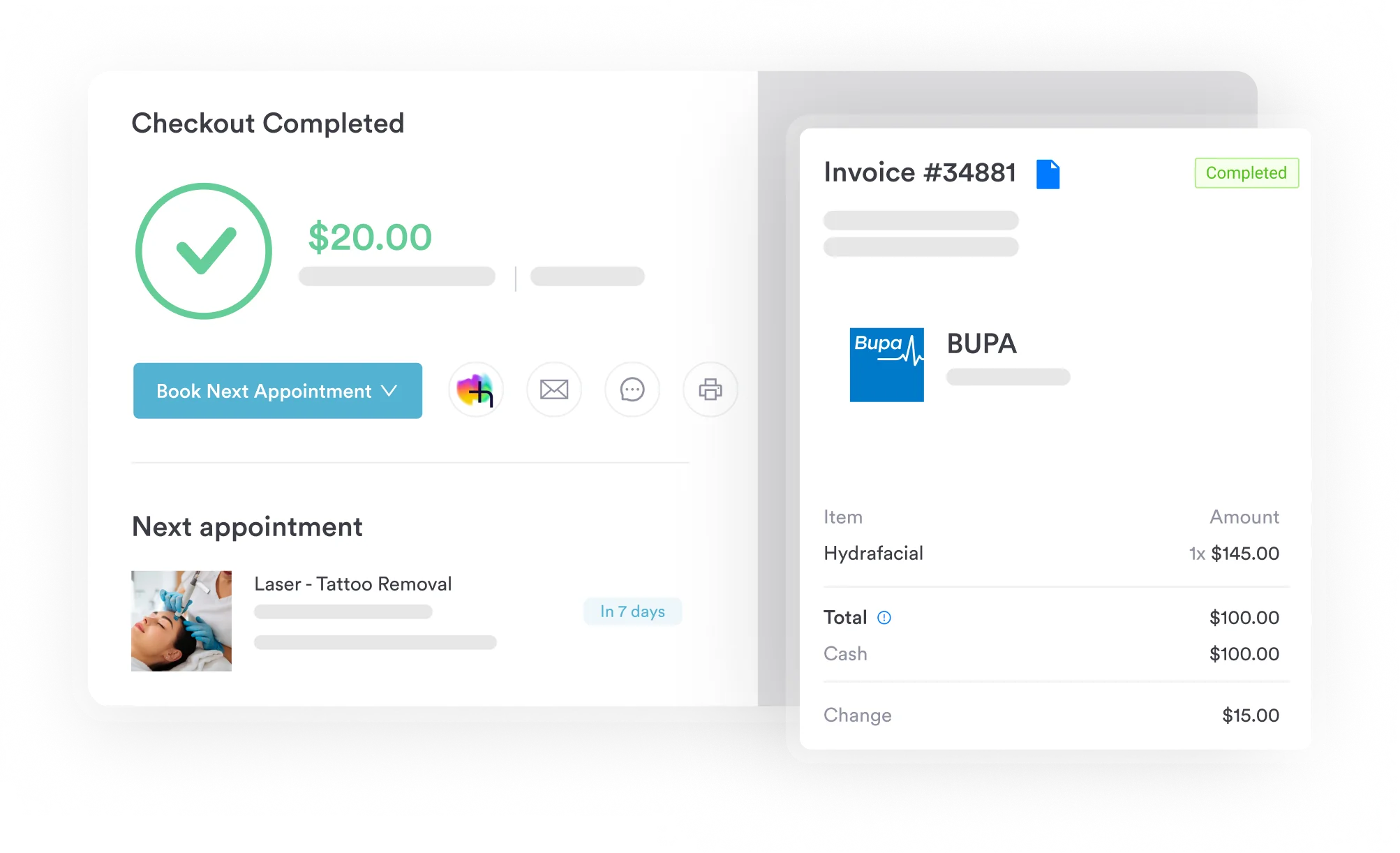

Pabau builds each claim from the patient record and checks the required fields before it goes, so fewer pinna claims come back for rework.

D0410 is one of the simpler codes in the ear chapter, and that is where the risk lies. It looks too easy to double-check, so an extra code slips onto the claim unnoticed.
Treat the six unacceptable combinations as a hard stop on every pinna claim. Get the pre-authorization under D0410 itself, even when the drainage can’t wait. Then make sure the note names the side, the contents and the drainage, and the claim has what the insurer needs.
Book a demo to see how Pabau links the ear procedure, the note and the Healthcode claim in one record.

Coding a sample taken from the outer ear? CCSD code D0610 covers biopsy of a lesion of the pinna as the sole procedure.
Coding a neighboring ear procedure? CCSD code D0140 sets out the claim rules for another D-series code.
Billing Bupa patients often? Bupa CCSD codes walks through how Bupa uses the schedule for fees and claims.
Treating patients who pay for themselves? Patient self-pay billing covers pricing and collections when no insurer is involved.
Seeing the same rejections every month? Denial management in healthcare sets out a routine for spotting and preventing repeat denials.
No. OPCS-4 is the NHS classification for procedures, while CCSD is the schedule UK private insurers use for claims. The two systems use different numbers, so never copy an OPCS-4 code onto a private claim.
The full schedule sits on the CCSD website behind a login. It shows each code’s narrative, its chapter and its unacceptable combinations.
Usually. Each insurer sets its own recognition rules, so check the surgeon’s status with the insurer before the procedure.
Yes. A self-pay patient pays your own price, so no insurer schedule applies. Keeping D0410 on the invoice still helps if the patient later asks for an itemized bill to claim the cost back.