CPT code 93503: Swan-Ganz catheter billing and modifiers
CPT code 93503: Official descriptor and procedure overview In the AMA CPT code s...

Last Updated: Oct 23, 2026
D0140 is the CCSD code for excision of preauricular sinus, the complete removal of a congenital sinus tract in front of the ear. It covers the sinus opening, the epithelial-lined tract and any associated cyst, with the wound closed at the same sitting.
UK private insurers such as Bupa, AXA Health and Aviva use it for surgeon and anaesthetist claims. It sits in chapter 5 (Ear, nose and throat), in the external ear section, and pairs with diagnosis code Q18.1. Drainage alone and excision of a preauricular skin tag are coded separately.
Let Pabau's smart automation suggest the right codes, reduce claim denials, and keep your practice compliant—effortlessly.
Automate repetitive tasks and focus on what matters most—your patients.
Reduce coding errors and ensure compliance with the latest regulations.
Clean claims, fewer denials, and faster reimbursements.
Powerful insights and reporting to help your practice thrive.
HIPAA compliant SOC 2 certified GDPR-compliant Trusted by 4,000+ clinics worldwide

CCSD code D0140 covers complete surgical excision of a congenital preauricular sinus tract, not drainage or incision alone.
ICD-10-CM Q18.1 (preauricular sinus and cyst) is the primary diagnosis code that should pair with every D0140 claim.
Most UK private insurers require prior authorisation for elective D0140 excision. A missing reference number is the leading denial trigger.
Practice management software like Pabau helps private practices track authorisation references, attach operative notes, and flag incomplete claims before submission.
CCSD code D0140 covers the complete excision of a preauricular sinus tract, with primary wound closure. The excision takes in the sinus opening, the epithelial-lined tract, and any associated cyst or abscess cavity. It belongs to Chapter 5 (Ear, Nose and Throat) of the Clinical Coding and Schedule Development (CCSD) schedule, in the external ear section. The schedule is maintained by the main UK private medical insurers and adopted across Bupa, AXA Health, Aviva, Vitality, WPA, Healix, Cigna, and Allianz Care.
For a searchable lookup, the Bupa code search portal lists D0140 with its official descriptor and associated fee guidance. Pabau’s CCSD coding guide explains how the chapters are organised if you need to place this code within the schedule.
The code applies to excision only. Simple incision and drainage of an infected preauricular abscess is coded separately. CCSD has no bilateral modifier. When both sides are excised at the same sitting, each payer sets its own rule for reporting the second side. Confirm bilateral handling with the payer before submission.
Other Chapter 5 codes settle the second side in the descriptor. CCSD code E1450 reads as bone flap to frontal sinus (and bilateral), so one code covers one or both. The descriptor for CCSD code E1432 names a bilateral operation, so a second FESS line would be a duplicate.
The same reading holds further down Chapter 5. CCSD code E3520 is written +/- biopsy, so tissue taken at the same sitting adds no second line.
A preauricular sinus is a small, epithelial-lined tract or pit just in front of the helix of the outer ear. It arises from incomplete fusion of the six auricular hillocks during embryological development. The condition is congenital, and ICD-10 classifies it under congenital malformations of the face and neck (Q18). Prevalence estimates range from 0.1% to 0.9% in European populations and up to 10% in some African and Asian populations. That makes it one of the more common minor congenital ear anomalies seen in ENT outpatient practice.
Most preauricular sinuses cause no symptoms for years. Problems arise when the tract becomes blocked and infected, producing pain, swelling, and purulent discharge in front of the ear. Recurrent infection is the main driver of surgical referral. The tract is often tortuous and blind-ending, so it cannot drain reliably. Antibiotics settle acute episodes but leave the underlying tract in place.
Private payers accept D0140 claims when the operative report and pre-operative notes demonstrate one of the following clinical indications:
Elective excision for a sinus that has never been infected is less consistently covered. Some payers classify it as cosmetic and decline the claim. Document the patient’s symptom history carefully, even when the current episode appears quiescent. Prior infection records are the foundation of a successful medical necessity argument.
Knowing the operative technique lets coders check that a D0140 claim matches the procedure performed. The standard approach involves these steps:
The operative note must document complete excision, confirm cartilage was reached where applicable, and note whether any abscess cavity was found. Coders reviewing op notes for a D0140 claim should look for language confirming the tract was excised in its entirety. A procedure documented only as “incision and drainage” or “sinus exploration” will not support D0140.
Every D0140 claim requires a diagnosis code to establish clinical context for the payer. The primary code is Q18.1.
Q18.1 is the only code that maps directly to preauricular sinus excision, and it is the pairing most UK private insurers expect. Submitting D0140 with an unrelated or non-specific diagnosis code, such as a general “congenital malformation” code, is a common denial trigger. Pabau’s private practice claims software lets practices save reusable code pairs, which reduces the risk of mismatched codes at submission.
Documentation failures are responsible for the majority of D0140 denials. A complete claim submission should include all of the following elements:
Structuring these documents consistently before submission cuts down revision cycles. Digital clinical forms can prompt practitioners to record infection episodes, dates, and prior treatment at the consultation rather than retrospectively. A standard pre-operative checklist then keeps every case file in the order the payer expects.
Prior authorisation requirements for D0140 vary by insurer and individual plan. The table below reflects typical practice. Always verify directly with the payer before the procedure, because requirements change and plan-level rules can differ from standard insurer guidance.
Practices that treat a high volume of private medical insurance (PMI) patients benefit from tracking authorisations systematically. Logging each auth reference against the booking means no case goes to theatre without one.
Several procedure codes are close enough to D0140 to cause miscoding errors. This happens most when coders work from incomplete operative notes or are unfamiliar with the CCSD chapter structure.
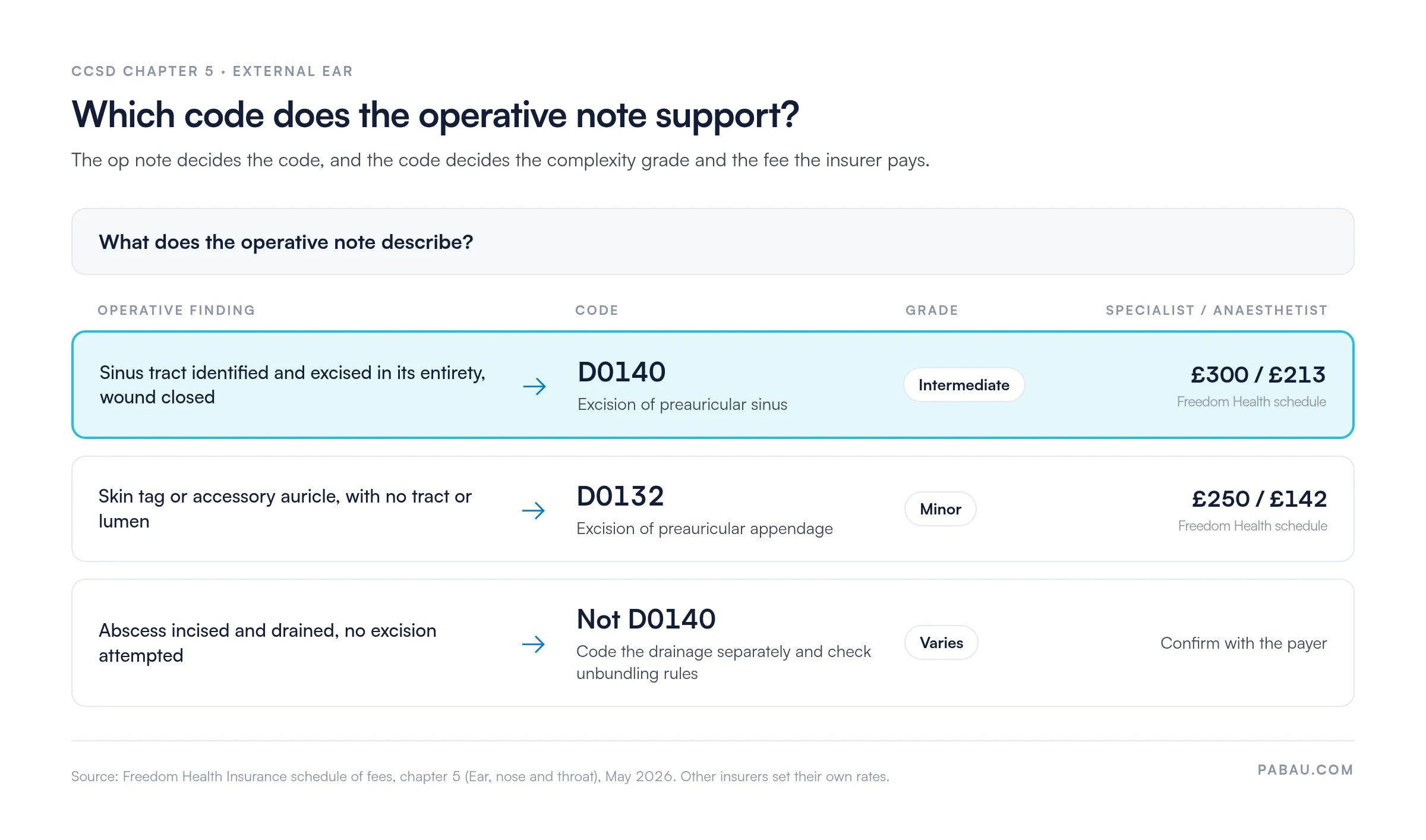
The D0132 vs D0140 distinction is the most common miscoding in this group. A preauricular appendage is a small skin tag or accessory auricle, with no tract and no lumen. A preauricular sinus has an epithelial-lined channel that must be excised completely. The op note’s description of tract identification and dissection is what separates the two.
The choice also changes the fee. The Freedom Health Insurance fee schedule grades D0132 as minor and D0140 as intermediate complexity, as the decision guide below shows.
D0140 is a CCSD code, not a CPT code and not a CDT code. These three systems serve different markets, and using the wrong system on a claim is an immediate technical rejection.
When a UK private practice holds international insurance affiliations or treats non-UK patients, the coding system must match the payer’s contract. CCSD is for UK PMI claims, and CPT is for US medical insurance claims. Send a CCSD code to a US payer, or a CPT code to a UK payer, and the claim fails on technical grounds. The official CCSD schedule confirms the D0140 descriptor and code structure.
CCSD code D0140 reimbursement is set by each insurer, and there is no single national fee schedule. Most insurers publish their rates through a provider portal, so verify the current figure before you quote the patient.
Anaesthetists bill D0140 under the same code, and insurers set their fee separately from the surgeon’s. General anaesthesia is common in paediatric patients and should be agreed in the prior authorisation.
Verify your D0140 allowed amount when you submit the prior authorisation request, not at invoice. Payer fee schedules update annually. A rate agreed verbally with an insurer representative is not binding unless the authorisation letter confirms it in writing.
The denial patterns below recur across UK private insurers for CCSD code D0140 claims.
When a patient presents with a recurrent sinus tract after a previous incomplete excision, the code stays D0140. There is no separate CCSD code for revision preauricular sinus surgery. What changes is the documentation burden. The claim must reference the original operative report and confirm residual tract was identified, often with imaging or a dye study. It should also explain why the first excision did not achieve complete removal.
Some insurers require an updated authorisation for revision surgery, even when a valid auth exists for the original procedure. Check with the payer before booking the revision, and don’t assume the first authorisation carries over.
A D0140 claim often draws on three separate trails. The auth reference sits in an email, the operative note in a letter, and the invoice in a billing tool. When one of them is missing at submission, the insurer rejects the claim or asks for more.
Pabau holds all three against the patient record. The authorisation reference is logged on the booking, and operative notes are stored with the case. The insurer invoice then goes out through Healthcode from the same screen.
The result is fewer returned claims and less chasing after theatre. Your team spends its time on the next surgical list instead of the last one.

Pabau helps private ENT and surgical practices track prior authorisation references, attach operative notes to claims, and submit clean CCSD-coded invoices. Your D0140 claims reach payers complete.

A D0140 claim holds up when the case file is complete before it leaves the practice. Three weak points cause most rejections. They are a missing auth reference, an op note that stops short of full tract excision, and no recorded infection history.
So build those checks into booking, not billing. Capture infection dates at consultation, log the authorisation before theatre, and send the op note with the invoice. A few extra minutes at booking cost far less than weeks spent chasing a returned claim.
Book a demo to see how Pabau tracks authorisations and operative notes for every CCSD claim your practice submits.

Need a full CCSD code reference for Bupa claims? Bupa CCSD codes reference covers the complete schedule chapter by chapter, with payer-specific billing notes.
Handling multiple UK insurer fee schedules? Bupa procedure code fee schedule breaks down allowed amounts and global period rules for the most commonly billed CCSD chapters.
Is the lesion a skin tag rather than a sinus? CCSD code D0132 covers excision of a preauricular appendage and the documentation that separates it from D0140.
CCSD code D0140 is used to bill for the complete surgical excision of a preauricular sinus, a congenital epithelial-lined tract in front of the ear. It is the correct code when the full tract is excised with primary wound closure. UK private insurers such as Bupa, AXA Health, Aviva, and Vitality accept it.
D0140 is a CCSD code used only in UK private healthcare billing. It is not a CPT code or a CDT code. CDT also uses D-prefixed codes, but CDT D0140 is a limited oral evaluation with no link to the CCSD procedure. US physicians bill similar procedures with CPT codes such as 69110, which UK private insurers do not accept.
Q18.1 (preauricular sinus and cyst) is the primary ICD-10-CM diagnosis code that pairs with D0140 on every claim. Where acute infection was documented at surgery, add a secondary code such as L02.01 (cutaneous abscess of face) or L03.211 (cellulitis of face).
The most common denial reasons are missing prior authorisation and weak evidence of medical necessity, especially no documented infection history. Wrong diagnosis code pairing is another, as is billing a drainage code and D0140 for the same operative session. Cosmetic exclusion denials also occur when the sinus has never caused symptoms and the pre-op notes do not establish clinical need.