

CCSD code G5100: Bypass of duodenum billing guide
CCSD code G5100 bills a bypass that leaves the duodenum in place CCSD code G5100...

Last Updated: Oct 16, 2026
C6160 is the CCSD code for complex glaucoma surgery (including anti-metabolites/insertion of seton devices) (including topical or local anaesthetic).
It is separate from standard trabeculectomy (C6010) and aqueous shunt tube surgery (C6051 or C6052), and cannot be billed with either. The CCSD schedule sets out what makes a case complex, so check it before coding.
Let Pabau's smart automation suggest the right codes, reduce claim denials, and keep your practice compliant—effortlessly.
Automate repetitive tasks and focus on what matters most—your patients.
Reduce coding errors and ensure compliance with the latest regulations.
Clean claims, fewer denials, and faster reimbursements.
Powerful insights and reporting to help your practice thrive.
HIPAA compliant SOC 2 certified GDPR-compliant Trusted by 4,000+ clinics worldwide

CCSD Code C6160 covers complex glaucoma surgery (including anti-metabolites/insertion of seton devices), and its fee includes topical or local anaesthetic.
Standard trabeculectomy has its own code, C6010, and aqueous shunt tube surgery is coded C6051 (unilateral) or C6052 (bilateral).
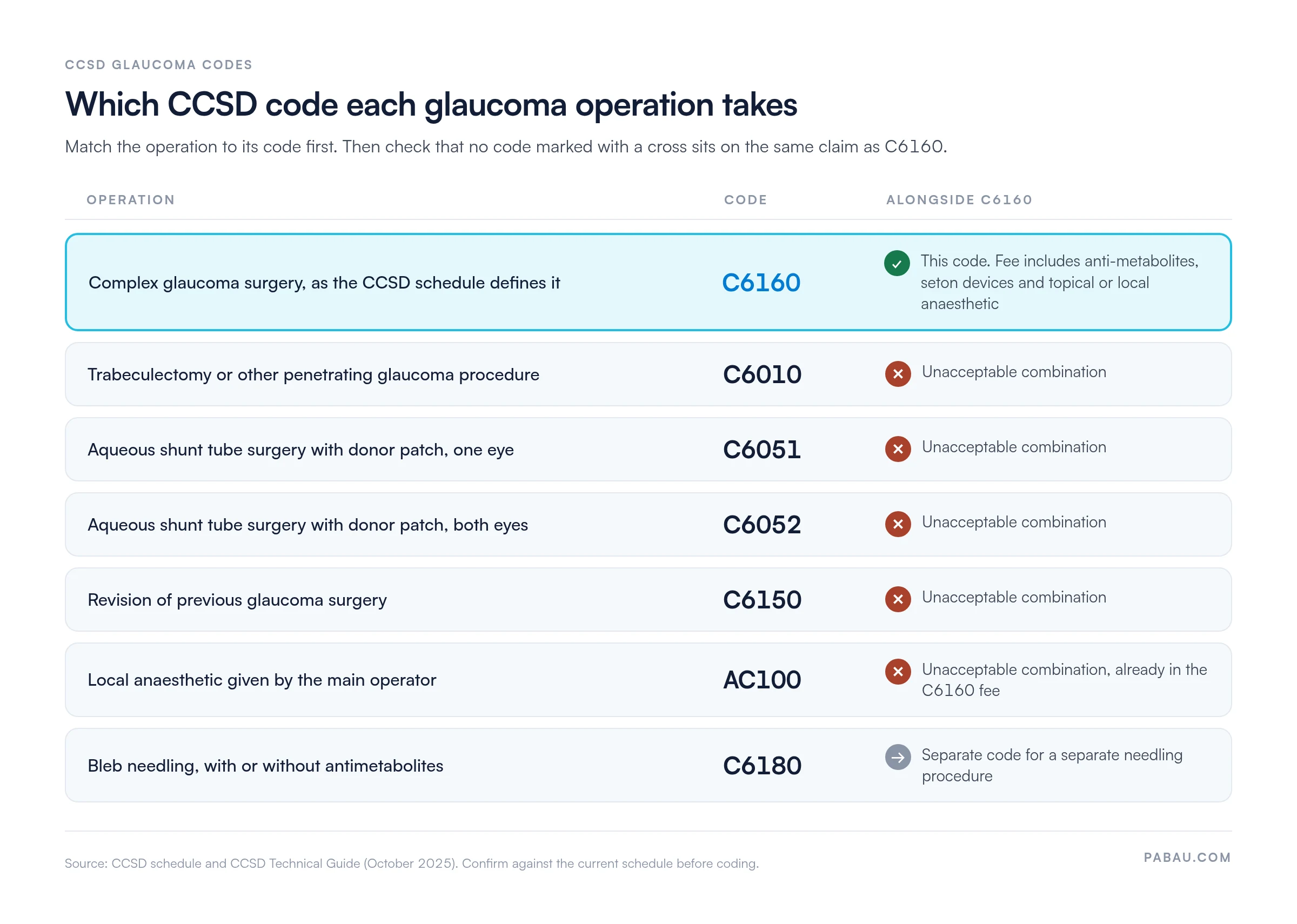
C6160 is an unacceptable combination with C6010, C6051, C6052, C6150 and other glaucoma codes, so it never shares a claim with them.
Check the CCSD schedule or Technical Guide for what makes a case complex before choosing C6160, and record that reason in the operative note.
Most UK private medical insurers expect pre-authorisation for elective glaucoma surgery, so log the reference before the theatre date.
CCSD Code C6160 is the Clinical Coding and Schedule Development code for complex glaucoma surgery. The CCSD schedule defines it as: Complex glaucoma surgery (including anti-metabolites/insertion of seton devices) (including topical or local anaesthetic). UK private medical insurers use it to identify and pay for glaucoma operations the schedule classes as complex.
C6160 sits in Chapter 4 (Eye and orbital contents), section 4.8 (Iris and anterior chamber), alongside several other glaucoma codes.
Standard trabeculectomy is coded C6010, and aqueous shunt tube surgery is coded C6051 (unilateral) or C6052 (bilateral). The schedule lists C6160 as an unacceptable combination with all three, so a claim carries one of these codes and never C6160 as well.
The public listing does not set out what makes a case complex. Those inclusion rules sit in the logged-in CCSD schedule and the CCSD Technical Guide. Check them before coding a case as C6160, and do not assume that adding mitomycin C or implanting a tube moves a case onto it.
C6160 includes glaucoma surgery that the CCSD schedule defines as complex, and its descriptor names anti-metabolites and seton devices within that scope. The public record stops there. The rules on what makes an individual case complex sit behind the CCSD login. The practice should confirm them there before choosing the code.
What the public evidence does support is summarised below.
Mitomycin C (MMC) and 5-fluorouracil (5-FU) are applied during glaucoma surgery to slow scarring at the drainage site. The C6160 descriptor includes them, so their use on a complex case is not billed as a separate item.
Their use does not settle the code by itself. Surgeons often use MMC during trabeculectomy, and trabeculectomy has its own code, C6010. The CCSD schedule decides whether a case counts as complex, and the coder should check it rather than code from the adjunct.
Whichever code applies, the operative note should record the agent, concentration, exposure time and method of application. MMC is typically applied on a soaked sponge at 0.1 to 0.4 mg/ml for one to five minutes. 5-FU may be applied during surgery or injected under the conjunctiva afterwards.
Seton devices route aqueous humour from the anterior chamber through a silicone tube to a plate under the conjunctiva. The C6160 descriptor mentions the insertion of seton devices. Aqueous shunt tube surgery including donor patch, however, has its own codes: C6051 for one eye and C6052 for both eyes.
C6051 and C6052 are both unacceptable combinations with C6160. A primary tube operation is therefore not C6160 by default. Check the schedule’s definition of complex surgery before coding a tube case as C6160.
The devices most often implanted in UK private practice are listed below.
Record the manufacturer, model and plate size in the operative note, along with the tube length trimmed. The insurer uses those details to check the claim against whichever code was submitted.
The C6160 descriptor explicitly includes topical and local anaesthetic. Any of the following approaches is already accounted for in the code fee and must not be billed separately.
The schedule lists AC100 (local anaesthetic by main operator) as an unacceptable combination with C6160. A surgeon-given block on a separate line will be refused.
General anaesthetic is not bundled. When a patient needs GA, for example in a paediatric case or where the patient cannot cooperate, the anaesthetist bills for it separately. The operative note should record the anaesthetic used, so the insurer can match any anaesthesia charge to it.
Most of the glaucoma codes around C6160 are unacceptable combinations with it. They cannot be billed alongside C6160 for the same operation, so the coder chooses one. Confirm descriptors against the current CCSD schedule, because CCSD reviews them regularly.
The chart below maps each common glaucoma operation to its code and flags the ones that can never share a claim with C6160. Our index of CCSD codes links to billing guides for other eye procedures.
The full list of neighbouring codes, including the laser and angle procedures, is set out below.
Trabecular bypass stents such as the iStent fall under C6120, which is also on the unacceptable list. Confirm code numbers against the CCSD Technical Guide before submitting.
Insurers expect the record to show why surgery was needed and why the case was complex. The clinical notes should trace the treatment pathway that led to theatre.
Indications that commonly lead to glaucoma surgery include:
The indication should be documented in the clinic letter or consent note before surgery, not retrospectively. An insurer seeing a C6160 claim with no pre-operative IOP history or failed treatment record will raise a query or decline the claim.
UK insurers ask for an ICD-10 diagnosis alongside the CCSD procedure code. The glaucoma codes most often paired with glaucoma surgery are:
Code the diagnosis to the highest level of detail the insurer accepts. The diagnosis should match the indication recorded in the clinic letter.
The operative note is the central document for any C6160 claim. Incomplete notes are a common avoidable cause of denial, and a missing element can lead to a query, a recode or a rejection. A structured operative note template that prompts for each required element reduces this risk.
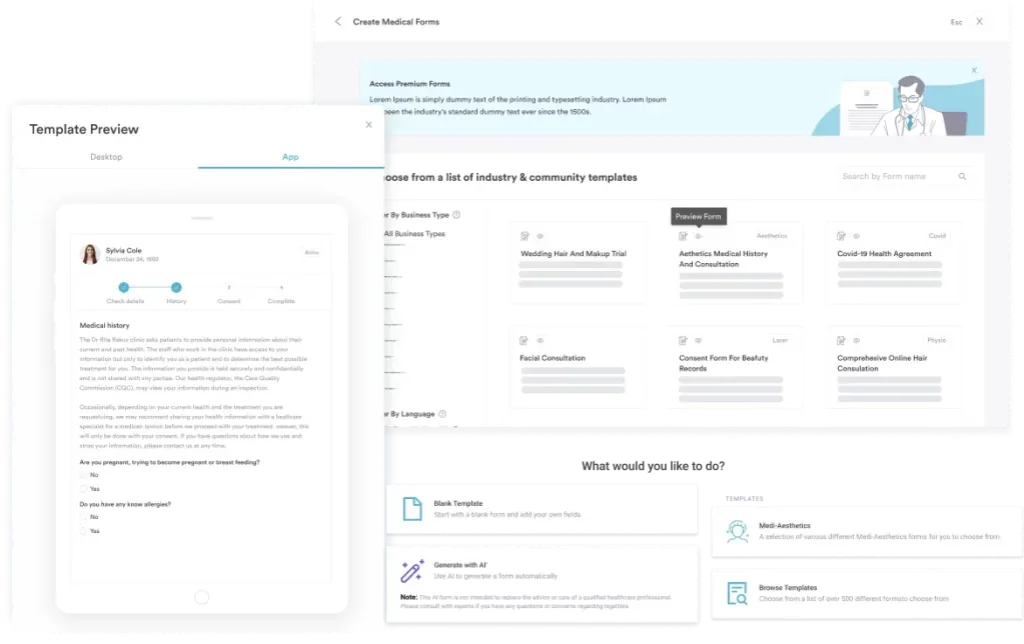
The operative note must record the following for a C6160 claim to be supportable.
The pre-operative clinic letter and the medication history showing prior topical therapy strengthen the claim. So does a consent form recording the risks of anti-metabolite use. Keeping GDPR-compliant clinical records to Information Commissioner’s Office (ICO) and General Medical Council (GMC) standards also protects the practice in an audit or complaint.
Build a glaucoma operative note template in your practice software with mandatory fields for the complexity rationale, each adjunct and each device. A coder cannot reconstruct missing details from a vague note, and insurers rarely accept a retrospective amendment.
Most UK private medical insurers require pre-authorisation before elective glaucoma surgery, and proceeding without it is an avoidable reason for a declined claim. Requirements vary by insurer and policy year, so check the patient’s policy before scheduling.
Log each reference number, approval date and authorisation window as soon as the insurer responds, because theatre dates often move. Practices billing Bupa, AXA Health, Aviva or Vitality should verify requirements through each insurer’s provider portal.
Pre-authorisation reference numbers must appear on the invoice. An insurer will not process a claim where the authorisation reference is missing or the surgery date falls outside the authorisation window. Treat the table above as a general guide and verify each patient’s current policy before scheduling theatre.
Complex glaucoma surgery is sometimes performed with cataract extraction, on both eyes, or after earlier glaucoma surgery. Each situation has its own billing rules.
Combined cataract and glaucoma surgery: check the CCSD schedule before adding a cataract code such as C7520 to a C6160 claim. C6012, canaloplasty combined with phacoemulsification, is itself an unacceptable combination with C6160. Insurers also differ on second-procedure reductions, so confirm the combination with the insurer in writing before the operative date.
Both eyes: C6160 has no separate bilateral code, unlike aqueous shunt tube surgery (C6051 and C6052). Ask the insurer how it wants both eyes billed and whether it reduces the second fee.
Later revision or needling: revision of previous glaucoma surgery is C6150, and bleb needling with or without antimetabolites is C6180. C6150 is an unacceptable combination with C6160, so the two never share a claim.
Most C6160 denials follow a handful of patterns that can be caught before submission. The table below maps each trigger to the corrective action.
When appealing a denied C6160 claim, ask the insurer for its specific denial reason in writing before sending more documentation. A blanket package that does not address the stated reason delays resolution.
Ophthalmology practices running private sessions alongside NHS work often keep the operative note, the authorisation reference and the claim in three different places. Pabau, the practice management platform we build for private practices, brings them into one patient record. Its claims management software then helps billing staff track each claim.
Surgeons can complete the glaucoma operative note in Pabau’s digital forms on the day of surgery. The complexity rationale, adjunct and device details are then already on file if the insurer queries the claim. The authorisation reference is kept with the same patient record, ready to quote on the invoice.
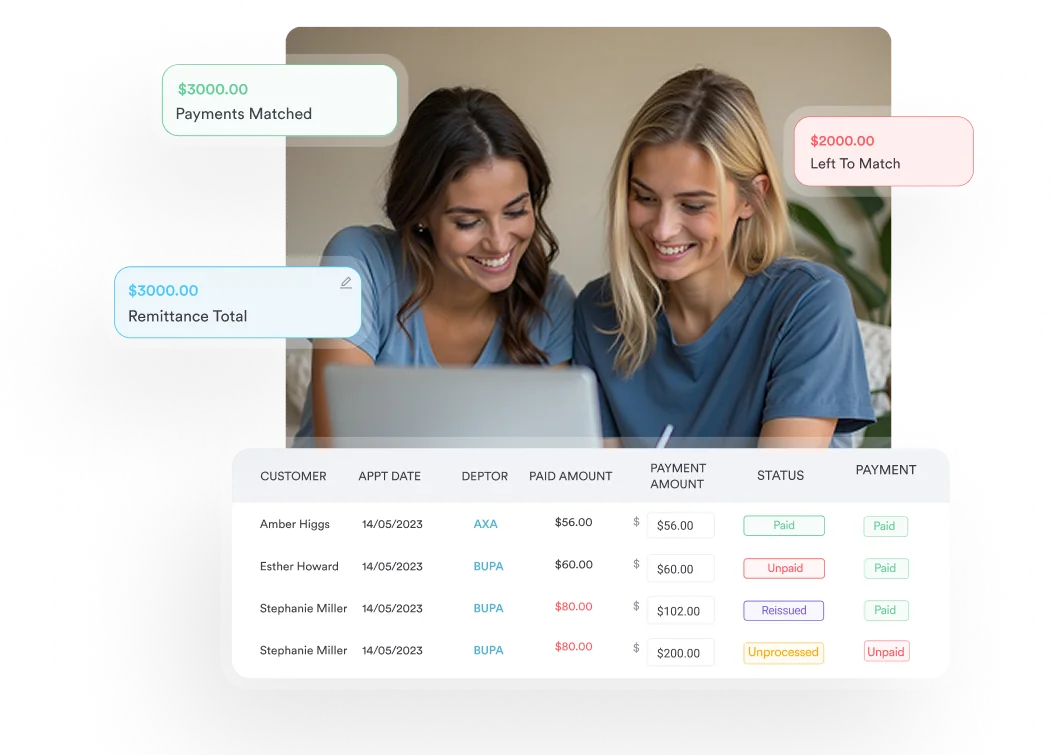
When a claim comes back declined or unpaid, billing staff can see its status and pull the supporting note from the same record. Our guide to Bupa CCSD procedure codes covers how one major insurer applies the schedule.

Pabau keeps the operative note and authorisation reference with the patient record, and its claims management tools help you track every C6160 claim.

Choosing C6160 starts with the CCSD definition of complex glaucoma surgery, not with the adjunct or device used in theatre. Standard trabeculectomy and primary tube surgery have their own codes, and neither can share a claim with C6160. A practice that checks the schedule, records why the case is complex and secures pre-authorisation gives the insurer little to query.
Pabau’s claims management tools help track each claim and keep the operative note and authorisation reference with the patient record. To see how that works for a UK ophthalmology practice, book a demo.

Billing Bupa for private eye surgery? Bupa CCSD codes and fee schedule covers how Bupa maps procedure codes to its reimbursement schedule for UK private practice.
Revising a failed glaucoma operation? CCSD Code C6150: Revision of previous glaucoma surgery explains how revision is coded and documented for UK private insurers.
Planning combined cataract and glaucoma surgery? CCSD Code C7520: Phacoemulsification of lens with implant covers billing for the cataract operation itself.
Coding other iris procedures? CCSD Code C6410: Repair of prolapsed iris walks through another eye code in the same chapter of the schedule.
CCSD Code C6160 covers complex glaucoma surgery (including anti-metabolites/insertion of seton devices), and its fee includes topical or local anaesthetic. The CCSD schedule, which needs a login, sets out what makes a case complex. Standard trabeculectomy (C6010) and aqueous shunt tube surgery (C6051 or C6052) have their own codes.
Yes. The C6160 fee includes the surgeon’s topical or local anaesthetic, so sub-Tenon, peribulbar and retrobulbar blocks and topical drops are not billed separately. General anaesthetic given by an anaesthetist remains separately billable when clinically required.
Check two things first. Confirm in the CCSD schedule that the cataract code is not an unacceptable combination with C6160, then confirm the insurer’s policy in writing. Insurers differ on second-procedure reductions, and some ask for a letter explaining why combined surgery was preferred to staged surgery.
The most common reasons are a missing or expired pre-authorisation and an operative note that does not support the code. Others are C6160 billed with an unacceptable combination such as C6010, C6051 or C6150, and surgeon-given local anaesthetic billed as a separate line.



