

CPT Code 52352: Ureteroscopic stone removal billing guide
CPT Code 52352: Official descriptor and procedure overview CPT Code 52352 descri...

Last Updated: Oct 30, 2026
C6230 is the CCSD code for laser iridotomy – unilateral, a laser procedure on one eye. UK private medical insurers such as Bupa and AXA Health pay the specialist's fee against it. The laser makes a small opening in the peripheral iris, which relieves pupillary block in angle closure.
C6230 sits in sub-chapter 4.8.0 Iris & Anterior Chamber of the CCSD Schedule. When both eyes are treated in the same session, the claim uses C6231 instead, and the schedule bars billing the two codes together.
Let Pabau's smart automation suggest the right codes, reduce claim denials, and keep your practice compliant—effortlessly.
Automate repetitive tasks and focus on what matters most—your patients.
Reduce coding errors and ensure compliance with the latest regulations.
Clean claims, fewer denials, and faster reimbursements.
Powerful insights and reporting to help your practice thrive.
HIPAA compliant SOC 2 certified GDPR-compliant Trusted by 4,000+ clinics worldwide

CCSD Code C6230 covers laser iridotomy on one eye, so each code instance represents a single treated eye.
Therapeutic and prophylactic iridotomy both bill under C6230, because the code does not distinguish by indication.
When both eyes are treated in one session, bill C6231 instead, since CCSD lists the two codes as an unacceptable combination.
Elective iridotomy usually needs insurer pre-authorization, and a missing or expired reference is a common reason claims are rejected.
Pabau, the practice management platform we build, keeps treatment notes, consent forms and invoices in one patient record for claim preparation.
CCSD Code C6230 is the procedure code for a laser iridotomy performed on one eye. The official descriptor is Laser iridotomy – unilateral, so each code instance represents a single eye. Same-session treatment of both eyes uses the adjacent code C6231 instead.
The code sits in sub-chapter 4.8.0 Iris & Anterior Chamber of the CCSD Schedule, which the Clinical Coding and Schedule Development Group maintains. You can browse its neighbors in our CCSD codes library.
C6230 applies whichever laser is used. Nd:YAG has largely replaced argon laser for peripheral iridotomy in UK practice, but the code mandates neither. Both are billable under C6230 when the clinical record notes the modality.
C6230 covers the laser procedure itself and typically includes immediate post-procedure intraocular pressure (IOP) monitoring in the same sitting. Whether post-operative review appointments are bundled or separately billable depends on the individual payer’s fee schedule and policy. Always check the relevant payer’s provider manual rather than assuming a universal rule.
Laser iridotomy creates a small full-thickness opening in the peripheral iris. Aqueous humor can then bypass a pupillary block, which equalizes pressure between the posterior and anterior chambers. The procedure is performed at the slit lamp under topical anesthesia.
A standard procedure follows these five steps, and each one leaves a record the claim depends on:
C6230 is appropriate across a range of angle-closure conditions. UK private medical insurance (PMI) payers typically accept the following indications, provided they are documented with a matching ICD-10 diagnosis code:
C6230 applies to both therapeutic and prophylactic laser iridotomy. The code does not differentiate by clinical urgency. What does differ is the payer pathway: Emergency acute angle-closure cases typically bypass or fast-track pre-authorization. Prophylactic procedures for narrow angles almost always require pre-auth before the procedure takes place.
Three procedures are easy to confuse in ophthalmic billing, and each takes a different code. The choice turns on two facts: how the iris opening was made, and how many eyes were treated in one session. The decision path below shows how those two facts settle the code.
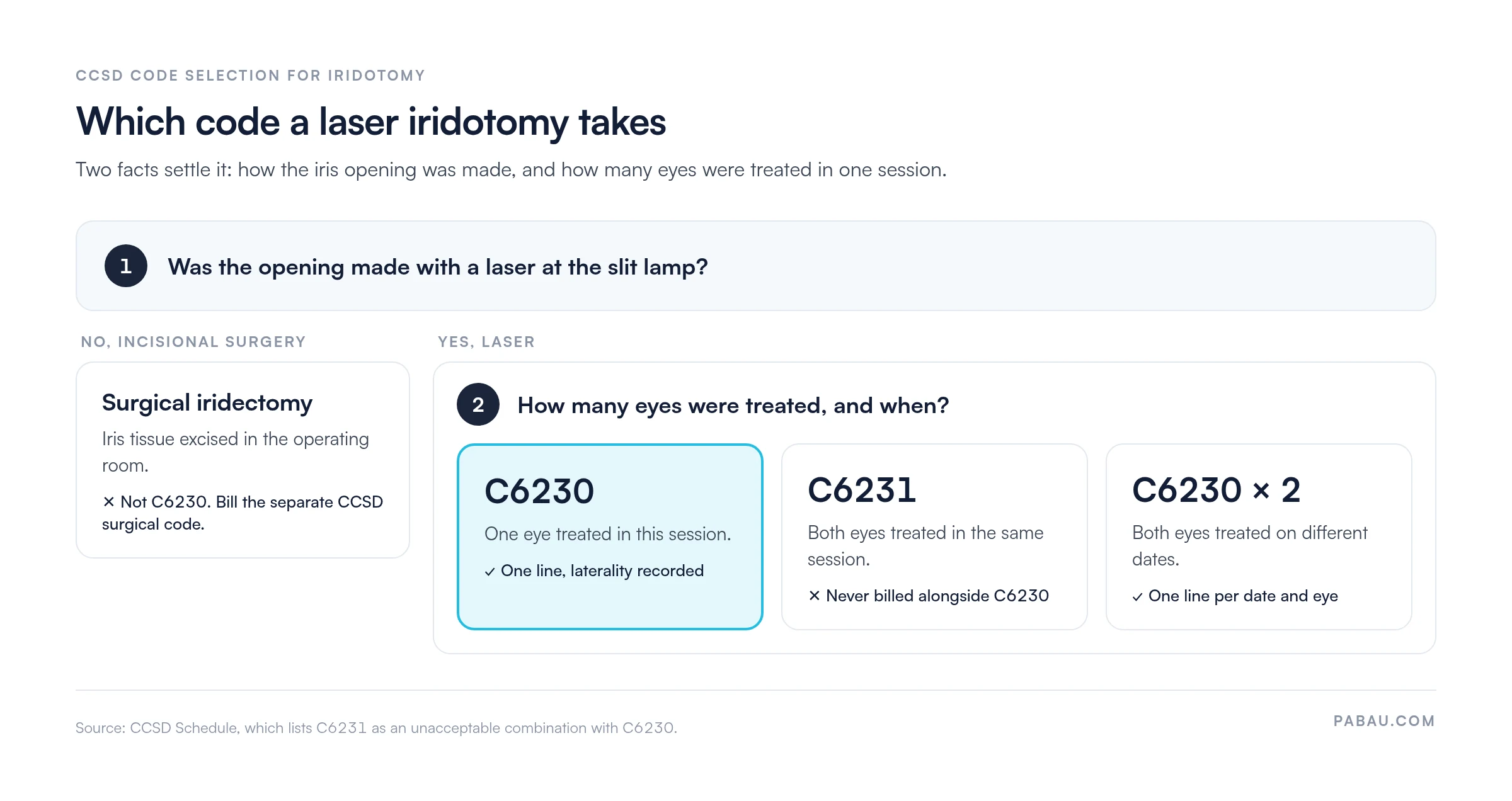
Two separate sessions, two eyes: If the right and left eyes are treated on different dates, use two separate lines of C6230. Each line carries the laterality of the eye treated that day. Do not use C6231 for staged bilateral procedures. The table compares the three procedures side by side.
CCSD lists C6231 as an unacceptable combination with C6230, so the two codes never appear on the same claim. Check the current CCSD schedule before submission, as the schedule is revised periodically.
Confirm whether the same-session or separate-session rule applies before you choose C6230 or C6231. Submitting C6231 for two staged unilateral procedures is an audit trigger. So is billing two lines of C6230 for both eyes treated in one session. When in doubt, call the payer’s provider helpline before submission.
Complete clinical records protect a claim against denial and payer audit. Structured operative note templates and digital intake forms reduce the chance of a missing field at submission. The minimum documentation for a C6230 claim includes:
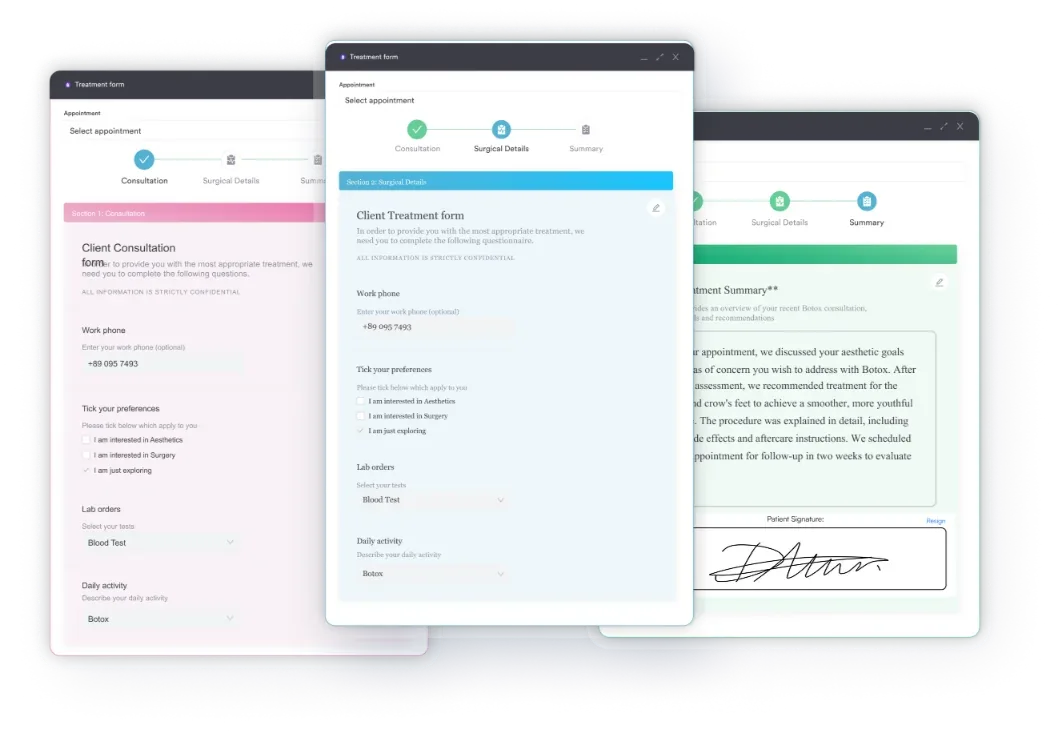
Store consent forms and procedure notes against the patient record in line with UK GDPR. The full audit trail is then ready if a payer asks for supporting evidence.
Most major UK PMI providers require pre-authorization before elective laser iridotomy. Submitting without a valid pre-auth reference is a frequent cause of rejected ophthalmic claims. Emergency acute angle-closure cases often qualify for a retrospective or fast-track pathway. Confirm this with each payer’s provider team before assuming a blanket exemption.
Pre-authorization rules change, and individual policy terms vary. Always consult the current provider manual for each payer before submitting.
The CCSD official schedule holds the authoritative code definitions that UK private medical insurers work from. For Bupa submissions, our Bupa CCSD codes list gathers the insurer’s accepted codes in one place.
Healthcode is the main electronic billing clearinghouse for UK private medical insurance claims. A handful of fields cause most C6230 rejections, so check them on every submission. Pabau’s claims management software keeps invoices and treatment notes in the same patient record, so each claim can be checked against the operative note.
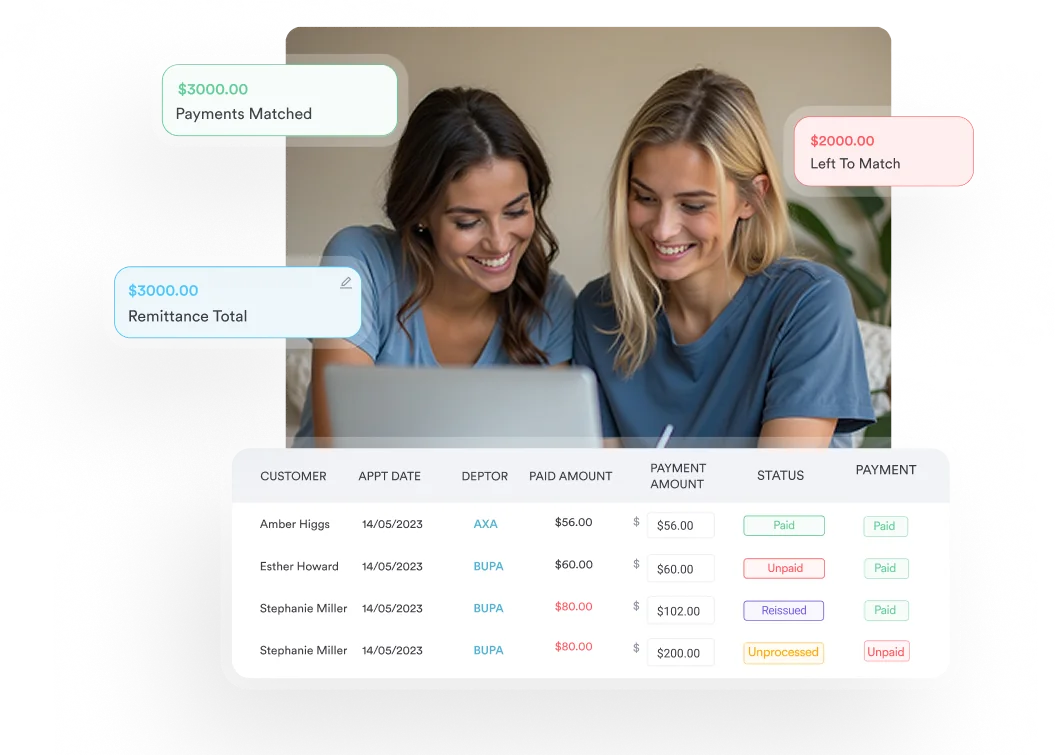
Checking for these denial patterns before submission is faster than chasing rejected claims afterward. These are the most common reasons UK PMI payers reject C6230 claims:
Several codes are commonly submitted alongside or instead of C6230. Knowing where each one applies prevents unbundling errors and miscoding:
Check the current schedule and the CCSD technical guide before submission, as the schedule is revised periodically. CCSD also lists anterior chamber injection, C6930, as an unacceptable combination with C6230.
Yes, in some cases. A separately documented consultation can often be billed on the same date, but IOP checks and trabeculoplasty on the same eye cannot. Rules vary by payer, and these principles apply across most UK PMI providers:
Build a C6230 billing checklist into your ophthalmic workflow. Log the pre-auth reference, confirm laterality against the operative note, and check the payer’s same-day consultation rules. Validate the ICD-10 code before the claim goes to Healthcode.
In many ophthalmology practices, the operative note sits in one system, the consent form in another, and the claim is keyed by hand. Laterality, pre-auth references and diagnosis codes get copied between screens, and that is where C6230 claims go wrong.
Pabau holds the treatment note, signed consent and invoice in the same patient record. Billing staff can check the code, the eye treated and the diagnosis against the operative note before a claim leaves the practice.
The result is fewer claims returned for a mismatched field, and an audit trail that is already filed if a payer asks for evidence.

Pabau keeps treatment notes, consent forms and invoices in one patient record, so CCSD claims can be checked before submission. See how it works for ophthalmology practices.

C6230 is a simple code to select and an easy one to get rejected. Its rejections cluster around laterality, the pre-auth reference and the C6230/C6231 split. Each one comes down to a claim field that does not match the operative note.
So treat the operative note as the source for every claim field, and check the claim against it before it goes to Healthcode. A practice that does this on every iridotomy spends less time on resubmissions and has its audit evidence ready when a payer asks.
Pabau supports that discipline with claims management and structured treatment notes in one patient record. Book a demo to see how it fits an ophthalmology billing workflow.

Need a full CCSD code guide for Bupa submissions? Bupa CCSD codes covers the full Bupa procedure code list used for UK private practice billing, including ophthalmic and surgical codes.
Billing an anterior chamber injection? CCSD Code C6930 explains how to bill anterior chamber injection, a code CCSD bars from the same claim as C6230.
Moving on to glaucoma surgery? CCSD Code C6160 covers billing for complex glaucoma surgery under the CCSD Schedule.
Treating refractory glaucoma? CCSD Code C6610 explains billing for ciliary body ablation.
CCSD Code C6230 is the procedure code for laser iridotomy performed on a single eye, with the official descriptor Laser iridotomy – unilateral. It covers the laser procedure itself (YAG or argon) at the slit lamp. It typically includes immediate post-procedure IOP monitoring in the same sitting. Whether post-operative follow-up appointments are separately billable depends on the individual payer’s fee schedule.
C6230 is unilateral, meaning one eye per code instance. Use C6231 when both eyes are treated in the same appointment. For staged treatment across two separate sessions, submit two lines of C6230. Each line carries its own laterality (OD or OS) and date of service.
CCSD C6230 does not mandate a specific laser modality. Both Nd:YAG and argon laser iridotomy are billable under C6230. Nd:YAG has become the dominant technique in UK private ophthalmology and has largely replaced argon for peripheral iridotomy, but the code accommodates either. Record the modality used in the operative note for payer audit purposes.
Elective C6230 procedures typically require pre-authorization from Bupa, AXA Health, Vitality, and Aviva before the procedure takes place. Emergency acute angle-closure cases may qualify for retrospective or fast-track authorization, but this varies by payer and policy. Always verify current requirements directly with each payer’s provider helpline rather than assuming a blanket rule applies.
Yes, in most cases a consultation code can be billed on the same day as C6230. The consultation must be substantive and separately documented, rather than just a pre-procedure check. Some payers reduce the consultation fee when a procedure is billed on the same date. Check the specific payer’s provider manual for the applicable rule before submitting.
Start with gonioscopy findings confirming occludable angles, with van Herick grading or equivalent, and the clinical rationale for prophylactic treatment. Then record the eye treated, the laser modality, pre- and post-procedure IOP, patient consent and the payer pre-authorization reference. This record supports both the C6230 claim and any later payer audit.



