

HCPCS Code G0163: Skilled nursing observation and assessment
What is HCPCS Code G0163? HCPCS Code G0163 is a deleted Level II code for skille...

Last Updated: Oct 15, 2026
C6610 is the CCSD code for ciliary body ablation. Surgeons use it to lower pressure inside the eye, often in glaucoma that drops or earlier surgery haven't controlled. Treating part of the ciliary body cuts the fluid it makes, so the pressure falls.
The code sits in Chapter 4, Eye and orbital contents, under the Iris and Anterior Chamber category. UK private medical insurers expect pre-authorization before an elective C6610 procedure, plus an operative note that names the eye treated. One pairing causes trouble: CCSD lists C6610 and C6710 (cyclodialysis) as an unacceptable combination.
Let Pabau's smart automation suggest the right codes, reduce claim denials, and keep your practice compliant—effortlessly.
Automate repetitive tasks and focus on what matters most—your patients.
Reduce coding errors and ensure compliance with the latest regulations.
Clean claims, fewer denials, and faster reimbursements.
Powerful insights and reporting to help your practice thrive.
HIPAA compliant SOC 2 certified GDPR-compliant Trusted by 4,000+ clinics worldwide

C6610 is the CCSD code for ciliary body ablation, an eye procedure in the Iris and Anterior Chamber category.
CCSD lists C6610 and C6710 (cyclodialysis) as an unacceptable combination, so the two don’t belong on one claim.
Bupa, AXA Health, Aviva and VitalityHealth generally want pre-authorization before an elective C6610 procedure.
The operative note should name the ablation, the eye treated and the clinical reason, because insurers can audit later.
Healthcode validates the invoice before the insurer sees it, so clear every flag before you submit.
CCSD code C6610 is the code UK private insurers recognize for ciliary body ablation. The surgeon treats part of the ciliary body, the tissue behind the iris that makes aqueous humor. Less fluid means lower pressure inside the eye, which is why the procedure belongs to glaucoma care.
Ablation is not the only route when earlier treatment stops holding the pressure down. If the surgeon revises that earlier glaucoma operation instead, the claim uses C6150.
In the schedule, C6610 sits in Chapter 4, Eye and orbital contents, within the Iris and Anterior Chamber category. It was added in January 2010. The Clinical Coding and Schedule Development group maintains the schedule, and our index of CCSD codes lists other entries we cover.
Descriptors are updated periodically. Before you bill, check the current entry on the CCSD website, which needs a login.
C6610 pays for the ablation itself. Here is how the work around it usually splits, although each insurer’s rules decide the edges.
Unsure whether a step is bundled? Check the insurer’s unbundling policy first. Healix, for example, publishes unbundling guidelines that explain when co-billing is allowed.
Ciliary body work has more than one code. The closest neighbor is the one most likely to get a claim queried, so here are the three questions billers ask about it.
What is C6710? It’s the CCSD code for cyclodialysis, the separation of the ciliary body. Both procedures target the same tissue, which is why they get mixed up.
Can you bill both? No. CCSD lists C6710 as an unacceptable combination with C6610. If both appear on one claim, expect the insurer to query or reject it.
How do you choose? Read the operative note. If it describes ablation, bill C6610. If it describes separating the ciliary body, C6710 is the code to check.
To see how an insurer treats either code, use the Bupa code search tool or the insurer’s own lookup. Our Bupa CCSD codes guide explains how Bupa sorts and pays procedure codes.
Read the operative note before you pick the code. If the wording could fit C6610 or C6710, ask the surgeon to clarify it before the invoice goes out. A corrected note takes minutes, while a queried claim means resubmitting and waiting again.
Get the pre-authorization reference before you book an elective C6610 procedure. Most UK insurers deny claims that arrive without one, and retrospective approval isn’t guaranteed.
Rules differ by insurer and can change without notice, so check the provider portal each time. As a general guide:
Urgent procedures are usually exempt. Even so, tell the insurer as soon as you can afterward, and note the date and any reference number they give you.
The main UK private medical insurers all use CCSD codes for procedure billing. The table shows how each one handles a C6610 claim. Fee rates vary, so confirm the current schedule with each insurer.
Providers outside an insurer’s network can still submit C6610 claims. However, payment may be capped at the insurer’s benefit schedule, and some insurers ask the patient to claim directly.
No single schedule sets the fee for C6610. Each insurer sets its own rates, and contracted rates usually differ from what non-contracted providers receive. Here is where to look:
For Bupa claims, our guide to the Bupa fee schedule explains how its procedure fees are grouped.
Charging more than the insurer pays is allowed, but tell the patient first. Put any shortfall in writing when they book. Skip that step and you risk a complaint, or a charge-back request from the insurer.
Healthcode is the main electronic billing gateway for UK private CCSD claims. Bupa, AXA Health, Aviva, VitalityHealth and WPA all receive invoices through it. The whole path from authorization to payment has five stages, and each one has its own weak spot.
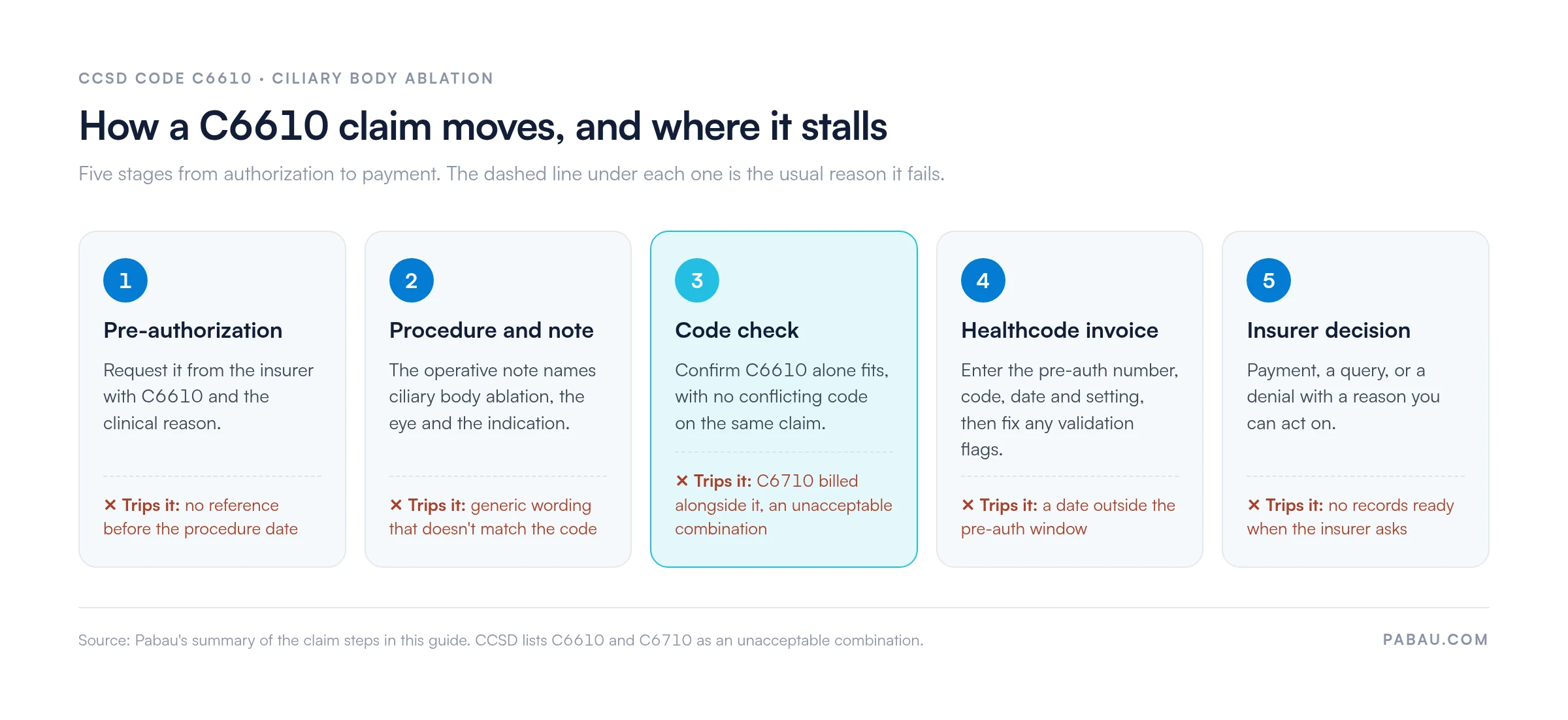
Inside Healthcode itself, the invoice takes eight steps:
Insurers can ask for records at any point after payment. If the notes can’t support the claim, the insurer can reverse it and ask for the money back. That makes the note the part of a C6610 claim that has to hold up longest.
At minimum, the note names the procedure performed, the eye treated, the clinical reason, and the date and setting. Some insurers also want evidence that other treatment was considered first.
Run through these checks before the invoice leaves the practice. Each one maps to a common reason C6610 claims come back.
A claim that passes all seven is what billers call a clean claim. It’s also the quickest route to payment.
Procedure claims carry more data than consultation claims, so they have more ways to fail. Fortunately, the usual causes are easy to catch before submission.
When a claim is denied, ask for the reason in writing. Most UK insurers give a reason code and, on request, the policy section behind it. Good denial management tracks those reasons by code and insurer, so patterns show up early.
Review denials by CCSD code once a month. Pull last month’s denied claims and group them by code and insurer. If C6610 denials cluster with one insurer, check its latest provider guidance for a policy change.
Most of the admin behind a C6610 claim is matching. The pre-auth reference has to match the invoice, the note has to match the code, and the outcome has to be logged somewhere.
Pabau’s claims management software does that matching inside the patient record. The CCSD code attached to the service carries onto the invoice. Required fields, such as the membership number and authorization code, are checked before the claim can be sent.
Claims then go to the insurer through Pabau’s Healthcode integration, and their status is tracked from the same screen. As a result, fewer claims bounce back for a missing reference, and there is one place to look when an insurer asks a question.
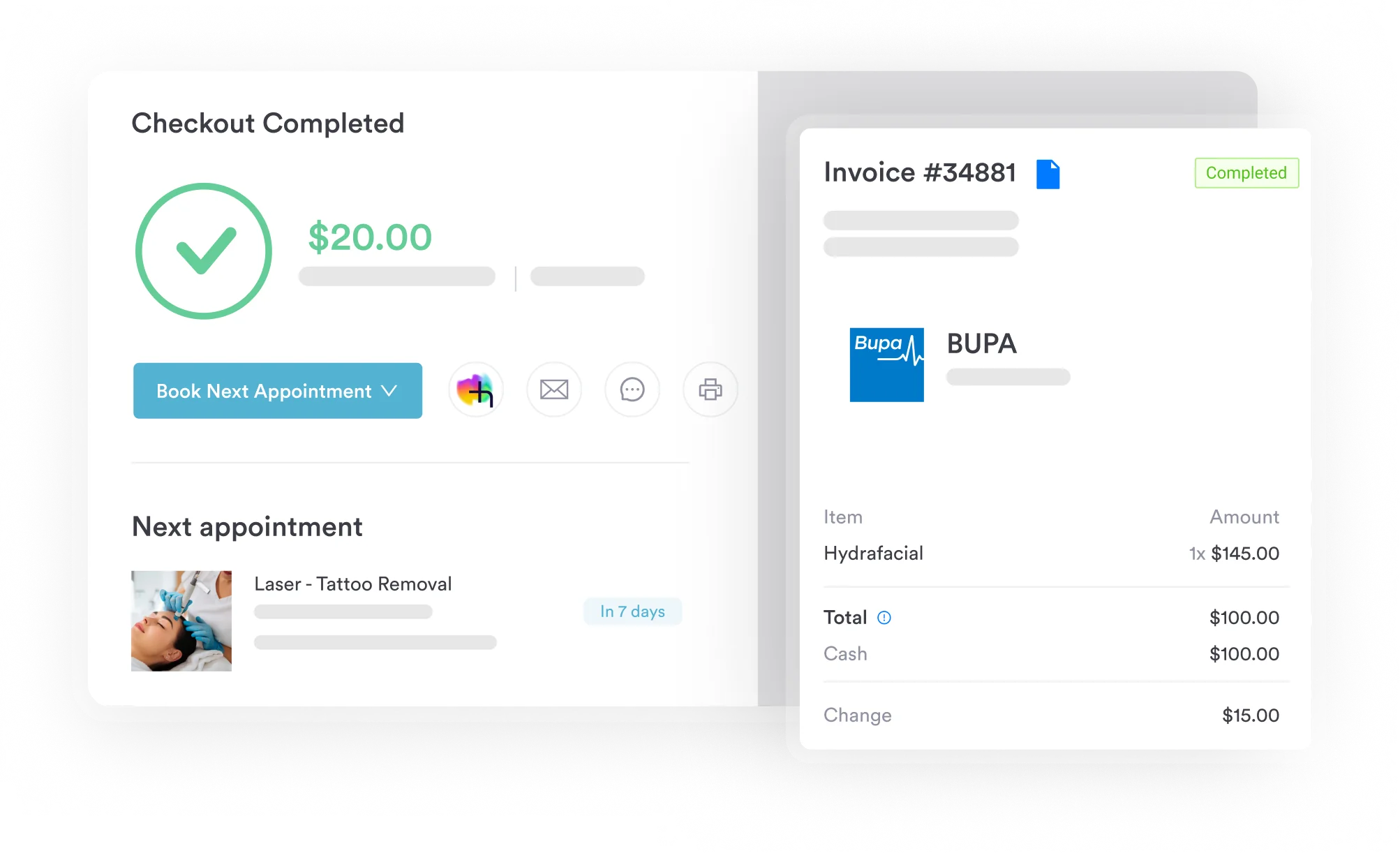

Pabau keeps CCSD codes, pre-authorization references and operative notes on one patient record, then submits through Healthcode. Your team spends less time chasing queried claims.

C6610 claims rarely fail on the code itself. They fail on the paperwork around it, such as a missing pre-auth reference, a vague note, or C6710 on the same invoice.
So fix the order of work. Get authorization first, then make sure the note names the ablation and the eye. Check the code pairing before the invoice goes to Healthcode. Each step takes minutes once it’s routine, and each one saves a claim you’d otherwise chase.
Want those checks to run inside the patient record rather than on a sticky note? Book a demo to see how Pabau handles CCSD billing for eye surgery practices.

Billing other Bupa procedures? Bupa CCSD codes explains how Bupa sorts, checks and pays procedure codes.
Setting your self-pay and insured prices? Bupa procedure codes and fee schedule shows how Bupa’s fee categories work.
Coding other eye procedures? CCSD code C7520 covers cataract surgery with a lens implant.
Treating orbital infections too? CCSD code C0620 walks through billing for drainage of the orbit.
Seeing the same denials every month? Denial management in healthcare sets out a process for tracking and fixing them.
It lowers pressure inside the eye, usually in glaucoma. Treating part of the ciliary body reduces the fluid it produces. Surgeons often use it when drops or earlier surgery haven’t controlled the pressure.
No. CCSD lists C6710, the code for cyclodialysis, as an unacceptable combination with C6610. Bill the code that matches the operative note and leave the other off the claim.
C6610 is in Chapter 4, Eye and orbital contents, within the Iris and Anterior Chamber category. It was added to the schedule in January 2010.
Yes, for elective procedures. Bupa, AXA Health, Aviva, VitalityHealth and WPA generally expect a pre-auth reference before treatment. Urgent cases are usually exempt, but tell the insurer promptly afterward.
Bupa, AXA Health, Aviva, VitalityHealth, WPA and Healix all accept CCSD-coded claims. Fee rates vary by insurer and by your recognition status, so check each provider portal before invoicing.
No. The anesthetist bills separately under the insurer’s rules. Imaging, lab tests and follow-up consultations after the procedure date usually go on their own lines too.




