



CCSD code G5100: Bypass of duodenum billing guide
CCSD code G5100 bills a bypass that leaves the duodenum in place CCSD code G5100...

Last Updated: Oct 16, 2026
CCSD code AA460 is the UK private healthcare code for destroying a trigeminal nerve branch by neurolytic injection, radiofrequency ablation, or cryoprobe. All three techniques bill under this one code. That is why the operative note has to name both the technique and the exact nerve branch treated. Missing either detail is a common reason CCSD code AA460 claims are rejected, and most major insurers also require pre-authorization before the procedure.

CCSD code AA460 covers percutaneous destruction of any trigeminal branch (V1, V2, or V3) by neurolytic injection, radiofrequency ablation, or cryoprobe under one code.
Bupa and most UK private medical insurers require pre-authorization before the procedure. Submitting without it is the leading denial reason.
The operative note must name the branch treated, the modality, the imaging guidance method, and the supporting ICD-10 diagnosis code (typically G50.0).
Pabau, the practice management platform we build, supports CCSD-coded claims and pre-auth tracking for UK pain management practices.
CCSD code AA460 describes destruction of a branch of the trigeminal nerve by neurolytic injection, radiofrequency ablation, or cryoprobe. The code is maintained by the Clinical Coding and Schedule Development (CCSD) group. That body runs the procedure coding schedule used by all major UK private insurers. Our CCSD billing guides cover other codes in the same schedule.
Three distinct techniques are captured under this single code. The trigeminal nerve (cranial nerve V, or CN V) has three peripheral branches: The ophthalmic (V1), maxillary (V2), and mandibular (V3). AA460 applies when any one of these branches is deliberately destroyed for lasting pain relief, as opposed to temporary anesthesia.
AA460 is indicated when a patient has medically refractory facial pain from a trigeminal nerve condition and first-line treatments haven’t worked. Trigeminal neuralgia (ICD-10 G50.0, tic douloureux) is the primary indication. It is characterized by episodic, severe, electric-shock pain along one or more trigeminal branches.
Other accepted indications include atypical facial pain, postherpetic trigeminal neuralgia (ICD-10 G53.0), and persistent facial pain secondary to malignancy. Insurers typically require documented evidence that conservative management was tried before they approve the procedure.
The procedure is performed by trained pain specialists, interventional radiologists, or neurosurgeons with the relevant specialist registration. Confirm scope of practice and indemnity cover beforehand, as requirements vary by qualification and clinical setting.
All three modalities below map to AA460. The same code is used whichever approach is taken, so the operative note must state the technique clearly.
Radiofrequency ablation (RF thermocoagulation) is the most commonly performed technique under AA460. An electrode is placed percutaneously at the gasserian ganglion or a peripheral trigeminal branch under fluoroscopic or CT guidance. Electrical current heats the target tissue to 60-80°C. The controlled lesion interrupts pain transmission while aiming to preserve tactile sensation. Sensory testing during the procedure guides how far the ablation goes.
The operative note must record these five details.
Cryoneurolysis (cryoprobe nerve destruction) applies extreme cold through a probe placed at the target trigeminal branch. Freeze-thaw cycles at approximately -60 to -70°C disrupt axonal continuity without destroying the endoneurium. The resulting pain relief may reverse over months. The technique is used more often on peripheral branches, such as the infraorbital and inferior alveolar nerves, than at the gasserian ganglion.
Documentation requirements match those for RF. The branch treated, number of freeze-thaw cycles, probe specifications, imaging guidance, and post-procedure assessment must all appear in the operative note.
Chemical neurolysis involves injecting a neurolytic agent (typically absolute alcohol or phenol) at the target trigeminal branch to produce lasting nerve destruction. Small volumes (0.1-0.5 ml) are used at peripheral branch sites, and the injection must be image-guided to confirm placement. Unlike a nerve block using local anesthetic alone, the intent here is permanent or prolonged pain relief through tissue destruction.
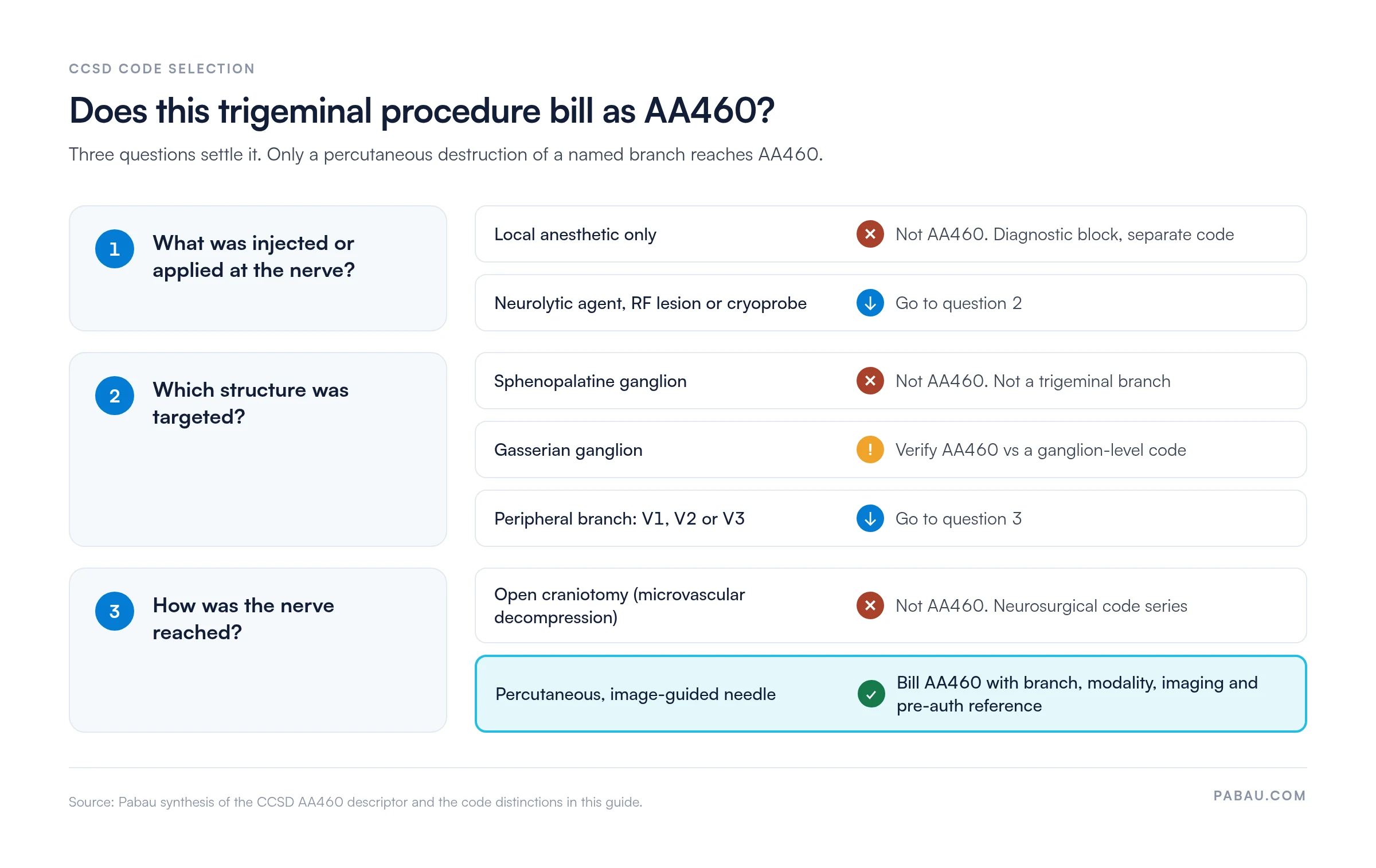
Key distinction for billing: A diagnostic trigeminal nerve block using only local anesthetic is NOT billable under AA460. The operative note must specify that a neurolytic agent was injected to justify the destruction code.
Check every AA460 operative note for four elements before submission. It needs the trigeminal branch treated (V1, V2, or V3) and the modality used, naming the agent if neurolytic. It also needs the imaging guidance method with its report reference, plus the insurer’s pre-auth reference number. A note missing any one of these is likely to generate a denial.
Knowing what AA460 bundles prevents both under-coding and denials for separately billable services.
Imaging guidance bundling rules for AA460 aren’t published in the freely available sections of the CCSD schedule. Check the insurer’s tariff documentation before adding fluoroscopy or CT guidance codes to an AA460 claim. Some insurers bundle guidance into the procedure fee. Others require a separate claim line with a supporting radiology report.
Picking the wrong code is a frequent billing error for trigeminal procedures. The table below sets out how to tell the options apart.
When RF ablation targets the gasserian ganglion rather than a peripheral branch, check with your billing team whether it meets the AA460 descriptor. It may instead fall under a ganglion-level CCSD code such as 25160. Either way, the operative note must be specific enough about the anatomical target to support the code selected.
The flow below runs the same checks in order, from the agent used to the route of access.
Incomplete documentation drives many AA460 claim denials. Every element below must appear in the operative note before submission. A claim missing any of them is at high risk of rejection by Bupa, AXA Health, Aviva, or any other private medical insurer.
Digital documentation workflows that prompt for each element when the note is completed make it less likely that a blank field reaches the claim stage.
The major UK private medical insurers require pre-authorization (pre-auth) for AA460. Performing the procedure without approval and then claiming is the leading cause of outright denial for this code. Insurer policies change, so verify current requirements with each insurer before every procedure.
For Bupa, the consultant typically submits clinical evidence through the Bupa code search and provider portal. The usual minimum is evidence that carbamazepine or oxcarbazepine was tried and either failed to control pain or caused intolerable side effects. Our guide to Bupa CCSD procedure codes adds context on submitting CCSD claims to Bupa.
AXA Health and Aviva also require evidence of failed conservative treatment before authorizing interventional pain procedures. AXA’s procedure code lookup is on the AXA Health specialist procedure portal. Aviva publishes its fee schedule and invoicing requirements on the Aviva provider fee schedule.
The denial patterns below recur in UK private billing for interventional pain procedures. Each has a prevention step you can build into the practice workflow.
Building these checks into the billing workflow catches missing documentation fields before a claim goes out, rather than after a denial arrives.
Every AA460 claim to a UK private medical insurer must include a supporting ICD-10 diagnosis code. The primary diagnosis must match the documented clinical indication.
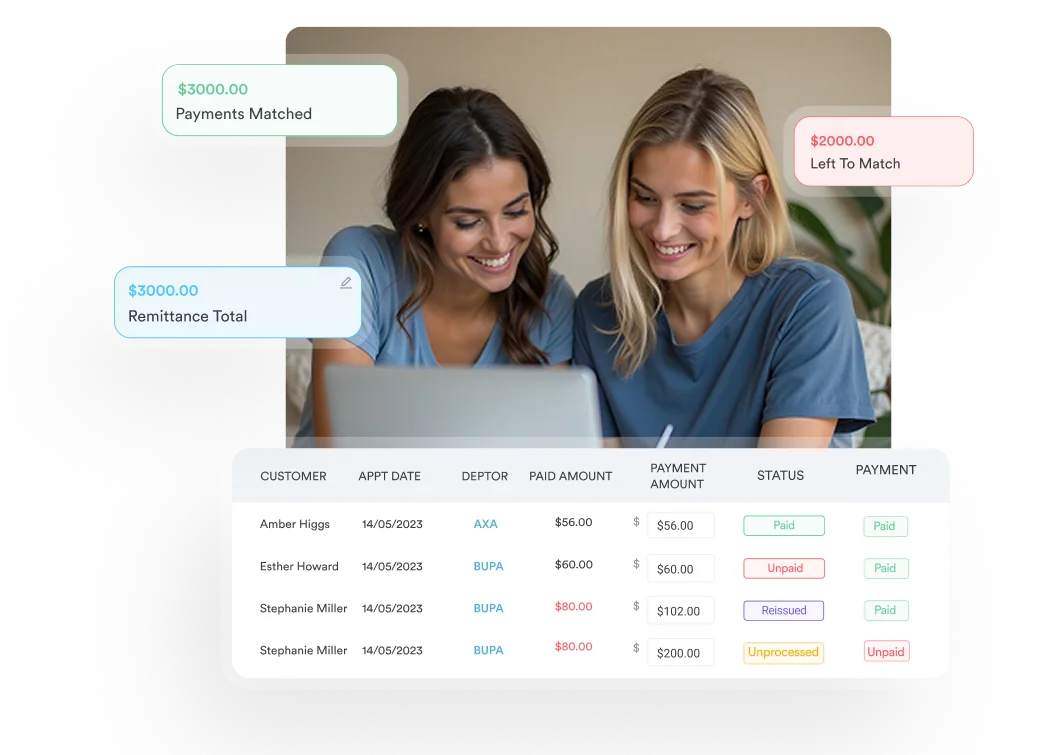
Many pain management practices still handle AA460 billing by hand across several insurers, each with its own pre-auth rules and documentation thresholds. Pabau’s claims management software supports CCSD-coded claim workflows and pre-auth tracking in the same system as the clinical record.
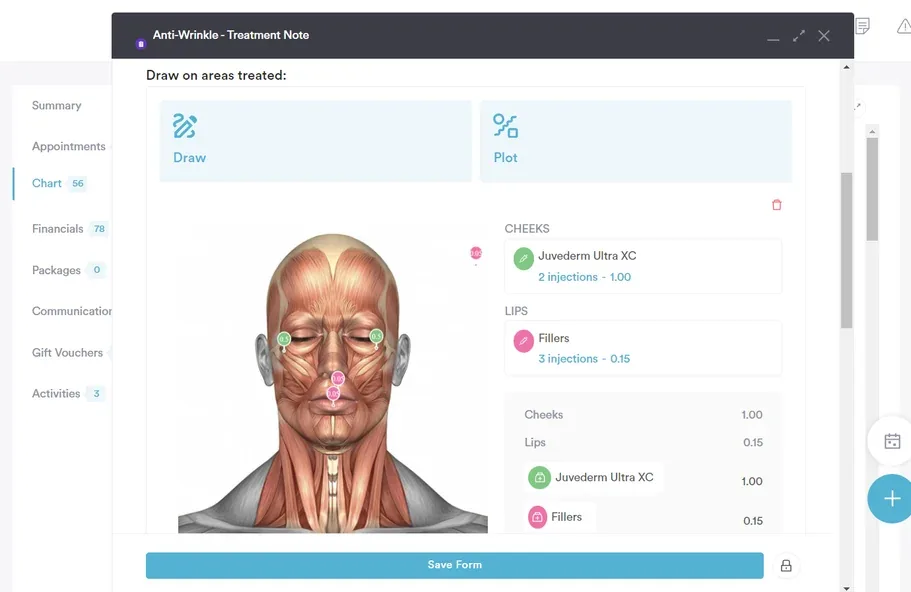
Consultants and practice managers can use structured clinical note templates with mandatory fields for branch, modality, and imaging guidance. Those details are captured when the note is completed, so fewer submissions go out incomplete. Pre-auth reference numbers can be logged against the appointment, linking the authorization to the procedure date and insurer.
For consultants new to UK private billing, that setup shortens the learning curve. CCSD codes, pre-auth tracking, and structured notes sit in one place instead of three.

Pabau helps UK private practices track pre-auth status, manage clinical documentation, and submit CCSD-coded claims without the administrative back-and-forth. See how it works for interventional pain management teams.

AA460 puts three very different techniques under one code. The claim only holds up if the operative note carries the detail the code leaves out. Write the branch, the modality, and the imaging guidance into the note on the day, not when the claim is queried.
Treat pre-authorization as a scheduling step rather than a billing task. A procedure booked without a confirmed reference number is likely to be denied, however complete the note is.
If your team still checks these elements from memory, a structured note and a pre-auth field on the booking will flag missing details before submission. Book a demo to see how Pabau keeps AA460 notes, pre-auth references, and insurer claims together.

Need a broader reference for CCSD codes accepted by Bupa? Bupa CCSD procedure codes covers the full Bupa CCSD schedule and billing requirements for UK private practice.
Comparing other nerve destruction codes? CCSD code A7300 covers radiofrequency, cryoprobe and phenol nerve denervation.
Injecting the trigeminal ganglion rather than a branch? CCSD code 25150 is our billing guide for trigeminal ganglion injection.
Was the nerve destroyed intracranially? CCSD code A2600 covers other intracranial destruction of a cranial nerve.
Billing a trigeminal nerve block in the US? CPT code 64400 is our billing guide for the trigeminal nerve block.
CCSD code AA460 covers destruction of a branch of the trigeminal nerve by neurolytic injection, radiofrequency ablation, or cryoprobe. All three techniques bill under the same code. The operative note must state which modality was used and which branch (V1, V2, or V3) was treated.
AA460 is a destructive procedure that uses a neurolytic agent, radiofrequency energy, or a cryoprobe for prolonged or permanent pain relief. A diagnostic trigeminal nerve block uses only local anesthetic for temporary, reversible numbness. It maps to a lower-value diagnostic block code. Billing a diagnostic block as AA460 is incorrect coding and will likely be denied on audit.
Yes. Bupa and AXA Health require pre-authorization for AA460, as they do for most interventional pain procedures. Both typically ask for a specialist referral letter, a documented diagnosis history, and evidence that first-line medications were tried and failed. Policies change, so verify current requirements with each insurer before every procedure.
Yes. The descriptor says “branch” without restricting it to one division, so AA460 applies to the V1 (ophthalmic), V2 (maxillary), and V3 (mandibular) branches. If several branches are treated in one session, ask the insurer whether to submit one AA460 line or several. Bundling rules for this aren’t uniformly published.
The closest US equivalents are three CPT codes. CPT 64600 covers destruction by neurolytic agent, trigeminal nerve; supraorbital, infraorbital, mental or inferior alveolar branch. CPT 64605 covers the second and third division branches at the foramen ovale, and CPT 64610 is the same, with radiologic monitoring. They are procedurally similar but not interchangeable for billing. CCSD and CPT are separate coding systems, so any mapping between them is approximate. Always use the code set of the system you are billing.
Insurers most often deny AA460 claims for four reasons. They are missing pre-authorization, an incomplete operative note, a diagnosis code that doesn’t support the procedure, and no evidence of failed conservative treatment. To prevent them, secure pre-auth before the procedure and use a structured operative note template that mandates every required field. Then map the correct ICD-10 code to the claim before submission, typically G50.0 for trigeminal neuralgia.



