

CCSD code G5100: Bypass of duodenum billing guide
CCSD code G5100 bills a bypass that leaves the duodenum in place CCSD code G5100...

Last Updated: Oct 16, 2026
25150 is the CCSD code for trigeminal ganglion injection (local anaesthetic under X-ray control). It covers a single injection of local anaesthetic into the trigeminal (Gasserian) ganglion, with fluoroscopy confirming needle placement through the foramen ovale.
The descriptor sets three billing conditions: a local anaesthetic agent, the trigeminal ganglion as the target, and X-ray control. A neurolytic injection, an unguided injection or a block at another site takes a different code. UK private medical insurers usually require prior authorisation first.
Let Pabau's smart automation suggest the right codes, reduce claim denials, and keep your practice compliant—effortlessly.
Automate repetitive tasks and focus on what matters most—your patients.
Reduce coding errors and ensure compliance with the latest regulations.
Clean claims, fewer denials, and faster reimbursements.
Powerful insights and reporting to help your practice thrive.
HIPAA compliant SOC 2 certified GDPR-compliant Trusted by 4,000+ clinics worldwide

CCSD Code 25150 covers trigeminal ganglion injection with local anaesthetic under X-ray control only. Neurolytic injections and unguided procedures use different codes.
Fluoroscopic guidance is mandatory, so without X-ray control the procedure cannot be billed as 25150, whatever anaesthetic agent was used.
Most UK private medical insurers, including Bupa, AXA Health and Aviva, require prior authorisation first. The usual primary diagnosis is ICD-10 G50.0, trigeminal neuralgia.
A sphenopalatine block or a diagnostic block of a trigeminal branch is coded A7350, not 25150.
Practice management software like Pabau keeps the CCSD code, insurer fees and the operative note in one workflow. Each claim is then prepared from one patient record.
CCSD Code 25150 is defined in the Clinical Coding and Schedule Development (CCSD) schedule as Trigeminal ganglion injection (local anaesthetic under X-ray control). The code applies when a clinician injects a local anaesthetic into the trigeminal (Gasserian) ganglion, with real-time fluoroscopy confirming needle placement. Each part of that descriptor is a billing condition. Change any one of them and the procedure moves to a different code, as the check below shows.
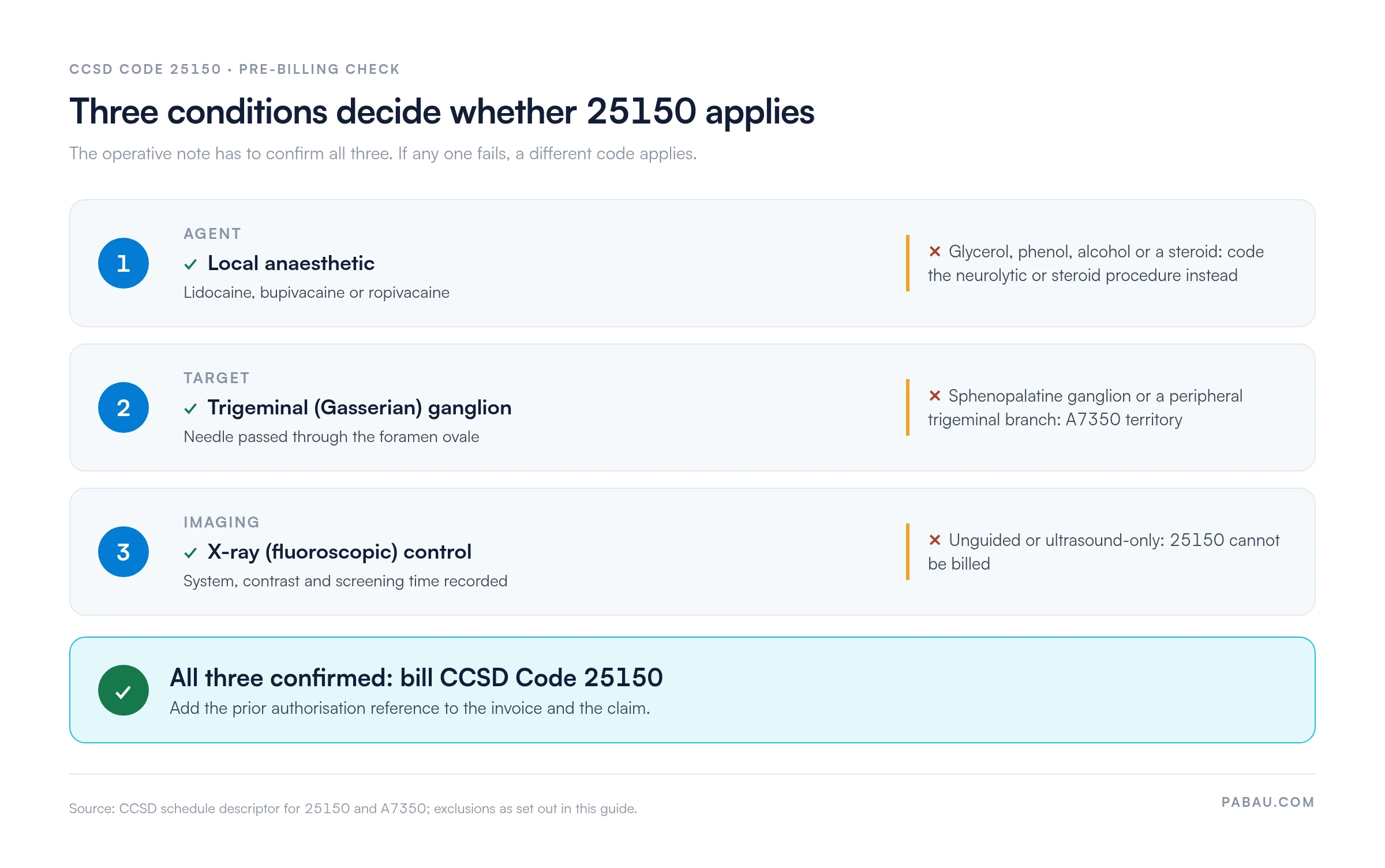
CCSD is a UK-specific coding system maintained by the CCSD Group. Four major private medical insurers make up the group: Bupa, Vitality, AXA Health and Aviva. Practices use it only in the independent and private healthcare sector. NHS providers do not use CCSD codes.
Trigeminal ganglion injection is a percutaneous procedure performed by an anaesthetist or interventional pain consultant, with the patient supine under fluoroscopic control. The technique explains why image guidance is inseparable from both the procedure and the billing code.
Fluoroscopy is a patient safety requirement, because the needle has to be placed accurately at the skull base. That same requirement decides code eligibility. A clinician who performs the injection without fluoroscopic guidance cannot bill CCSD Code 25150, whatever the clinical indication or anaesthetic agent.
The procedure treats facial pain conditions where the trigeminal nerve pathway is the anatomical target. Referral letters and operative notes should document the specific indication, since insurers may request it during prior authorisation or claim assessment. In pain medicine, prior authorisation criteria typically hinge on documented evidence of failed conservative treatment.
Clinical decisions about patient suitability and contraindications rest entirely with the treating clinician. This article covers billing and coding only.
The descriptor boundary is precise. A code that does not match the procedure exactly is the most correctable cause of claim denial. Check the inclusions and exclusions below against the operative note before submission.
Several adjacent CCSD codes cover interventional pain procedures at nearby sites or with different agents. The right code depends on the injection site, the agent used and whether imaging guidance was employed. Verify current descriptors against the official CCSD schedule before billing, since descriptors and code boundaries are revised periodically.
Where the agent goes into the cerebrospinal fluid instead, the schedule entry is CCSD Code A5420. It covers injection of a therapeutic substance into CSF, so the needle position decides which code applies.
A sphenopalatine block or a diagnostic block of a single trigeminal branch is billed as A7350, not 25150. The summaries above are for orientation only, so check the full descriptor in the current schedule before you code.
A radiofrequency lesion at the same ganglion is a separate procedure, coded 25160. 25150 applies when local anaesthetic is injected and no nerve tissue is destroyed.
An injection into or around the orbit is a different site again, billed under CCSD Code C0840. That entry typically covers the retrobulbar, sub-Tenon and peri-orbital approaches.
The words “under X-ray control” make fluoroscopic guidance a billing criterion for CCSD Code 25150. A procedure performed without real-time X-ray imaging cannot be billed under this code, even if the correct ganglion and the correct anaesthetic agent were used.
Document fluoroscopy in the operative note with three data points. Record the imaging system used, such as C-arm fluoroscopy, and the contrast agent and volume that confirmed needle placement. Add the screening time or image count if your insurer contract requires it. Missing any of these is a common trigger for a 25150 denial.
Whether the radiological supervision element can be coded separately depends on who performs and reports the imaging. If a radiologist separately performs and reports the fluoroscopic supervision, that radiologist may be able to bill a radiology supervision code.
If the anaesthetist uses fluoroscopy as part of their own technique, insurers generally consider it bundled within CCSD Code 25150. Insurers differ on this point. Confirm the co-billing position with each insurer, or ask the CCSD technical helpdesk, before billing a separate radiology code.
A complete claim file for CCSD Code 25150 shows that the procedure matches the descriptor at every point. Digital clinical documentation that captures the required fields at the point of procedure lowers the risk of a missing-documentation denial. The claim file should hold these items before submission.
A pre-submission checklist for interventional pain procedures lets practice managers confirm each item is captured before the claim goes out. That is far quicker than chasing missing documents after a denial arrives. Referral requirements also vary by insurer, so confirm them with each payer when onboarding new consultants.
UK private medical insurers typically require prior authorisation (PA) before a trigeminal ganglion injection. Authorisation is a condition of reimbursement. A procedure performed before it is granted may be denied, even when it was clinically appropriate and correctly coded.
PA criteria change, so verify them directly with each insurer. The requirements below are typical and must be checked against each insurer’s current guidance.
Facility accreditation is a common sticking point. Independent-sector facilities in England must hold CQC registration, and some insurers check it as part of their provider recognition criteria. Confirm your facility’s recognition status with each insurer when you onboard a new procedure.
CCSD Code 25150 denials usually trace back to one of six causes. Each has a straightforward fix, provided the procedure was performed correctly and documented in full.
CCSD fee schedules are negotiated individually between each insurer and recognised providers, so published rates are commercially sensitive and updated annually. Verify your current fee entitlement against your insurer contracts rather than relying on third-party estimates. The notes below are indicative sector context only.
For the most accurate reimbursement figures, log in to the Bupa code search portal, the Aviva fee schedule or your insurer’s provider portal. Our CCSD billing guides break down other codes in the schedule the same way, including the neighbouring nerve block codes.
In many practices the code lives in one system, the insurer fees in a spreadsheet and the operative note somewhere else. Each hand-off is a chance for an invoice to go out at the wrong rate, or without the fluoroscopy details an insurer asks for.
Practice management software like Pabau stores the CCSD code, per-insurer fees and the clinical record against the same patient. Setting 25150 up once, before the first procedure, saves re-entering fee data and correcting invoices later. Pabau’s claims software for practices then tracks each claim after submission. To set the code up:

Store CCSD codes, insurer-specific fees and clinical notes in one place. Each 25150 claim then goes out with the right code, fee and authorisation reference.

Before billing 25150, read the operative note against the descriptor: local anaesthetic, trigeminal ganglion, X-ray control. If one element is missing or different, recode now. A denied claim costs a full resubmission cycle, and a correct code up front costs nothing extra.
The trade-off is a few extra minutes of documentation at the procedure. Recording the agent, the fluoroscopy details and the PA reference saves weeks of chasing payment later. Book a demo to see how Pabau keeps CCSD codes, insurer fees and procedure notes together for UK private practices.

Need guidance on Bupa’s CCSD coding requirements? Bupa CCSD codes reference covers Bupa-specific code lists, fee structures and submission requirements for UK private practice.
Billing a block at the dorsal root ganglion instead? CCSD code 25120: dorsal root ganglion block explains how one code covers both local anaesthetic and neurolytic agents.
Checking Bupa’s fees for a procedure? Bupa procedure codes and fee schedule collects Bupa’s codes and fee guidance in one place.
CCSD Code 25150 covers an injection of local anaesthetic into the trigeminal (Gasserian) ganglion under real-time X-ray (fluoroscopic) control. It applies to a single-session procedure with agents such as lidocaine or bupivacaine. Neurolytic injections, steroid injections and procedures without imaging guidance fall outside this code.
Yes. Fluoroscopy is a billing condition written into the official descriptor. A trigeminal ganglion injection performed without X-ray control cannot be billed under 25150, whatever the indication or the anaesthetic agent.
A complete claim file starts with the referral letter confirming the diagnosis code and an operative note naming the local anaesthetic and the fluoroscopic guidance. Add the fluoroscopy record with contrast agent and screening time, plus the signed consent. The prior authorisation reference and an invoice showing 25150 with its official descriptor complete the file.
The most common reasons are missing fluoroscopy documentation and a neurolytic agent billed as a local anaesthetic injection. Absent or expired prior authorisation, a wrong ICD-10 diagnosis code and late submission account for most of the rest. Each has a corrective action, covered in the denial section above.



