

CCSD code G5100: Bypass of duodenum billing guide
CCSD code G5100 bills a bypass that leaves the duodenum in place CCSD code G5100...

Last Updated: Oct 16, 2026
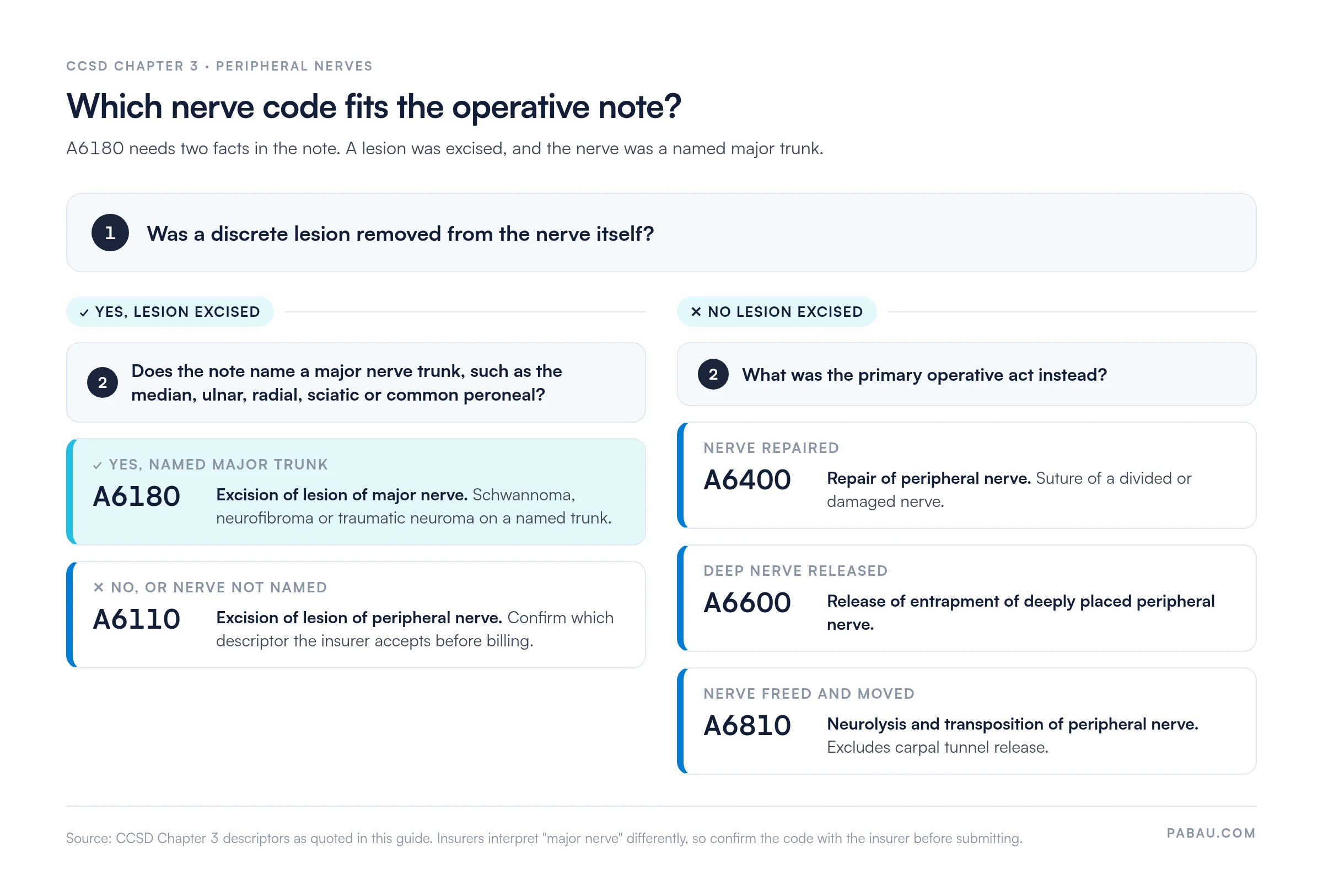
A6180 is the CCSD code for excision of lesion of major nerve. It covers surgical removal of a discrete lesion, such as a schwannoma, neurofibroma or traumatic neuroma, from a named peripheral nerve trunk.
The code sits in Chapter 3 of the CCSD schedule, under Peripheral Nerves. Assignment turns on two facts in the operative note. A lesion was excised, and the nerve was a major trunk such as the median, ulnar, radial or sciatic nerve.
Let Pabau's smart automation suggest the right codes, reduce claim denials, and keep your practice compliant—effortlessly.
Automate repetitive tasks and focus on what matters most—your patients.
Reduce coding errors and ensure compliance with the latest regulations.
Clean claims, fewer denials, and faster reimbursements.
Powerful insights and reporting to help your practice thrive.
HIPAA compliant SOC 2 certified GDPR-compliant Trusted by 4,000+ clinics worldwide

CCSD code A6180 covers surgical excision of a lesion from a named major peripheral nerve. Nerve decompression, nerve repair and minor-nerve excision use other codes.
Most UK private medical insurers require pre-authorization before they will consider a nerve excision claim, however urgent the case.
Most A6180 denials happen because the operative note doesn’t name a major nerve, or the invoice lacks the pre-authorization reference.
Pabau, the practice management platform we build, lets UK private surgeons attach CCSD codes, authorization references and fees to one invoice.
CCSD code A6180 describes the surgical excision of a lesion of a major peripheral nerve. It sits within Chapter 3 (Spine, spinal cord and peripheral nerves) of the CCSD schedule, under Peripheral Nerves. The “major” qualifier matters clinically. It limits A6180 to named nerve trunks, while minor cutaneous or digital nerves are coded separately.
The CCSD Group updates the schedule periodically. Fee values associated with A6180 vary by insurer and by individual consultant agreement, and are revised annually. Always verify the current figure against the relevant insurer’s fee schedule before invoicing.
A procedure captured by CCSD code A6180 typically follows five steps.
Where a specimen is sent for histology, confirm the pathology coding implications with the relevant insurer.
Major peripheral nerves commonly involved include the median, ulnar, radial, sciatic, and common peroneal nerves. Insurers don’t all agree on which nerves count as “major” under the CCSD schedule, so verify the nerve directly with the insurer.
Intraoperative nerve monitoring (neurophysiology) may be performed at the same time. It is typically coded and billed separately, as the section on billing A6180 alongside other codes explains.
A6180 is the correct code when the primary operative act is removing a discrete lesion from a named peripheral nerve trunk. The most common qualifying diagnoses are listed below.
A6180 is not appropriate for nerve decompression (release of external compression without lesion removal), nerve repair (neurorrhaphy), or nerve grafting. Each of these has its own CCSD code.
Chapter 3 of the CCSD schedule groups the spine, spinal cord and peripheral nerve procedures. Knowing the codes next to CCSD code A6180 helps coders avoid picking a neighboring code for a clinically distinct procedure. Codes outside the peripheral nerve range are listed in our CCSD codes index.
The three most common miscoding errors involving CCSD code A6180 all arise from failing to distinguish the primary operative act.
A6180 vs nerve decompression: Decompression releases a nerve from surrounding compression without removing a discrete lesion from the nerve itself. Carpal tunnel release and cubital tunnel decompression are common examples. If no lesion is excised, A6180 does not apply. Release of a deeply placed nerve is coded as A6600, and neurolysis with transposition as A6810.
A6180 vs neurorrhaphy: Neurorrhaphy codes capture nerve repair or suture after transection, and peripheral nerve repair is coded as A6400. Excision of a neuroma followed by nerve repair in the same session is a more complex scenario. The primary procedure drives code selection, so discuss concurrent repair with the insurer before billing.
A6180 vs minor nerve excision: A lesion on a cutaneous or digital nerve takes a different CCSD code. Check whether A6110 fits the lesion better. Then confirm the nerve against the insurer’s definition of “major nerve” before submitting.
The diagram below runs through the same two questions an insurer asks of the operative note.
An A6180 claim that reaches a private medical insurance (PMI) provider without a compliant operative note is almost always denied or queried. The Royal College of Surgeons of England’s operative note standards set the baseline. For a claim to be defensible, the note should include the following elements.
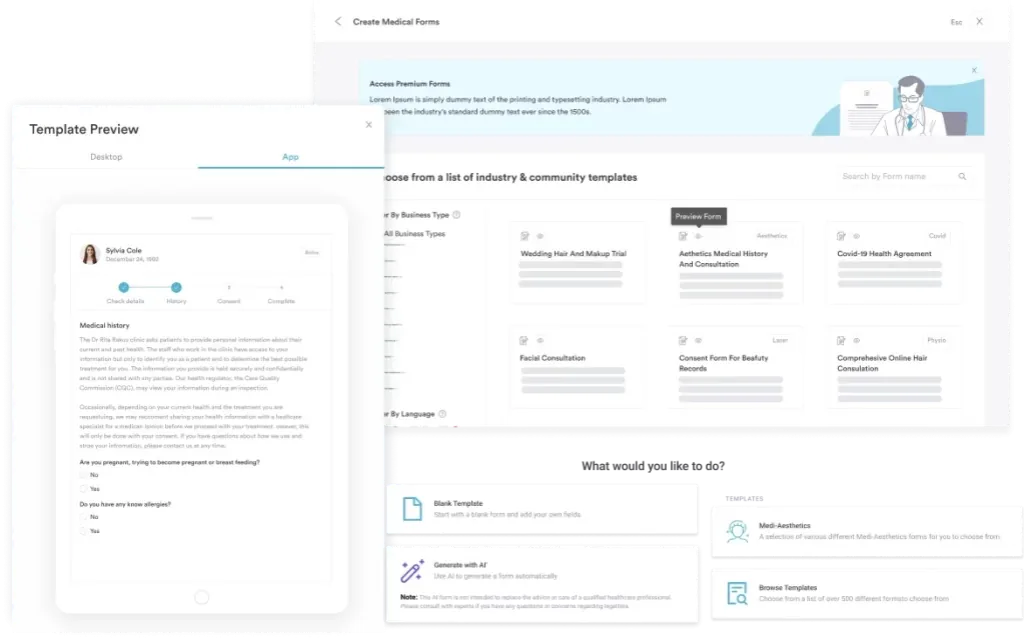
Digital operative note forms with a field for each of these elements reduce the risk of an incomplete record at claim submission.
All major UK private medical insurers require pre-authorization before they will consider a claim for nerve excision surgery under CCSD code A6180. The specific requirements vary by insurer and by individual policy terms. The table below summarizes typical requirements based on publicly available insurer guidance. Verify them directly with each insurer before proceeding.
Pre-authorization does not guarantee payment. It confirms only that the procedure is covered in principle under the patient’s policy at the time of the request. Clinical eligibility, policy excesses, and coverage limits are assessed at the claim stage.
Request pre-authorization before booking the operating room, not on the day of surgery. Last-minute authorization requests are more frequently declined, and some insurers will not backdate approval for a procedure already performed.
Claims for CCSD code A6180 are denied for a predictable set of reasons. Knowing them in advance prevents the most avoidable rejections.
When a claim is denied, a structured appeal typically follows these steps:
Whether and how CCSD code A6180 can be billed concurrently with other codes depends on the insurer and the specific combination of procedures performed. The table below outlines common concurrent billing scenarios and the general approach UK private insurers take.
Where multiple procedures are performed in one session, UK PMI insurers typically apply a multiple-procedure reduction convention. The primary (highest-value) procedure is paid in full; secondary procedures attract a reduced percentage. Confirm the exact reduction scale with each insurer before submitting a multi-code invoice.
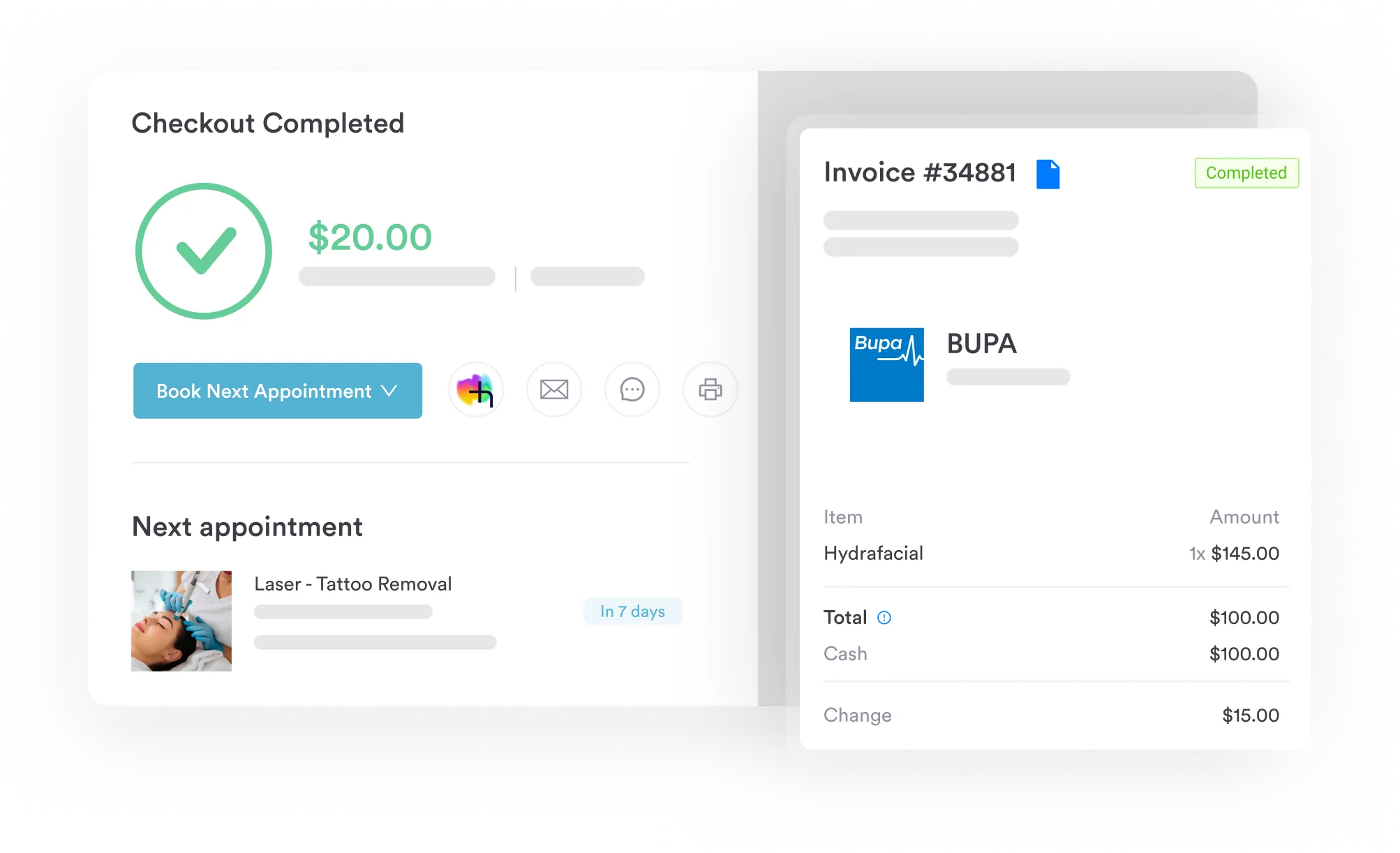
Pabau’s claims management software supports UK private practice billing workflows, including the submission of CCSD-coded invoices to PMI insurers. The steps below outline how to build and send an A6180 claim within the platform.
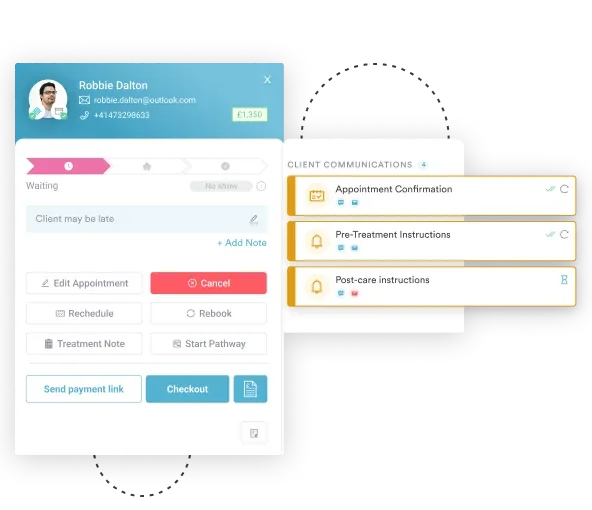
For practices with a high volume of CCSD-coded procedures, Pabau’s automated workflows can create and send invoices at set points in the patient journey. That cuts the manual steps between finishing the procedure and submitting the claim.
Review outstanding A6180 claims at the 30-day mark. UK PMI insurers typically acknowledge claims within 5–10 working days. If no acknowledgment arrives after two weeks, contact the insurer to confirm receipt before the claim is treated as abandoned.

Pabau helps UK private surgeons and their billing teams attach procedure codes, authorization references, and fee information to invoices in one step. See how the billing workflow handles CCSD claims from consultation through submission.

A6180 is one of the easier CCSD codes to defend, as long as the operative note proves two facts. A lesion was excised, and the nerve was a named major trunk.
Most denied A6180 claims trace back to paperwork. An unnamed nerve or a missing pre-authorization reference stalls the claim before anyone looks at the surgery itself. Build both into your operative note template and your invoice, and most of those denials never happen.
Book a demo to see how Pabau keeps CCSD codes, authorization numbers and operative notes on one invoice for UK private surgical practices.

Need a full reference for Bupa CCSD billing? Bupa CCSD procedure codes guide covers how Bupa applies the CCSD schedule, fee submission, and code lookup.
Transecting the nerve for a neuroma instead? CCSD code A6030 covers transection of a peripheral nerve for neuroma and how insurers band it.
Releasing a nerve without removing a lesion? CCSD code A6600 explains billing for release of a deeply placed peripheral nerve.
Repairing the nerve after excision? CCSD code A6400 covers peripheral nerve repair coding and the denials it attracts.
CCSD code A6180 covers surgical excision of a lesion from a major (named) peripheral nerve. That includes schwannomas, neurofibromas and traumatic neuromas on trunks such as the median, ulnar, radial, sciatic or common peroneal nerve. It does not cover nerve decompression, nerve repair, or excision of lesions on minor cutaneous or digital nerves.
Nerve excision (A6180) involves surgically removing a discrete lesion from the nerve itself. Nerve decompression releases the nerve from external compression without removing a lesion from the nerve. The two procedures use different CCSD codes, and billing A6180 for a decompression procedure will result in claim denial.
Yes, Bupa, AXA Health, Aviva and most other UK PMI insurers require pre-authorization before they will process a claim for nerve excision surgery. Get it before booking the operating room, through each insurer’s provider portal or helpline. Requirements vary by policy and insurer.
The most common denial reason is a missing pre-authorization reference on the invoice. Others include an operative note that doesn’t name the nerve, or A6180 billed for a minor or cutaneous nerve. Unbundling errors and policy exclusions cause the rest.
It depends on the CCSD edition in use and the insurer’s interpretation. Morton’s neuroma involves an interdigital nerve, which some insurers classify as a minor nerve rather than a major peripheral nerve trunk. Confirm with the relevant insurer before billing A6180 for a Morton’s neuroma excision to avoid a mis-coding denial.
Yes, with conditions. Anesthesia is billed separately by the anesthetist under their own CCSD code. Assistant surgeon fees are insurer-dependent, typically attract a percentage reduction, and often need separate pre-authorization. Intraoperative nerve monitoring is usually billed by the neurophysiologist under a dedicated code. Confirm the rules with each insurer before submitting a multi-code invoice.



