CPT code 93503: Swan-Ganz catheter billing and modifiers
CPT code 93503: Official descriptor and procedure overview In the AMA CPT code s...

Last Updated: Oct 23, 2026
A6110 is the CCSD code for excision of lesion of peripheral nerve (eg neurilemoma). It covers complete surgical removal of a benign lesion, typically a schwannoma, from a peripheral nerve, usually without cutting the nerve itself.
A6110 sits in CCSD sub-section 3.6, Peripheral nerves. A lesion on a major nerve is coded A6180 instead, and a biopsy-only procedure is coded A7310. UK insurers pair it with the WHO ICD-10 diagnosis D36.1.
Let Pabau's smart automation suggest the right codes, reduce claim denials, and keep your practice compliant—effortlessly.
Automate repetitive tasks and focus on what matters most—your patients.
Reduce coding errors and ensure compliance with the latest regulations.
Clean claims, fewer denials, and faster reimbursements.
Powerful insights and reporting to help your practice thrive.
HIPAA compliant SOC 2 certified GDPR-compliant Trusted by 4,000+ clinics worldwide

CCSD code A6110 covers excision of a peripheral nerve lesion, such as a neurilemoma (schwannoma), not neurolysis, biopsy, or nerve repair.
UK insurers use WHO ICD-10 D36.1 as the pairing diagnosis, while D36.10 to D36.13 are ICD-10-CM subcodes for US-style billing.
Most major UK private health insurers require prior authorization, and a claim without a PA reference is the most common reason for outright denial.
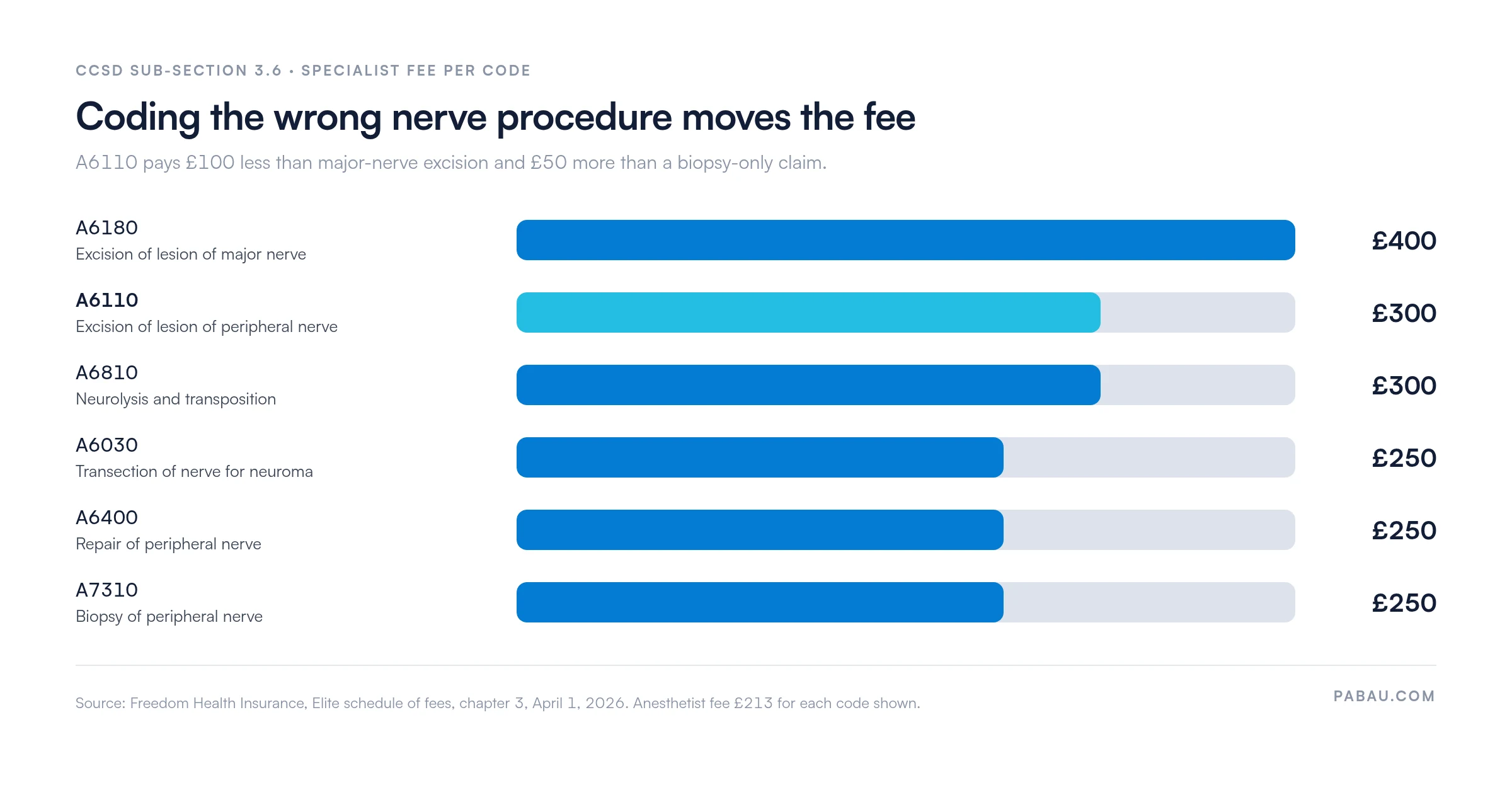
A lesion on a major nerve takes A6180 instead, which Freedom Health’s 2026 schedule pays at £400 against £300 for A6110.
Pabau’s claims management software keeps the PA reference, operative note, and histopathology report attached to each CCSD claim.
CCSD code A6110 covers the surgical excision of a lesion arising on a peripheral nerve, with neurilemoma as the archetypal example. A neurilemoma (also called schwannoma) is a benign, encapsulated tumor of Schwann cell origin. It forms on the nerve sheath rather than within the nerve fascicles.
Because it is encapsulated, the tumor can usually be shelled out without cutting through the nerve itself. That makes this a technically demanding but nerve-preserving procedure. The code sits in sub-section 3.6, Peripheral nerves, of chapter 3 in the wider list of CCSD procedure codes that UK insurers use.
The official descriptor is concise: Excision of lesion of peripheral nerve (eg neurilemoma). The parenthetical qualifier is illustrative, not exhaustive. Other benign peripheral nerve lesions, such as encapsulated neurofibromas or perineural cysts, may also attract A6110. The operative approach and anatomical context must match the descriptor.
Where the lesion sits on a major nerve, the schedule has a separate code. A6180, Excision of lesion of major nerve, applies instead of A6110.
A peripheral nerve lesion excision under A6110 follows a consistent operative sequence. The coder should recognize each step in the operative report to confirm the code is correct.
When intraoperative nerve monitoring is used, it is typically performed by a separate neuromonitoring technician and may attract its own code. See the section on co-billing below for bundling considerations.
Medical necessity for peripheral nerve lesion excision under A6110 generally requires that the tumor is symptomatic or growing. Private health insurers assess clinical motivation against their own medical necessity criteria, which vary by scheme.
Accepted indications across most UK private insurers include the following. Record which criteria are present in the pre-operative assessment, so the claim can point to them if the insurer asks.
Asymptomatic incidental schwannomas without growth or functional deficit are rarely approved by private insurers without a compelling clinical argument. Document the specific indication in the clinical letter, because payers reject vague justifications.
Every CCSD A6110 claim must carry a supporting ICD-10 diagnosis code. UK private insurers code to WHO ICD-10, so the pairing there is D36.1, Benign neoplasm of peripheral nerves and autonomic nervous system. WHO ICD-10 has no fifth-character split for this code.
The site-specific subcodes D36.10 to D36.13 come from ICD-10-CM, the US clinical modification. Use them for US-style billing, matched to the anatomical site confirmed in the operative report and histopathology.
Send D36.1 to UK insurers, which work from WHO ICD-10. On a US-style claim, use the most specific ICD-10-CM subcode instead. Submitting D36.10 (unspecified site) when the operative report identifies an upper-limb nerve invites a specificity query.
D36.1 follows the WHO ICD-10 browser. The D36.10 to D36.13 subcodes follow the CDC/NCHS ICD-10-CM tabular list. If histopathology returns a diagnosis other than neurilemoma or schwannoma, check whether another ICD-10 code fits better. A neurofibroma associated with neurofibromatosis type 1 is the usual example.
Inadequate operative documentation is the most common reason A6110 claims are queried or denied. Private insurers may request clinical records before paying, so every element below should be in the patient file before the claim goes out. Storing each document against the patient record, with a timestamp, makes retrieval quick when an insurer asks for evidence.
Prior authorization (PA) is required by most major UK private health insurers for peripheral nerve tumor excision under A6110, though individual scheme rules vary. A claim without a valid PA reference is the most common trigger for outright denial, rather than a request for more information. Flag procedures that need PA before the surgery date is confirmed.
Typical PA requirements across Bupa, AXA Health, Aviva, and Vitality include the following. Verify current scheme rules directly, as policies change annually.
Submit the PA application early. Most schemes take five to 10 working days to process it. Emergency PA pathways exist but attract extra scrutiny. Once approved, keep the authorization reference number and include it on the claim form.
CCSD modifiers adjust how the base A6110 fee is calculated. Most UK private insurers follow the CCSD technical guide rules on modifier application, though individual schemes may restrict or augment specific modifiers.
Do not apply the bilateral modifier unless both sides are excised and documented. Incorrectly claiming bilateral status is a common audit flag and can result in retrospective repayment demands from insurers.
Selecting the correct code from sub-section 3.6 means knowing where A6110 ends and neighboring codes begin. The table below separates A6110 from adjacent CCSD codes and maps each to its approximate US CPT equivalent. Two more neighbors catch coders out: A6030 for transection of a nerve for neuroma, and A6400 for nerve repair.
An operative note that describes freeing the nerve with no lesion removed points to A6810, whose closest US counterpart is CPT 64708. CPT and CCSD are maintained independently, so descriptor boundaries can drift apart. Confirm each crosswalk against the current edition of both code sets, with the AMA CPT code set as the US reference.
If the operative report uses the word ‘biopsy’ without confirming complete tumor removal, A6110 is not the correct code. The distinction between incisional biopsy and complete excision determines the code. Review the operation note for language confirming the lesion was removed in its entirety before assigning A6110.
A6110 claims attract a predictable set of denial triggers, and most are preventable with a thorough pre-submission review. Running each claim through error-checking claims software before it reaches the insurer catches most of them.
Intraoperative nerve monitoring (IONM) is commonly used during peripheral nerve excision to help the surgical team identify and preserve functioning nerve fascicles. Whether IONM attracts a separate, billable code alongside A6110 depends on each insurer’s bundling rules. Verify this directly with each scheme before submitting a co-bill.
Schedule fees for CCSD A6110 are set by individual insurers and published in their annual fee schedules. There is no single universal tariff. Reimbursement varies by insurer, year, and whether the fee follows the CCSD schedule or a negotiated rate.
Each insurer publishes its own lookup tool: The Vitality fee finder, the Healix fee schedule, and the Bupa code search. Each one lists current schedule fees by code. Bupa’s version of the schedule is explained in our guide to Bupa CCSD codes.
Freedom Health Insurance publishes one worked example. Its Elite schedule, dated April 1, 2026, pays a £300 specialist fee and a £213 anesthetist fee for A6110. The neighboring codes in sub-section 3.6 pay differently, so the code you choose moves the fee.
On the same schedule, major-nerve excision under A6180 pays £400 and A6810 pays £300. A6030, A6400 and biopsy-only A7310 each pay £250, as the chart below shows.
Key factors that affect the final reimbursable amount include:
Most A6110 queries trace back to a missing document. The PA reference sits in an email, the operative note in a hospital system, and the histopathology report arrives weeks later.
Pabau, the practice management and billing platform we build, keeps those documents against the patient record. Your team can attach them to the claim and share a treatment note with the insurer straight from the record.
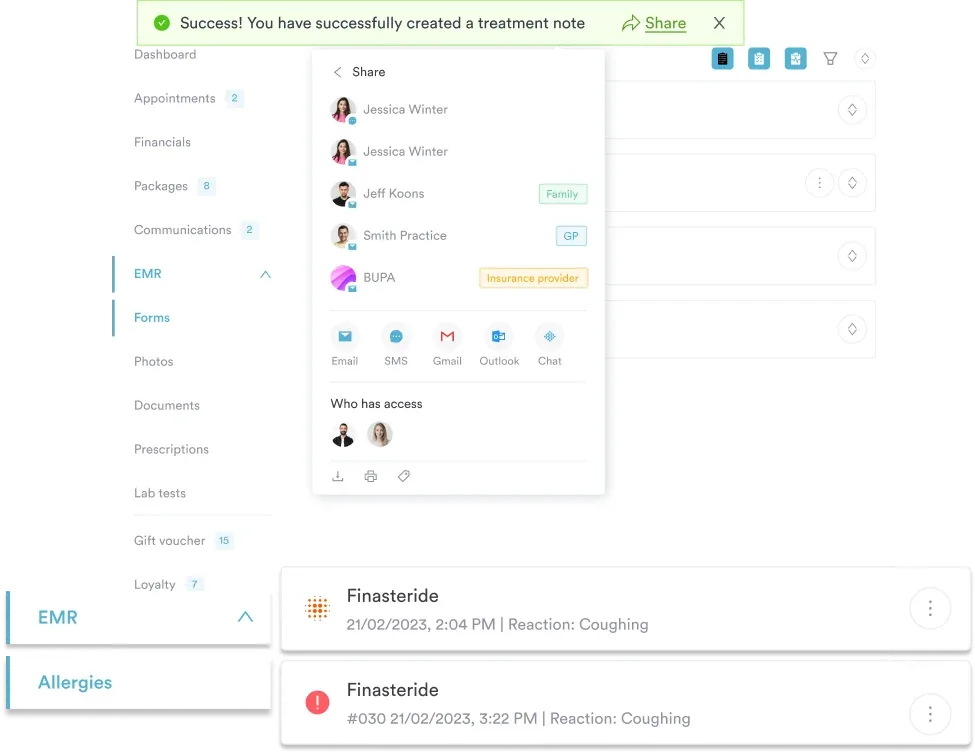
The result is a claim that carries its PA reference, A6110, and the right diagnosis code on first submission. Your team spends less time answering insurer queries and chasing held payments.

Pabau helps surgical and specialist practices track prior authorization status, attach operative notes directly to claims, and submit CCSD codes with the correct ICD-10 pairings. See how it works for private practice.

Treat A6110 as a documentation code as much as a surgical one. The operation itself is rarely in dispute. Payment turns on whether the PA reference, the named nerve, and the histopathology reach the insurer together.
Before the next case goes in, check two lines of the operative note. It should say the lesion was excised rather than biopsied, and the nerve it names should not be a major trunk that belongs under A6180.
Book a demo to see how Pabau keeps PA references, operative notes, and pathology reports attached to every CCSD claim.

Need guidance on Bupa CCSD procedure codes? Bupa CCSD codes covers how to navigate the CCSD schedule for UK private practice claims.
Releasing a trapped nerve rather than removing a lesion? CCSD code A6700 explains how to code and document release of entrapment of a peripheral nerve.
Working on a deeply placed nerve? CCSD code A6600 sets out the billing rules for release of entrapment of a deeply placed peripheral nerve.
CCSD code A6110 covers the excision of a lesion of a peripheral nerve, with neurilemoma (schwannoma) as the named example. It applies when a surgeon removes a benign encapsulated tumor from a peripheral nerve, confirmed by operative report and histopathology.
UK private insurers take the WHO ICD-10 code D36.1, Benign neoplasm of peripheral nerves and autonomic nervous system. WHO ICD-10 has no fifth-character split for this code. For US-style billing, the ICD-10-CM subcodes are D36.10 (unspecified), D36.11 (head, face and neck), D36.12 (upper limb) and D36.13 (lower limb).
Yes, in most cases. Major UK private health insurers including Bupa, AXA Health, Aviva, and Vitality require prior authorization for elective peripheral nerve tumor excision. A claim without a valid PA reference number is the leading cause of outright denial, so always obtain authorization before the procedure date.
CPT 64790 (excision of neurofibroma or neurolemmoma, major peripheral nerve) is the approximate US equivalent of CCSD A6110. CPT 64788 applies instead when the lesion sits on a cutaneous nerve. Descriptor boundaries differ between the two systems, so verify against the current edition of each code set.
The most common denial triggers are: Missing prior authorization, a mismatched diagnosis code, and a vague operative report. A vague report fails to name the nerve or confirm complete excision. Missing histopathology and wrong code selection, such as A6110 for a biopsy-only procedure, complete the list.
It depends on the insurer. Some UK private health insurers allow intraoperative nerve monitoring to be billed separately when a distinct neuromonitoring provider performs it. Others bundle monitoring into the surgical fee. Verify the current scheme rule before submitting both codes, and name the monitoring provider in the operative report.