

HCPCS Code L0472: Hyperextension TLSO billing guide
HCPCS code L0472: Official descriptor and device definition HCPCS code L0472 des...

Last Updated: Nov 5, 2026
22023 is the CCSD code for recording and reporting on electromyography and nerve conduction studies (EMG); mononeuropathy (eg ulnar), Cx/lumbar radiculopathy, myopathy.
Where CPT codes govern US procedure billing, the CCSD schedule sets the standard across UK private medical insurers. Code 22023 covers the combined study used to investigate a single damaged nerve, a compressed nerve root, or muscle disease. Common causes of denial include the wrong indication documented, a missing signed consultant report, or confusion with codes 22022 and 22024.
Let Pabau's smart automation suggest the right codes, reduce claim denials, and keep your practice compliant—effortlessly.
Automate repetitive tasks and focus on what matters most—your patients.
Reduce coding errors and ensure compliance with the latest regulations.
Clean claims, fewer denials, and faster reimbursements.
Powerful insights and reporting to help your practice thrive.
HIPAA compliant SOC 2 certified GDPR-compliant Trusted by 4,000+ clinics worldwide

CCSD code 22023 sits in Chapter 3 of the CCSD schedule and covers a combined EMG and nerve conduction study session.
The code applies to mononeuropathy (such as ulnar neuropathy), cervical or lumbar radiculopathy, and myopathy. The documented indication has to match one of those three.
Peripheral neuropathy and carpal tunnel syndrome belong to code 22022. Codes 22024 and 22025 bill the same combined study for a different set of indications.
Most UK private medical insurers require a signed consultant report before they reimburse, and a missing signature is a common cause of rejection.
Pabau, the practice management platform we build, lets neurophysiology teams log CCSD codes, attach clinical reports, and track insurer claim status in one workspace.
CCSD code 22023 is the procedure code for a combined electromyography and nerve conduction study.
It is used in UK private practice to investigate mononeuropathy, cervical or lumbar radiculopathy, or myopathy. It appears in Chapter 3 of the CCSD schedule, the chapter covering spine, spinal cord, and peripheral nerves. The Clinical Coding and Schedule Development (CCSD) group maintains the schedule and updates it annually. Insurers adopt the current edition as the basis for reimbursement decisions.
US CPT codes for EMG run from 95860 to 95872 and are maintained by the American Medical Association. CCSD codes are UK-specific and cannot be swapped for them.
A claim submitted with a CPT code to a UK private medical insurer will be rejected. A CCSD code carries no weight in a US billing context. Both systems cover electrodiagnostic studies through separate coding frameworks.
Chapter 3 of the CCSD schedule covers interventions for the spine, spinal cord, and peripheral nerves. Within that chapter, the neurophysiological procedures subsection holds the EMG and nerve conduction study family: 22022, 22023, 22024, and 22025. Code 22023 carries the MINOR 5 fee banding, which is the tier insurers price the combined study against.
CCSD code 22023 covers three distinct clinical indications. Each produces different electrodiagnostic findings, and each has to be named in the formal report for the claim to stand. Coders and billers need to know what the three conditions mean clinically, because the documentation has to reflect the condition under investigation.
Mononeuropathy is damage or dysfunction affecting a single peripheral nerve. The CCSD descriptor gives ulnar neuropathy as the example, and the code also applies to median and peroneal neuropathy.
The nerve conduction study measures conduction velocity and amplitude across the affected segment to localize the site of compression or injury. Needle EMG of the muscles that nerve supplies then confirms the clinical picture.
Radiculopathy is nerve root dysfunction caused by compression or irritation at the spinal level. Cervical radiculopathy (Cx radiculopathy in the CCSD descriptor) affects the arm and hand, while lumbar radiculopathy affects the leg and foot.
Nerve conduction studies are often normal here, because the lesion sits proximal to the dorsal root ganglion. Needle EMG of the paraspinal and limb muscles in the affected myotome carries more diagnostic weight.
Myopathy is disease of the muscle itself rather than the nerve supplying it. Inflammatory myopathies such as polymyositis and dermatomyositis, along with hereditary myopathies, produce characteristic needle EMG changes.
The report describes short-duration, low-amplitude, polyphasic motor unit potentials with early recruitment. Nerve conduction studies in myopathy are typically normal, so the myopathic pattern in the EMG is what holds the code up under insurer scrutiny.
A combined study under CCSD code 22023 runs in two phases. Both are performed by a consultant neurophysiologist or appropriately credentialed specialist, or under their direct supervision.
That expectation follows General Medical Council (GMC) guidance on consultant-led care and British Society for Clinical Neurophysiology (BSCN) practice standards. A study delegated to an unsupervised junior is unlikely to meet insurer requirements for the code.
Documentation is where most CCSD code 22023 claims either succeed or fail. Insurers treat the formal written report as the primary evidence of medical necessity.
Insurers also audit claims after payment, and an inconsistent report can trigger a recovery demand long after the episode of care has closed. Structured clinical forms completed at the point of care reduce the risk of an omission reaching the claim.
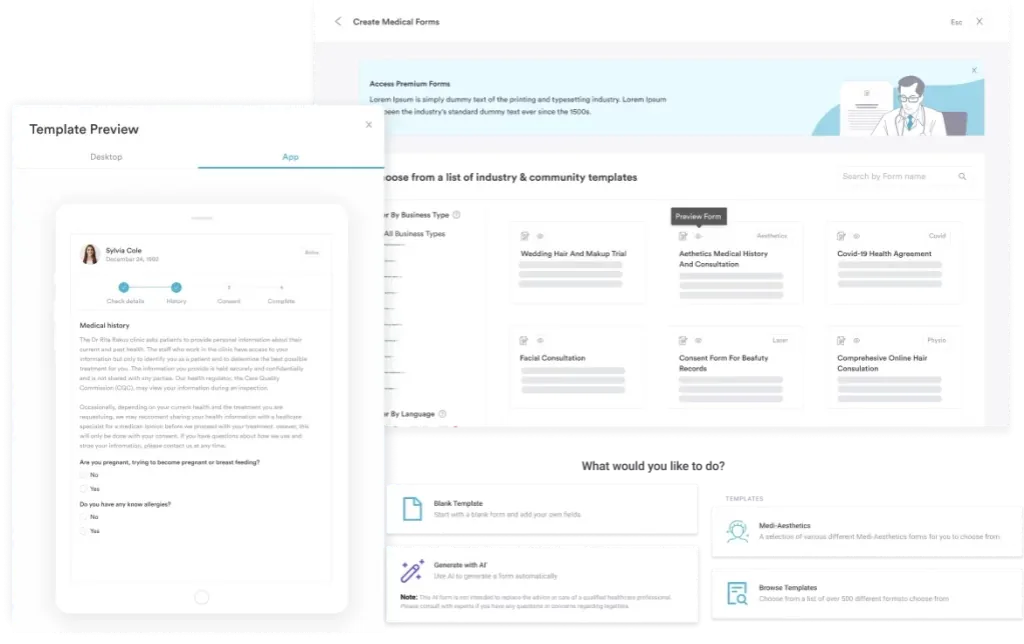
The elements below make up a complete and valid CCSD code 22023 claim. Requirements vary by insurer, so check the relevant portal before submitting.
Across a busy neurophysiology list, compliance depends on the system prompting the report. The consultant completes and signs it before the invoice is raised, not after.

Flag any report missing a consultant signature before the claim leaves your system. Build a workflow where the invoice cannot be generated until the signed report is attached to the patient record. A missing signature is a common reason a CCSD code 22023 claim gets returned.
All major UK private medical insurers use the CCSD schedule for procedure reimbursement, so code 22023 is recognized across the market. Each claim still has to clear that insurer’s own rules, though.
Pre-authorization rules, referral conditions, and documentation standards vary by insurer and by individual policy. Verify the requirements on the insurer portal before the study is booked. For Bupa-specific guidance, see our guide to Bupa CCSD procedure codes.
Fee amounts are not published here, because CCSD fees change annually and differ by insurer. Check the current schedule and your insurer portal for the rate that applies to the MINOR 5 banding.
CCSD code 22023 sits in a group of four closely related neurophysiology codes in Chapter 3. Picking the wrong one is among the more common billing errors in this specialty.
All four share one descriptor, recording and reporting on electromyography and nerve conduction studies (EMG), and differ only by indication. The table below sets out each code. Verify them against the current CCSD technical guide, since descriptors are revised annually.
One question separates these four codes: which indication is under investigation? Each bills the same combined EMG and nerve conduction study, so the condition in the report decides the code. Mononeuritis multiplex, MND-AHC, multiple muscle monitoring and myasthenia gravis without single-fiber EMG go to 22024. Myasthenia gravis with single-fiber EMG goes to 22025.
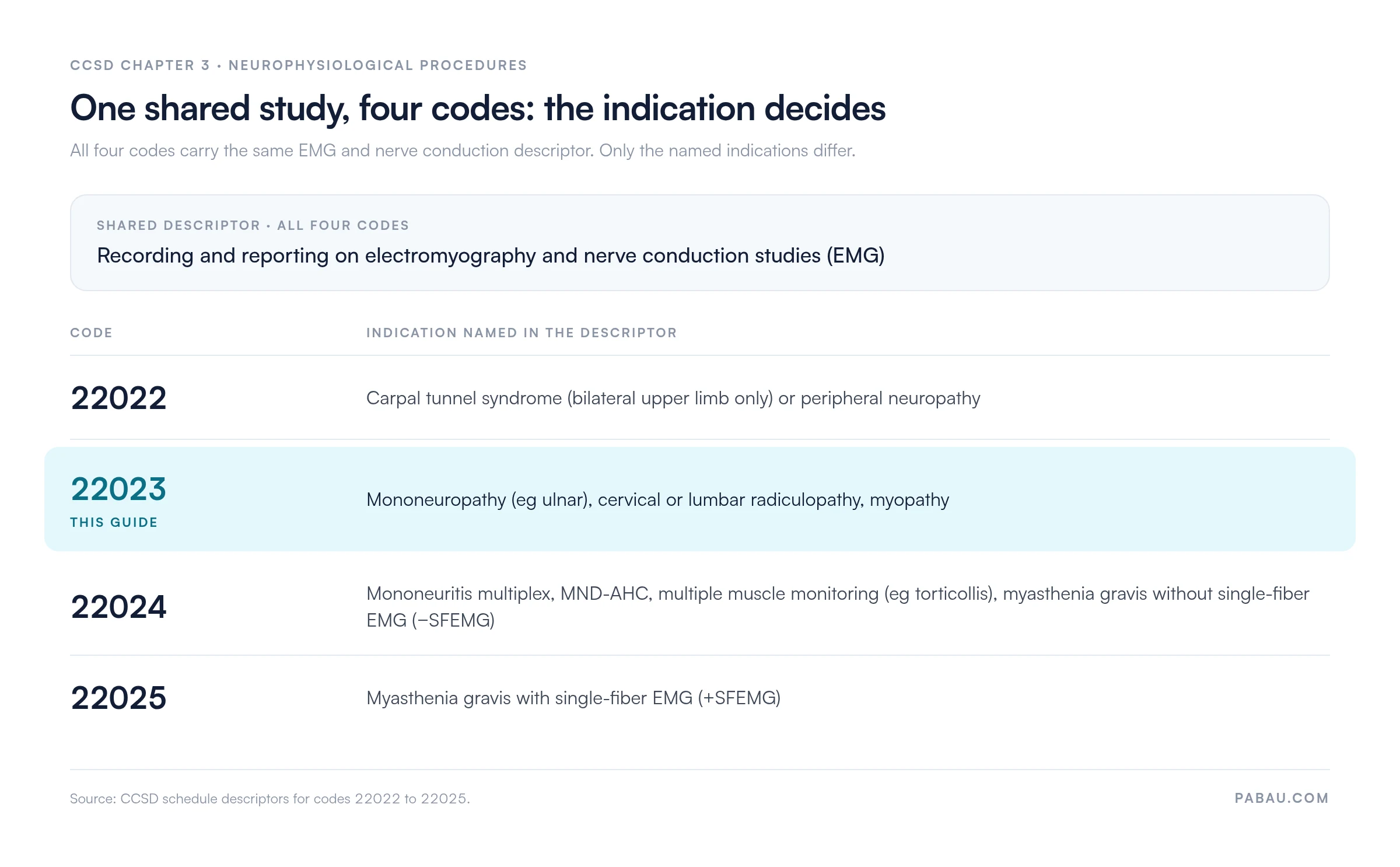
The pairing to watch is 22022 against 22023, because a neuropathy referral can land under either. Carpal tunnel syndrome and peripheral neuropathy sit with 22022. A single damaged nerve, a compressed cervical or lumbar root, or muscle disease sits with 22023.
All three indications fall under CCSD code 22023, and the documentation still has to show which one was investigated. An insurer auditing the claim checks that the recorded indication matches the electrodiagnostic findings in the report.
The guide below pairs each referral picture with the findings that support it, so the coder can confirm the choice at the point of documentation.
If the referral asks about peripheral neuropathy and the consultant finds an incidental mononeuropathy, document both findings. Code by the primary conclusion the report reaches: 22023 where the focal lesion is the diagnosis, 22022 where the diffuse neuropathy is. Before submitting both codes for one session, confirm with the insurer that unbundling is permitted.
Rejections of CCSD code 22023 claims follow a small number of recurring patterns. Several of them start in the clinical documentation rather than the billing submission. That is why the whole team needs to recognize them, not only the biller. Insurers return these claims with the same handful of denial codes, so a rejection usually tells you which step failed.
A neurophysiology practice usually keeps the study report in one system, the patient record in another, and the insurer invoice in a spreadsheet. The code then gets copied by hand at each step, which is where indications drift and signatures go missing.
Pabau holds the treatment record, the signed report, and the insurer invoice against the same patient. Our claims software for consultants carries the CCSD code from the treatment record onto the invoice.
The code the consultant recorded is the code the insurer receives. Claim status stays visible in the same place, which shortens the time between the study and the payment.
Build a pre-submission checklist into your workflow: signed report attached, pre-authorization number recorded, indication matching the report, and no duplicate codes for the same session. Running four checks before submission takes under two minutes and catches the errors that turn into weeks of appeals.

Pabau lets you log CCSD procedure codes, attach signed clinical reports, raise insurer invoices, and track claim status without switching between systems. See how it works for a neurophysiology practice.

CCSD code 22023 is narrower than it looks. It covers a combined EMG and nerve conduction study for three named indications, and the neighboring codes pick up the rest of the neurophysiology list. Get the indication and the signature right and the claim is straightforward. Get either wrong and the claim comes back, however well the study itself was performed.
The practical step is to make the report gate the invoice, so nothing is billed before a consultant has signed off the findings.
Holding the clinical record, the code, and the insurer invoice in one audit-ready system is what makes that routine rather than a monthly chase. Book a demo to see how Pabau handles CCSD coding and insurer claims for a neurophysiology practice.

Need to understand Bupa’s CCSD code requirements? Bupa CCSD procedure codes covers how Bupa applies the CCSD schedule, which codes are recognized, and what to check before submitting a claim.
Looking for another code in the schedule? CCSD codes is the index of the schedule, with the descriptor and billing notes for each procedure code.
Want to know what a CCSD procedure pays? Bupa procedure codes fee schedule explains how fee bandings work and where to find the current rate for a code.
Tightening up documentation before an audit? Medical billing compliance sets out the record-keeping standards insurers test when they review a paid claim.
CCSD code 22023 covers recording and reporting on electromyography (EMG) and nerve conduction studies for three clinical indications. Those are mononeuropathy (such as ulnar neuropathy), cervical or lumbar radiculopathy, and myopathy. The code is used in UK private practice and has to be supported by a formal clinical report signed by a consultant neurophysiologist.
Both codes cover the same combined EMG and nerve conduction study, so they differ only in indication. Code 22023 is for mononeuropathy, cervical or lumbar radiculopathy, and myopathy. Code 22024 is for mononeuritis multiplex, MND-AHC, multiple muscle monitoring such as torticollis, and myasthenia gravis without single-fiber EMG. The indication documented in the report decides which one applies.
All major UK private medical insurers use the CCSD schedule, including Bupa, AXA Health, Aviva, Vitality Health, Cigna Healthcare, and Freedom Health Insurance. AXA Health and Freedom Health list code 22023 explicitly in their published specialist code schedules. Pre-authorization rules and documentation standards vary by insurer, so check the relevant portal before the study is booked.
A valid claim needs a formal written report. It carries the patient identifiers and insurer membership number, the referring clinician details, and the date of the study. It also records the clinical indication, the nerves and muscles studied, the quantitative NCS results, and the needle EMG findings. The clinical interpretation and the responsible consultant’s signature close it out. A missing element is likely to cause a rejection.
Yes. The official CCSD descriptor names ulnar neuropathy as its example of the mononeuropathy indication. The clinical report has to document the nerve conduction study findings across the ulnar nerve. It also records the needle EMG findings in ulnar-innervated muscles.
CCSD codes are used only in UK private healthcare billing and are maintained by the Clinical Coding and Schedule Development group. CPT codes such as 95860 to 95872 are maintained by the American Medical Association for the US healthcare system. The two frameworks are separate and cannot be swapped, so a CPT code submitted to a UK private medical insurer will be rejected.
Select the CCSD code that matches the indication, since 22022 to 22025 all describe the same combined study. Use 22023 for mononeuropathy, cervical or lumbar radiculopathy, or myopathy. Use 22022 where the referral question is carpal tunnel syndrome or peripheral neuropathy. Codes 22024 and 22025 apply to a different set of indications (mononeuritis multiplex, MND-AHC, multiple muscle monitoring, myasthenia gravis). Have the consultant sign the report before the insurer invoice is raised, then check the portal for pre-authorization rules and current rates.



