CPT Code 25210: Excision of a single carpal bone
CPT Code 25210: Official descriptor and quick-reference data CPT Code 25210 is a...

Last Updated: Nov 26, 2026
V1910 is the CCSD code for reconstruction of jaw (non-vascularised reconstruction). It covers rebuilding the mandible or the maxilla with a bone graft that has no blood supply of its own.
The code sits in sub-chapter 6.1.0 Face and Jaws of the CCSD schedule used by UK private medical insurers, under CCSD reference Ff.013. A microvascular free flap is a different operation and is coded separately.
Let Pabau's smart automation suggest the right codes, reduce claim denials, and keep your practice compliant—effortlessly.
Automate repetitive tasks and focus on what matters most—your patients.
Reduce coding errors and ensure compliance with the latest regulations.
Clean claims, fewer denials, and faster reimbursements.
Powerful insights and reporting to help your practice thrive.
HIPAA compliant SOC 2 certified GDPR-compliant Trusted by 4,000+ clinics worldwide

CCSD code V1910 covers reconstruction of the jaw with a non-vascularized graft. It sits in sub-chapter 6.1.0 Face and Jaws of the schedule UK private insurers use.
A microvascular free flap is coded separately, so the operation note has to state that no anastomosis was performed.
V1422, extensive segmental excision of mandible, lists V1910 as an unacceptable combination. A resection and graft in one sitting needs the insurer’s coding guidance.
UK claims use WHO ICD-10, which codes drug- and radiation-induced osteonecrosis of the jaw as K10.2 rather than under M87.
Claims go to insurers such as Bupa, AXA Health, Aviva and Healix through Healthcode or direct, with the pre-authorization number on the claim.
CCSD code V1910 is the code UK private medical insurers use for reconstruction of the jaw with a non-vascularized graft. Its narrative in the CCSD schedule reads “Reconstruction of jaw (non-vascularised reconstruction)”. Insurers such as Bupa, AXA Health and Aviva build their procedure lists on that schedule.
Non-vascularized means the graft has no blood supply of its own. It survives on the vessels at the recipient site, so it suits a defect with healthy soft tissue around it. The narrative says “jaw”, so the code covers a graft to the mandible or the maxilla.
Three nearby operations have codes of their own and stay off a V1910 claim:
The CCSD Group updates its schedule over time, so check the edition your insurer works from. Our index of CCSD codes lists the other procedure codes we cover.
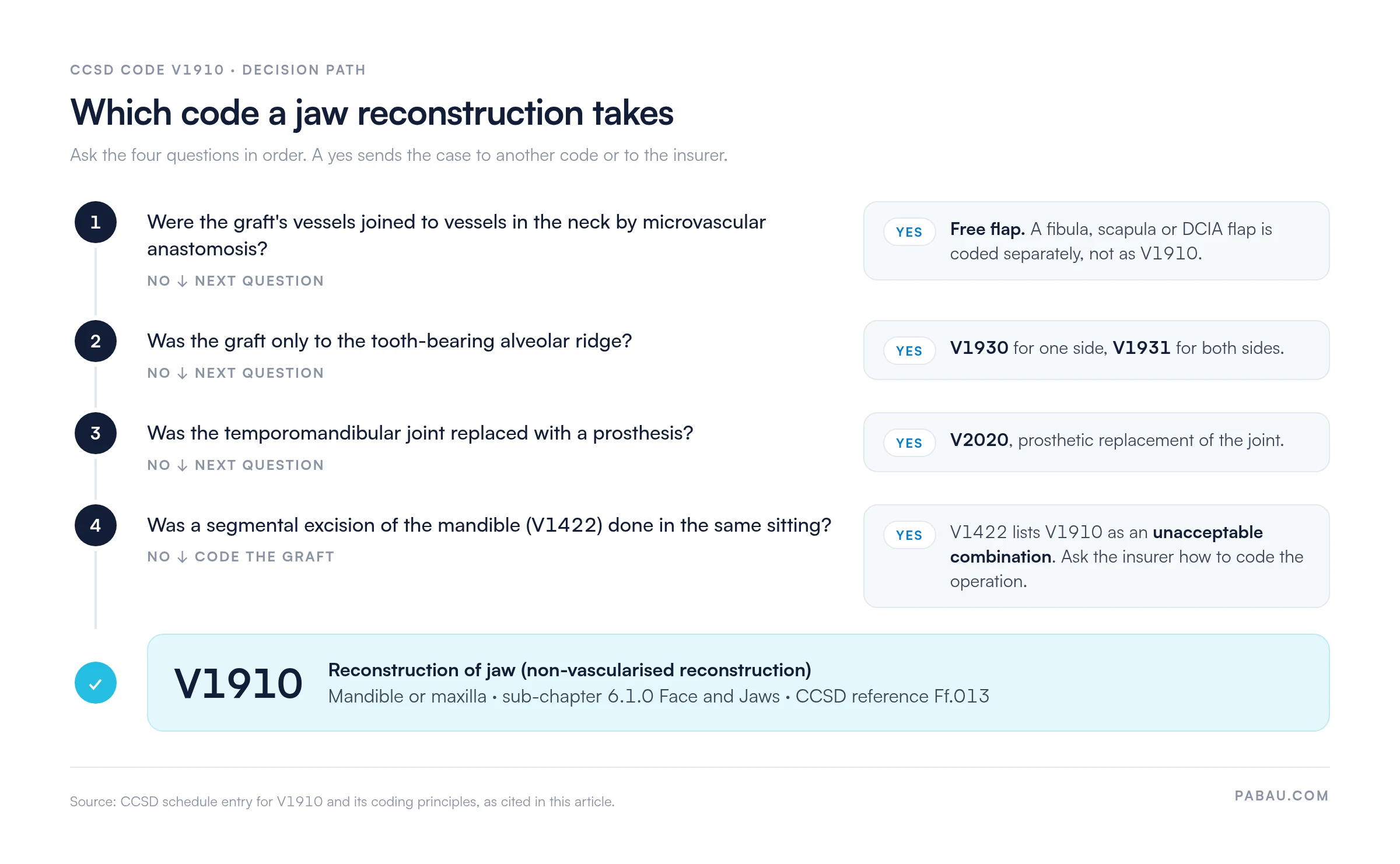
The first question for any jaw reconstruction is whether the surgeon joined the graft’s vessels to vessels in the neck. If the note describes microvascular anastomosis, V1910 is the wrong code.
Coding a graft as a free flap overstates the operation, and an insurer can query the claim or recover the payment after audit. Coding a free flap as V1910 under-claims the work. The operation note settles both, so it should name the technique in plain words.
Four questions, asked in order, settle whether a jaw case lands on V1910 or on one of its neighbors.
V1910 shares sub-chapter 6.1.0 Face and Jaws with the codes for jaw fractures, resections and joint surgery. The schedule’s coding principles link it to 21 other codes, and those links govern which pairs may be billed together.
The V1422 rule matters most, because tumor surgery often removes a segment of mandible and grafts the defect in the same sitting. V1422 lists V1910 as an unacceptable combination, so the two codes can’t simply share one claim.
Read the schedule’s notes and ask the insurer how it wants the combined operation coded before you submit. The coding principles link V1423 to V1910 as well, so check that pairing before you bill both.
V1910 has no unilateral or bilateral version, unlike the alveolar bone graft codes V1930 and V1931. For an unusual case, such as grafts to both jaws in one sitting, ask the insurer how to code it. Keep the answer on file.
A V1910 claim is only as strong as the note behind it. A note that says “jaw reconstruction” and stops there leaves the coder guessing between V1910 and a free flap.
Agree a standard procedure title with your maxillofacial surgeons, such as “Non-vascularised iliac crest graft reconstruction of left mandible”. When the title names the technique, the person coding the claim sees it at once.
Jaw reconstruction often runs over more than one operation, especially after cancer surgery or osteonecrosis. Three situations come up most:
When an insurer asks for a diagnosis, UK claims use WHO ICD-10 codes, which you can check in the WHO ICD-10 browser. Use the diagnosis the surgeon documented, and pick the code for the jaw that received the graft.
WHO ICD-10 codes drug- and radiation-induced osteonecrosis of the jaw to K10.2. Its M87 osteonecrosis category excludes the jaw for those causes, so M87.1 doesn’t belong on a V1910 claim for medication-related osteonecrosis.
M27.2 and M87.180 are US ICD-10-CM codes, and they don’t belong on a UK claim. The same conditions take K10.2 here.
C41.1 is for cancer of the bone itself. WHO excludes most carcinomas of the lower jaw from it and codes them to C03.1, lower gum. Only intraosseous and odontogenic carcinomas stay in C41.1.
Check cover first, because policies differ on reconstructive surgery after cancer or injury. Confirm with the insurer that the patient’s plan covers the operation before the date is set.
The table below shows what each insurer usually expects, and the payer has the final word on every detail.
Once the operation is done, the claim follows the same five steps whichever insurer pays it.
The anesthetist bills separately for the same operation, under their own fee.
Jaw reconstruction claims are most often held up by a handful of avoidable slips.
If a claim is still refused, check the insurer’s current provider manual for its appeal process. Our guide to denial management in healthcare covers the follow-up work in more depth.
Bupa is one of the UK’s largest private health insurers. Its rules are worth knowing before the first jaw reconstruction claim goes out.
Our guide to Bupa CCSD codes explains how Bupa’s procedure list works. For fee tiers, see our guide to the Bupa fee schedule.
On a jaw reconstruction case, the authorization often sits in an email and the operation note in the hospital system. The claim then gets keyed in by hand, and every handoff is a chance to lose the reference number.
Pabau, practice management software for private practices, keeps the billing side of those steps on the patient record. Its claims software for practices sends UK insurer claims electronically through Healthcode and to Bupa. The insurance policy, the case and its authorization code sit on the patient’s file, with a warning when the code is missing.
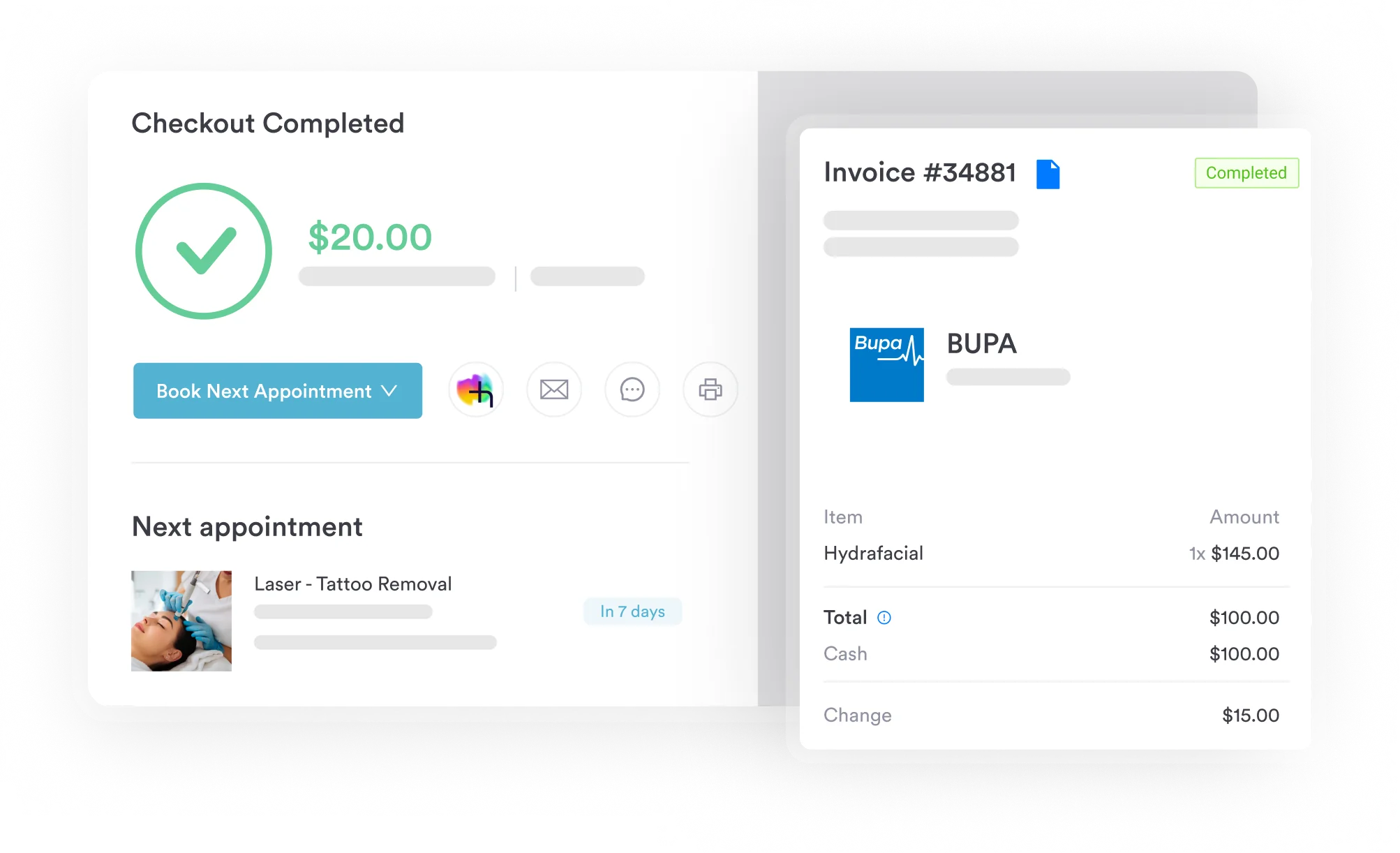
The result is fewer claims bounced for a missing reference, and a clear view of what each insurer still owes. Your billing team stops rebuilding claims from emails and hospital notes.

Pabau tracks authorization codes on the patient’s case and sends claims electronically through Healthcode and to Bupa. You see each claim’s status without phoning the insurer.

V1910 is simple once the note names the technique. Claims stall on a free flap coded as a graft, a resection billed alongside it, or a US diagnosis code on a UK claim.
Agree a standard procedure title with your surgeons, and check each insurer’s current list before you invoice. Those two habits settle the code before the claim leaves. Book a demo to see how Pabau keeps authorizations and Healthcode claims on one patient record.

Looking up another procedure code? CCSD codes lists the CCSD procedure codes Pabau covers.
Need a full Bupa CCSD billing reference? Bupa CCSD codes covers Bupa’s procedure list and how its claims work.
Checking Bupa fees before you invoice? Bupa procedure codes and fee schedule walks through Bupa’s recognized codes and fee tiers.
Chasing refused insurer claims? Denial management in healthcare covers how to work a refused claim through to payment.
CCSD code V1910 covers reconstruction of the jaw with a non-vascularized graft, one that has no blood supply of its own. It sits in sub-chapter 6.1.0 Face and Jaws of the CCSD schedule, under reference Ff.013.
A non-vascularized graft relies on the blood supply at the recipient site and is coded V1910. A vascularized free flap carries its own vessels, joined by microvascular anastomosis, and is coded separately. The operation note decides which one applies.
Most UK insurers, including Bupa, AXA Health and Aviva, expect pre-authorization for planned surgery, and cover depends on the patient’s policy. Get the reference number before admission and put it on the claim.
UK claims use WHO ICD-10 codes. K10.2 covers drug- or radiation-induced osteonecrosis of the jaw, and S02.6 a mandible fracture. D16.5 or C41.1 fits after a mandibular tumor is removed. Use the diagnosis the surgeon documented.
The usual causes are a missing pre-authorization reference and a note that doesn’t name the graft or the technique. A US diagnosis code on a UK claim is another. So is billing V1910 alongside V1422, an unacceptable combination.
Not with V1422, extensive segmental excision of mandible, which lists V1910 as an unacceptable combination. Read the schedule’s notes and ask the insurer how it wants a same-session resection and graft coded.