CPT Code 25210: Excision of a single carpal bone
CPT Code 25210: Official descriptor and quick-reference data CPT Code 25210 is a...

Last Updated: Nov 26, 2026
V2030 is the CCSD code for arthroplasty of the temporomandibular bone joint on one side. It covers open surgery that reshapes the mandibular condyle and joint surfaces, without fitting a prosthesis.
The code sits in sub-chapter 6.1.0 Face and Jaws of the CCSD schedule used by UK private medical insurers, under CCSD reference Ff.017. An operation on both joints in one session is billed as V2031.
Let Pabau's smart automation suggest the right codes, reduce claim denials, and keep your practice compliant—effortlessly.
Automate repetitive tasks and focus on what matters most—your patients.
Reduce coding errors and ensure compliance with the latest regulations.
Clean claims, fewer denials, and faster reimbursements.
Powerful insights and reporting to help your practice thrive.
HIPAA compliant SOC 2 certified GDPR-compliant Trusted by 4,000+ clinics worldwide

CCSD code V2030 covers arthroplasty of the temporomandibular bone joint on one side, under CCSD reference Ff.017 in sub-chapter 6.1.0 Face and Jaws.
Since October 2022 the narrative ends in “unilateral”. An operation on both joints in one session is claimed once under V2031, never as V2030 twice.
Arthroplasty reshapes the joint’s own surfaces. Prosthetic replacement is V2020, and meniscectomy, arthrocentesis and arthroscopy each have their own codes.
UK insurers work with WHO ICD-10, not US M26 codes. Derangement and dysfunction usually take K07.6, while ankylosis is classed in M24.6, ankylosis of joint.
Get the insurer’s pre-authorization before the operation, then submit electronically via Healthcode or direct to the insurer.
UK private insurers use CCSD code V2030 for arthroplasty of the temporomandibular bone joint on one side of the jaw. Insurer schedules such as National Friendly’s CCSD-based schedule of fees list it in the Major band.
Arthroplasty means surgically reshaping the joint’s own bony surfaces, without fitting a prosthesis. On the temporomandibular joint (TMJ), the surgeon opens the joint, recontours the mandibular condyle and treats the articular disc where needed.
The CCSD Group changed the narrative in October 2022 by adding “unilateral” to it. At the same time it created V2031 for the bilateral operation. A billing template that still reads “Arthroplasty of temporomandibular bone joint” was built before that split.
The CCSD Group publishes the codes, but each insurer sets its own band and fee. National Friendly, for example, lists a £663 procedure fee for V2030. Check the schedule of the insurer that is paying before you invoice. For the other procedure codes in the schedule, browse our CCSD code library.
Laterality is the coding choice that moves the most money on a TMJ arthroplasty claim. V2030 covers one joint. When the surgeon operates on both joints in the same session, the claim takes V2031, “Arthroplasty of temporomandibular bone joint – bilateral”.
There is no modifier to add and no second unit to claim. The CCSD technical guide and business rules explain that some codes exist in both unilateral and bilateral form, with laterality written into the narrative. The same guide says a common intervention should not routinely need more than one code.
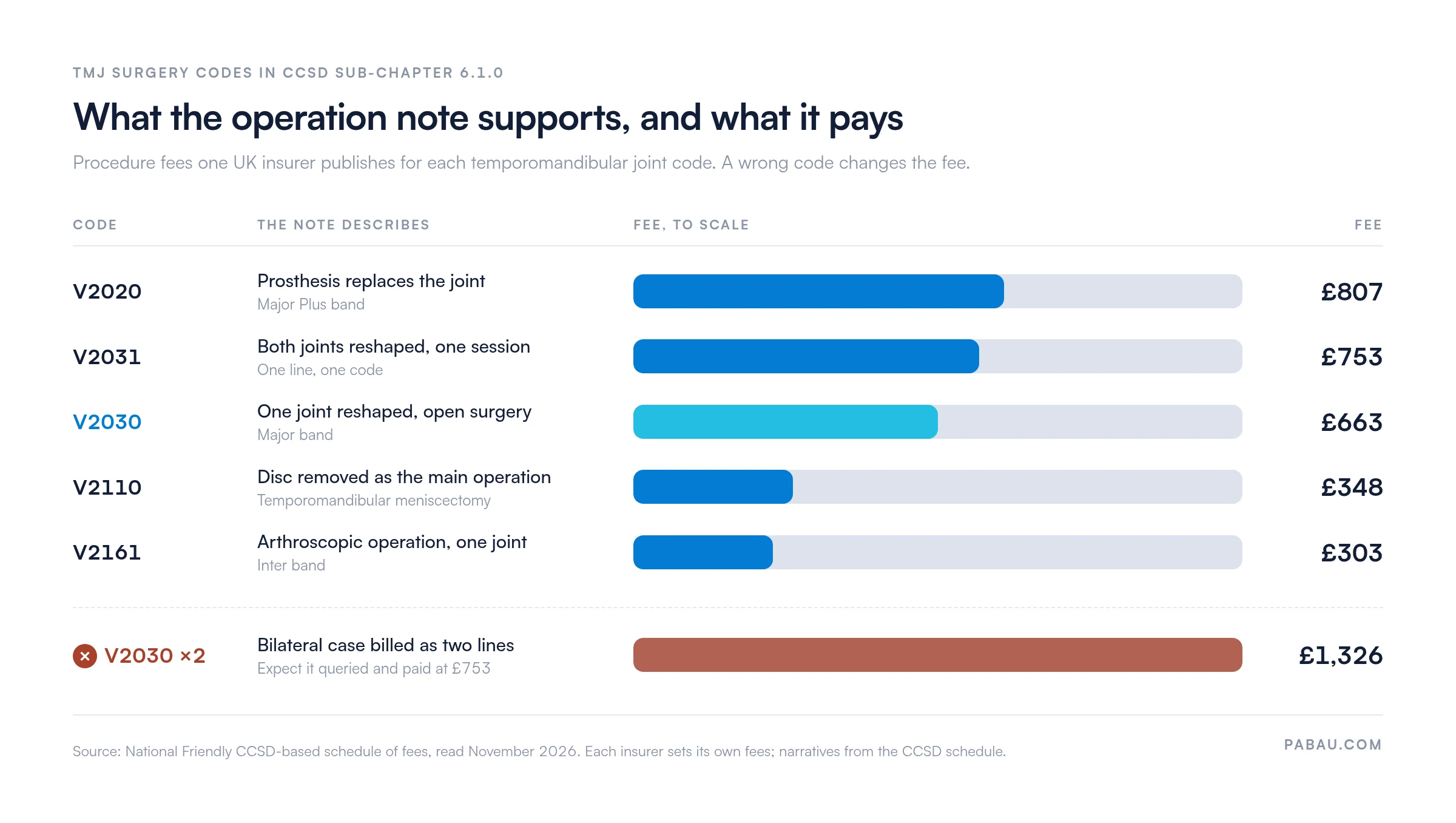
The fees show why this matters. National Friendly lists V2030 at £663 and V2031 at £753. Two lines of V2030 would ask for £1,326, against a schedule that pays £753 for the bilateral operation. Expect that claim to be queried and paid at the V2031 rate, if at all.
When a patient is booked for surgery on both joints, put V2031 on the pre-authorization request. An authorization issued for V2030 won’t match a bilateral claim, and the mismatch is easier to fix before the operation than after it.
Knowing the surgical steps helps billing staff check that the operation note supports V2030 before the claim goes out.
Removing the disc as the main operation is a different procedure, coded V2110 temporomandibular meniscectomy. A note that describes only a joint washout or a keyhole procedure doesn’t support V2030 either. Arthrocentesis and therapeutic arthroscopy carry their own unilateral and bilateral codes.
Insurers expect the clinical record to explain why open joint surgery was chosen over less invasive care. The usual indications are:
Record which treatments were tried first, such as splints, physiotherapy, medication or arthrocentesis, and why they failed. Where the pathology is structural, as in ankylosis, say why conservative care wasn’t an option. Each insurer sets its own criteria, so check them before you request authorization.
UK insurers use the WHO version of ICD-10, not the US ICD-10-CM. Codes such as M26.61 or M26.63 belong to the US system and don’t exist in WHO ICD-10. The WHO ICD-10 browser holds the codes below.
Record the diagnosis in the same terms in the referral, the pre-authorization request and the operation note. Name the specific condition, such as ankylosis or degenerative disease, so the insurer can see why the joint was opened.
CCSD files every temporomandibular joint operation in sub-chapter 6.1.0. The table shows the codes most likely to be confused with V2030, with narratives taken from the CCSD schedule.
The bands differ, so a wrong code changes the fee, as the chart below shows. National Friendly lists V2020 at £807 in the Major Plus band, and V2110 at £348. Therapeutic arthroscopy of one joint, V2161, sits in the Inter band at £303. For a dislocated jaw, see our guide to CCSD code V2120.
V2010 and V2040 are not CCSD codes. A claim that uses either is likely to be queried or returned.
A V2030 claim is only as strong as the operation note behind it. If the note just says “TMJ surgery”, the coder can’t tell arthroplasty from arthroscopy or replacement, and the insurer may query it.
In Pabau’s practice software, digital forms let you build a TMJ operation note with fields for the side, the diagnosis and the technique. The coder then reads V2030 or V2031 straight from the note.
The work starts before the operation. UK insurers such as Bupa, AXA Health, Aviva and Vitality generally ask for planned surgery to be approved in advance. The patient’s policy decides what is covered, so confirm each step with the insurer. Our guide to Bupa CCSD codes covers how Bupa handles CCSD claims.
V2030 is done under general anesthesia, and the anesthetist usually sends their own claim for the same operation. Many insurers pay anesthetists from a separate fee schedule. Check whether the insurer wants the same procedure code and authorization reference on both claims.
Adding a second procedure code to the surgeon’s claim needs care. The CCSD technical guide says each insurer has its own contractual rules on multiple codes. Contact the insurer before you combine V2030 with another code, and make sure the note describes both procedures.
Each of these slips gives the insurer a reason to query a V2030 claim, and each one has a fix.
If a claim is still refused, check the insurer’s current provider manual for its appeal process. Only commit to a deadline you have confirmed there.
In many oral and maxillofacial practices, the authorization lives in an email and the operation note sits in another system. Then the claim is keyed in by hand. Every handoff is a chance to lose the reference number or send V2030 where V2031 belongs.
Pabau keeps those steps on the patient record. Its paperless claims management sends claims electronically through Healthcode and to Bupa. The authorization code, dates and sessions sit on the patient’s case, with a warning when one is missing.
The result is fewer claims queried for a missing reference or the wrong laterality code. Your team spends less time on rework and more on patients.

Pabau tracks authorization codes on the patient’s case and sends claims electronically through Healthcode and to Bupa. You see each claim’s status without phoning the insurer.

V2030 is a one-joint code, and most trouble comes from forgetting that. Since October 2022 the schedule splits TMJ arthroplasty by side, and a bilateral operation is a single V2031 claim. The other common errors are coding arthroscopy or replacement as arthroplasty and pairing it with a US diagnosis code.
Build an operation note that records the side, the diagnosis and the technique, and check each insurer’s current schedule before you invoice. Book a demo to see how Pabau tracks authorizations and sends your Healthcode claims from one patient record.

Looking for another CCSD procedure code? CCSD codes lists the procedure codes Pabau covers, chapter by chapter.
Need a full Bupa CCSD billing reference? Bupa CCSD codes covers Bupa’s procedure list and how its claims work.
Treating a dislocated jaw? CCSD code V2120 covers reduction of a temporomandibular joint dislocation.
Planning reconstruction of the jaw? CCSD code V1910 covers jaw reconstruction and how to claim it.
Fixing a mandible from outside the mouth? CCSD code V1730 covers extraoral fixation of the mandible.
CCSD code V2030 covers arthroplasty of the temporomandibular bone joint on one side. The surgeon opens the joint and reshapes the condyle and joint surfaces, without fitting a prosthesis. UK private insurers use it under CCSD reference Ff.017.
Bilateral TMJ arthroplasty is CCSD code V2031, added in October 2022. Claim it once when both joints are operated on in the same session. Don’t bill V2030 twice or add a modifier.
V2030 sits in chapter 6.0.0 Face, Mouth, Salivary & Thyroid, sub-chapter 6.1.0 Face and Jaws. Its CCSD reference is Ff.017, and the other temporomandibular joint codes sit in the same sub-chapter.
V2030 reshapes the joint’s own surfaces. V2020 is prosthetic replacement of the temporomandibular joint, where an implant replaces the joint surfaces. National Friendly’s schedule places V2020 in a higher band.
UK insurers use WHO ICD-10. K07.6, temporomandibular joint disorders, is the usual code for derangement and dysfunction of the joint. Ankylosis is classed in M24.6, ankylosis of joint, so confirm that pairing with the insurer. Unilateral condylar hyperplasia sits under K10.8. US ICD-10-CM codes such as M26.61 don’t exist in the WHO version.
Most UK insurers expect planned surgery to be pre-authorized, and the patient’s policy decides what is covered. Confirm with the insurer before the operation date and put the authorization reference on the claim.
Submit it electronically via Healthcode or direct to the insurer, with the authorization reference and a fee that matches the insurer’s current schedule. Keep the operation note ready in case the insurer asks for it.