Pabau Engage inbox

Pabau Engage is here: every patient conversation in one inbox.

Learn more
Book a demo Book a demo
CCSD Code

CCSD code 22025 EMG and nerve conduction studies for myasthenia gravis


Code Definition

22025 is the CCSD code for recording and reporting on electromyography and nerve conduction studies (EMG); myaesthenia gravis (+ SFEMG).

Group
3 Spine, spinal cord and peripheral nerves
Category
Nerve Roots
Code also known as
single fibre EMG billing, SFEMG billing UK, myasthenia gravis electrophysiology billing, nerve conduction study myasthenia gravis
Save time. Improve accuracy. Get paid faster.
Automate coding with Pabau

Let Pabau's smart automation suggest the right codes, reduce claim denials, and keep your practice compliant—effortlessly.

  • AI-powered code suggestions
  • Real-time compliance checks
  • Faster claims, fewer denials
Why practices choose Pabau
Save hours every week

Automate repetitive tasks and focus on what matters most—your patients.

Improve accuracy

Reduce coding errors and ensure compliance with the latest regulations.

Get paid faster

Clean claims, fewer denials, and faster reimbursements.

Grow with confidence

Powerful insights and reporting to help your practice thrive.

HIPAA compliant SOC 2 certified GDPR-compliant Trusted by 4,000+ clinics worldwide

Key Takeaways

Key Takeaways

CCSD Code 22025 covers both the recording and reporting of EMG and nerve conduction studies specifically for myasthenia gravis, including single fibre EMG (SFEMG) jitter analysis

Both the recording (performing the test) and the reporting (written clinical interpretation) must be documented separately; missing either is a leading audit trigger

ICD-10 codes G70.00 and G70.01 are the primary diagnosis codes supported by CCSD Code 22025; confirm your payer’s accepted code list before submitting

Pabau’s claims management tools help private neurology practices track prior authorisation status, link diagnosis codes, and submit complete documentation for CCSD Code 22025 claims

CCSD Code 22025: official descriptor and scope

CCSD Code 22025 covers recording and reporting on electromyography and nerve conduction studies (EMG) for myasthenia gravis, including single fibre electromyography (SFEMG). The CCSD (Clinical Coding and Schedule Development Group) maintains this code as part of the UK private healthcare schedule used by Bupa, AXA Health, Aviva, Vitality, and other private medical insurers. The code is specific to the myasthenia gravis investigation context; a standard EMG performed for any other indication should be billed under a different CCSD code.

Two elements define the scope: the procedure itself (the physical test session) and the written clinical interpretation. CCSD Code 22025 encompasses both. Any claim that documents only one of these two components is incomplete and subject to rejection. For UK private practice billing in the UK, this dual-component requirement is the single most important feature to understand before submitting.

Component Definition Required for billing?
Recording Performing the EMG, NCS, and SFEMG test session; capturing raw waveform data Yes
Reporting Written clinical interpretation of findings, signed by the billing clinician Yes
SFEMG (jitter analysis) Single fibre EMG measuring neuromuscular jitter; the specialist component for MG diagnosis When performed as part of the MG investigation

The procedure: EMG, NCS, and SFEMG for myasthenia gravis

A CCSD Code 22025 session typically involves three complementary tests performed in sequence by a consultant neurologist or clinical neurophysiologist. Each tests a different aspect of neuromuscular function, and together they build the clinical picture needed to confirm or exclude myasthenia gravis.

  • Needle EMG: Records electrical activity in individual muscle fibres at rest and during voluntary contraction. Helps distinguish neuromuscular junction disorders from primary muscle disease.
  • Nerve conduction studies (NCS): Surface electrode recordings of motor and sensory nerve responses. Establishes baseline nerve function and rules out peripheral neuropathy as an alternative diagnosis.
  • Single fibre EMG (SFEMG): The specialist component. A fine electrode records action potentials from individual muscle fibres innervated by the same motor neurone. The clinician measures neuromuscular jitter, which reflects the reliability of transmission at the neuromuscular junction. Elevated jitter and blocking are hallmarks of myasthenia gravis. SFEMG sensitivity for MG is approximately 95% when performed in clinically affected muscles, according to published neurophysiology guidelines.
  • Repetitive nerve stimulation (RNS): Often performed in the same session. Tests the neuromuscular junction at a population level by applying repeated electrical stimuli and measuring the compound muscle action potential decrement. RNS is less sensitive than SFEMG for MG but less operator-dependent.

Clinical indications and medical necessity criteria

UK private insurers will accept CCSD Code 22025 when the clinical record supports a clear indication for the investigation. Broadly accepted indications include:

  • Suspected or confirmed myasthenia gravis
  • Unexplained ptosis with fatigable component
  • Fatigable proximal limb weakness without another established cause
  • Bulbar symptoms (dysarthria, dysphagia) that worsen with repetitive activity
  • Positive acetylcholine receptor or MuSK antibody result requiring electrophysiological confirmation
  • Monitoring of known MG in the context of treatment change or clinical relapse

Borderline indications, such as fatigue in a patient with non-specific autoimmune disease, are more likely to trigger a medical necessity review. For these cases, the referral letter and clinical notes should explicitly document the reasoning. Review compliance requirements for clinical procedures in private practice settings to understand how insurers evaluate necessity criteria across specialist diagnostics.

Pro Tip

Document the clinical indication in your own words in the report, not just as a diagnosis code. Payers reviewing borderline cases look for the consultant’s narrative, not just a code string. A sentence explaining why SFEMG was clinically necessary can be the difference between payment and a medical necessity rejection.

What CCSD 22025 requires: recording vs reporting

The recording and reporting distinction is where CCSD Code 22025 claims most often fall apart under audit. Recording refers to the physical test session: the clinician (or a supervised technician) performs the needle EMG, surface NCS, and SFEMG, capturing the raw waveform data. Reporting refers to the written clinical interpretation: the consultant reviews the findings, integrates them with the clinical history, and produces a signed written report.

For the claim to be valid, both must be attributable to the billing consultant. If a technician performs the recording unsupervised and the consultant writes the report without being present, many insurers will reject the claim. Insurer rules on supervision and delegation vary, so confirm your specific payer’s requirements before splitting the recording and reporting between team members.

  • The report must be a distinct document, not a brief note appended to a referral letter
  • It must include the consultant’s interpretation, not just the raw measurement values
  • The consultant who signs the report must be the one recognised by the insurer for this procedure
  • Both documents must be available on request for any claims audit

Diagnosis codes to use with CCSD Code 22025

Every CCSD Code 22025 claim must be linked to a supporting ICD-10 diagnosis code. The codes below are the primary options; confirm with your insurer whether their approved list matches, as payer-specific approved code lists can differ from the standard ICD-10 classification.

ICD-10 code Description Notes
G70.00 Myasthenia gravis without exacerbation Most common code for stable or newly diagnosed MG
G70.01 Myasthenia gravis with exacerbation Use when the study is prompted by a clinical worsening episode
G70.1 Toxic myoneural disorder Where drug-induced NMJ dysfunction is under investigation
G70.9 Disorders of neuromuscular junction, unspecified Use only when a specific classification cannot yet be made; some payers prefer a more specific code before authorising

Choosing the wrong CCSD code is a common billing error that results in claim rejection even when the clinical work was appropriate. The codes most often confused with CCSD Code 22025 are those covering standard EMG or NCS performed outside the myasthenia gravis context. Refer to the Bupa procedure codes fee schedule for current fee rates alongside the descriptions below.

Code Descriptor summary Key difference from 22025 When to use instead
22025 EMG and NCS for myasthenia gravis, including SFEMG Specific to MG investigation; includes SFEMG MG workup with SFEMG performed
22021 EMG recording and reporting (standard; not MG-specific) No SFEMG; no MG indication requirement General neuromuscular EMG, not MG-specific
22022 NCS recording and reporting (standard) NCS only; no EMG or SFEMG component Isolated nerve conduction study without EMG
22028 Repetitive nerve stimulation recording and reporting RNS only; may be billed alongside 22025 (confirm with insurer) When RNS is performed as a standalone study

Note: The code numbers for 22021, 22022, and 22028 above are representative; always verify the current CCSD schedule at ccsd.org.uk before billing, as code numbers and descriptors are updated periodically.

Billing CCSD Code 22025: step-by-step for private practice

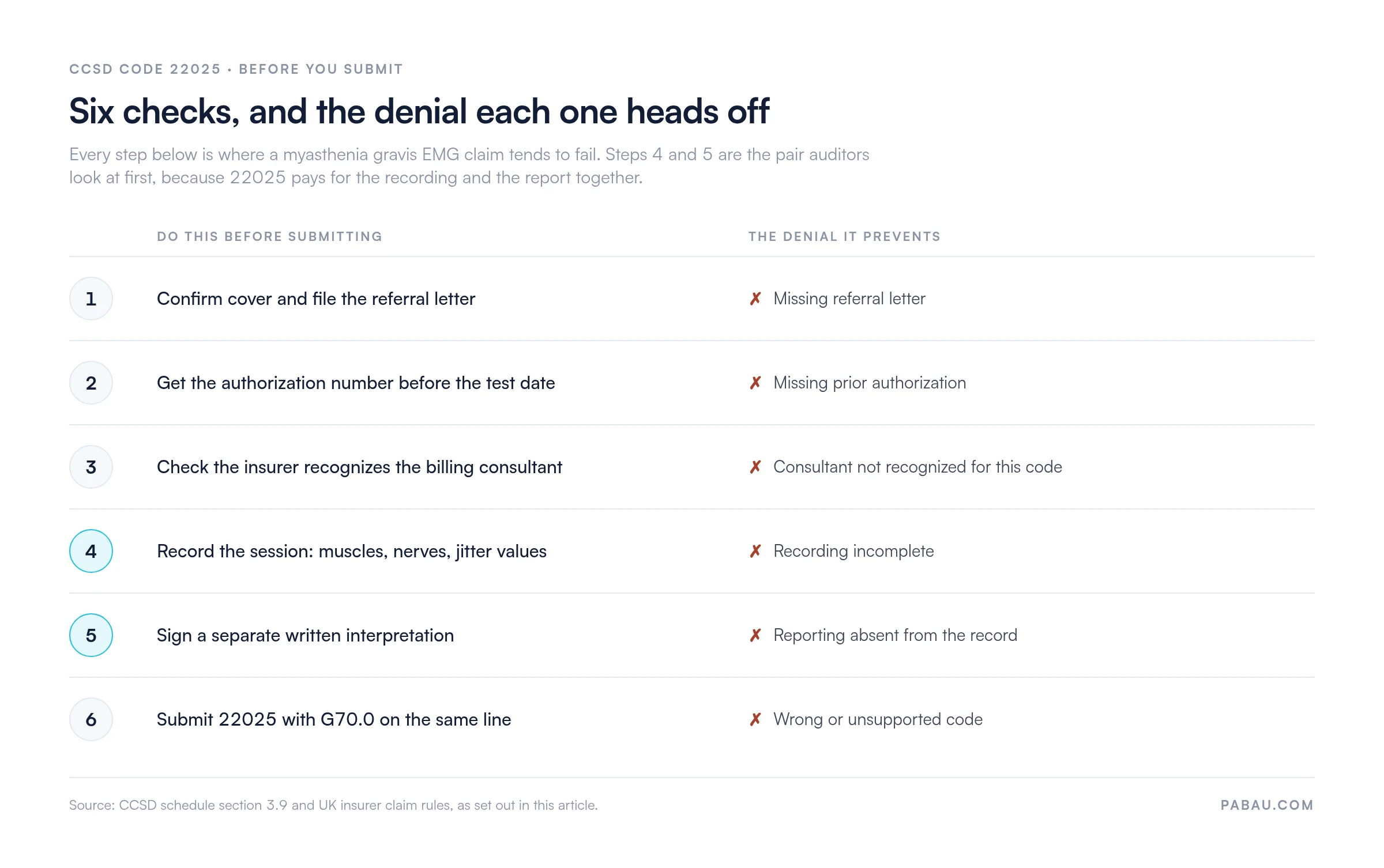
Getting CCSD Code 22025 paid consistently requires a systematic pre-submission workflow. Each step below corresponds to a common failure point identified in claim denials for this procedure. Using claims management software to track these steps for each patient helps prevent the manual oversights that cause most rejections.

Automate claims through Healthcode
  1. Verify patient coverage: Confirm the patient’s policy covers CCSD Code 22025 before booking the appointment. Ask whether a referral letter from a GP or consultant is required as a precondition.
  2. Confirm prior authorisation status: Contact the insurer to check whether pre-authorisation is required for this code. Record the authorisation reference number in the patient’s file before the test date.
  3. Perform and document the full test session: Complete the needle EMG, NCS, and SFEMG. Ensure the recording is documented with the muscles/nerves tested, waveform values, and jitter measurements.
  4. Produce the written clinical report: The billing consultant must sign a distinct written interpretation that integrates the findings with the clinical history and states a conclusion relevant to the MG investigation.
  5. Link the correct ICD-10 diagnosis code: Attach G70.00 or G70.01 (or an alternative from the table above) as appropriate. Do not leave the diagnosis field blank or use an unspecified code if a more specific one fits.
  6. Submit via Healthcode or your insurer’s portal: Most UK private claims are submitted through Healthcode. Include both the procedure code (CCSD Code 22025) and the diagnosis code on the same submission line. Attach or reference the clinical report.

Practices using Pabau can store the authorisation reference number against the appointment, flag incomplete documentation before submission, and link the diagnosis code in the billing record, reducing the back-and-forth with insurers. See how time-saving features for private practices reduce administrative overhead in specialist billing workflows.

Manage CCSD billing workflows without the paperwork

Pabau helps UK private practices track prior authorisation, link diagnosis codes, and submit complete documentation for CCSD claims, all from one platform.

Pabau practice management platform

Prior authorisation requirements

Whether CCSD Code 22025 requires prior authorisation depends on the insurer, the specific policy, and the policy year. Requirements vary and can change; always verify with the payer directly rather than assuming based on prior experience. General patterns in the UK private medical insurance (PMI) market are outlined below, but none of these should be treated as definitive without checking the current policy terms.

Insurer Pre-auth typical pattern Verification resource
Bupa Pre-authorisation required for specialist diagnostics in most plans; obtain an authorisation number before the test Bupa code search portal
AXA Health Some specialist investigation codes require pre-approval via the specialist forms portal; check per-policy rules AXA Health specialist procedure codes
Aviva Check the fee schedule and invoicing guidance; pre-auth requirements vary by plan type Aviva fee schedule for practitioners
Vitality Health Use the fee finder to confirm code status and whether pre-authorisation is flagged for this procedure Vitality fee finder

If a claim is submitted without required prior authorisation, most insurers will not pay retrospectively. Some allow retrospective authorisation requests in exceptional circumstances (urgent clinical situations), but these are assessed case by case. Good private practice management processes should make pre-auth verification a routine step that happens at the time of booking, not on the day of the test. See also benefits of private practice structures that systematise this kind of insurer compliance workflow.

Why CCSD 22025 claims get denied and how to prevent it

Most CCSD Code 22025 rejections fall into a small number of repeating patterns. Each one has a prevention strategy that can be built into the pre-submission workflow. Implementing compliance management for clinics helps catch these issues before a claim leaves the practice.

HIPAA compliance toggle
Denial reason Prevention strategy
Missing prior authorisation Make pre-auth confirmation a booking precondition; record the authorisation number against the appointment
Recording documented, reporting absent Use a report template that is automatically flagged as incomplete if the consultant’s written interpretation has not been signed
Wrong code submitted (standard EMG instead of CCSD Code 22025) Build a procedure-to-code mapping in your billing system; any MG investigation appointment should default to 22025
Unsupported ICD-10 diagnosis code Check the insurer’s approved diagnosis code list for this procedure; G70.9 (unspecified) is rejected by some payers
Clinician not credentialed for the procedure Confirm the billing consultant is recognised by the insurer for CCSD Code 22025 before the appointment is booked
Missing referral letter Some insurers require a GP or specialist referral as a precondition; request and file this before the test date

Documentation best practices for CCSD 22025

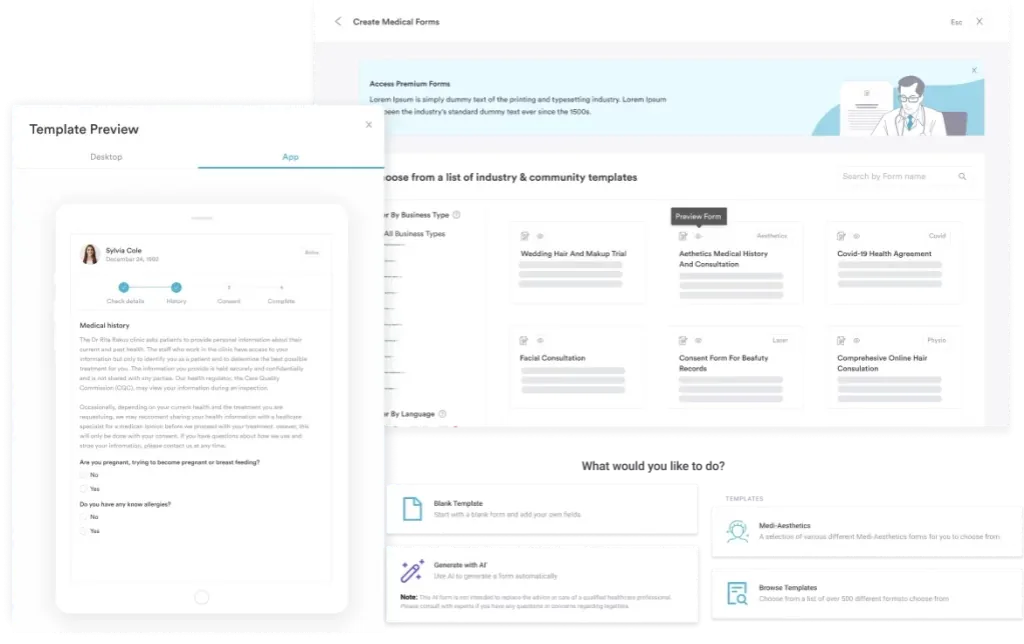
The clinical report for CCSD Code 22025 must stand alone as a complete record of what was done, what was found, and what it means clinically. Insurers reviewing claims will assess whether the report demonstrates that both the recording and reporting requirements of the code were met. Using structured clinical documentation at your practice reduces the risk of missing mandatory elements. Pabau’s digital forms for clinical documentation allow neurophysiology practices to build report templates with required fields that cannot be submitted incomplete.

Digital forms
Digital forms

The minimum required elements in the CCSD Code 22025 clinical report are:

  • Patient demographics and date of study
  • Clinical indication (referral diagnosis and reason for the investigation)
  • Muscles and nerves tested, with laterality specified
  • EMG findings: spontaneous activity, motor unit morphology, recruitment pattern
  • NCS findings: conduction velocities, amplitudes, distal latencies
  • SFEMG findings: jitter values, blocking percentage, muscles sampled
  • Clinical interpretation: what the findings indicate in the context of the MG investigation
  • Conclusion: whether the results are consistent with, or exclude, myasthenia gravis
  • Billing consultant signature and date

Pro Tip

Run an internal audit of your last 10 CCSD Code 22025 reports before your next claims submission batch. Check whether every report contains all nine elements above and whether the consultant’s signature is dated. Reports missing the clinical interpretation or the conclusion are the most common audit trigger for this code.

Can CCSD 22025 be billed with other codes on the same day?

Whether CCSD Code 22025 can be billed alongside other codes on the same date of service depends on the insurer’s current bundling rules and the specific codes involved. The CCSD schedule and individual insurer guidelines should always be checked before co-billing. General patterns are outlined below.

  • Repetitive nerve stimulation (RNS): RNS is a complementary test to SFEMG in the myasthenia gravis workup and may have its own CCSD code (such as 22028). Some insurers accept both codes on the same claim when both tests were genuinely performed and separately documented. Others treat RNS as bundled within the CCSD Code 22025 fee. Confirm with the insurer before billing both.
  • Standard EMG (e.g. 22021): Billing a standard EMG code alongside CCSD Code 22025 on the same day for the same limbs is typically not accepted. The code 22025 is intended to cover the full test session for the MG investigation.
  • Consultation codes: If a new patient consultation is provided at the same appointment, the consultation code and CCSD Code 22025 may generally be billed together, provided the consultation and the investigation are separately documented. Check each insurer’s same-day consultation rules.
  • Insurer-specific restrictions: Healix and some other payers apply explicit unbundling guidelines to electrophysiology codes. Review the private practice billing guidance for your payers annually, as bundling rules change with schedule updates.

Conclusion

CCSD Code 22025 is a specialist neurology billing code that rewards systematic preparation. Practices that confirm prior authorisation at the booking stage, document both the recording and reporting components completely, and link the correct ICD-10 diagnosis code consistently will see far fewer denials for this procedure.

Pabau’s claims management software helps UK private neurology practices track authorisation references, build report templates with required fields, and submit complete CCSD documentation, reducing the back-and-forth with insurers. To see how Pabau supports neurophysiology and private specialist billing workflows, book a demo with the team.

Continue your research

Continue your research

Billing across multiple UK private insurers? Bupa procedure codes fee schedule covers the current CCSD rates and fee structure for Bupa-registered practitioners.

Need a better system for clinical documentation compliance? Compliance management for clinics helps private practices build audit-ready workflows that meet insurer documentation requirements.

Considering the move from NHS to private practice? Private practice billing in the UK covers the administrative and billing differences consultants encounter when setting up independently.

Frequently Asked Questions

What does CCSD Code 22025 cover?

CCSD Code 22025 covers recording and reporting on electromyography and nerve conduction studies performed in the investigation of myasthenia gravis, including single fibre electromyography (SFEMG). The code encompasses the full test session and the written clinical interpretation, both of which must be documented to support a valid claim.

What is single fibre EMG and when is it used for myasthenia gravis?

Single fibre EMG (SFEMG) is a highly sensitive electrophysiological technique that measures neuromuscular jitter, the variability in transmission timing at individual neuromuscular junctions. It is used when myasthenia gravis is clinically suspected, particularly when standard EMG and serology are inconclusive. Published neurophysiology literature reports SFEMG sensitivity of approximately 95% for MG when performed in a clinically affected muscle.

What documentation is required to bill CCSD Code 22025?

The clinical report must include the clinical indication, muscles and nerves tested, EMG and NCS findings, SFEMG jitter values, a clinical interpretation, a conclusion relevant to the MG investigation, and the billing consultant’s signature. Both the recording and reporting components must be separately evidenced; a report that contains raw data but no clinical interpretation does not satisfy the reporting requirement.

What are the most common reasons CCSD 22025 claims are denied?

The most common denial reasons are missing prior authorisation, the reporting component being absent from the clinical record, a standard EMG code submitted instead of CCSD Code 22025, an ICD-10 diagnosis code that is not on the insurer’s approved list for this procedure, and the billing consultant not being credentialed by the insurer for this procedure type.

Does billing CCSD Code 22025 require prior authorisation?

Prior authorisation requirements vary by insurer and policy year. Bupa typically requires pre-authorisation for specialist diagnostic procedures. AXA Health, Aviva, and Vitality each have their own pre-approval processes that differ by plan type. Always verify with the specific insurer before the appointment; submitting without required authorisation typically results in non-payment with limited retrospective appeal options.

Which ICD-10 codes support CCSD Code 22025 for myasthenia gravis?

G70.00 (myasthenia gravis without exacerbation) and G70.01 (myasthenia gravis with exacerbation) are the primary ICD-10 codes used with CCSD Code 22025. G70.1 (toxic myoneural disorder) applies where drug-induced neuromuscular junction dysfunction is under investigation. G70.9 (unspecified neuromuscular junction disorder) is accepted by some payers but rejected by others; use a more specific code wherever the clinical picture allows.

Can CCSD 22025 be billed alongside repetitive nerve stimulation codes?

Possibly, depending on the insurer. Repetitive nerve stimulation (RNS) is a complementary test to SFEMG in the myasthenia gravis workup and may have its own CCSD code. Some insurers accept both on the same date of service when both tests were performed and separately documented; others treat RNS as bundled within the CCSD Code 22025 fee. Confirm the insurer’s current bundling rules before co-billing.

×