ICD-10 Code Y76.0: Diagnostic obstetric and gynecological devices
ICD-10 Code Y76.0: Definition and billable status ICD-10 Code Y76.0 is a valid, ...

Last Updated: Oct 23, 2026
Billable Code Specific Code
Z56.9 is the billable ICD-10-CM code for unspecified problems related to employment. Coders assign it when a patient's health is affected by work-related difficulties that no more specific Z56 subcode describes.
As a social determinants of health (SDOH) code in ICD-10-CM Chapter 21, it is always a secondary or additional diagnosis, never the principal listed code. It took effect for FY2026 on October 1, 2025 and stays valid for dates of service through September 30, 2026.
Let Pabau's smart automation suggest the right codes, reduce claim denials, and keep your practice compliant—effortlessly.
Automate repetitive tasks and focus on what matters most—your patients.
Reduce coding errors and ensure compliance with the latest regulations.
Clean claims, fewer denials, and faster reimbursements.
Powerful insights and reporting to help your practice thrive.
HIPAA compliant SOC 2 certified GDPR-compliant Trusted by 4,000+ clinics worldwide

Z56.9 codes unspecified employment-related problems in patients where no more specific Z56 subcode applies.
It is a billable, secondary-only code valid for FY2026 (effective October 1, 2025) and cannot be the principal diagnosis.
Use Z56.9 alongside primary diagnoses such as depression (F32), anxiety (F41), or adjustment disorder (F43.2) when work factors are clinically documented.
Practice management software like Pabau carries secondary diagnosis fields on every claim, so Z56.9 travels out with the primary code.
ICD-10 Code Z56.9 is a specific, billable ICD-10-CM diagnosis code for unspecified problems related to employment. It sits in the Z56 block (Problems related to employment and unemployment) in Chapter 21, Factors influencing health status and contact with health services. The chapter is maintained by the Centers for Medicare and Medicaid Services (CMS) and the National Center for Health Statistics (NCHS).
Z56.9 applies when a patient’s health problems are influenced by their employment situation. The record has to describe nothing specific enough for a more precise Z56 subcode. Documented scenarios include general occupational dissatisfaction, unspecified work-related stress, and non-specific job difficulties that affect the patient’s mental or physical health.
This is an SDOH code, so it does not describe the clinical condition. It contextualizes it. Take a clinician noting “patient reports chronic work stress affecting sleep and mood.” Z56.9 goes on that claim as a secondary code, beside the primary diagnosis driving the encounter.
Approximate synonyms recognized by ICD-10-CM for Z56.9 include:
These phrases turn up in clinical notes, referral letters, and social history documentation. When a coder finds one of them in the record, Z56.9 is the right code if no more specific subcode applies. Documented burnout is the exception, and it takes Z73.0 instead.
Z56.9 is appropriate as a secondary or additional diagnosis when a qualified clinician documents that employment-related problems are affecting the patient’s health. The ICD-10-CM Official Guidelines for Coding and Reporting are maintained jointly by CMS and NCHS. They allow Z codes as additional codes alongside any other code, to describe factors influencing health status.
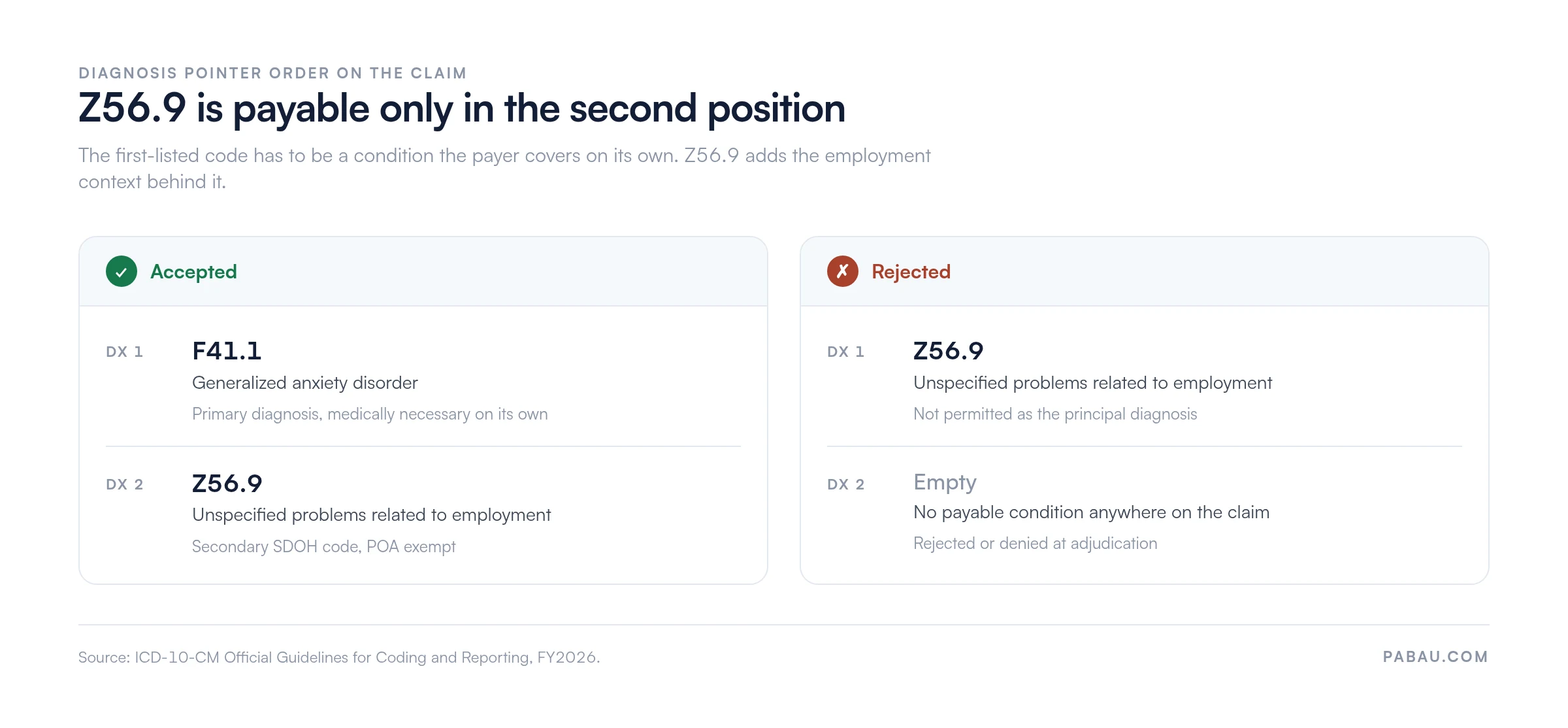
Per the CDC/NCHS ICD-10-CM coding guidelines, Z56.9 cannot stand alone as the principal or first-listed diagnosis. It supplements a primary diagnosis code that identifies the condition being treated. A claim carrying Z56.9 as the sole diagnosis will be rejected or denied.
The Z56 category includes ten subcodes besides Z56.9 itself. Assign the most specific code the documentation supports. Reach for Z56.9 only when none of the subcodes below fits the record.
The most common coding error is defaulting to Z56.9 when the documentation supports a specific subcode. A note reading “patient is stressed about possible layoffs” is Z56.2, threat of job loss. Read the provider’s language closely before you pick the unspecified code. Z56 is one of several Chapter 21 blocks worth checking here, and the ICD-10-CM code index lists the neighboring Z55-Z65 categories.
Two categories of excludes notes apply to the whole Z56 block, including Z56.9. Misapplying them is a common reason for claim edits.
There are no Excludes1 restrictions specific to Z56.9. Physical workplace hazards such as dust, radiation, or noise belong under Z57, not Z56.9. The Z56 block covers psychosocial employment problems only.
The distinction matters for denial management. A code pulled from an excluded category can generate a claim edit, so query the provider whenever the note is ambiguous.
Z56.9 is one of the SDOH Z codes CMS encourages practices to document for value-based care and population health work. Chapter 21 Z codes capture social and environmental factors that influence patient outcomes, even when those factors are not the reason for the encounter.
For practices under value-based contracts, SDOH Z codes like Z56.9 feed risk-adjustment accuracy. They also help show the full complexity of a patient panel. Mental health practices, primary care offices, and occupational health practices use this code most often.
Employment is one SDOH domain among several. A documented social difficulty with no work connection belongs to the Z60 block instead, where Z60.8 covers inadequate social support or lack of emotional support.
Best practices for SDOH Z code documentation include:
Z56.9 is a fully billable ICD-10-CM code. It can appear on claims to Medicare, Medicaid, and most commercial insurers as a secondary or additional diagnosis.
Payer treatment of SDOH Z codes varies widely. Some payers encourage them for population health tracking, while others treat them as informational and adjust no payment. Verify the payer’s Z code policy before you assume a reimbursement impact.
On an electronic claim, Z56.9 must sit in a secondary diagnosis field, never the principal one. Practice management software like Pabau carries several secondary diagnosis fields on every claim. The coder attaches Z56.9 beside the primary diagnosis without a workaround, which is what cleaner claims management buys a billing team.
Medicare has no coverage determination for Z56.9 on its own. It is an informational code that supports clinical context. The primary diagnosis still has to be medically necessary and payable by itself. Z56.9 adds context, but it does not create a billable encounter.
Check your payer contracts before you rely on Z56.9 for risk-adjustment credit. Medicare Advantage plans vary in whether they accept SDOH Z codes for HCC risk scoring. Run a small test batch with your most common payers. Review the 835 remittance codes to confirm how Z56.9 is processed before you apply it systematically.
Practices maintaining legacy records or comparing historical billing data need the ICD-9-CM equivalent for Z56.9. The crosswalk is approximate, so the scenarios covered by each code are not identical in scope.
V62.1 was the ICD-9-CM code for adverse effects of work environment, and it covered a broader range of work-related social history factors. When you reconcile pre-2015 records, V62.1 is the closest approximate equivalent to Z56.9.
ICD-9-CM had no subcategory structure comparable to Z56, so a V62.1 entry in a legacy record may map to any Z56 code depending on context. Treat the crosswalk as a reference rather than a conversion rule, and verify each case against AAPC’s ICD-10-CM lookup.
Z56.9 is almost always paired with a primary diagnosis code. The table below shows the most common pairings by clinical specialty, with sequencing notes.
Sequence the primary condition first, and let Z56.9 follow as an additional code. Never swap the order. A claim with Z56.9 in the primary position will be denied, and the two claim lines below show what separates the two outcomes.
Accurate Z56.9 coding starts in the clinical note. Five documentation steps cut the risk of a coder query or a denial.
Build an SDOH note template in your EHR with three required fields. Capture employment status, the documented stressor, and a clinical linkage statement. When all three are present, your coder can assign Z56.9 without querying the provider, because the template has already removed the guesswork from code selection.
In most practices the employment context lives in free text. A clinician types “work stress” into the social history, the coder never sees it during charge entry, and Z56.9 never reaches the claim. The detail was recorded, but it did not travel.
Pabau keeps the note and the claim in one record. Structured social history fields capture employment status and the documented stressor at intake. The coder reads them on the same screen as the charge and adds Z56.9 to the secondary diagnosis field. The claim then leaves with its context attached.
The outcome is a shorter query loop and fewer resubmissions. Employment problems that stay clinically relevant sit on the problem list, so they carry forward to the next encounter rather than being retyped each visit.

Pabau supports secondary diagnosis code fields on every claim, so your team can document Z56.9 and other SDOH codes without switching between systems. See how it works in a live demo.

Z56.9 is straightforward when the documentation supports it, and a common denial trigger when it does not. The clinician has to connect the employment problem to the patient’s health in the note. The code then goes on the claim as a secondary diagnosis, beside a billable primary condition.
The judgment worth keeping is simple. Reach for the specific subcode first, and let Z56.9 stay the fallback rather than the habit. Practices that capture SDOH codes consistently run one workflow, from structured social history intake to electronic claim submission. Book a demo to see how ICD-10-CM code documentation works inside Pabau’s clinical workflow.

Need the primary diagnosis that Z56.9 sits behind? ICD-10 code for depression covers the F32 family that most often carries an employment-related secondary code.
Wondering how claim denials happen on secondary codes? Denial management in healthcare covers the reasons secondary diagnosis codes trigger edits, and how to prevent them.
Checking how a payer handled your SDOH code? Electronic remittance advice explains how to read the 835 file that comes back after adjudication.
New to the claim lifecycle behind these codes? What is medical billing walks through the path from encounter to payment.
ICD-10 Code Z56.9 documents unspecified problems related to employment as a secondary diagnosis. It is used when work-related factors affect a patient’s health and no more specific Z56 subcode applies. It appears on claims alongside a primary diagnosis code, such as major depression (F32.x) or anxiety (F41.1), where the provider has documented the employment-related factor.
Yes. Z56.9 is a fully billable, specific ICD-10-CM code valid for FY2026 (effective October 1, 2025). It must be used as a secondary or additional diagnosis on claims, never as the principal or first-listed diagnosis. Submitting it as the sole diagnosis will result in a claim rejection.
Use Z56.9 only when the documentation describes employment problems in non-specific terms, with no identifiable subtype. If the provider documents a threat of job loss, use Z56.2. If the note names a stressful work schedule, use Z56.3. ICD-10-CM guidelines require the most specific code the documentation supports. Z56.9 is the correct fallback only when the note fits none of the subcodes, which are Z56.0 through Z56.6, Z56.81, Z56.82, or Z56.89.
No. Z56.9 cannot be the principal or first-listed diagnosis on a claim. ICD-10-CM Official Coding Guidelines classify Z56.9 as an additional code that contextualizes a patient’s health encounter. It requires a primary diagnosis code that identifies the condition being actively treated.
Z73.0 (Burnout) is the specific code when a clinician documents burnout as a diagnosis. Z56.9 fits where the documentation describes general, unspecified employment problems without meeting the clinical threshold for burnout. Conflating the two is a coding error. Z73.0 sits in a different block, Z73 Problems related to life management difficulty. It belongs on the claim only when burnout is named in the assessment.
Z56.9 is an SDOH Z code under ICD-10-CM Chapter 21, which covers factors influencing health status. CMS encourages the documentation of SDOH Z codes to support population health management and value-based care reporting. Practices under risk-based contracts may use Z56.9 and related Z codes to reflect the social complexity of their patient panel. Any reimbursement impact depends on the payer and the contract terms.