

ICD-10 code S61.201A: Open wound of left index finger without nail damage
ICD-10 code S61.201A covers a left index finger wound of unstated type ICD-10 co...

Last Updated: Oct 16, 2026
Billable Code Specific Code
W21.31XA is the billable ICD-10-CM code for struck by shoe cleats, initial encounter.
It sits in the W21.3 subgroup covering sports footwear, and it is never sequenced first on a claim. A primary injury diagnosis has to come ahead of it. The placeholder X in position 6 and the 7th character A are both required for the code to clear a clearinghouse edit.
Let Pabau's smart automation suggest the right codes, reduce claim denials, and keep your practice compliant—effortlessly.
Automate repetitive tasks and focus on what matters most—your patients.
Reduce coding errors and ensure compliance with the latest regulations.
Clean claims, fewer denials, and faster reimbursements.
Powerful insights and reporting to help your practice thrive.
HIPAA compliant SOC 2 certified GDPR-compliant Trusted by 4,000+ clinics worldwide

W21.31XA is a billable ICD-10-CM external cause code valid through FY2026, covering struck by shoe cleats at the initial encounter only.
The placeholder X in position 6 is mandatory. Omitting it invalidates the code and triggers automatic claim rejection.
This code is never sequenced first. A primary injury diagnosis such as a contusion, laceration, or fracture must precede it on every claim.
Medicare does not require external cause codes, but workers’ compensation and most commercial payers do. Document the mechanism of injury explicitly.
ICD-10 Code W21.31XA is the billable code for a patient struck by shoe cleats, reported at the initial encounter. It sits in the external causes of morbidity chapter (V00-Y99), inside the W20-W49 block for exposure to inanimate mechanical forces. It is a secondary code, so a primary injury diagnosis has to be sequenced ahead of it on the claim.
The table below carries the reference data coders and billers reach for most often.
W21.31XA is a seven-character alphanumeric code, and each position carries a specific meaning. Reading the anatomy prevents the two structural errors that account for most rejections: a missing placeholder X and a wrong 7th character.
The placeholder X has no clinical meaning. Its function is structural. Codes in this family carry only five characters before the 7th character extension. The X fills position 6 so the encounter type lands in slot 7. Submitting W21.31A creates a six-character code that clearinghouses reject automatically.
Reading W21.31XA’s position in the tabular list shows you its siblings, which matters when documentation names the object but not the encounter phase. The CDC/NCHS ICD-10-CM web tool lets you navigate this hierarchy directly.
W21.31 without a 7th character extension is not a valid submission code. Coders always select from the three billable children: XA, XD, or XS. Stepping up to the parent when documentation is vague is not an option, because W21.31 carries no billable form of its own.
The 7th character is where most cleat-injury coding errors occur. Choosing XA over XD has nothing to do with how many visits a patient has had. It turns on whether the provider is still actively managing the injury.
One error accounts for most XA and XD mix-ups. A patient returns for a wound check three days after a cleat laceration, and the coder reaches for XD because the visit is a follow-up.
If the provider is still changing dressings and watching for infection, XA is correct, because active treatment has not ended. ICD-10-CM Official Guidelines Section I.C.20 is the authority on that distinction.
W21.31XA applies at the first active-treatment visit for an injury caused by being struck by a shoe cleat. It holds whether the cleat belonged to an opponent or to the patient’s own footwear during a fall.
Typical presentations fall into three groups:
Documentation that supports this code must capture three elements explicitly:
Mechanism language has to reach the coder in the words the payer needs, so documentation habits decide the claim. Practice management software like Pabau links the encounter note to code selection. That way “struck by shoe cleats” is captured at the point of care rather than reconstructed at billing time.
External cause codes in the V00-Y99 range are never sequenced as the principal or first-listed diagnosis. ICD-10-CM Official Guidelines Section I.C.20.a is explicit that these codes are supplemental and must follow the injury code. The order below is what a compliant cleat-injury claim looks like.
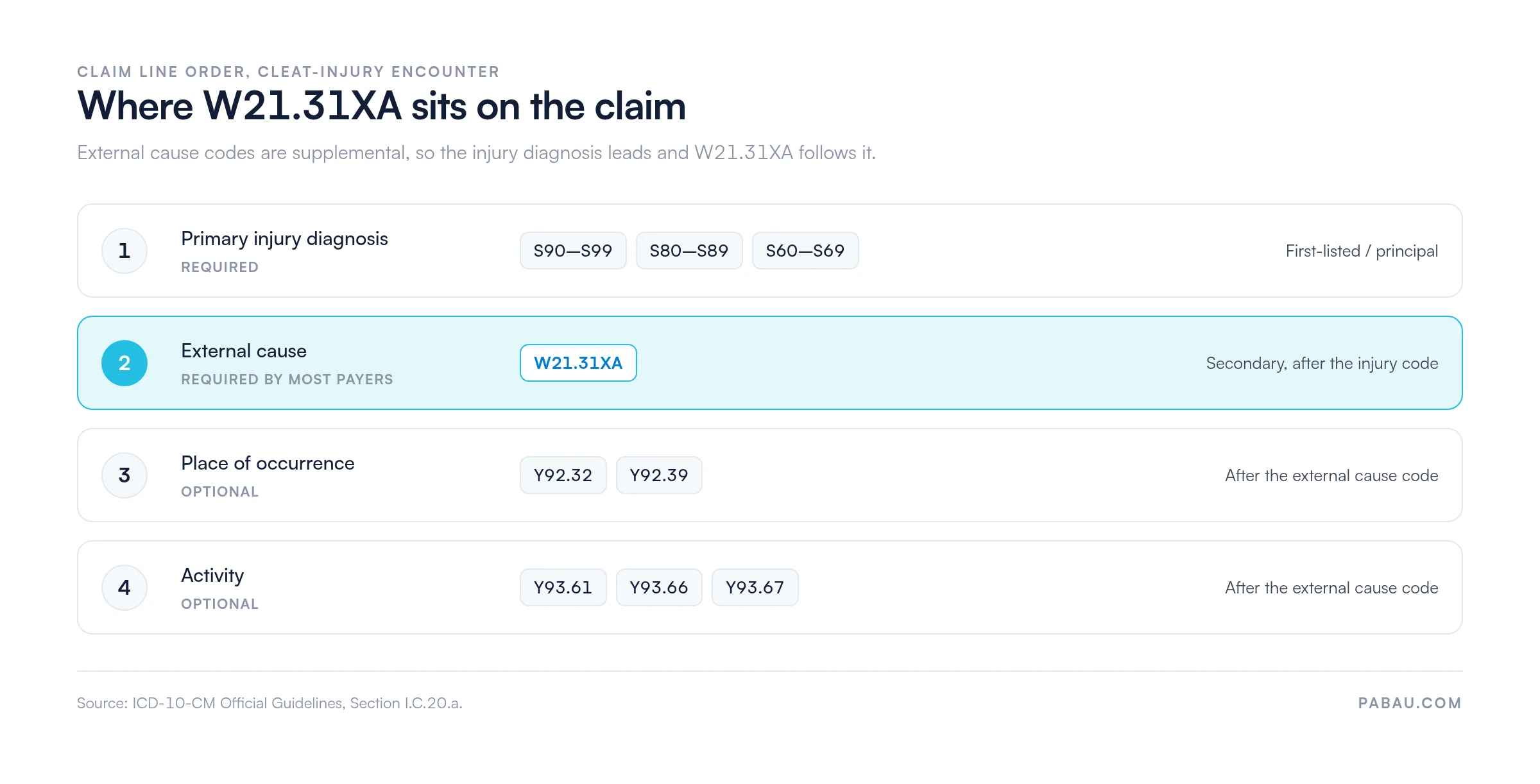
Several adjacent codes trip up coders working with cleat-injury claims. The table below covers the most frequent wrong-code scenarios.
Check the encounter note for the word ‘monitoring’ before assigning XA. If the note says the provider is monitoring healing rather than actively treating, XD applies. The clinical record decides this, and the visit count has no bearing on it.
Payer policy on external cause codes like ICD-10 Code W21.31XA varies widely. Treating Medicare’s baseline as universal is the most common billing mistake in this category.
Per the ResDAC guidance on ICD codes in Medicare claims data, Medicare itself does not require external cause codes for payment. Several state Medicaid programs mandate them, and most commercial payers require them for sports-related injury claims.
A billing workflow that checks payer policy at the time of coding, rather than after the denial, is what keeps these claims moving. Pabau’s claims management software surfaces payer-specific rules before submission, so an omitted external cause code does not reach the clearinghouse.
ICD-10 Code W21.31XA denials cluster around four root causes, and each has a specific fix. The denial codes in medical billing that show up most often with external cause codes point straight at which one you are dealing with.
A clearinghouse that validates the code string on submission catches structural errors before the payer ever sees the claim.
All four are caught at the coding stage if someone checks for them there, which is cheaper than working them out of a remittance file. A clean claim checklist written specifically for external cause codes gives billers that check.
Practices reconciling older records, or working with systems that still reference ICD-9-CM, need the General Equivalence Mapping (GEMs) crosswalk. The mapping is approximate rather than exact, because ICD-9-CM had no code specific to shoe cleats.
For soft-tissue presentations the nearest ICD-9-CM code is 917.8, other and unspecified superficial injury of foot and toes, without mention of infection. For multi-site contusions it is 924.8, contusion of multiple sites, not elsewhere classified. Neither one carries the external cause mechanism.
That loss of detail is the practical argument for ICD-10-CM’s granularity. The W21.31 family tells the payer what struck the patient, which the ICD-9 approximations never did. Verify the exact GEMs mapping against the official CMS ICD-10 codes page before applying it to a live claim.
ICD-10 Code W21.31XA is valid for FY2026 (effective October 1, 2025). No revisions, deletions, or descriptor changes were applied to the W21.3 family in either update cycle.
The WHO ICD-10 browser provides the international parent classification. Annual US updates come from CMS and NCHS, and each one takes effect on October 1 of the relevant fiscal year. Verify code validity at the start of each fiscal year against the official CMS tabular list, because commercial lookup tools can lag the official release.
In most practices the mechanism of injury is written in clinical language, and the code is chosen later. The person choosing it was not in the room. The coder reads “sports injury”, finds no object to specify, and W21.9XXA goes on the claim instead of W21.31XA.
Pabau connects the clinical record to the claim, so the note and the code are built from the same entry. Encounter templates prompt for the striking object and the treatment phase while the patient is still in the chair. The claim then carries the injury diagnosis first and W21.31XA behind it, in the order the guidelines require.
Claims route through the Claim.MD clearinghouse before they reach the payer, where structural errors surface the same day. A missing placeholder X gets fixed in minutes instead of after a 30-day denial cycle. Every Pabau subscription includes the full feature set, so claim validation is not an add-on you buy later.

Pabau connects clinical documentation to claims submission. Built-in external cause code validation and clearinghouse integration mean cleat-injury claims leave your practice clean the first time.

W21.31XA is a simple code with an unforgiving submission format. What decides the claim is the encounter note, written before anyone opens the billing screen. A coder who has only “sports injury” to work from cannot rescue it later.
So the change worth making sits upstream. Ask providers to name the striking object and the treatment phase in the note itself, and the four denial causes above stop appearing. The trade-off is a slightly longer note for a claim that pays on the first pass.
Pabau’s claims management software links encounter documentation to code validation, then routes the claim through Claim.MD before it reaches the payer. To see how that works in a sports medicine or multi-specialty practice, book a demo.

Need to understand how clearinghouses validate external cause codes? Medical claims clearinghouse guide explains how electronic claim validation works before a claim reaches a payer.
Want to reduce denial turnaround on sports injury claims? Electronic remittance advice covers how ERA files map denial reason codes back to specific claim lines.
Credentialing with payers that require external cause codes? Credentialing with insurance companies walks through the documentation payers require during provider enrollment.
ICD-10 Code W21.31XA is the billable external cause code for a patient struck by shoe cleats during the initial encounter, meaning the active treatment phase. It belongs to the W21.3 subgroup of the ICD-10-CM external causes chapter. It must be paired with a primary injury diagnosis code, and it cannot stand alone as the first-listed diagnosis on a claim.
Yes. W21.31XA is a valid, billable ICD-10-CM code for FY2025 and FY2026. The code requires the placeholder X in position 6 and the 7th character A for the initial encounter. Without both, the submitted code is structurally invalid and gets rejected at the clearinghouse.
W21.31XA covers active treatment visits, where the provider is still managing the acute injury. W21.31XD covers healing-phase visits, where the provider monitors recovery rather than actively treating. The distinction depends on what the provider does at the visit, not on how many visits have occurred.
W21.31XS applies when the original cleat injury has healed but a residual condition is now being treated as its own problem. Chronic pain, nerve damage and scarring are the usual examples. Sequela coding requires both W21.31XS and a code for the sequela condition itself, sequenced per the ICD-10-CM guidelines.
No. Medicare does not require external cause codes for payment. Workers’ compensation payers, most commercial insurers, and personal injury cases almost always do require them. Verify requirements with each payer individually before assuming Medicare’s policy applies.
Four causes account for most denials. The placeholder X is omitted, so the code goes out as W21.31A. W21.31XA is sequenced as the first-listed diagnosis instead of after the injury code. The wrong 7th character is used, usually XD during active treatment. Or the encounter note never documents the mechanism of injury.



