ICD-10 Code S82.242H: Displaced spiral tibial shaft fracture, delayed healing
ICD-10 Code S82.242H: Definition and code details ICD-10 Code S82.242H designate...

Last Updated: Oct 15, 2026
Billable Code Specific Code
V46.7XXA is the billable ICD-10-CM code for person on outside of car injured in collision with other nonmotor vehicle in traffic accident, initial encounter. In category V46, other nonmotor vehicle means an animal-drawn vehicle, an animal being ridden, or a streetcar.
External cause codes like V46.7XXA are secondary codes. They describe how and where an injury happened, not the injury itself. Pair this code with the primary injury diagnosis (fracture, laceration, concussion, etc.) on every claim. The code is valid for fiscal year 2026 and approved for submission in HIPAA-covered electronic transactions.
Let Pabau's smart automation suggest the right codes, reduce claim denials, and keep your practice compliant—effortlessly.
Automate repetitive tasks and focus on what matters most—your patients.
Reduce coding errors and ensure compliance with the latest regulations.
Clean claims, fewer denials, and faster reimbursements.
Powerful insights and reporting to help your practice thrive.
HIPAA compliant SOC 2 certified GDPR-compliant Trusted by 4,000+ clinics worldwide

V46.7XXA covers a person riding on the outside of a car who is hurt in a traffic collision with a nonmotor vehicle, initial encounter.
In category V46, a nonmotor vehicle means an animal-drawn vehicle, an animal being ridden, or a streetcar. A bus or heavy truck belongs to V44 instead.
The 7th character A marks the initial encounter. Use D for subsequent visits and S for sequela.
Always pair V46.7XXA with the primary injury diagnosis. External cause codes cannot stand alone on a claim.
Practice management software like Pabau sends CMS-1500 claims to the Claim.MD clearinghouse and tracks eligibility, claim status, and ERAs in one place.
ICD-10 Code V46.7XXA describes a person riding on the outside of a passenger car during a traffic accident. The car collides with another nonmotor vehicle, and the person on the exterior is injured. “Outside of car” means an exterior surface such as a running board, roof, step, or bumper rather than an enclosed seat. This is a specific, fully billable ICD-10-CM code valid for 2026 submissions.
One mix-up drives most V46 errors. A bus or a heavy truck is itself a motor vehicle, so a collision with one is coded under V44, never V46. The V46 category carries an Includes note that names exactly what counts here: an animal-drawn vehicle, an animal being ridden, or a streetcar.
According to the CMS ICD-10 codes page, external cause codes in the V00-Y99 range must be reported as secondary codes alongside a primary injury diagnosis. A claim carrying only V46.7XXA without a primary diagnosis code will be denied. That pairing requirement is one of the most common points where denial management becomes necessary for trauma-related claims.
V46.7XXA sits within the V00-Y99 external causes of morbidity chapter, in the V40-V49 block covering car occupants injured in transport accidents. Reading the hierarchy from the top down is the quickest way to catch a wrong-category assignment before it reaches the payer.
External cause coding works from the most specific level the tabular list offers. V46.7 has no further subdivision, so the placeholder X characters fill the 5th and 6th positions. The 7th character then carries the encounter type. The wider ICD-10-CM code index sets out the same chapter, category, and subcategory structure for every diagnosis you report.
The 7th character in V46.7XXA is A, which marks an initial encounter. It applies while the patient is receiving active treatment for the injury, not only on the first calendar day. A patient may be seen in the ED on day one and by a specialist two days later. If that specialist is still managing the wound, the second visit also carries the A suffix.
The ICD-10-CM Official Guidelines Section I.C.20 define these encounter types. Coding a subsequent encounter as an initial one is a common audit trigger. A patient record that shows the whole visit history makes that keying error much harder to commit. Confirm the encounter type against the chart before the claim goes out.
V46.7XXA applies when all four of the following conditions hold for the patient’s first active-treatment visit.
Each failed check sends the claim to a different code, as the chart below sets out.
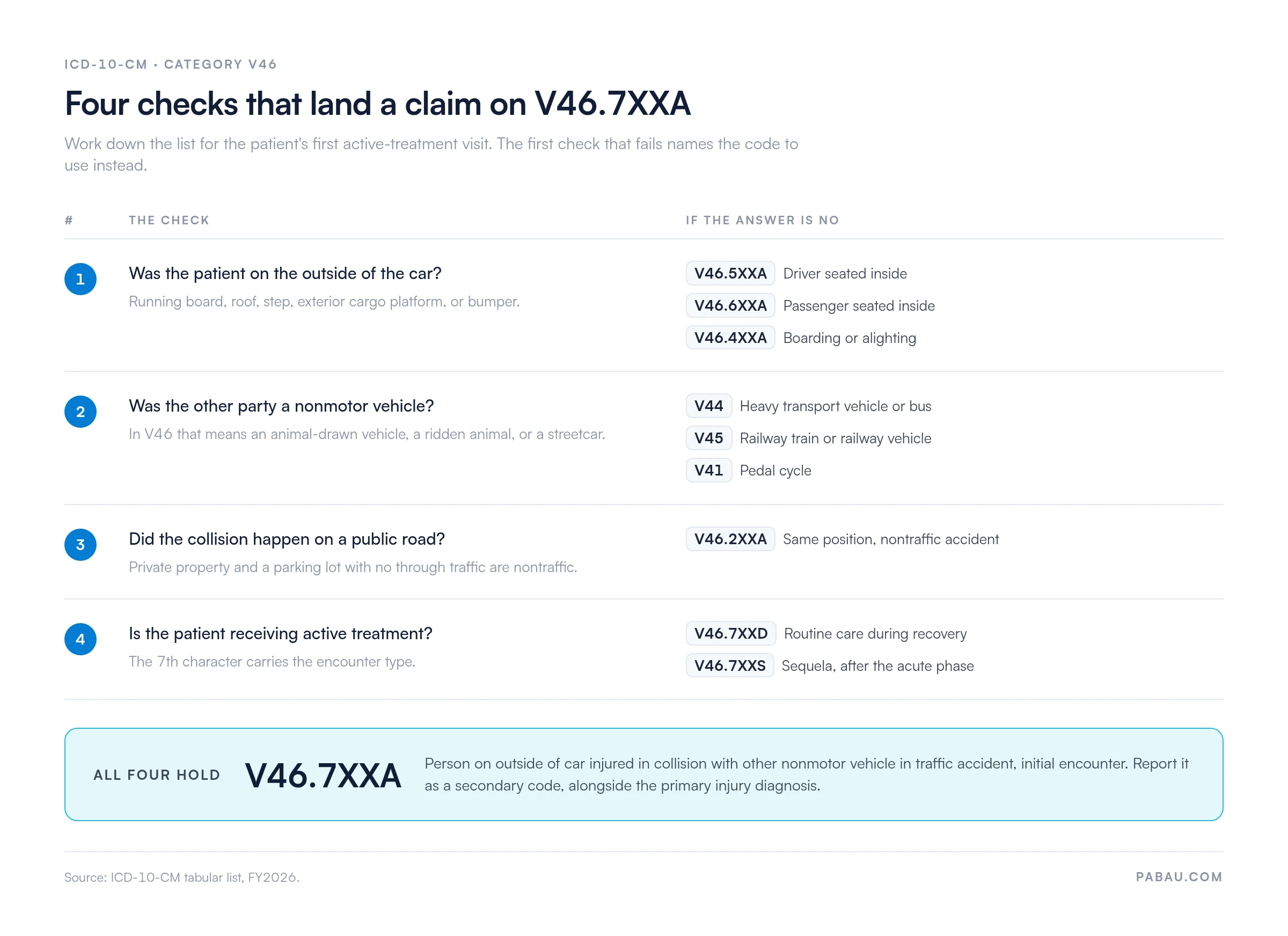
Here is a worked example. A patient arrives at the ED after riding on the exterior step of a car. That car struck a horse-drawn carriage on a public road. The physician documents a clavicle fracture and road-rash abrasions. The coder assigns the fracture and abrasion codes first, then appends V46.7XXA as the external cause code for this initial visit. An orthopedic follow-up two weeks later, with no new active intervention, takes V46.7XXD.
A pedestrian on foot hurt by an animal-drawn vehicle falls outside V46 altogether. Code that patient to V06.90XA at the initial encounter when the record leaves traffic status unstated.
Document the patient’s exact position on the vehicle and name the other party in the collision. Payers reviewing external cause codes can request the record to confirm that V46 was the right category at all. A note reading ‘fall from vehicle’ tells a reviewer nothing. Write ‘patient was riding on the exterior step when the car struck a horse-drawn carriage’ and the code defends itself.
Coders searching the ICD-10-CM alphabetic index may reach V46.7XXA through several wordings. These all describe the same clinical circumstance.
All of these resolve to the same code. Any wording that names a motorized collision partner, such as a bus or a heavy truck, points somewhere else in the V40-V49 block. Check the index entry against the CDC NCHS ICD-10-CM tabular list before you commit the code.
Within V46, the code you need depends on where the occupant was and whether the crash happened in traffic. The table below lists the initial-encounter form of every V46 subcategory.
The choice between V46.7XXA and V46.9XXA matters for claim accuracy. Payers can request supporting documentation to verify the coded position. Use the unspecified code only when the record genuinely does not say where the patient was.
Every category in the V40-V49 block uses the same subdivision pattern. The .7XXA ending always means a person on the outside of the car, in a traffic accident, at the initial encounter. Only the category digit changes with the other party involved.
Reading the categories side by side is the fastest way to avoid the V44 and V46 swap. Confirm the collision partner in the record before you settle on a category.
Those categories all assume the patient was on or in the car. At the initial encounter, a driver or passenger of the heavy transport vehicle takes V69.9XXA when the traffic accident type is undocumented.
V46.7XXA has been valid within ICD-10-CM since the code set was adopted in the United States. The descriptor and billable status carry into fiscal year 2026 unchanged. The CMS ICD-10-CM annual updates page is the authoritative source for fiscal year validity and descriptor changes. Verify against the current tabular list before each October 1 update.
Bookmark the CDC NCHS ICD-10-CM release page and the CMS fiscal year schedule to catch descriptor or validity changes effective October 1. Practices that hold their code list in one system can update it centrally, rather than relying on individual reference books.
External cause codes travel on claims as secondary diagnosis codes. On an electronic claim, V46.7XXA sits in a secondary diagnosis field on the 837P or the 837I. Send it without a primary injury code and the payer rejects the claim. The visit then joins the appeals queue instead of the payment run.
Practice management software like Pabau submits CMS-1500 claims to thousands of US payers through its Claim.MD clearinghouse integration. Pabau checks patient eligibility using 270 and 271 transactions before the visit, and validates membership and authorization details. It then tracks claim status and posts electronic remittance advice as payers respond.
Diagnosis code selection stays with the coder. The integration moves the claim and reports what the payer did with it, so accuracy on V46.7XXA still comes from your own review. Routing trauma claims through claims software for practices means a rejection shows up on the status report within days. A coding error caught that early never becomes an appeal.

Pabau submits your CMS-1500 claims through the Claim.MD clearinghouse, checks eligibility before the visit, and tracks status and remittance in one place.

Accurate use of ICD-10 Code V46.7XXA turns on three checks. First, the patient was on the exterior of the car. Second, the other party was a nonmotor vehicle on a public road, which in V46 means an animal-drawn vehicle, a ridden animal, or a streetcar. Third, this was an initial encounter with active treatment. A bus or a heavy truck sends the claim to V44 instead.
Pabau sends your coded claims to the Claim.MD clearinghouse. It tracks eligibility, status, and remittance in one place, so a rejection reaches you while you can still act. To see how that fits your billing workflow, book a demo.

Need to understand how denial codes affect your trauma claims? Denial management in healthcare covers the most common reasons external cause code claims are rejected and how to appeal them effectively.
Want to see how Pabau handles claim submission end to end? What is revenue cycle management walks through the full billing cycle from code assignment through payment posting.
Worried about how an encounter type holds up in an audit? Medical billing compliance sets out the documentation checks that keep a coded claim defensible when a payer asks for the record.
V46.7XXA is the billable ICD-10-CM code for a person on the outside of a car hit by a nonmotor vehicle in traffic. The 7th character A marks the initial encounter. In category V46, a nonmotor vehicle means an animal-drawn vehicle, an animal being ridden, or a streetcar.
Yes. V46.7XXA is a fully billable, specific ICD-10-CM code valid for fiscal year 2026 HIPAA-covered transactions. It must be submitted as a secondary code alongside the primary injury diagnosis code.
The 7th character A indicates an initial encounter, meaning the patient is receiving active treatment for the injury. Use V46.7XXD for subsequent routine-care visits. Use V46.7XXS for sequela, when you are documenting late effects after the acute phase has resolved.
That belongs to V44, not V46. V44.7XXA covers a person on the outside of a car injured in a traffic collision with a heavy transport vehicle or bus. V46 is reserved for nonmotor collision partners, so a bus or truck never falls under it.
ICD-9-CM was retired for HIPAA-covered US claims on October 1, 2015, so current billing needs no conversion. For legacy records, map the code through the CMS General Equivalence Mappings rather than a published shortcut. Confirm the ICD-9 E-code description matches the documented collision before you rely on it.