

ICD-10 Code S42.444P: Medial epicondyle fracture, right humerus
ICD-10 Code S42.444P: full descriptor and code validity ICD-10 Code S42.444P car...

Last Updated: Oct 13, 2026
Billable Code Specific Code
V72.7XXA is the billable ICD-10-CM code for a person on the outside of a bus injured in collision with a two- or three-wheeled motor vehicle. It applies to traffic accidents only, and the 7th character A marks the initial encounter.
The code describes someone positioned outside the body of the bus, such as a person riding the running board or hanging from a door. A bus occupant seated inside takes a different V72 subcode. V72.7XXA is an external cause code, so the injury diagnosis is always sequenced ahead of it.
Let Pabau's smart automation suggest the right codes, reduce claim denials, and keep your practice compliant—effortlessly.
Automate repetitive tasks and focus on what matters most—your patients.
Reduce coding errors and ensure compliance with the latest regulations.
Clean claims, fewer denials, and faster reimbursements.
Powerful insights and reporting to help your practice thrive.
HIPAA compliant SOC 2 certified GDPR-compliant Trusted by 4,000+ clinics worldwide

V72.7XXA covers a person on the outside of a bus, struck by a two- or three-wheeled motor vehicle in traffic.
The code is billable and valid for FY2026 claim submission.
The 7th character A marks the active treatment phase, not the first calendar visit to a provider.
V72.7XXA is never sequenced as the principal diagnosis, because the injury code always comes first.
Report the Y92, Y93, and Y99 companion codes whenever the record documents them.
Use the table below to confirm the core facts about ICD-10 code V72.7XXA before you assign it. Every field reflects the FY2026 ICD-10-CM tabular list published by CDC/NCHS.
Practice management software like Pabau keeps the same reference inside its claims management software, so coders check a descriptor without leaving the claim.
A person on the outside of a bus is someone not seated inside the passenger or driver compartment. ICD-10-CM covers riders on the running board, people hanging from a door handle, and anyone standing on a rear step. It does not cover bus drivers, passengers seated inside, or unspecified occupants.
The collision must involve a two-wheeled or three-wheeled motor vehicle, and both fall under the single V72.7 subcode. Motorcycles, motor scooters, mopeds, motorized tricycles, and three-wheeled all-terrain vehicles all qualify. A collision with a four-wheeled passenger car falls under V73 instead.
The code applies only to traffic accidents, meaning an accident on a public road open to traffic. An identical collision on private property is a non-traffic accident with its own code. That covers a parking lot, a warehouse yard, or a farm track. Confirm the accident location in the medical record before you assign V72.7XXA.
The ICD-10-CM tabular list attaches instructional notes to the V70-V79 block that govern how these codes interact with others. The notes decide which block a bus-related injury belongs in, so read them before assigning V72.7XXA.
The Excludes1 note on minibus injuries is the one that matters most in practice. If the record describes a minibus, code from V50-V59, occupant of pick-up truck or van, rather than from the V70-V79 bus block. V71 is a different code altogether. It covers a bus occupant injured in a collision with a pedal cycle.
The 7th character in V72.7XXA records the phase of care, not the number of visits. The ICD-10-CM Official Guidelines define an initial encounter as one where the patient is still receiving active treatment.
A patient can attend a fifteenth physical therapy session and still be coded A, provided that treatment targets the original collision injury.
The move from A to D happens when the treating clinician documents that active treatment has concluded. It is not tied to a fixed number of visits. Look for discharge language, a transfer to rehabilitation, or a note placing the patient in the recovery phase.
Selecting the 7th character is the highest-volume error on this code family. Work through three questions before you assign it.
The chart below maps the three characters onto the run of encounters that a single collision generates.
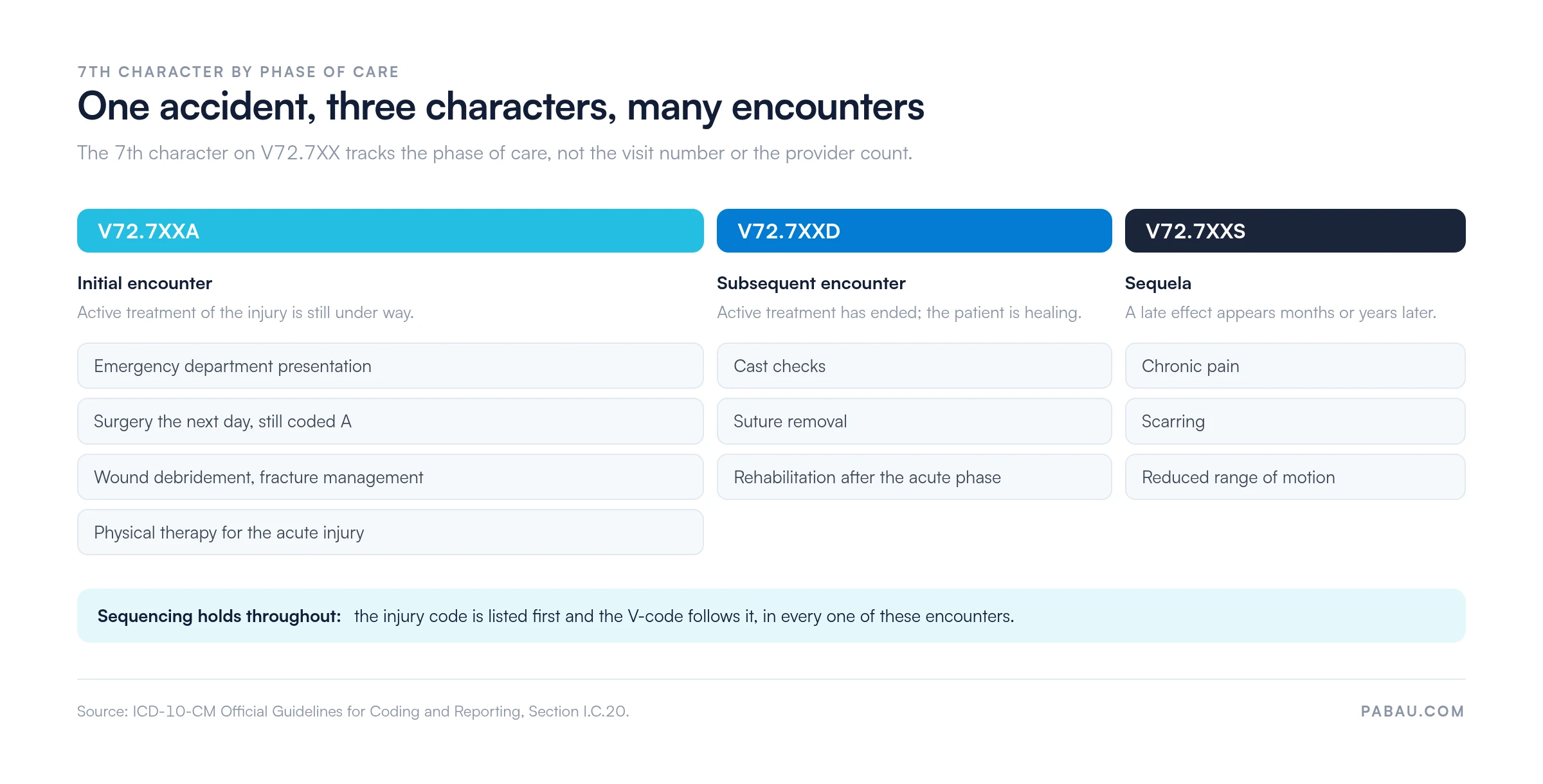
Coders sometimes switch from A to D after the emergency department visit, treating the ED as the initial encounter. That reading is wrong. A patient admitted for surgery the next day is still coded A, and the character holds through every active-treatment encounter.
V72.7XXA is one of nine subcodes in the V72 category, and V72 itself sits inside the wider V70-V79 bus block. The table below maps the codes most often confused with it.
The V73.7XXA comparison is the most audit-sensitive. Use V72.7XXA when a motorcycle, moped, or scooter struck the bus, and V73.7XXA when the striking vehicle was a car, pickup, or van. Both codes describe a person on the outside of a bus, so the collision partner is the only differentiator.
V72.9XXA covers an unspecified bus occupant, but it still assumes the striking vehicle was a two- or three-wheeled motor vehicle. When the record names neither the occupant’s position nor the striking vehicle, the bus-occupant sequela code is V79.60XS.
ICD-9-CM did not carry the occupant-role granularity that ICD-10-CM introduced. The approximate crosswalk maps V72.7XXA to the ICD-9-CM range covering bus occupant injuries in motor vehicle traffic accidents. No one-to-one equivalent exists, because ICD-9-CM had no “person on outside” sub-classification.
Payers running legacy claim audits or coordination-of-benefits investigations may ask for a documented crosswalk. Flag the conversion as approximate in the record when you convert a legacy claim. The AAPC code lookup returns crosswalk results for a specific claim context.
V72.7XXA fails at audit when the medical record cannot support what the code asserts. The note must confirm four elements.
External cause documentation follows one pattern across the V00-Y99 block. The record must support every element the code asserts. Query the treating provider whenever one of the four elements above is absent or ambiguous.
Run the documentation checklist at the point of coding, not at the point of billing. Three questions do the work. Does the record name the patient’s position on the bus? Does it identify the striking vehicle as two- or three-wheeled? Does it confirm a public road? If any answer is no, query the provider before you submit.
V72.7XXA is an external cause code. It explains how an injury happened and never replaces the injury diagnosis. Structure the claim in the order below to avoid a payer rejection.
Payers reject claims when companion codes are missing, because the claim reads as incomplete. Submitting V72.7XXA without an injury code in the first position is the most common V-code denial trigger.
On an 837P professional claim, the format supports up to 12 diagnosis code pointers per claim line. Companion codes take additional pointer positions and never displace the injury code.
Claims carrying V72.7XXA are denied more often for structural coding errors than for clinical reasons. Five patterns account for most rejections.
Medicare and many commercial payers treat any code from the V00-Y99 block as a flag for auto liability investigation. The claim may be pended while the payer decides whether auto insurance pays first. That hold is a coordination-of-benefits step rather than a denial of the code itself.
Remittance advice for these rejections often carries CARC 4 for coordination of benefits, or CARC 96 for a non-covered charge. Read the denial codes against the claim structure before you appeal, because a sequencing fix usually resolves it.
When a claim is pended for MSP investigation rather than denied outright, do not recode. The V-code is correct. Submit the coordination-of-benefits questionnaire, identify the primary payer, and resubmit with the MSP data. Recoding to avoid the V-code creates a different problem, namely inaccurate external cause reporting.
A sequencing error usually surfaces after the payer returns the claim. The external cause code goes out in the first position, the claim clears the practice, and the rejection lands two weeks later. By then the coder has moved on to another batch.
Pabau runs that check before submission instead. Its claims tools validate the diagnosis order on every line. A claim whose first-listed code comes from V00-Y99 is held until an injury code leads it. Missing Y92, Y93, or Y99 companion codes are flagged in the same pass.
Pabau also routes 837P claims through the Claim.MD clearinghouse to thousands of US payers, with eligibility checks and electronic remittance advice in the same workflow. Coders read the rejection reason against the claim they built, so the correction takes one pass.

Pabau integrates with Claim.MD to validate external cause codes and flag missing companion codes. Claims reach thousands of US payers without stopping in the rejection queue.

The position qualifier is what makes V72.7XXA narrow, and a narrow code is only as good as the note behind it. When a record says only “passenger”, query the provider before you assign a position-specific code.
Sequencing is the other half of the job. An injury code leads, V72.7XXA follows, and the companion codes fill the remaining pointers. Practices that build that order into the claim rather than the appeal spend far less time on coordination-of-benefits holds.
Book a demo to see how Pabau checks diagnosis order before a V-code claim leaves the practice.

Coding another bus occupant injury? ICD-10 code V77.1XXD covers a passenger inside a bus in a nontraffic collision with a fixed object, on a subsequent encounter.
Working through a rejection on a V-code claim? Denial management in healthcare covers CARC interpretation, appeal workflows, and how to cut first-pass rejection rates.
Submitting 837P claims from a US practice? Claim.MD clearinghouse explains how claims are routed to thousands of US payers and how remittance advice comes back.
Want fewer first-pass rejections overall? What a clean claim is sets out the fields a payer accepts without raising a query.
V72.7XXA is the billable diagnosis code for a person on the outside of a bus. The collision must involve a two- or three-wheeled motor vehicle in a traffic accident. The 7th character A marks the initial encounter. It is an external cause code that documents the circumstances of the injury rather than the injury itself.
Yes, V72.7XXA is a valid, billable ICD-10-CM code for FY2026 submissions. It cannot be submitted as the sole or primary diagnosis. The specific injury code must accompany it in the primary position.
Use V72.7XXA while the patient is still receiving active treatment for injuries from the bus collision. Use V72.7XXD once active treatment is complete and the patient is in the healing or follow-up phase. The switch is determined by the treating clinician’s documentation, not by the number of visits attended.
The 7th character A indicates an initial encounter, meaning the patient is in the active treatment phase. It does not mean the first calendar visit. A patient can receive treatment across several weeks and still be coded A, as long as clinical management of the original injury continues.
The injury diagnosis code is always sequenced before V72.7XXA. Companion codes include Y92.xx for place of occurrence, Y93.xx for activity, and Y99.xx for external cause status. Report each of them when the medical record documents the relevant information.
Most denials follow four patterns. The code is submitted as the primary diagnosis, or no injury code accompanies it. Other denials follow a wrong 7th character, or missing auto liability coordination-of-benefits data. Correcting the code sequence and submitting MSP questionnaire data resolves the majority of these rejections.




