ICD-10 code S61.201A: Open wound of left index finger without nail damage
ICD-10 code S61.201A covers a left index finger wound of unstated type ICD-10 co...

Last Updated: Oct 16, 2026
Billable Code Specific Code
V19.60XS is the billable ICD-10-CM code for an unspecified pedal cyclist injured in a collision with unspecified motor vehicles in a traffic accident, sequela.
The 7th character S means the code applies to a late effect once the original injury has healed, not the initial encounter. Traffic means the collision happened on a public highway; the nontraffic counterpart is a separate code, V19.20XS, and as an external cause code, V19.60XS is never submitted on its own.
Let Pabau's smart automation suggest the right codes, reduce claim denials, and keep your practice compliant—effortlessly.
Automate repetitive tasks and focus on what matters most—your patients.
Reduce coding errors and ensure compliance with the latest regulations.
Clean claims, fewer denials, and faster reimbursements.
Powerful insights and reporting to help your practice thrive.
HIPAA compliant SOC 2 certified GDPR-compliant Trusted by 4,000+ clinics worldwide

ICD-10 Code V19.60XS is a billable sequela code for an unspecified pedal cyclist hit by an unspecified motor vehicle in a traffic accident
Traffic means the collision happened on a public highway, and the nontraffic counterpart is a separate code, V19.20XS
The 7th character S means sequela, so the code is correct only when the visit treats a late effect of a past collision
V19.60 is non-billable on its own, and the X placeholder in position 6 is required to reach the 7th character
Pabau’s claims management software submits external cause codes and tracks their status through the Claim.MD clearinghouse integration
ICD-10 Code V19.60XS covers an unspecified pedal cyclist injured in a collision with unspecified motor vehicles in a traffic accident, sequela. Specifically, traffic means the collision happened on a public highway. The S in the seventh position marks a late effect, so the code applies once the original injury has healed.
The code is billable and has been valid for submission since October 1, 2015. Even so, it is never submitted on its own, because an external cause code always follows the principal diagnosis that names the sequela condition.
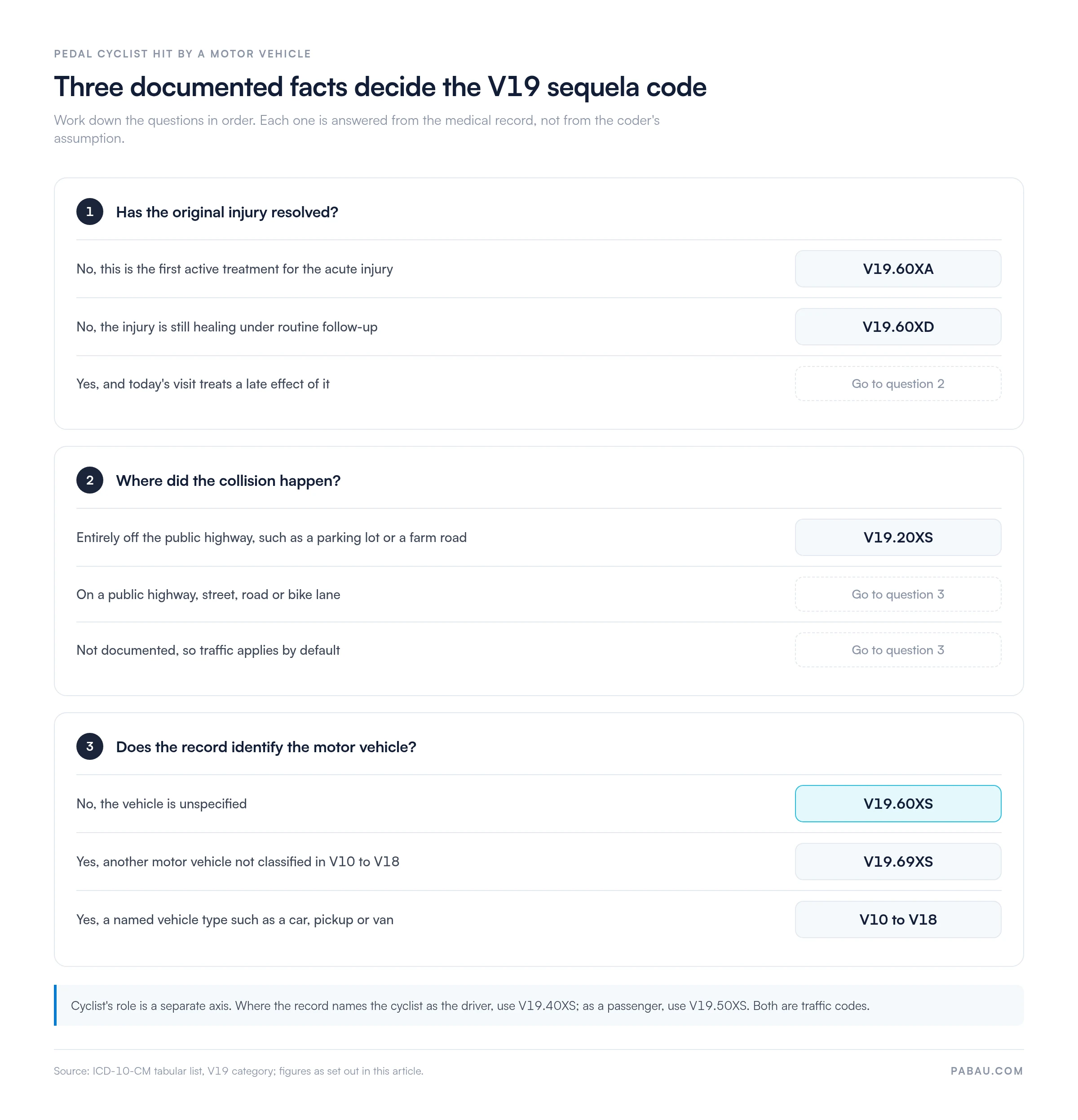
Three documented facts settle the choice: whether the original injury has resolved, where the collision happened, and whether the record identifies the vehicle. Accordingly, the sections below work through each one, plus the code hierarchy, the applicable-to notes, and the sibling codes.
ICD-10 Code V19.60XS describes an unspecified pedal cyclist injured in a collision with unspecified motor vehicles in a traffic accident, sequela. According to the CDC/NCHS ICD-10-CM web tool, this code is valid for submission and has been billable since October 1, 2015.
In fact, the word unspecified does double duty in that descriptor. Specifically, it covers a cyclist whose role as driver or passenger is not documented, and it covers a motor vehicle the record never identifies.
Because V19.60XS is an external cause code, it does not stand alone. The ICD-10-CM Official Guidelines for Coding and Reporting (Section I.C.20) require a principal diagnosis code alongside it. That code names the sequela condition itself, such as chronic pain, scarring, or a neurological deficit left by the collision.
Each segment of V19.60XS carries a distinct clinical and structural meaning. As a result, misreading any component leads to the wrong code selection, or to a claim that bounces at the payer.
The X placeholder is a structural requirement, not a clinical classification. Consequently, without it, the code cannot reach the 7th character position and becomes non-billable. For instance, omitting the X and writing V19.60S is a common transcription error. In practice, it produces an invalid code, and claim scrubbers reject it before adjudication.
V19.60 has three billable child codes, each distinguished only by the 7th character. Therefore, choosing the wrong one changes what the encounter claims to be, because A, D, and S describe three different clinical contexts.
The distinction between D and S often trips up newer coders. Specifically, subsequent encounter (D) covers care during the healing phase of the original injury. Sequela (S) applies only after the original injury has healed, once a new condition has emerged as a direct consequence.
So if the patient is still recovering from the collision wounds, D is correct. Conversely, if the wounds have healed and the patient now presents with a lasting complication, S applies.
A sequela is a condition that arises as a direct late effect of a prior injury, after that injury has fully resolved. In short, what decides the S suffix is the status of the original injury. Time elapsed does not enter into it, so a recent collision and a decade-old one are coded the same way once the injury has healed.
A practical two-question test for deciding between D and S:
Common sequela conditions documented after bicycle collision injuries include complex regional pain syndrome, post-traumatic osteoarthritis, peripheral nerve damage, and scarring with functional limitation. When documenting any of these, V19.60XS is paired with the specific sequela diagnosis code as the principal diagnosis. According to CMS ICD-10-CM guidelines, the external cause code is sequenced after the code for the nature of the sequela.
The same sequencing holds across every other sequela family in the chapter. To put it another way, the late-effect condition is the principal diagnosis, and the external cause code with the S suffix supplies the etiology.
Document the causal relationship explicitly. The medical record must state that the current condition (e.g. chronic pain, nerve damage, arthritis) is a direct result of the prior bicycle collision. A vague note saying ‘history of bike accident’ does not establish the sequela relationship needed to support V19.60XS at audit.
V19.60XS sits in the traffic half of the V19 category. Its parent subcategory, V19.6, reads “in traffic accident”, so every code beneath it describes a collision on a public highway. Otherwise, a collision that happened entirely off the highway belongs to a different subcategory.
ICD-10-CM treats a traffic accident as any vehicle accident occurring on a public highway. Indeed, that takes in an accident that starts on the highway, ends on it, or involves a vehicle partly on it. In contrast, a nontraffic accident is one that occurs entirely somewhere other than a public highway.
Overall, V19 splits cleanly along that line. As a result, miscoding it can hold up payment, because liability documentation often turns on whether the collision counted as a traffic event.
The nontraffic counterpart of V19.60XS is V19.20XS. Same cyclist, same unidentified motor vehicle, same sequela encounter, but the collision happened off the public highway. Choosing between the two comes down to one documented fact, which is where the collision took place.
External cause codes also divide by which road user was hurt, not only by setting. When a motorcycle strikes someone on foot in a nontraffic accident, the initial encounter is coded V02.00XA.
By comparison, the fifth character carries a separate distinction, and location plays no part in it. V19.60 is used when the motor vehicle is unspecified, and V19.69 when the record identifies another motor vehicle. Either way, both are traffic codes.
That default matters. ICD-10-CM assumes a transport accident happened on the public highway unless the record places it somewhere else. So if the documentation is silent on location, V19.60XS is the correct sequela code. Even so, a provider query is still worth raising when the circumstances look off-road.
In sum, those three facts settle the code between them, and they have to be read in order.
V19.60XS sits at the bottom of a six-level hierarchy within the V00-Y99 External Causes of Morbidity chapter. In practice, reading each level helps coders reach the correct code without leaning on keyword search tools. In fact, those tools sometimes surface the non-billable parent instead of the specific child.
V19.60 without the X placeholder and S suffix is non-billable. Accordingly, claims submitted with V19.60 alone are rejected. In addition, the hierarchy also shows why a coder cannot use V19 or V19.6 as a catch-all. Those parent levels exist only to organize the tabular list and carry no billing authority of their own.
The ICD-10-CM tabular list includes official “Applicable To” notes that define the scope of this code. According to the AAPC ICD-10-CM code reference, V19.60XS applies to encounters involving:
Electric bicycles and motorized scooters may fall under different code categories. Their classification depends on applicable state law and the ICD-10-CM guidelines in effect for the fiscal year. Accordingly, when documentation describes a motorized or electric-assist bicycle, verify code applicability against the current-year tabular list before assigning V19.60XS.
No ICD-10-CM Excludes1 or Excludes2 note specific to V19.60XS prohibits use with the diagnosis codes that usually accompany it. Code-also notes at the V19 category level do require any associated injuries to be coded separately. Notably, sequelae from multiple injury sites each receive their own diagnosis code alongside V19.60XS.
Most code references stop at the description and the hierarchy. In truth, documentation is where claims for V19.60XS are won or lost at audit. Once a claim has been adjudicated, reversing it is slow work, and the payer’s denial codes only name which element was missing.
To support V19.60XS, the medical record must establish four things:
Submitting V19.60XS without these four elements creates an audit vulnerability. For this reason, practice management software like Pabau connects to the Claim.MD clearinghouse, which runs eligibility checks and scrubs claims for format and payer-rule errors before submission.
No clearinghouse reads the clinical note or confirms that the codes match it, so the causal documentation stays with the practice. Where these pairings are billed at volume, claims management software is what keeps the coding consistent between providers.

A clean claim for V19.60XS carries two coding elements and the record behind them. The sequela diagnosis code comes first as the principal diagnosis, and V19.60XS follows as the external cause secondary code. In addition, the record then has to satisfy each of the four requirements above.
Indeed, missing the principal diagnosis pairing is itself a denial trigger, because external cause codes cannot stand alone on a claim.
V19.60XS belongs to a family of codes covering pedal cyclist injury scenarios. Generally, coders cross-reference these when the documentation names a nontraffic setting, a different cyclist role, or a collision with a specific vehicle type.
When the record identifies the specific motor vehicle, a more specific code from the V10-V18 range is preferred over V19.60XS. In short, V19.60XS is appropriate only when the vehicle type is genuinely unidentified or unspecified in the documentation. Use the AAPC ICD-10-CM code lookup to confirm sibling code validity for the current code year before finalizing the selection.
When documentation says ‘unknown vehicle’ and puts the collision on a street or road, V19.60XS is correct. When it names the vehicle, such as a car or a pickup truck, move to a more specific code in V10-V18. Unspecified describes a vehicle that genuinely cannot be identified, not a default for cases where nobody looked up the specific code.
The sequela pairing is usually rebuilt by hand at every encounter. A coder reads the note, picks the principal diagnosis, then attaches V19.60XS behind it. Eventually, the patient returns for the same late effect six months later, and a different coder starts again from the narrative.
Pabau stores diagnosis codes on the client record rather than on a single claim. The pairing used at the last visit is on screen when the patient comes back. The second coder can see exactly what the first one submitted. Claims then go out through the Claim.MD clearinghouse, which checks eligibility and scrubs for format and payer-rule errors.
The outcome is fewer pairings rebuilt from memory and fewer denials that trace back to a missing principal diagnosis. Even so, the causal sentence still belongs to the treating provider, and no software writes it for them.

Pabau connects to the Claim.MD clearinghouse for real-time eligibility checks and claim scrubbing before submission. See how Pabau keeps sequela claims moving and cuts preventable denials.

V19.60XS is a narrow code doing one specific job. Specifically, it says the late effect treated today traces back to a bicycle collision on a public highway, with a vehicle nobody could name.
The judgment worth keeping is that the code follows the record, never the other way round. In other words, where the note does not place the collision, traffic is the default and V19.60XS stands. In that case, where the note puts it in a parking lot, the code changes to V19.20XS and no amount of clinical detail rescues it.
So the work sits in the note rather than in the code lookup. Ask for the causal sentence while the provider still remembers the visit. Book a demo to see how Pabau keeps external cause pairings and their documentation together across encounters.

Coding another pedal cycle sequela? ICD-10 code V10.5XXS applies the same S-suffix rules to a passenger struck by a pedestrian or an animal in traffic.
Submitting external cause codes through a clearinghouse? Medical claims clearinghouse guide explains how a clearinghouse scrubs, formats, and routes claims before they reach payers.
Want to understand what happens after a sequela claim is denied? Denial management in healthcare walks through the appeal and resubmission process for external cause code denials.
ICD-10 Code V19.60XS is a billable ICD-10-CM code for the sequela of a bicycle collision on a public highway. Specifically, the full descriptor is unspecified pedal cyclist injured in collision with unspecified motor vehicles in traffic accident, sequela. The 7th character S means the current visit treats a late effect of the collision rather than the injury itself.
V19.60XS is a traffic accident code. Its parent subcategory V19.6 covers collisions in traffic accidents, which ICD-10-CM defines as accidents on a public highway. Conversely, the nontraffic counterpart is V19.20XS, used when the collision happened entirely off the highway.
Bicycle accident external cause codes fall within the V10-V19 range of ICD-10-CM. V10-V18 cover collisions with specific identified vehicle types, and V19 covers collisions with other and unspecified vehicles. The correct code depends on the vehicle involved, whether the accident was a traffic or nontraffic event, and the cyclist’s role. Furthermore, driver, passenger, and unspecified rider each map to a different subcategory.
Both codes cover an unspecified pedal cyclist injured in a traffic accident, sequela. V19.60XS applies when the motor vehicle involved is not specified in the record. In contrast, V19.69XS applies when the record identifies another motor vehicle that is not classified elsewhere in V10 to V18.