ICD-10 Code Y76.0: Diagnostic obstetric and gynecological devices
ICD-10 Code Y76.0: Definition and billable status ICD-10 Code Y76.0 is a valid, ...

Last Updated: Oct 23, 2026
Billable Code Specific Code
V00.382D is the billable ICD-10-CM code for pedestrian on other flat-bottomed pedestrian conveyance colliding with stationary object, subsequent encounter.
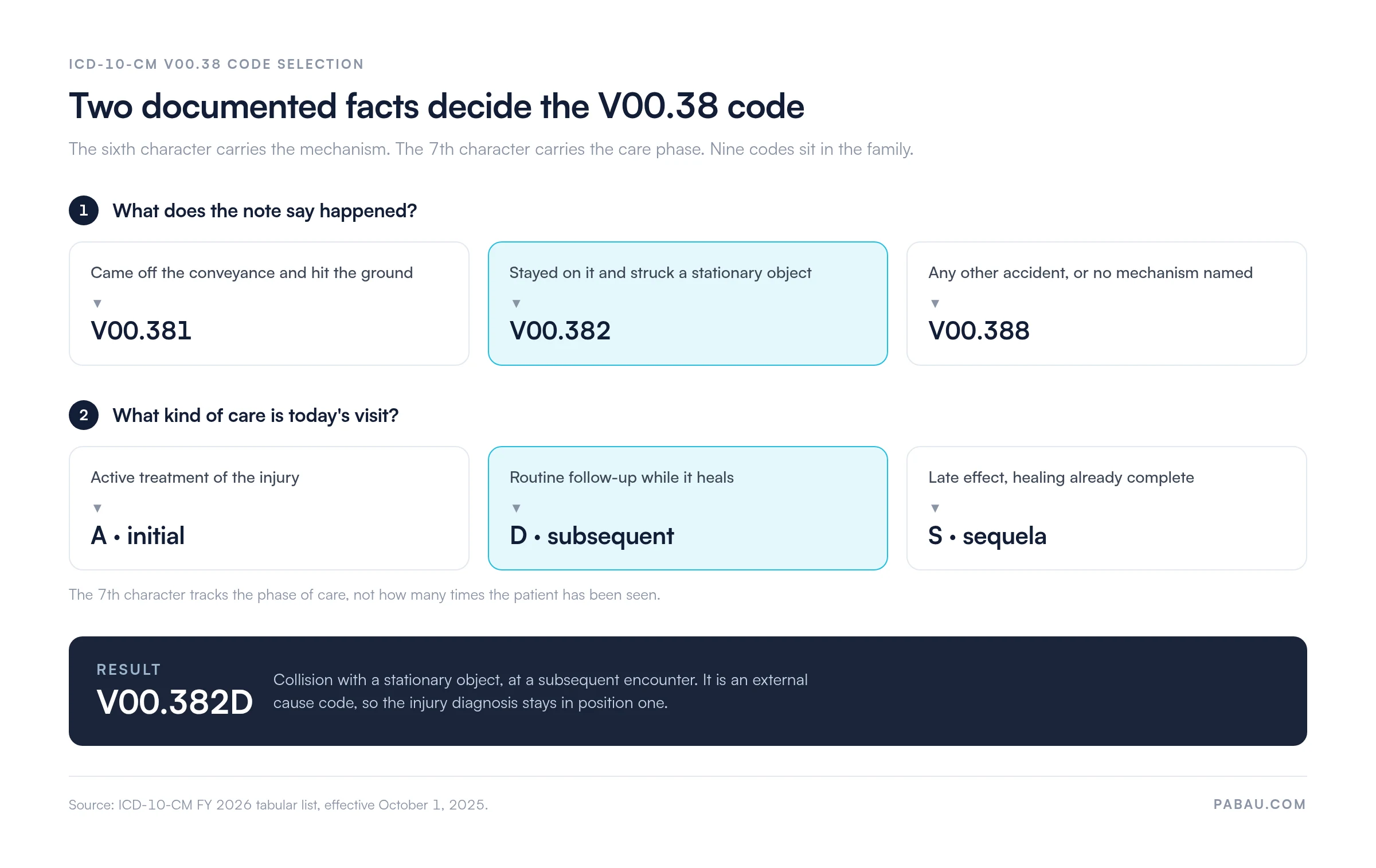
The mechanism decides the sixth character. V00.381 covers a fall from the conveyance, V00.382 a collision with a stationary object, and V00.388 any other accident. Mixing up the first two is where most V00.38 claim errors begin.
Let Pabau's smart automation suggest the right codes, reduce claim denials, and keep your practice compliant—effortlessly.
Automate repetitive tasks and focus on what matters most—your patients.
Reduce coding errors and ensure compliance with the latest regulations.
Clean claims, fewer denials, and faster reimbursements.
Powerful insights and reporting to help your practice thrive.
HIPAA compliant SOC 2 certified GDPR-compliant Trusted by 4,000+ clinics worldwide

ICD-10 code V00.382D covers a pedestrian on another flat-bottomed conveyance who collided with a stationary object, at a subsequent encounter
The 7th character D means the patient is back for routine follow-up care of a healing injury, not active treatment
Pick V00.381 for a fall from the conveyance, V00.382 for a collision with a stationary object, and V00.388 for any other accident
V00.382D is a billable ICD-10-CM code valid for HIPAA-covered transactions in the FY 2026 edition, effective October 1, 2025
It is an external cause code, so it never leads a claim: the injury diagnosis goes in position one
Pabau’s claims management software and Claim.MD clearinghouse integration help practices submit these external cause codes accurately
V00.382D is current in the FY 2026 ICD-10-CM edition, which took effect on October 1, 2025. The table below captures the billing and classification details.
Each segment of the code carries a specific clinical meaning. Breaking it down removes the ambiguity coders run into when choosing between sibling codes.
Flat-bottomed does not mean wheeled. Devices that run on wheels or rollers, including skateboards and roller-skates, belong to the rolling-type family at V00.1. Devices that glide on blades or runners, such as ice-skates and sleds, sit under V00.2. V00.38 is left for flat-based sliding devices the classification does not name individually.
The stationary object is the other half of the code. It can be a tree, a fence post, a wall, a barrier, or a parked car. The object only needs to have been still at the point of impact. If the patient struck a moving land transport vehicle, the case leaves V00 entirely and moves to the V01-V09 block.
Documentation systems and coders sometimes describe the code differently. Wordings like “flat-bottomed conveyance rider struck fixed object, follow-up” and “non-motorized conveyance collision with stationary object, subsequent visit” point to this same code.
A conveyance that no V00 subcategory names moves to V00.89 instead. For a late effect of that stationary-object collision, the code is V00.892S.
The 7th character is where most V00-series coding errors originate. ICD-10-CM requires coders to select from three options for external cause injury codes, and each has a precise clinical meaning.
One misconception comes up repeatedly. “Subsequent encounter” describes the type of care, not the number of visits. A patient can carry several initial-encounter (A) claims while active treatment continues. The shift to D happens once the care becomes routine follow-up of a healing injury.
Add one required field to your follow-up note template that makes the clinician pick the care phase, active treatment or routine follow-up during healing. That single field settles the 7th character at submission, with no extra coder review.
Tracing the path from the parent chapter down to V00.382D confirms the coder has the most specific code available. The chapter it sits in is given over entirely to external causes of morbidity, which are always supplementary to a principal diagnosis. Every family in the ICD-10-CM code set is built on the same descent, from chapter to block to billable code.
V00.382D belongs to a nine-code family that shares the V00.38 parent. Three mechanisms each take three 7th characters. Picking the wrong combination is a common validation error on flat-bottomed conveyance claims, and the table below shows all nine.
Both V00.38 and V00.382 are non-billable category headers. V00.382D is the correct billable choice when the notes describe a collision with a stationary object and the visit is routine follow-up care. Confirm the mechanism in the clinical record before assigning the code.
The sixth character carries the mechanism, and it separates the three code families. The diagram below pairs each mechanism with the 7th character that goes with it. The list underneath gives the wording to look for in the note.
A fall that follows a collision is the one case worth a clinician query. If the patient hit a post and then fell, the record should say which event caused the injury being treated. Code the mechanism the documentation supports rather than defaulting to the fall.
Payers auditing V00.382D claims look for specific documentation elements. Missing any one of them can flip a claim from paid to denied. Building these six fields into the follow-up visit note template cuts the manual coder review that follows.
Practices using practice management software like Pabau can build these prompts into the follow-up note itself. The mechanism and the care phase are then on record before the claim is generated.
Three worked examples show where V00.382D applies and where a sibling code fits better. Each pairs the external cause code with a principal injury diagnosis at the matching encounter stage.
The CMS ICD-10-CM guidelines set five firm rules for external cause codes like V00.382D. Breaking one of them at the claim level almost always ends in a denial.
Rejections on external cause codes usually trace back to sequencing errors or 7th character mismatches. A clean claim on a follow-up visit carries the injury code, V00.382D, and the same 7th character on both.
Five errors account for most V00.382D rejections. A pre-submission check catches the sequencing problems. The rest come down to how carefully the note was read.
Knowing when a code was introduced or revised matters for appeals and retrospective audits. V00.382D has been in the code set since ICD-10-CM went live in the United States, so date-of-service rejections on this code are rare.
The AAPC Codify ICD-10-CM lookup lists V00.382D as a current, valid, billable code for fiscal year 2026. It shows no revision or retirement notice against the code in the FY 2026 edition.
The claim carries an injury diagnosis in position one and V00.382D in a secondary diagnosis field. Both codes take the same 7th character. A clearinghouse that validates external cause sequencing before submission catches the mismatch while it is still cheap to fix.
Practices submitting on CMS-1500 or 837P should pre-populate the principal injury code alongside the external cause code. That removes the most common error on follow-up visits, which is sending V00.382D with nothing in front of it.
Run a monthly claim audit filtering for V00-series external cause codes submitted without a paired principal injury diagnosis. These claims look billable in the system but hit the payer with a sequencing error. Catching them pre-submission saves the resubmission cycle entirely.
In most billing teams a sequencing error surfaces only after the payer sends the claim back. The claim looked complete in the system, the external cause code was valid, and the rejection lands weeks later with a thin reason code.
Pabau’s claims management software checks ICD-10-CM validity and flags sequencing conflicts before anything leaves the practice. Its Claim.MD integration supports CMS-1500 and 837P formats and processes electronic remittance advice. Your billing team sees why each claim was accepted or denied without calling the payer.
On follow-up visits that means fewer resubmission cycles, and a shorter review queue for whoever owns your V00-series claims.

Pabau integrates with Claim.MD to validate ICD-10-CM codes before submission, reducing denials from sequencing errors and 7th character mismatches. See how the workflow fits your practice.

V00.382D comes down to two decisions. The sixth character says the patient collided with a stationary object rather than falling. The 7th character says the visit is routine follow-up care. Get both right, keep the code behind an injury diagnosis, and the claim clears.
The trade-off worth remembering is where the effort goes. One query to the clinician about the mechanism costs less than a resubmission cycle, and the note is the only place that answer lives.
Book a demo to walk through the V00-series claim workflow with your billing team.

Need guidance on ICD-10-CM billing submission workflows? Claim.MD clearinghouse overview explains how electronic claim submission and remittance processing works end to end.
Want to reduce external cause code claim denials? Denial codes in medical billing covers the most common rejection reasons and how to address them before resubmission.
Looking for a structured approach to ICD-10 billing compliance? Medical billing compliance outlines documentation standards and audit preparation steps for external cause codes and injury claims.
ICD-10 code V00.382D is the billable ICD-10-CM code for a pedestrian on another flat-bottomed pedestrian conveyance colliding with a stationary object, at a subsequent encounter. The “D” 7th character means the patient has finished active treatment and is attending routine follow-up care while the injury heals.
Yes. V00.382D is a specific, billable ICD-10-CM code valid for HIPAA-covered transactions. It is current in the FY 2026 edition, which took effect on October 1, 2025. The code has been in the set since ICD-10-CM was implemented in the United States.
The sixth character carries the mechanism. V00.381 is a fall from another flat-bottomed pedestrian conveyance, where the patient came off the device and hit the ground. V00.382 is a collision with a stationary object, where the patient stayed on the device and struck something that was not moving.
Initial encounter (7th character A) is used while the patient is actively receiving treatment for the injury. Subsequent encounter (7th character D) applies once treatment becomes routine follow-up during healing or recovery. The distinction rests on the type of care at that visit, not the number of times the patient has been seen.
Use 7th character D when the patient is presenting for routine care of a healing or recovering injury. That covers a wound check, a cast change, a physical therapy review, or a medication adjustment after the initial treatment phase. Both the injury code and the external cause code should carry the same 7th character at the same encounter.
V00.382D sits in a nine-code family under V00.38. Its siblings are V00.382A and V00.382S, which use the same collision mechanism at other encounter stages. V00.381A/D/S cover a fall from the conveyance, and V00.388A/D/S cover any other accident on it.
The immediate parent is V00.382 (pedestrian on other flat-bottomed pedestrian conveyance colliding with stationary object). Above it sit V00.38 and V00.3, the two flat-bottomed conveyance accident subcategories. Those roll up to V00 (pedestrian conveyance accident), inside the V00-V09 block and the V00-Y99 chapter.
No. V00.382D is an external cause code from ICD-10-CM Chapter 20, so it is always reported as a secondary diagnosis. The principal diagnosis has to be the injury being treated, such as a healing fracture, laceration, or contusion at the same encounter stage.