ICD-10 Code R63.4: Abnormal weight loss
ICD-10 code R63.4: Definition, billability and code structure ICD-10 code R63.4 ...

Last Updated: Nov 13, 2026
Billable Code Specific Code
V00.321A is the billable ICD-10-CM code for fall from snow-skis, initial encounter.
This code lives in Chapter 20 of ICD-10-CM (External causes of morbidity). It supplements the injury diagnosis code and is never sequenced first. Report it after the injury code. Add activity code Y93.23 for downhill skiing, or Y93.24 for cross-country skiing, plus a place-of-occurrence code when the record supports them. A fall from a snowboard takes V00.311A instead.
Let Pabau's smart automation suggest the right codes, reduce claim denials, and keep your practice compliant—effortlessly.
Automate repetitive tasks and focus on what matters most—your patients.
Reduce coding errors and ensure compliance with the latest regulations.
Clean claims, fewer denials, and faster reimbursements.
Powerful insights and reporting to help your practice thrive.
HIPAA compliant SOC 2 certified GDPR-compliant Trusted by 4,000+ clinics worldwide

V00.321A reports a fall from snow-skis at the initial encounter, while the patient receives active treatment for the injury.
It is a Chapter 20 external cause code, so it never leads the claim and always follows the injury diagnosis code.
A snowboard fall takes V00.311A, not V00.321A, so confirm the equipment in the record before you assign the code.
Pabau, the practice management platform we build, submits and tracks claims through Claim.MD, so your team can follow each ski injury claim after submission.
ICD-10 Code V00.321A identifies a fall from snow-skis as the external cause of an injury, at the initial encounter. The table below gives the reference data coders need before applying the code on a claim.
Per the CMS ICD-10-CM coding guidelines, external cause codes from Chapter 20 are supplemental codes applied alongside the injury diagnosis. They are never the reason for the visit and cannot stand alone on a claim.
V00.321A captures how the injury happened when a patient falls from snow-skis, at an encounter for active treatment. It does not describe the injury itself. The accompanying injury code does that, whether it is a fracture, sprain, contusion or head injury.
ICD-10-CM classes snow-skis as a pedestrian conveyance, so a ski fall sits in the transport accident block. That separates it from a fall on ice while walking (W00) and from a snowboard fall (V00.311A).
Breaking down V00.321A character by character helps coders select the right code the first time. The 7th character extension rules for external cause codes align with the CDC/NCHS ICD-10-CM tabular list, which coders should consult for the current fiscal year. Other injury and external cause codes in our ICD-10-CM code library follow the same character-by-character layout.
The 7th character follows the phase of care for the injury, not whether the provider is new to the patient. A patient in a cast at a follow-up visit is a subsequent encounter (D), even on a first visit with that provider.
V00.321A applies when the documented mechanism is a fall from snow-skis. It does not cover every fall on a ski slope or every winter sport injury.
The V00.3 subcategory covers several flat-bottomed pedestrian conveyances, including snowboards and snow-skis. Coders who rely on keyword searches rather than the tabular list hierarchy can select the wrong code. This table shows the key distinctions, cross-referenced against the AAPC ICD-10-CM code lookup.
The error to watch for is swapping skis and snowboards. A note that only says the patient fell on the slopes does not name the equipment, so query the provider before choosing V00.321A or V00.311A. A pedestrian who slips on ice near the lodge without skis on maps to W00.0XXA instead. The decision path below puts that equipment question first.
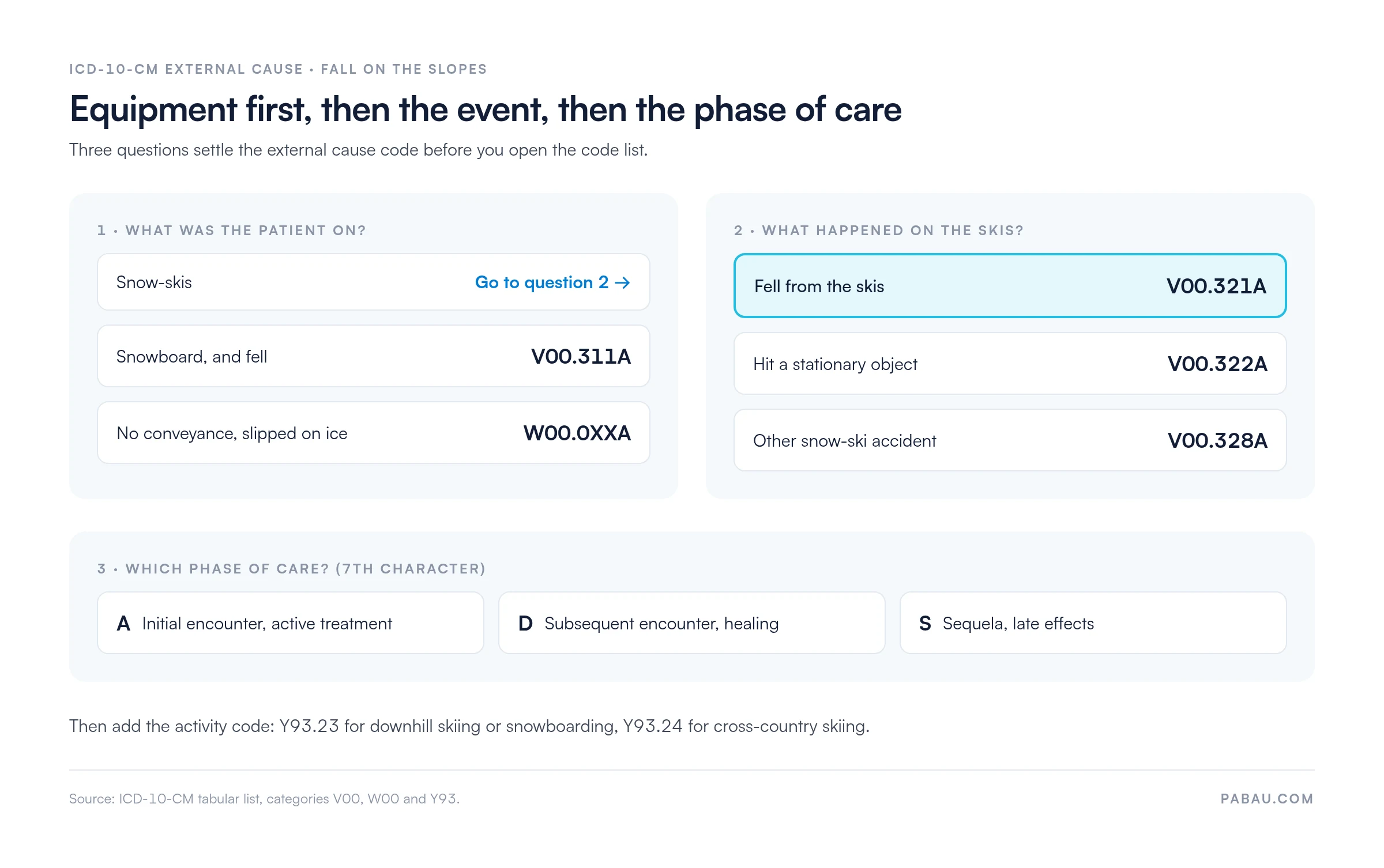
Check three points in the record before applying V00.321A. The patient was on snow-skis, the event was a fall rather than a collision, and the visit is for active treatment. If any one is missing, review whether a neighboring code fits the documented facts better.
V00.321A is never the principal or first-listed code. Per the ICD-10-CM Official Guidelines for Coding and Reporting, Chapter 20 codes supplement the injury diagnosis. They explain how the injury happened, not what the injury is.
The claim sequence for a skiing fall at an initial encounter is listed below. A clean claim lists each code type in this order when the record supports it.
Most recreational ski falls take Y99.8 as the status code, because the patient was skiing for leisure rather than for pay.
Pabau submits and tracks claims through Claim.MD, so your team can see where each ski injury claim stands after it leaves the practice. The coding decisions stay with your coders, so check the sequence above before the claim goes out.
The medical record must support each element of V00.321A before the code is assigned. Understanding medical billing fundamentals for external cause codes begins with what the chart needs to say.
If the record does not name the equipment, the coder cannot assume skis. Query the provider for clarification rather than defaulting to V00.321A.
External cause code requirements vary by payer type. Coders and billers should verify individual payer policies before assuming a universal rule applies.
Recreational injury claims can prompt liability and subrogation questions at commercial payers. A payer may ask whether a third party, such as another skier or a resort operator, is responsible for the costs. Document the mechanism clearly so those questions can be answered from the chart.
External cause codes produce a predictable set of coding errors. The table below lists the frequent ones for V00.321A and the fix for each. Practices with heavy winter-sports volumes can build these checks into their denial management workflows as standing pre-submission reviews.
Run a quarterly audit of your V00.321A claims against your clearinghouse denial reports. Look for snowboard falls coded as ski falls, external cause codes listed first, and the wrong 7th character. Each one is a coder habit, so a short, targeted team review fixes it.
Ski season brings a run of injury claims that each carry several codes. Your coders assign the injury code, V00.321A, Y93.23, and the place and status codes. Then someone has to submit each claim and follow it to payment.
Pabau’s claims management software submits those claims through Claim.MD and tracks each one after submission. Your billers can see which claims were accepted, which were rejected, and which still wait on a payer.
Coding decisions stay with your team. Pabau keeps the visit, the clinical note, and the claim on one patient record. A coder answering a query finds the documentation in one place.
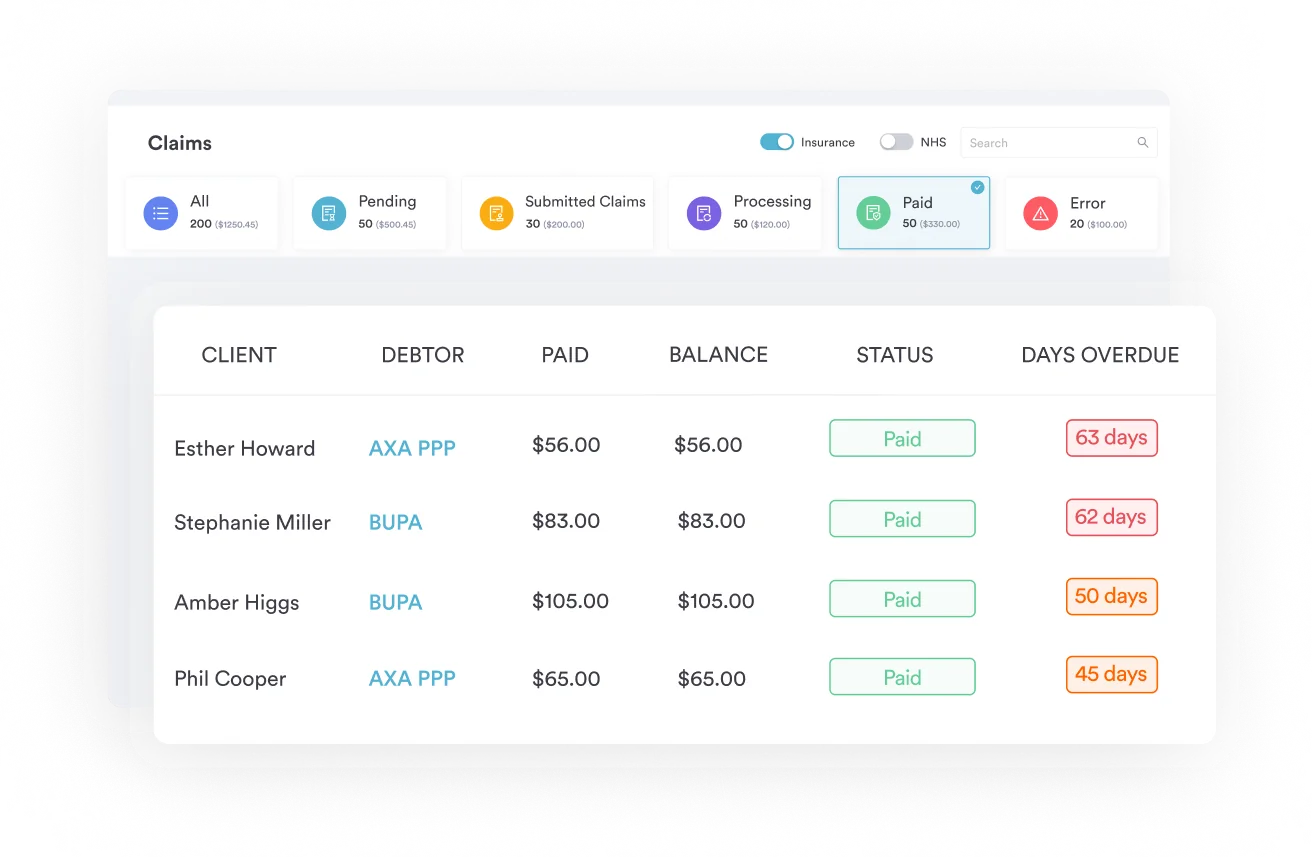

Pabau submits and tracks claims through Claim.MD, so your team can follow each injury claim after it leaves the practice. See how the claims workflow fits your practice.

V00.321A rewards one habit above the rest: read the equipment before you read the code list. Skis and snowboards sit side by side in V00.3, and their fall codes differ by a single digit.
Get the equipment right, keep the injury code first, and match the 7th character to the phase of care. Then add the activity, place and status codes where the chart supports them. Keeping the note and the claim on one record makes those checks faster. Book a demo to see how Pabau submits and tracks injury claims for sports medicine and orthopedic practices.

Want to see how claims move through a clearinghouse? The Claim.MD clearinghouse guide explains how Claim.MD routes claims to payers and reports their status back.
Looking for a primer on the full billing workflow around injury claims? What is revenue cycle management covers the end-to-end claim lifecycle from coding through payment posting.
Want to reduce denials across your coding team? Denial codes in medical billing breaks down the most common CARC codes and the corrective actions that resolve them.
ICD-10 Code V00.321A is the billable external cause code for a fall from snow-skis, initial encounter. It belongs to Chapter 20 of ICD-10-CM, External causes of morbidity. It is always sequenced after the injury diagnosis code, never as the principal or first-listed code on a claim.
The 7th character A marks an initial encounter, meaning the patient is receiving active treatment for the injury from the skiing fall. Use D for subsequent encounters during the healing phase and S for sequela visits that address late effects of the original injury.
All three codes describe a fall from snow-skis and differ only by encounter type. V00.321A applies during active treatment, V00.321D during healing or recovery, and V00.321S when the visit addresses a late effect. The mechanism stays the same, and only the phase of care changes.
A fall from a snowboard takes V00.311A, Fall from snowboard, initial encounter. Both codes sit in V00.3, flat-bottomed pedestrian conveyance accidents. V00.31 covers snowboard accidents and V00.32 covers snow-ski accidents, so confirm the equipment in the record before choosing.
V00.321A is an external cause code and is never used as a principal diagnosis or first-listed code. Per the ICD-10-CM Official Guidelines, Chapter 20 codes supplement the injury diagnosis by recording the mechanism. A specific injury code, such as a fracture or sprain, is always sequenced first.