ICD-10 code I50.20: Unspecified systolic heart failure
ICD-10 code I50.20 covers systolic heart failure with no stated acuity ICD-10 co...

Last Updated: Nov 12, 2026
Billable Code Specific Code
T86.831 is the billable ICD-10-CM code for bone graft failure. It applies when an autograft or allograft fails to incorporate into host bone, through non-union or resorption, and the physician documents that failure.
It sits in subcategory T86.83 with four sibling codes: T86.830 (rejection), T86.832 (infection), T86.838 (other complications) and T86.839 (unspecified). Mechanical complications of a graft code to T84.3- instead. Selecting the wrong sibling is a common cause of denials.
Let Pabau's smart automation suggest the right codes, reduce claim denials, and keep your practice compliant—effortlessly.
Automate repetitive tasks and focus on what matters most—your patients.
Reduce coding errors and ensure compliance with the latest regulations.
Clean claims, fewer denials, and faster reimbursements.
Powerful insights and reporting to help your practice thrive.
HIPAA compliant SOC 2 certified GDPR-compliant Trusted by 4,000+ clinics worldwide

T86.831 is a billable, six-character ICD-10-CM code for bone graft failure, with no 7th character required.
It covers failed autografts and allografts, while synthetic substitutes and devices are coded under T84.- instead.
Assign T86.831 only when the physician documents failure; rejection is T86.830, infection is T86.832, and other specified complications are T86.838.
Mechanical complications of a bone graft are coded under T84.3-, per the Excludes2 note at T86.83.
Pabau, the practice management platform we build, submits 837P claims through Claim.MD, runs eligibility checks and matches ERAs to claims.
ICD-10 Code T86.831 is the billable ICD-10-CM code for bone graft failure, meaning an autograft or allograft that does not incorporate into host bone. It is one of five codes under T86.83, and it is complete at six characters.
T86.831 covers a bone graft that has failed to incorporate into host bone. The graft does not unite with the surrounding bone, or it resorbs without new bone forming. This is a biological process, distinct from immune rejection.
The code applies to biologic grafts, whether autograft or allograft. Autologous cancellous bone from the iliac crest and cortical allograft from a donor both map to T86.831 when failure is documented. The tabular list does not split the code by graft source.
Clinical presentations that support T86.831 include:
What T86.831 does not cover: Immune-mediated rejection maps to T86.830, and infection at the graft site maps to T86.832. A documented complication that is none of these three maps to T86.838. Use T86.839 only when the record does not say which complication occurred.
Two kinds of failure leave subcategory T86.83 altogether. Mechanical complications of a bone graft, such as fracture or displacement, are coded under T84.3- per the Excludes2 note at T86.83. Synthetic bone substitutes and devices are not transplanted tissue, so their complications are coded under T84.- as well.
Subcategory T86.83 holds five codes: T86.830, T86.831, T86.832, T86.838 and T86.839. The table below maps each one to its clinical trigger and the documentation it needs.
Rejection and failure split on mechanism. Rejection is immune-mediated, while failure is a breakdown in incorporation. When a chart uses both terms loosely, query the treating physician before assigning either code.
The choice runs in three steps, and the first two route the claim out of T86.83 altogether.
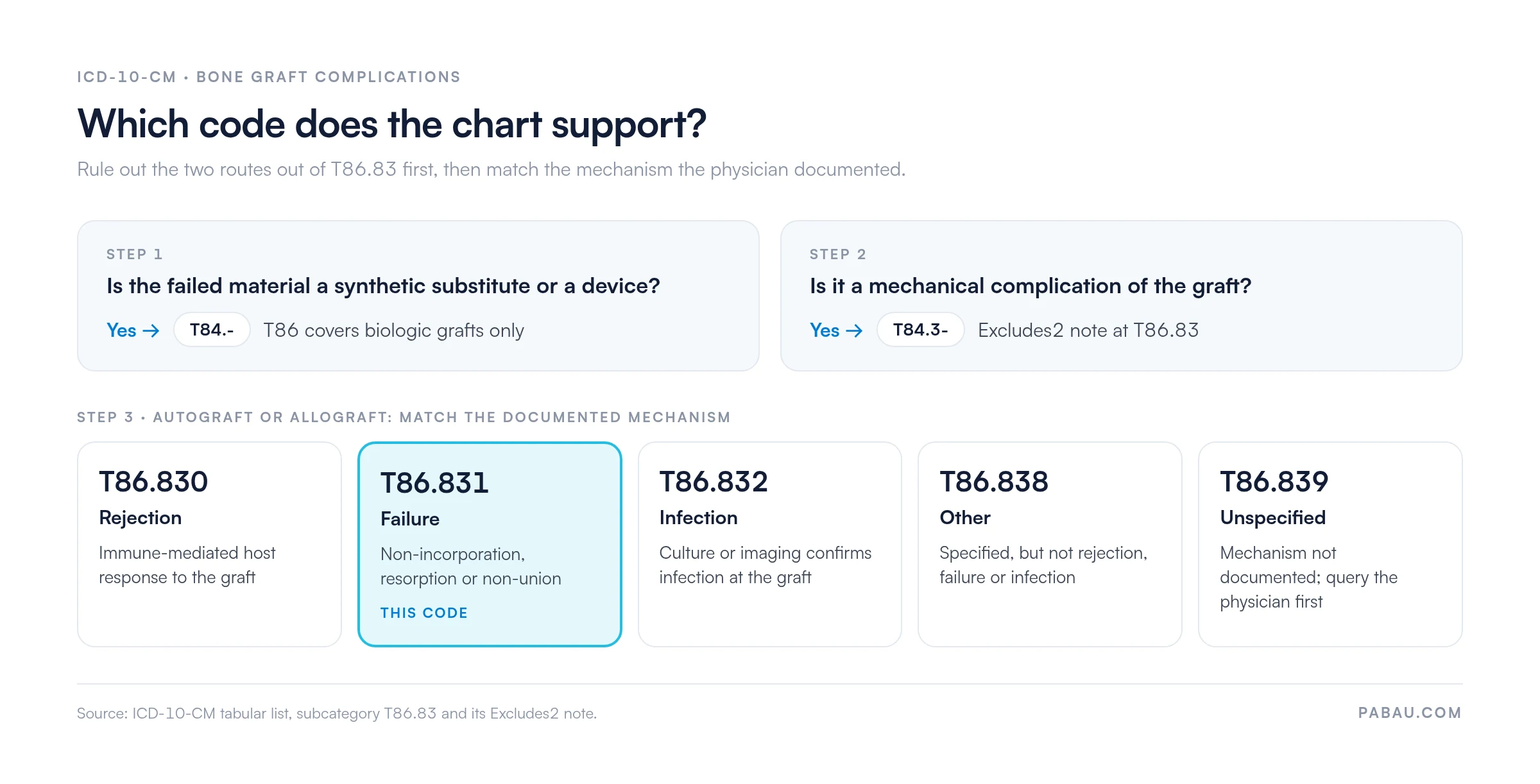
The parent-child path below is what a coder cites when a payer queries the code.
Chapter 19 placement tells the payer that the encounter concerns a complication of earlier surgical care. That context carries into the medical necessity review of any revision procedure.
The ICD-10-CM Official Guidelines for Coding and Reporting require the physician’s documentation to support the assigned code. For T86.831, the minimum record elements are:
T86.831 is complete at six characters. No 7th character extension table applies to this code. The initial/subsequent/sequela encounter logic that governs many Chapter 19 injury codes does not add a character to T86.831 itself.
Encounter type still matters for the claim. A first workup, ongoing management and a late effect each belong in the encounter documentation. The code itself stays the same. Your medical billing workflow must capture that visit context in the chart, because medical necessity review reads it.
Query the physician whenever the operative note documents graft complications without naming the mechanism. ‘Graft complication’ or ‘graft problem’ does not support T86.831. The note must separate failure from rejection, infection and mechanical complications before you code.
T86.831 is a diagnosis code, so it always appears alongside a procedure code on a claim. The most frequent pairings are revision or replacement grafting after a documented failure.
Payers running edit checks flag T86.831 when it appears without a clinically appropriate procedure code. Confirm the procedure-to-diagnosis pairing in the chart before the claim goes out.
Prior authorization rules for revision bone graft surgery vary by payer and plan. Medicare does not require prior authorization for most orthopedic revision procedures, but commercial and Medicare Advantage plans often do. Submitting T86.831 without confirming authorization status is an avoidable denial cause.
Run a prior authorization check for the revision procedure code during insurance eligibility verification. Catching a missing authorization before surgery avoids a larger denial afterward. Practices that bill electronically can run eligibility checks through Claim.MD, which connects to thousands of US payers. Where a payer requires enrollment, Pabau surfaces Claim.MD’s enrollment forms.
Claims carrying T86.831 are denied for predictable reasons, and each one has a specific prevention step. Our denial code reference explains the CARC and RARC codes a payer returns.
When a T86.831 claim is denied, start the denial management review by checking which T86.83 code the documentation supports. Then fix the physician query process upstream. Claim.MD returns 835 electronic remittance advice files, and Pabau matches each one to its claim. The CARC denial reason then shows in the patient’s billing record, with no manual payer portal lookup.
No. T86.831 covers failure of either biologic graft type, autograft or allograft. The tabular list does not subdivide the code by source, so the code is the same either way.
Document the graft source in the chart anyway, because it informs the revision plan and may affect payer coverage criteria. It does not change the ICD-10-CM code selection.
Check the Excludes notes at T86.83 in each fiscal year’s ICD-10-CM tabular list. The Excludes2 note sends mechanical complications of a bone graft to T84.3-. Use the official CDC or CMS release rather than a third-party lookup tool.
A T86.831 claim depends on work done before it is filed. The revision needs prior authorization, the patient’s coverage needs checking, and any denial needs reading against the chart.
In Pabau, the practice records the authorization code, dates and sessions on the patient’s case, with a warning when one is missing. Pabau’s claims software for practices submits 837P claims through Claim.MD, runs eligibility checks and matches ERAs to claims.
The revision claim goes out with its authorization on file. If it is denied, your billers can trace the denial to a specific CARC code.

Pabau’s claims management submits 837P claims through Claim.MD, runs eligibility checks and matches ERAs to claims. Authorization codes sit on the patient’s case, with a warning when one is missing.

T86.831 is right only when the physician has documented failure, as distinct from rejection, infection or a mechanical complication. The five T86.83 codes sit close together, and a short physician query costs far less than a denial cycle.
Build that check into the workflow before the claim is built. Confirm the graft was an autograft or allograft, rule out a T84.3- mechanical complication, then match the documented mechanism to its code.
Book a demo to see how Pabau keeps authorizations, eligibility checks and remittances for revision claims on one patient record.

Need to understand how claims move through a clearinghouse? Medical claims clearinghouse guide explains how 837P files are validated and routed to payers.
Building a denial resolution process for complication codes? Denial codes in medical billing covers CARC and RARC code interpretation for appeal workflows.
Want to understand the 837 file format before integrating with a clearinghouse? 837 file overview breaks down the electronic claim transaction structure.
ICD-10 Code T86.831 is the billable ICD-10-CM code for bone graft failure. It applies when an autograft or allograft fails to incorporate and the physician documents that failure. It sits in subcategory T86.83 in Chapter 19 and is valid for FY2026 and FY2027.
Yes. T86.831 is a billable, specific ICD-10-CM code at six characters. No 7th character is required, and the code can be a principal or secondary diagnosis depending on the encounter.
T86.830 is for immune-mediated rejection, where the host’s immune system responds against the graft tissue. T86.831 is for failure, where the graft does not incorporate, resorbs or does not unite, without evidence of rejection. Mechanical complications of the graft go to T84.3- instead. The physician must document which mechanism applies.
Yes. T86.831 applies to failure of both autografts and allografts, and the tabular list does not subdivide the code by graft source. The code stays the same whichever biologic graft failed.
A common reason is choosing the wrong T86.83 code, such as T86.830 or T86.832 when the chart documents failure. Missing physician attestation of failure, missing imaging and a mismatched procedure code also cause denials. On commercial and Medicare Advantage plans, a missing prior authorization for the revision is another frequent cause.
Yes, when the encounter is for evaluating or managing bone graft failure. When graft failure complicates an encounter for another reason, T86.831 is reported as a secondary code under ICD-10-CM sequencing guidelines.