

ICD-10 Code S42.444P: Medial epicondyle fracture, right humerus
ICD-10 Code S42.444P: full descriptor and code validity ICD-10 Code S42.444P car...

Last Updated: Oct 13, 2026
Billable Code Specific Code
T40.901S is the billable ICD-10-CM code for poisoning by unspecified psychodysleptics [hallucinogens], accidental (unintentional), sequela.
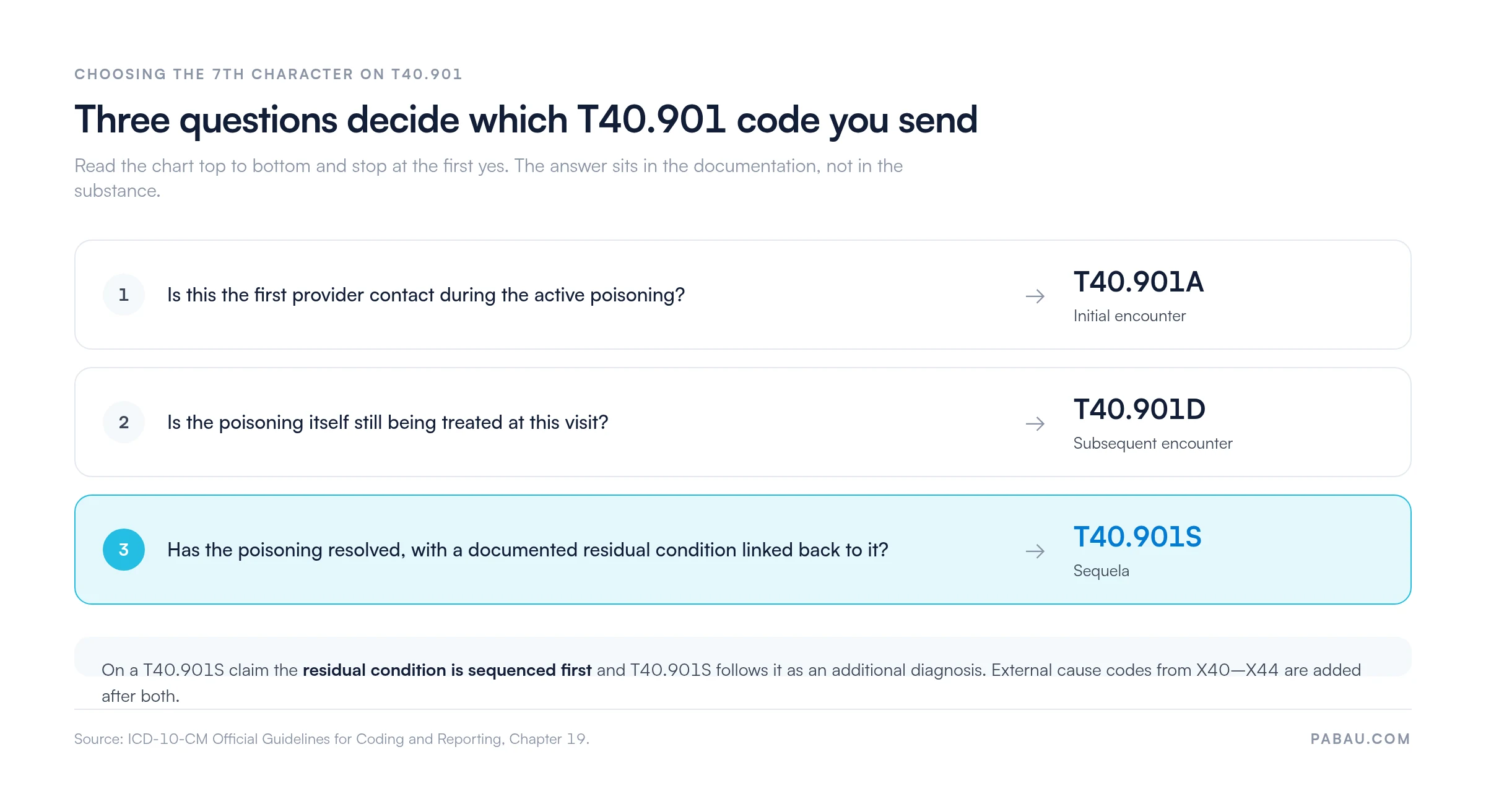
The sequela character applies only after the poisoning episode itself has resolved. T40.901A covers the first contact during the active event, and T40.901D covers follow-up while treatment continues. For T40.901S, the record must tie a current residual condition back to the earlier poisoning.
Let Pabau's smart automation suggest the right codes, reduce claim denials, and keep your practice compliant—effortlessly.
Automate repetitive tasks and focus on what matters most—your patients.
Reduce coding errors and ensure compliance with the latest regulations.
Clean claims, fewer denials, and faster reimbursements.
Powerful insights and reporting to help your practice thrive.
HIPAA compliant SOC 2 certified GDPR-compliant Trusted by 4,000+ clinics worldwide

T40.901S reports the residual effects of an accidental hallucinogen poisoning, not the poisoning event itself.
The 7th character S applies only once the poisoning episode has resolved and treatment for it has ended.
Sequence the residual condition first, then T40.901S as an additional diagnosis.
External cause codes from X40 to X44 are recommended companions, though payer requirements vary.
Hallucinogen use disorder belongs to the F16 series, and coding it here is a routine denial trigger.
ICD-10 code T40.901S is the billable diagnosis code for poisoning by unspecified psychodysleptics [hallucinogens], accidental (unintentional), sequela. It reports a residual condition left behind by an accidental hallucinogen poisoning that has already run its course.
The code is valid for the 2026 edition, effective October 1, 2025. The CDC/NCHS ICD-10-CM web tool lists it as a specific, billable code. Nothing more granular is needed before you put it on a claim.
Three attributes are packed into that descriptor. Substance class is unspecified psychodysleptics, intent is accidental, and encounter type is sequela. Each one has to be supported somewhere in the chart, and the third is where most of these claims come apart.
Each position in the code encodes one decision, and misreading a single position is the fastest route to a denial. The table below decodes them in order.
Character 6 already carries the intent, so no separate intent qualifier is needed. What the chart still has to do is rule out self-harm and assault, because the accidental designation rests on that.
When a provider documents self-harm instead, the intent character changes and so does the code. T38.5X2S carries that intent for estrogen and progestogen poisoning, still at the sequela stage.
The assault branch works the same way. T61.773S reports fish poisoning inflicted by another person, recorded at the sequela stage.
The 7th character tells the payer which phase of care the visit belongs to. Choose the wrong one and the claim contradicts the note, which is a routine rejection trigger on T40.9 codes.
A sequela is a condition that persists after the poisoning episode has closed. The poisoning is no longer the reason for the visit. The residual condition is, and Chapter 19 sequences the sequela code after that condition rather than before it.
Residual conditions after accidental hallucinogen poisoning include hallucinogen persisting perception disorder (HPPD) and persistent psychosis.
Cognitive dysfunction and mood or anxiety disturbance also qualify when they trace back to the poisoning. The treating provider has to document the condition. A coder cannot infer it from the visit narrative alone.
When the record leaves room for doubt, work the three questions below in order and stop at the first yes.
Psychodysleptics are substances that alter perception, mood, and cognition. ICD-10-CM treats “psychodysleptic” and “hallucinogen” as the same thing inside T40, which is why the descriptor carries both words.
The unspecified designation in T40.901S applies when the agent is not documented or cannot be determined. Where the substance is named, a more specific code usually exists, so check before you default to the unspecified option.
T40.9 is not an opioid code. Grouping T40.9x codes with the opioid poisoning codes at T40.0 through T40.6 is a substantive error. The two branches stay separate in every annual update file.
A named opioid takes its own subcategory. T40.422A reports tramadol poisoning by intentional self-harm at the initial encounter, so intent and encounter phase both differ from T40.901S.
Reading the tree from the top shows why unspecified is a last resort. Each level narrows the substance, then the intent, then the encounter, and only the bottom row is billable.
One question separates the three. Was the substance taken as a valid prescription directs? If it was, an adverse effect or underdosing code applies. If it was not, the encounter is a poisoning.
Intent in the chart drives the choice. Where the record says nothing about intent, the ICD-10-CM guidelines default to accidental rather than undetermined. Undetermined intent is held back for notes that state the intent could not be established.
Flag encounters where the provider notes are silent on intent, and query the provider before coding T40.901S. A documented “accidental” designation in the discharge summary or office note is the most audit-proof support this code can carry.
Six codes come up again and again beside this one. Keeping them in one reference cuts the cross-code confusion that slows a denial review down.
Chapter 19 puts the residual condition in the first-listed position and T40.901S after it. The sequela code is there to explain where the residual condition came from, so it supports the primary diagnosis rather than replacing it.
When one of these claims comes back denied, the cause is usually one of two things. Either the sequencing is inverted, or a companion code the payer wanted is missing. Both surface on the remittance rather than at submission, so a standing denial management review finds them faster than re-reading the claim form.
Three documentation elements hold this code up at audit. Practices that lose T40.901S claims on retrospective review are almost always missing one of them.
Practices that template these three checkpoints into the encounter note stop querying the provider after the fact. A structured intake that prompts for prior substance history, causal attribution, and current episode status gives the coder what they need the first time.
The first is reporting T40.901S while the poisoning is still being treated, which is T40.901D territory. The second is reaching for it on a hallucinogen use disorder visit, where the F16 series applies instead. Both are cheap to catch at coding and expensive to unpick after payment.
Chapter 19 governs every T40.9x code, and its sequencing rules produce most of the errors on sequela encounters. The CMS ICD-10-CM coding guidelines set out the following.
Behavioral health and addiction medicine practices meet T40.9x codes often enough that these rules belong in the written coding policy. Leaving them to memory is how the sequencing flips on a busy afternoon.
T40.9x codes do two jobs at once. They pay the claim, and they feed the national drug use datasets held by the CDC National Center for Health Statistics. A submitted T40.901S claim lands in hospital discharge data, emergency department databases, and vital statistics registries.
That gives miscoding a second cost. Using T40.901A on what is really a sequela visit inflates the count of active hallucinogen poisonings and shrinks the count of residual ones. Research indexed at NCBI has used T40.9 codes to classify psychodysleptic use in Medicare data. Claim-level accuracy reaches research-grade datasets more directly than most coders expect.
Coders searching by term rather than by number meet these variants in EHR and encoder software. All of them resolve to T40.901S.
None of them name a substance. Where the record does name one, check the more specific options in the ICD-10-CM code index before you fall back to the unspecified designation.
Audit the encounters you coded T40.901S where the clinical note names the substance. Documented specificity should have carried through to a more specific T40 child code. Defaulting to unspecified when a specific code existed is a common audit finding.
Most of the work above happens in two places that rarely talk to each other. The clinical note lives in the chart, and the diagnosis codes get keyed into a claim somewhere else. Every rekeying step is another chance for the sequencing to flip.
Pabau, a practice management software platform for medical and aesthetic practices, keeps both on one record. Codes are looked up and pulled from the encounter itself, and required fields are checked before the claim is released. Claims go out through the clearinghouse from the same screen, and remittances come back against the same invoice.
The encounter-type call still belongs to the coder and the note. Pabau’s claims management software handles the mechanical part around it. That means less retyping, fewer missing companion codes, and a remittance that lands against the right invoice.
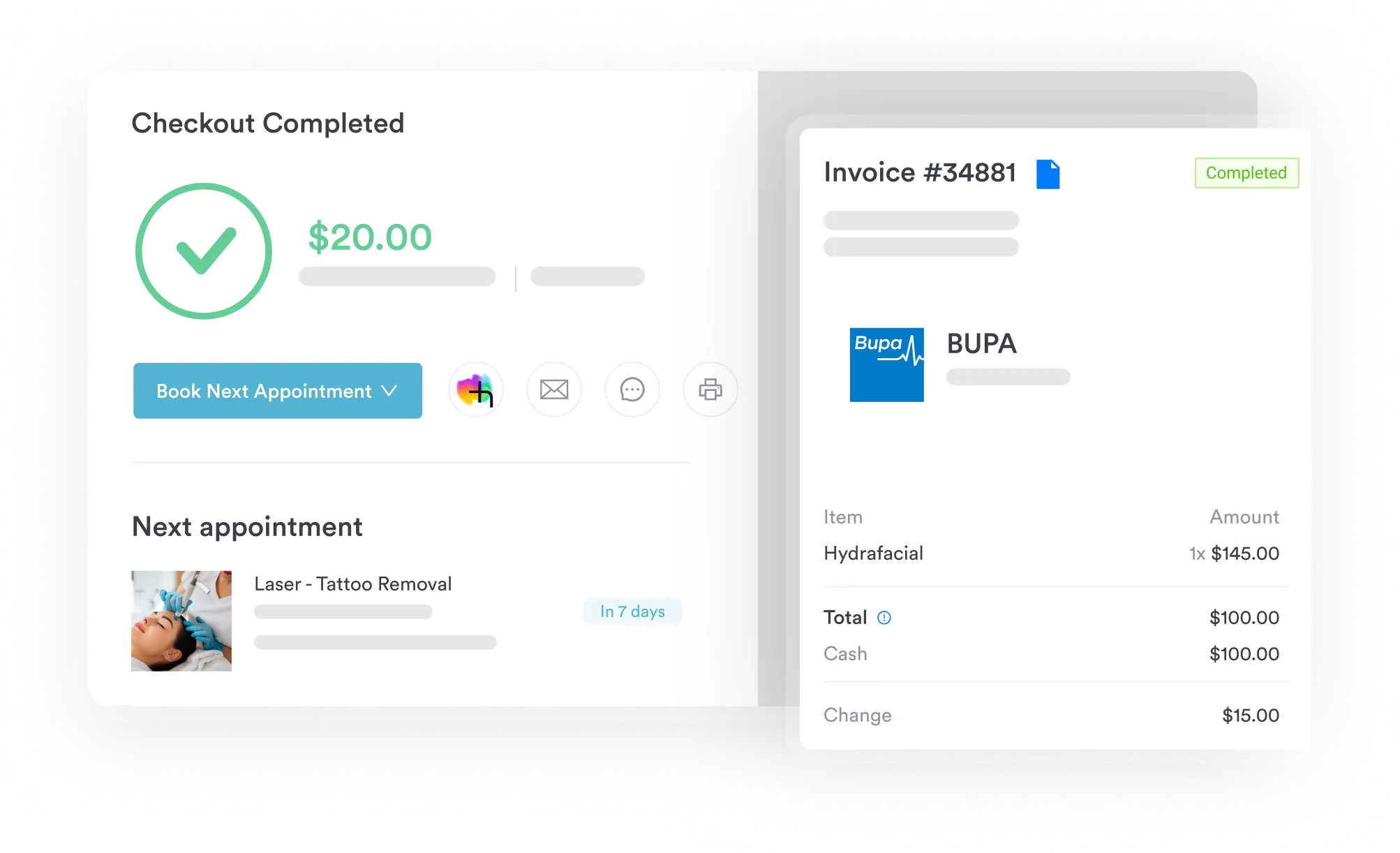

Pabau connects ICD-10 code lookup, claim submission, and remittance tracking on one patient record. See how it works for behavioral health and addiction medicine practices.

Assigning T40.901S takes seconds. Defending it takes documentation, because the chart carries every element that makes the code correct. A prior accidental poisoning, a current residual condition, and a provider statement joining the two.
Get the sequencing right and most of the trouble disappears. The residual condition leads, T40.901S follows, and the encounter type matches the phase of care the note describes. Practices that write those checks into the coding policy stop rediscovering them one denial at a time.
Book a demo to see how Pabau keeps the coded diagnosis, the claim, and the remittance on a single patient record.

Need a denial tracking workflow for T40.9x claims? Denial management in healthcare covers how to build a systematic denial review and appeal process for substance-related codes.
Want to understand how electronic claims move from submission to payment? Electronic claims clearinghouse explains how clearinghouse routing and remittance matching work for behavioral health practices.
Looking for revenue cycle guidance for addiction medicine billing? Revenue cycle management fundamentals covers the end-to-end process from code selection through payment posting.
No. ICD-10-CM sets no time limit on the sequela character. T40.901S applies whenever the residual condition is treated, whether that is two months or two years later. What matters is that the poisoning episode has ended and the record ties the current condition back to it.
Code the intent as accidental. The ICD-10-CM guidelines default to accidental intent when the record is silent, which keeps T40.901S in play. Undetermined intent, T40.904S, is held back for notes that state the intent could not be established. Query the provider first where a query is realistic.
Rarely. The residual condition code carries medical necessity for the service billed, and T40.901S explains where that condition came from. Payers read the first-listed diagnosis against the procedure, so an inverted sequence can fail a medical necessity edit even when both codes are correct.
No. Nothing is attached at submission. The prior episode still has to sit in the chart, because an audit or an appeal will ask for it. A line in the intake history, a previous encounter note, or a transfer record is enough.




