ICD-10 Code S02.602D: Fracture of mandible, subsequent encounter
ICD-10 Code S02.602D: Definition and billable status ICD-10 Code S02.602D is the...

Last Updated: Oct 8, 2026
Billable Code Specific Code
T40.496S is the billable ICD-10-CM code for underdosing of other synthetic narcotics, sequela.
The code never travels alone on a claim. You sequence the code for the sequela condition first, then T40.496S to identify what caused it.
Let Pabau's smart automation suggest the right codes, reduce claim denials, and keep your practice compliant—effortlessly.
Automate repetitive tasks and focus on what matters most—your patients.
Reduce coding errors and ensure compliance with the latest regulations.
Clean claims, fewer denials, and faster reimbursements.
Powerful insights and reporting to help your practice thrive.
HIPAA compliant SOC 2 certified GDPR-compliant Trusted by 4,000+ clinics worldwide

T40.496S is a billable ICD-10-CM code for underdosing of other synthetic narcotics, sequela, in effect since October 1, 2016.
The 7th character S marks a sequela encounter, used once the acute underdosing episode resolves and a late-effect condition persists.
Sequela coding takes two codes, with the manifestation sequenced first and T40.496S second to identify its cause.
Practice management software like Pabau ties diagnostic codes to billing workflows, so coders make fewer sequencing errors.
T40.496S is a billable, specific ICD-10-CM diagnosis code representing underdosing of other synthetic narcotics, sequela. It has been in effect since October 1, 2016 and remains current in the FY2026 edition, per the CMS ICD-10 codes and guidelines.
The code captures a late-effect encounter. The patient previously had subtherapeutic levels of a synthetic narcotic, that acute episode has since resolved, and a residual condition caused by it persists. The 7th character S is what signals sequela status to the payer.
T40.496S sits within the T40 category, which covers poisoning by, adverse effect of, and underdosing of narcotics and psychodysleptics. T40 itself falls under the broader T36-T50 block for poisoning by drugs, medicaments, and biological substances.
Within T40, the subcategories break out by drug class. T40.4 covers other synthetic narcotics and splits three ways: fentanyl, tramadol, and everything else in that class. The CDC/NCHS ICD-10-CM official tool shows the full tabular listing.
T40.49 is the parent for synthetic narcotics that are neither fentanyl nor tramadol. T40.496S is the sequela-specific underdosing code under that parent.
Underdosing occurs when a patient takes less of a prescribed medication than directed, leaving drug levels below the therapeutic range. ICD-10-CM treats it as its own coding category, separate from poisoning and from adverse effect.
Per the ICD-10-CM Official Guidelines for Coding and Reporting, underdosing is coded when the patient intentionally or unintentionally takes less medication than prescribed. Common causes include cost, deliberate refusal, and age-related difficulty with a dosing schedule.
When underdosing follows patient noncompliance, an additional Z-code from the Z91.1x series identifies the reason. Use Z91.12 for intentional underdosing of a medication regimen, or Z91.13 for unintentional underdosing. Both are parent codes, so add the 6th character that names the documented reason.
The 7th character is mandatory for T40.496x codes. Without it, the code is not billable. Each character signals a distinct encounter type to the payer, and picking the wrong one is a primary source of denials in this code family.
The distinction for S is that underdosing is no longer the active clinical issue. The patient has a residual condition, and that condition is the reason for the current encounter. Both T40.496S and a code for the sequela manifestation are required.
Per ICD-10-CM Official Guidelines Section I.C.19, a sequela is a condition caused by a previous injury or illness. It is coded once the acute phase has resolved. A complication during active treatment is a different scenario and takes a different 7th character.
Take a patient who underdosed a synthetic narcotic and had acute subtherapeutic effects. Months later they present with persistent pain or a neurological condition traced to that episode. That meets the sequela definition. The underdosing is resolved, but its consequence persists.
Code the sequela manifestation first, then T40.496S. Reversing the order is a common sequela coding error. The manifestation tells the payer what you are treating today; T40.496S tells them why.
The T36-T50 block carries excludes notes that govern what may sit alongside T40.496S on a claim. They are reproduced in the official tabular and in the AAPC ICD-10-CM code reference.
Excludes1 (cannot be coded together): toxic reaction to local anesthesia in pregnancy (O29.3-). An Excludes1 note means the two conditions cannot occur together, so they must never appear on the same claim.
Excludes2 (may be coded together): drug reaction and poisoning affecting the newborn (P00-P96), and pathological drug intoxication (F10-F19). An Excludes2 note means the condition is classified elsewhere but may coexist and be coded alongside T40.496S.
Block-level and category-level notes apply to every code beneath them, T40.496S included. Check the code, its category, and its block before you finalize the claim. Paraphrasing an exclusion from memory instead of reading the current tabular is a common source of errors.
These three intent categories govern the whole T40 chapter and drive code selection. Confusing them is the most consequential error a coder can make in this family, because each one leads to a different code.
The clinical documentation has to state the mechanism. “Patient not taking medication as prescribed” supports underdosing. “Patient took extra doses” is poisoning. A properly taken drug that caused a reaction is an adverse effect. Each pathway produces a different code.
Thin documentation is the main reason T40.496S claims are denied or flagged on audit. The record has to support every element of the code, from the drug class to the encounter type. Strong medical billing compliance starts with what the clinician writes at the point of care.
The note must establish a causal chain. The patient took less of a synthetic narcotic than prescribed, and drug levels fell below therapeutic range. The acute episode has since resolved, and the presenting condition follows directly from it. All four elements need to be in the record.
Correct sequela coding for this code follows a set order. Working through these steps reduces both denial risk and audit exposure.
The finished claim carries these lines, in this order.
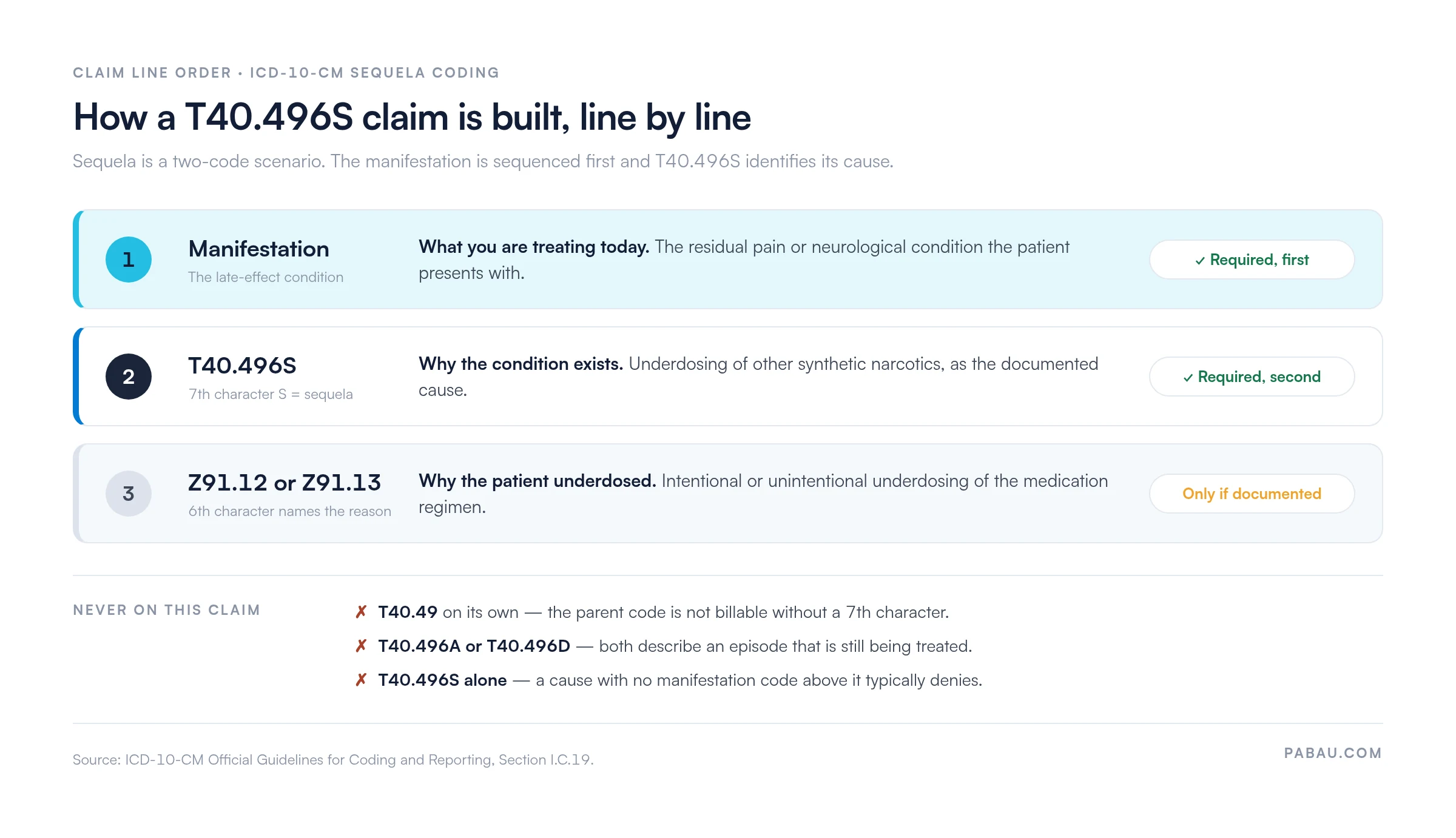
Never code T40.496S without a sequela manifestation code above it. Sequela is always a two-code scenario: the manifestation first, then the cause. A standalone T40.496S will typically deny.
The T40.49x family reads in two directions. You move across the A, D and S variants, then up through the parent code and sibling subcategories. The crosswalk below covers both.
Verify the drug class before defaulting to T40.496S. Methadone has its own T40.3x series. Within T40.4, only fentanyl and tramadol carry their own subcategories, so any other synthetic narcotic belongs in T40.49x. There is no T40.43x through T40.48x to reach for.
The tramadol subcategory then branches by intent and encounter character. T40.422A covers poisoning by tramadol with intentional self-harm as the documented intent, at an initial encounter rather than a sequela.
Most denials for T40.496S trace back to a handful of recurring mistakes. Catching them before submission is cheaper than appealing, and the denial codes payers return will usually tell you which one you made.
Manual code lookups add friction to a documentation workflow that is already crowded. Coders switch between a reference site and the practice management system, and sequencing errors creep into multi-code claims like this one.
Pabau is practice management software for healthcare practices, and its claims software for practices puts diagnostic coding inside the clinical note. Practitioners search and apply ICD-10-CM codes at the point of care, so the manifestation code and T40.496S get captured together instead of reconstructed later.
For US practices billing electronically, Pabau generates CMS-1500 claims from the invoices you already raise. Those claims go to thousands of payers through Claim.MD, its clearinghouse partner. Claim statuses and electronic remittance advice come back into the same system.
That closes the loop on coding quality. A sequela-without-manifestation denial lands next to the note that produced it. Your team can spot the pattern and fix it at source.

Pabau puts diagnostic code search inside your clinical documentation workflow. Book a demo to see how practices cut coding errors and submit cleaner claims.

T40.496S rewards precision in the note rather than speed at the code lookup. The 7th character, the two-code sequence, and the documented causal link are the three points where these claims fail.
Before you submit, read the record back and check three things. It names the synthetic narcotic, it states that the acute episode has resolved, and it ties the presenting condition to that episode. If any one is missing, the claim is an appeal waiting to happen.
Book a demo to see how Pabau keeps ICD-10 code selection, clinical notes, and claim submission in one place for your coding team.

Coding another sequela claim? ICD-10 code S65.503S applies the same two-code sequencing rules to an injury sequela.
Want the claim paid first time? What is a clean claim sets out the fields a claim must carry before it goes to the payer.
Building the superbill behind the claim? Superbill documentation requirements explains what clinical detail has to appear to support ICD-10 diagnosis codes.
T40.496S is a billable ICD-10-CM diagnosis code for underdosing of other synthetic narcotics, sequela. It applies when a patient took less of a synthetic narcotic than prescribed and that acute episode has resolved. The patient now presents with a late-effect condition caused by it. The code has been in effect since October 1, 2016 and remains current in the FY2026 edition.
T40.496A (initial encounter) is used when the patient is receiving active treatment for the underdosing episode. T40.496D (subsequent encounter) is used during routine follow-up care after the event. T40.496S (sequela) is used when the acute underdosing has resolved and the patient presents with a residual condition caused by it. Selecting the wrong 7th character is a primary source of claim denials in this code family.
Use the S 7th character once the acute phase of the original condition has resolved. The patient then presents with a residual condition caused by it. For T40.496S, that means the underdosing event is no longer active, but a consequence of it persists. Always code the sequela manifestation first, then T40.496S as the second code to identify the cause.
Yes, T40.496S is a billable, specific ICD-10-CM code valid for reimbursement purposes, including in the FY2026 edition. The parent code T40.49 is not billable. Only the 7th-character-extended codes (T40.496A, T40.496D, T40.496S) are valid for claim submission. A claim submitted with only T40.49 will be rejected as insufficiently specific.
Documentation must establish four elements. First, the patient took less than the prescribed synthetic narcotic dose. Second, the record names the specific drug class. Third, the acute underdosing episode has resolved. Fourth, the current late-effect condition follows directly from it. If noncompliance caused the underdosing, add Z91.12 or Z91.13 with the 6th character that names the documented reason.
Underdosing means the patient took less than the prescribed dose, resulting in subtherapeutic drug levels. Poisoning means too much drug was taken, the wrong drug was taken, or a drug was taken in error. Adverse effect means the drug was correctly prescribed and properly taken but caused an unintended harmful reaction. All three categories exist within T40, but each leads to a different code selection based on clinical documentation.